


 EN
 ไทย


Customers Also Purchased



Seeing dust accumulate in machine crevices, on workbenches, or in corners of the room might make you think of Blowers first, because it seems easy to use, fast, and doesn't require as much physical effort as sweeping, dusting, or mopping. But the question is: does the blown dust "really disappear," or does it just become suspended in the air?
This is why the topic of blowers and fine dust is frequently overlooked. Because fine dust is lightweight and easily airborne, encountering the airflow from a blower may not actually clean, but rather scatter dust across the entire area even more.
So, let's explore why blowers aren't suitable for fine dust in many situations, how dangerous fine dust really is, what problems can arise from using a blower, and if you must clean an area with fine dust, which methods are safer and more effective.
Blowers work great, but may not be suitable for every type of dust
Before stating that blowers are unsuitable for fine dust, let's clarify first: a blower is an extremely useful tool for many types of tasks. Blowers Weighing Under 2 kg: Why Is Their Airflow Deceptively Powerful?
Tasks like blowing leaves, coarse debris, sawdust, cleaning surfaces before working, chasing away moisture, or clearing debris from open spaces can be done quickly, conveniently, and with real effort savings.
However, one The Most Common Problem for Blower Users It's "fine dust." The principle of this tool is to use airflow to push materials away from their original position—it doesn't vacuum them up, filter them, or contain dust in a tank like a vacuum cleaner does. Therefore, if the debris is large enough, heavy enough, or in an open area, blowing clears the space well. But if it's fine dust that is extremely lightweight, the airflow will send it airborne, and the higher the airflow, the further the dust disperses.
Coarse Dust vs. Fine Dust: More Different Than You Think
Many people might think dust is just dust. In reality, different types of dust behave differently. Coarse debris—such as leaf scraps, paper scraps, small wood chips, or coarse sand—will scatter, move, or easily gather into piles when blown. However, fine dust—such as cement powder, fine sawdust, sanding dust, or tiny airborne particles—remains suspended in the air for a long time and is much harder to see.
The concerning part is that some types of fine dust don't just make an area look dirty; they also easily enter the respiratory system—especially PM 2.5 or ultra-fine particles, which can pass through the nose and travel deep into the respiratory tract.
Using a blower can turn dust resting harmlessly on the floor or work surface into airborne particles that people in the area unknowingly inhale.
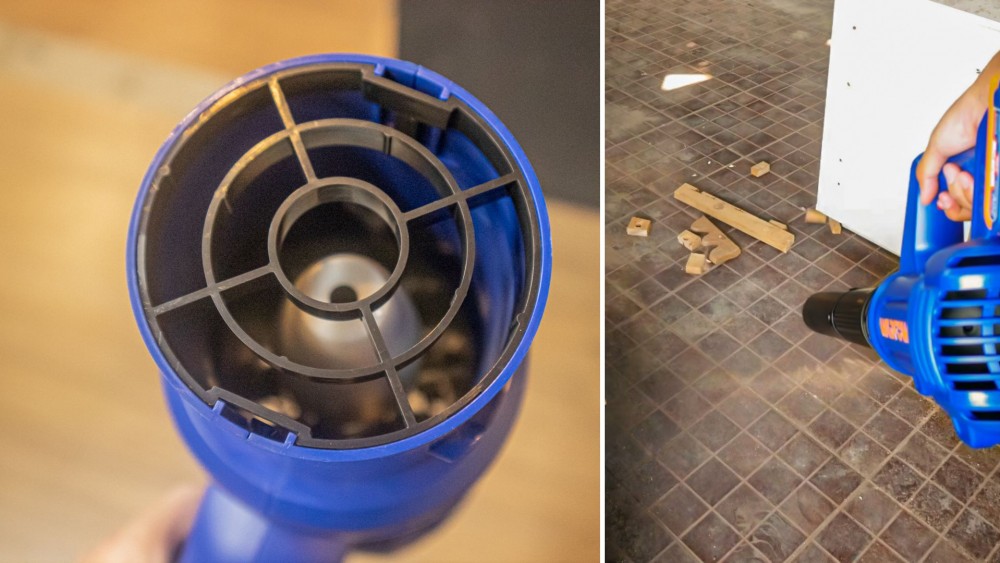
Does Using a Blower Make Fine Dust Scatter Even More?
Blowers are designed to generate high air volume or high airflow to push debris out of an area. The higher the power, the stronger the wind, and the easier it is for lightweight materials to disperse—especially fine dust, which is already prone to becoming airborne.
Imagine a table lightly dusted with powder. If you just swipe it gently with your hand, some powder might stick to your hand. But if you blow on it, the powder scatters everywhere. Fine dust behaves similarly, though it is often less visible than powder. This gives the false impression that the dust is gone, when in reality, it may be floating in the air around us or settling onto walls, ceilings, shelves, fans, or other equipment instead.
Blowers Have No Dust Filtration System
Tools like vacuum cleaners—especially models designed for fine dust—feature suction systems, collection tanks, and filter elements to trap dust and prevent it from blowing back into the air. Most blowers do not have these systems. Their function is to blow, or in some models, provide light vacuuming, but they do not filter dust at all. Without trapping it, the dust has nowhere to go except scattering into the air.
Many people think that simply blowing dust away from where it can be seen means it's clean. From a health and safety perspective, however, kicking fine dust into the air can be worse than leaving it piled in place. Settled dust can still be managed, but airborne dust is much harder to control and more easily enters the body or equipment.
Why Using a Blower in an Enclosed Room Is Even Riskier
In an outdoor area, using a blower for coarse debris is suitable because natural breezes help carry some of the dust particles away. Blowing dust in tight spaces: Is a blower good to use? How to do it effectively? In an enclosed or semi-enclosed room, however, the problem becomes much more apparent. The dust blown up has no way out; it swirls around in the same space, remains suspended in the air, and slowly settles across various surfaces.
Worse, using a blower in a room with fans, air conditioners, vents, or machinery with cooling fans can force dust into these systems, causing it to spread even further. Examples include dust entering AC coils, blowing dust off a desk right into a computer, or dust settling on workpieces prepped for assembly—turning a small issue into time-consuming rework.
Stronger Wind Doesn't Mean Cleaner
Powerful airflow might make you think it's efficient, fast, and satisfying to use. But for fine dust, excessive power can become a drawback. High airflow blows the dust across a much wider radius. Instead of lying in a thin layer on the floor or in a corner, blowing with high power disperses dust throughout the entire room in seconds.
Fine Dust Can Damage Tools and Electrical Equipment
Another reason people often overlook is that fine dust doesn't just affect human health; it also impacts tools and equipment—especially devices with ventilation slots, motors, fans, bearings, circuit boards, or moving parts. When fine dust is blown into the air by a blower, it can settle and accumulate in spots that are even harder to clean.
A simple example: if we blow dust off a workbench where computers, battery chargers, power tools, or power strips are nearby, the dust may not leave the area but instead enter their ventilation vents. As it accumulates, equipment may cool less effectively, run hotter, or develop nagging long-term issues.
Blowing dust near circuit boards requires extra caution
In electrical repair work, using a blower to blast dust out of boards or crevices is very convenient. However, if it's fine dust or mixed with moisture, strong blowing can push the dust deeper inside or scatter it onto contacts, connection points, and small crevices in the equipment.
The strong air from a blower, if aimed at tiny parts or fragile equipment, could also dislodge, shift, or damage them. Even if it doesn't happen every time, it's a good reason to exercise caution in electronics work or tasks where dust impacts precision.
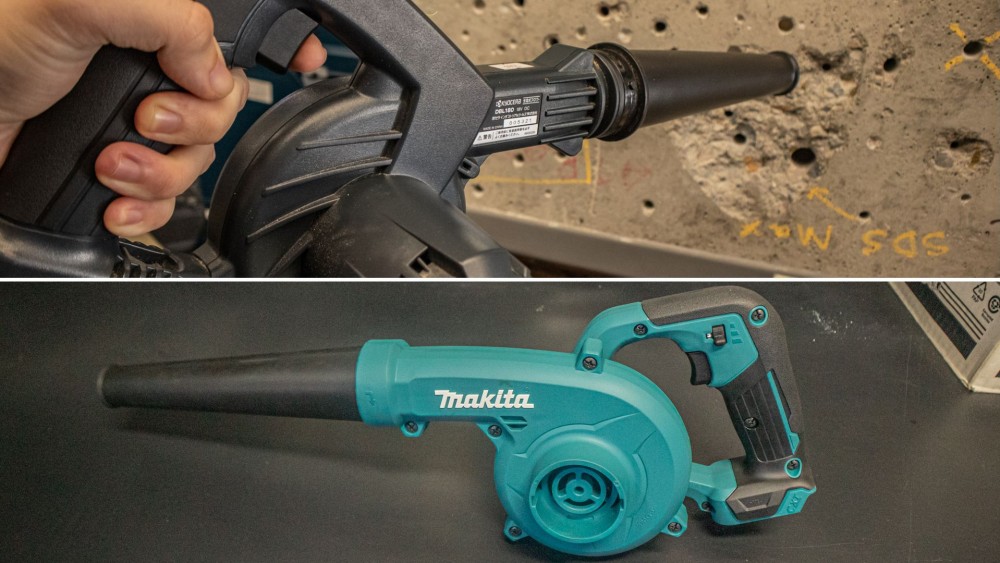
What kind of work is a blower more suitable for?
Blowers are suited for tasks that require clearing debris out of an area quickly, where materials are large enough not to easily disperse in the air, and in open, well-ventilated spaces—for example, blowing leaves in front of the house, blowing coarse wood shavings after cutting, blowing dust on garage floors, blowing powder out of corners to be swept up later, or blowing water off damp surfaces.
Simply put, a blower is better for "moving debris" than for "collecting dust." If the goal is to clear the area before sweeping or picking things up, a blower helps tremendously. But if the goal is truly eliminating dust from the area, a blower alone may not solve the problem, because it doesn't trap dust in a closed system.
Applications where a blower is suitable
- Blowing leaves, grass clippings, or outdoor debris
- Blowing coarse sawdust in open areas
- Blowing water or moisture off non-fragile surfaces
- Blowing debris and powder out of an area before sweeping or vacuuming again
- Blowing coarse dust in garages, patios, and well-ventilated spaces
Therefore, if the job involves concrete dust, sanding dust, fine wood dust, grinding powder, dust in closed rooms, or dust near electrical equipment, think carefully before using a blower.
How to use a blower in areas containing both debris and fine dust?
In real work environments, we often encounter not just fine dust alone, but a mix of leaves, wood chips, coarse sawdust, concrete fragments, sand grains, and fine dust all in one spot. In such cases, many people wonder whether a blower can still be used or if it should be completely avoided.
The answer is yes, it can be used, but you need to follow a proper step-by-step process—not just blast high-speed air at everything. Because if that pile of debris contains a lot of fine dust, the airflow will push coarse pieces away, but at the same time, it will send fine dust billowing into the air.
Blow from low to high speed, and never blow back into clean areas
If you must use a blower in an area with a mix of dust types, start with low airflow first and only increase it as necessary. Clearly determine the direction of the airflow so you know where you are blowing the debris. Avoid blowing haphazardly or blowing back toward yourself, as this causes fine dust to blow into your face and scatter into already cleaned areas.
A blower is a tool to help herd debris in a desired direction. Once the coarse debris is corralled, follow-up steps are necessary—such as using a vacuum cleaner, a broom, or a damp cloth for any remaining fine dust residue.
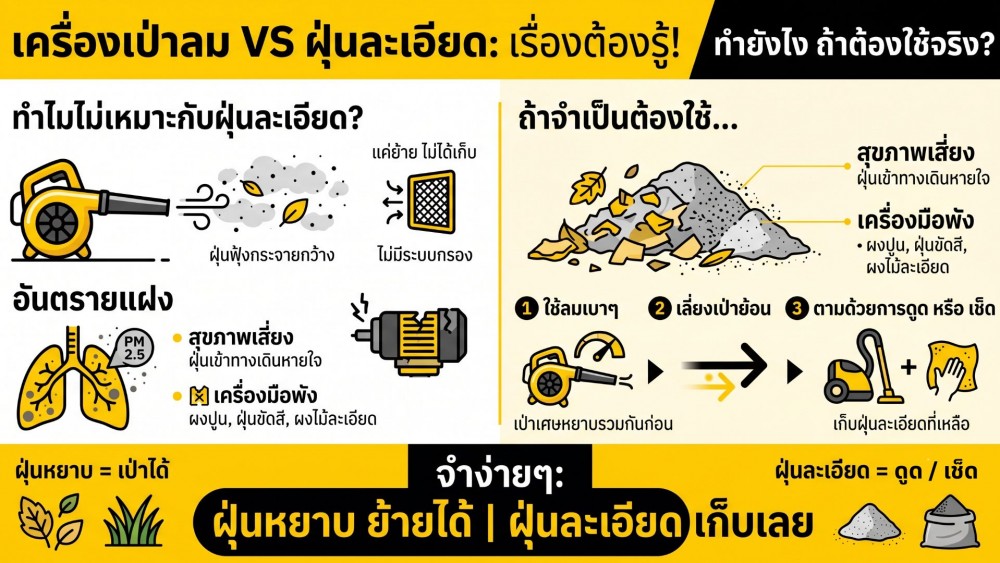
Conclusion
In the end, the main point isn't whether a blower is good or bad, but what kind of dust you are dealing with. If it's coarse debris, an open area, or scraps that need to be blown away before sweeping, a blower works great. But if it's fine dust in an enclosed room, near electrical equipment, or in areas that require true cleanliness, blowing might just cause the dust to float, scatter, and become even harder to control.
Just remember: Coarse dust can be blown, but fine dust should preferably be vacuumed or wiped down. Because blowers are meant for moving dust, not collecting it. Before using one, check what kind of dust is in front of you. If it's concrete powder, sawdust, sanding dust, or dust in an enclosed space, using a vacuum, a wipe cloth, or appropriate dust control methods will result in a truly clean and much safer environment.
So, before grabbing a Blowers to use each time, take a moment to look at what kind of dust is right in front of you.