


 EN
 ไทย


Customers Also Purchased


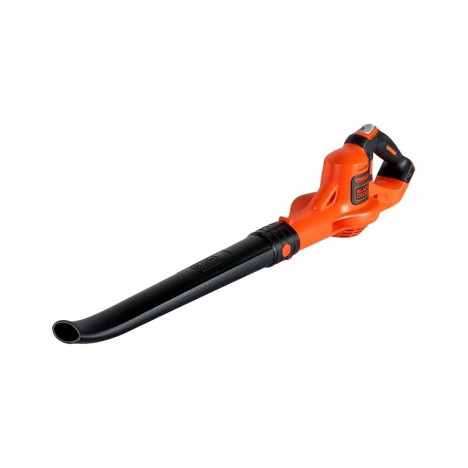

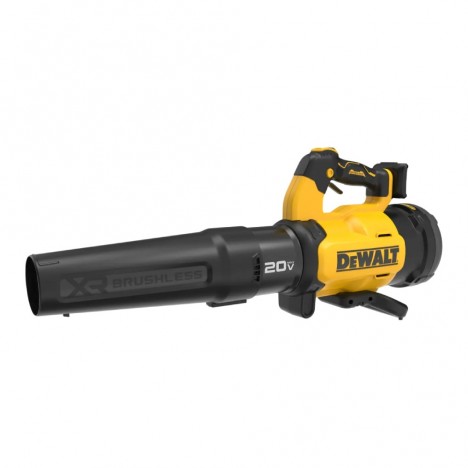
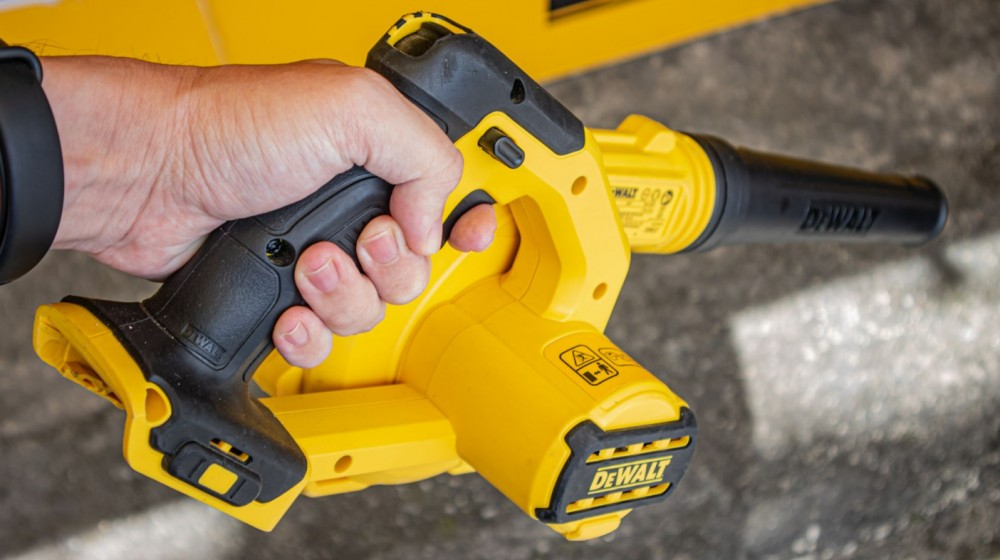
Many of us have probably experienced opening a cabinet or small crevice only to find a thick accumulation of dust. It looks clean on the outside, but the inside is full of hard-to-reach dust—some spots are barely visible, and touching it just a little sends it flying into the air. A wiping cloth won't reach, and a vacuum cleaner can't get in deep enough or has too large a nozzle. In the end, you end up doing a halfway cleaning job and cycling right back to the same problem all over again.
At this point, the classic question arises: “Blowers” will it help? Because it seems like a sensible choice—powerful, easy to access tight spots, and capable of handling dust in cramped areas without having to risk putting your hands inside. In reality, however, the answer might not always be that straightforward.
Therefore, in this article, we will explore everything from the working principles of blowers, techniques for operating in tight spaces, to common mistakes many people don't know or overlook. This way, you can use your blower to its full potential—not just scattering dust into the air, but truly managing it effectively without creating recurring long-term buildup.
Is an air blower really the answer for dusting in tight spaces?
Know before you choose: the working principle of air blowers that makes them so versatile To put it simply, a blower is one of the “most suitable” tools for confined space jobs. It can direct airflow into spots where hands or other tools cannot reach, such as deep crevices or narrow channels where dust accumulates—a problem that is very difficult for typical tools to handle.
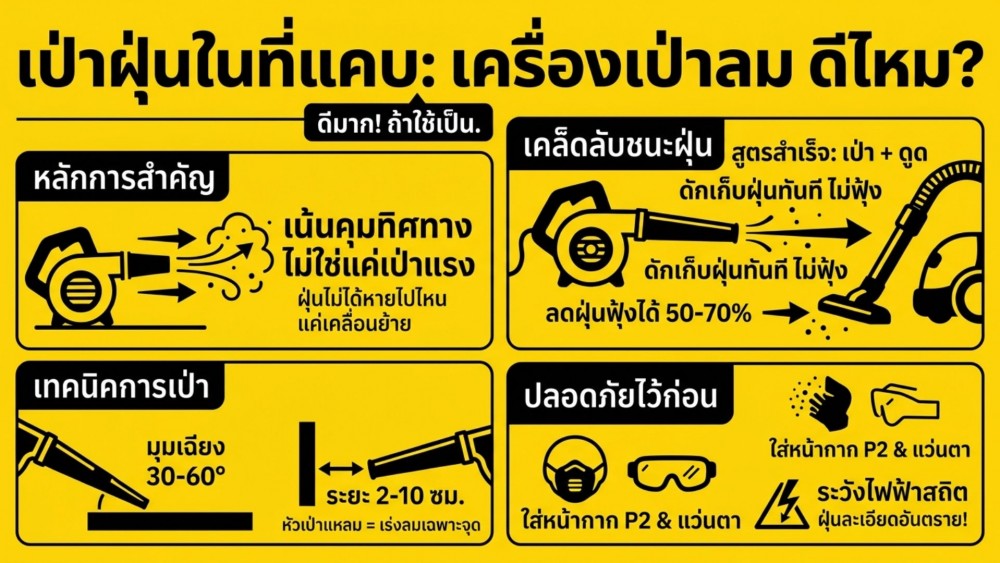
However, what you must clearly understand is that a blower does not “eliminate dust” in the sense of making it disappear. Rather, its role is to “move dust” from one point to another. Therefore, without directional control, the dust doesn't actually go anywhere. It might just settle somewhere else, or worse, blow right back at you.
The reason why many people feel that using a blower doesn't work well usually isn't because the machine is bad, but because of inappropriate usage methods, such as: Blowing without defining an exit path for the dust, using an airflow force unsuitable for the type of dust, or not using auxiliary tools like a vacuum cleaner in combination. This causes dust to disperse everywhere instead of actually being managed. And this is yet another Factor to consider before buying an electric air blower for use
If you ask overall whether an air blower is good for dusting tight spaces, the answer is yes, very much so. However, it must be used with a systematic approach—not by blowing randomly or expecting raw air power alone to solve the entire problem.
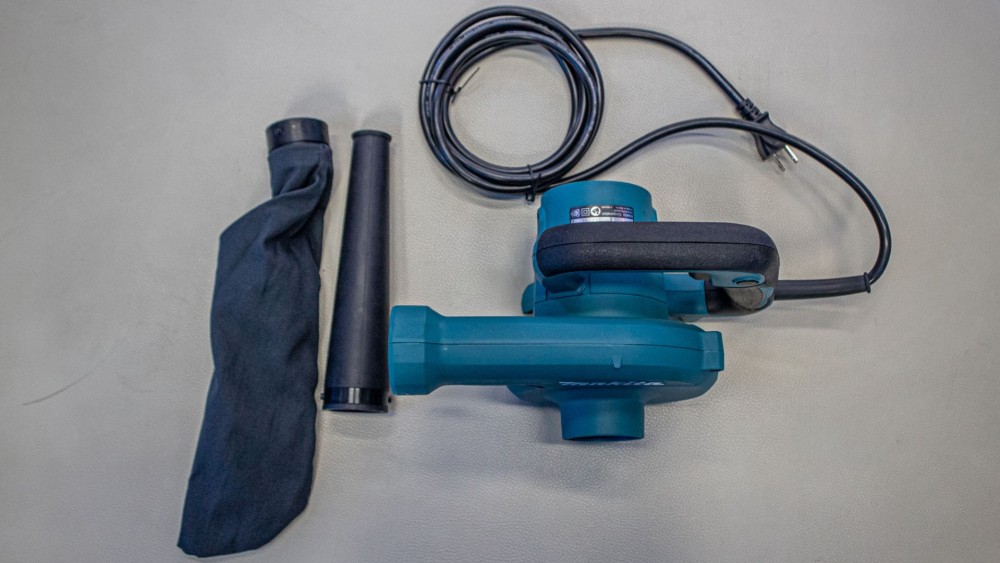
Why is blowing dust out of tight spaces harder than you think?
Many people assume the main issue with using a blower in confined spaces is insufficient airflow. In reality, the true challenge is controlling the direction of the dust, as tight spaces possess distinct characteristics fundamentally different from open areas.
In confined spaces, dust often has no clear escape route. So when you blow air into it, the dust doesn't get blown outward as you might expect; instead, it swirls around inside or clings to the interior walls. This creates the illusion of temporary cleanliness, but in truth, the dust remains trapped in the space just as before.
Another factor is the blowback air force. When we blow air into narrow spaces, the air hits the walls or internal structures and bounces back, making it harder to control the direction. Sometimes dust can blow straight back out very quickly, catching many people off guard.
Additionally, dust in confined spaces is often fine dust, such as dust on circuit boards, air conditioner dust, or accumulated dust inside tools, which is highly airborne and scatters very easily. Using a blower carelessly might cause dust to spread all over the area instead of being cleared out.
Therefore, blowing dust in tight spaces is not just about wind force, but also about understanding dust behavior and the surrounding environment together. Without thinking before blowing, the chances of achieving good results drop significantly.
What type of blower should you choose for tight crevices?
Different types of blowers provide different "airflow characteristics," measured by air flow rate (CFM – cubic feet per minute) and air velocity (m/s). These two values are more important than just a broad concept of "power" because they determine how far the air can carry dust and how well the direction can be controlled.
Corded electric blowers for general use typically deliver around 1.5–3.0 m³/min (approx. 50–100 CFM) and a nozzle tip air velocity of about 40–80 m/s. This is sufficient for general household dust, as well as equipment or narrow spaces without stubborn grime. Their highlight is easy control without damaging delicate workpieces.
For cordless blowers, overall values range from 30–70 CFM with air velocities of 30–60 m/s, which is adequate for light maintenance work or areas requiring high maneuverability. However, for deep crevices or dense dust, it may take more time and technique to achieve results close to an industrial-grade blower.
In terms of numbers, for delicate tasks or electrical equipment, look for a blower with an air velocity not exceeding ~60–80 m/s to prevent damage. But for mechanical or machinery work, values over 100 m/s will make "dislodging dust" much easier.
Comparing blowers to air blow guns used with air compressors, air blow guns rely on system pressure, such as 6–8 bar (90–115 PSI). When paired with a suitable nozzle, they deliver tip air velocities exceeding 100–150 m/s with flow rates of 100–300 CFM. This allows them to effectively dislodge tightly adhered dust or deep crevice dust, making them far better suited for machinery, industrial applications, or heavily accumulated dust than electric blowers.
Techniques for using blowers for a "truly clean" professional finish
The principle of using a blower in confined spaces is to control "direction and air energy" to match the space, not simply cranking up the wind force. The core idea is to make the dust move continuously in one direction until it is completely expelled.
Therefore, before starting to blow, always create an "escape route for dust," such as opening covers or positioning a clear exit opening. Without an exit path, dust will swirl around and settle back in the same place. Establishing an exit path helps the exact same CFM airflow yield distinctly better results.
A technique that greatly enhances efficiency is using a vacuum cleaner alongside it: place the vacuum nozzle at the exit while blowing with the blower from the opposite side. This method creates a "unidirectional flow" that carries the dust out and traps it immediately, reducing dust scattering by over 50–70% compared to blowing alone.
Regarding angle and distance, blow at an angle of about 30–60 degrees instead of shooting straight in, allowing the airflow to glide along surfaces and carry the dust out without forcing it deeper. The optimal nozzle distance is typically 2–10 cm depending on wind force; with higher air power, pull back the distance to prevent dust from splattering wildly.
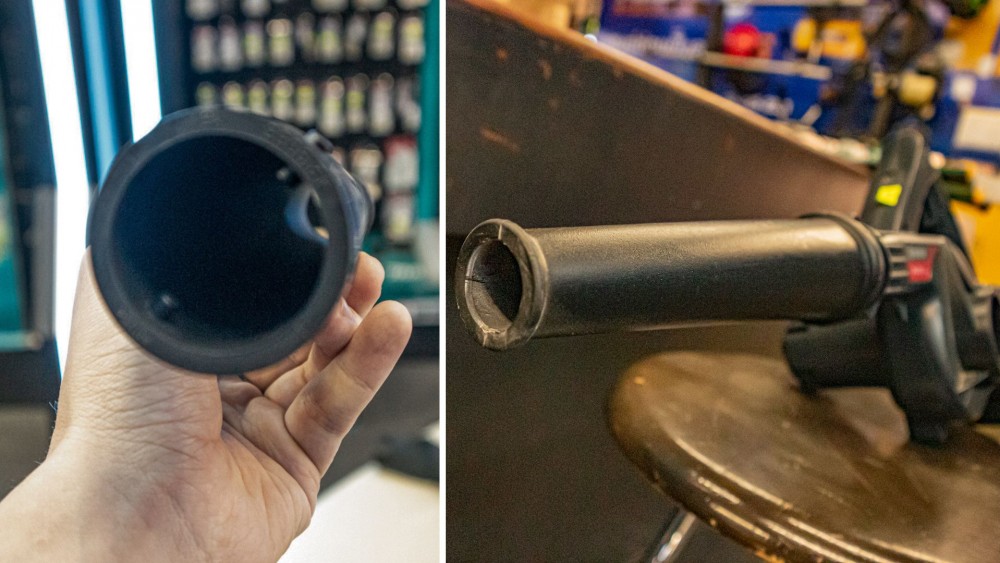
The nozzle significantly affects "airflow intensity." A pointed nozzle increases localized air velocity (jet effect), raising the blower's m/s rating even with the same CFM.
Real-world situations: Which type of blower should you use?
- Blowing dust in computers / electrical equipment You should use a blower that is not too powerful and be mindful of static electricity.
- Blowing dust from air conditioners Corded electric or cordless blowers are very suitable because they provide wide airflow while still reaching the fins well, but there should also be a path for dust ventilation.
- Blowing dust under machinery A high-power blower should be used, preferably combined with a vacuum cleaner.
- Blowing dust in cars General blowers are suitable for seat crevices and AC vents, but a smaller nozzle should be used.
Mistakes that make blowers "ineffective"
The reason blowers do not deliver the expected results often stems from using airflow power that doesn't match the space conditions, such as: Using high airflow in an enclosed space without an exit path, or using low airflow on tightly adhered grime that cannot lift the dust. Additionally, blowing directly into deep crevices without controlling the angle will push the dust deeper inside instead of clearing it out.
Another overlooked point is not using a vacuum cleaner along with the blower, meaning that even with high CFM, dust still scatters and settles elsewhere.
Not wearing personal protection during jobs with fine dust, such as PM2.5 or circuit board dust, causes users to directly inhale dust, which is a risk that should never be overlooked. How to use a blower safely? 5 tips every technician should know
What to watch out for when using a blower in tight spaces?
- Risks to both the user and the workpiece Especially when using air pressure higher than 6 bar or air velocity exceeding 100 m/s, which may cause small parts to shift, dislodge, or get damaged, including the risk of static electricity in electronic devices.
- Fine dust can stay suspended in the air for several minutes. Especially particles under 10 microns, which easily enter the respiratory system. Wearing a P2-rated dust mask (or equivalent) and safety glasses will significantly reduce risks.
- Avoid working in enclosed spaces. If unavoidable, provide adequate ventilation or work in short intervals to reduce dust accumulation in the air, and avoid blowing high-pressure air directly onto skin, which may cause irritation or injury.
How to choose a blower without making a mistake
Choosing a blower for tight spaces isn't just about high airflow; it requires considering real-world application as well. A tool that is too powerful can damage delicate work, while one with too little power might fail to dislodge stubborn, caked-on dust.
The first question to ask yourself is what kind of work you're doing. For household tasks, light duties, or general equipment, an electric or cordless blower is sufficient. But for mechanical work, machinery, or heavily accumulated dust, an air blow gun paired with an air compressor will deliver much clearer results.
Another crucial factor is maneuverability. If you need to work in confined spaces or move around frequently, a cordless blower offers far greater convenience. However, for prolonged, continuous operation, corded or pneumatic tools naturally make more sense.
Accessories like nozzles directly affect performance. Selecting the right nozzle for the specific crevices or openings you need to clean will noticeably help the blower operate at its full potential.
Conclusion: Are blowers good for tight spaces?
Blowers are "excellent" for tight spaces, but performance depends on selecting the right airflow volume (CFM) and air speed (m/s) for the job, as well as systematically controlling the direction of the dust.
Once you understand these principles, using a blower won't just be about blowing dust around, but rather a well-planned dust management approach that enables deeper, faster cleaning and effectively minimizes re-accumulation.
Ultimately, Blowers Whether it works well or not depends not only on the tool itself, but also on how it is used and the user's understanding.