


 EN
 ไทย


Customers Also Purchased


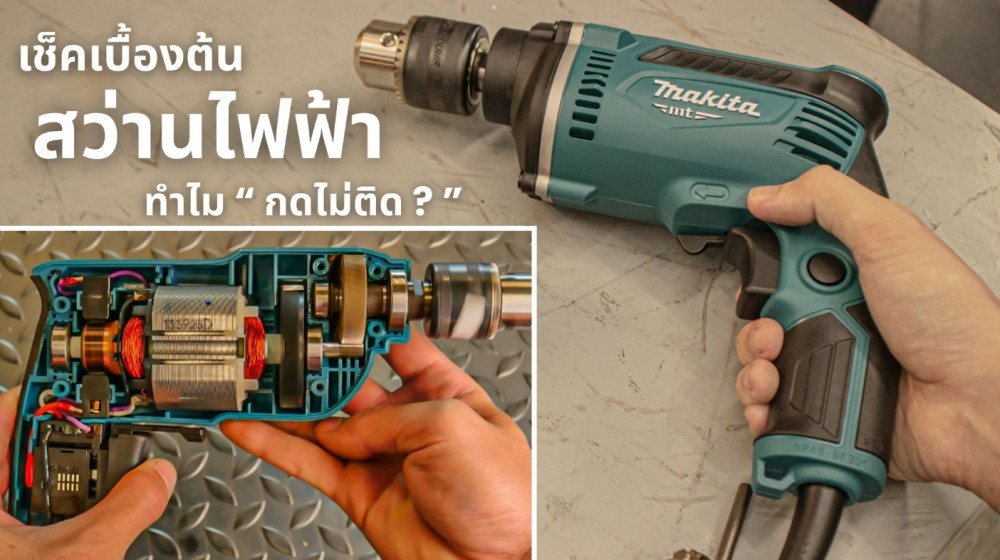
You pick up your Electric drills go-to tool, plug it in, and get ready to drill just one final hole—the job is almost done, just a little more. But when you pull the trigger, there's complete silence: no sound, no recoil, not even a motor smell. It's as if it's completely "dead."
If it were a cordless drill, you'd immediately guess, "Oh, the battery must be dead," easily fixed by charging or swapping the pack. But what about a corded electric drill? You might think, "There's wall power, it's plugged in, so it should run!" skipping basic checks and jumping straight to the conclusion that the tool is totally broken. Often, the real cause is just a loose extension cord, an internal wire break, or a stuck switch.
The question is: Is the electric drill really broken? Or is it just a "small issue" like a loose connection, broken wire, or worn-out part that keeps it from turning on?
To eliminate guesswork, let's go through a step-by-step troubleshooting checklist of things you can do yourself without tearing the tool apart and causing more damage. Crucially, learn to distinguish between issues you can fix yourself and those that should be sent to a service center—because a corded drill that won't start can stem from many layers, ranging from a tiny plug contact to the motor itself.
Why won't an electric drill turn on even though it's plugged in?
An electric drill doesn't seem overly complicated, leading many to think, "It's plugged in, so it must work!" But in reality, power tools have dozens of connection points: wall outlet, plug, power cord, handle connections, switch, carbon brushes, commutator, windings, rotor/stator, all the way to the core motor itself that drives rotation. If any single point falters, loosens, burns out, or breaks, the symptom you see is always the same: total silence. How to Use an Electric Drill Safely: A Basic Handyman's Guide
Heavy-duty corded electric drills: How to choose the most suitable one? For electric drills subjected to heavy use (drilling concrete, drilling steel, high dust, exposure to moisture), there is always a chance that something will wear out prematurely. This wear typically accumulates gradually until one day it simply won't start when you pull the trigger.
Check First: Could the problem be your home's power supply rather than the electric drill?
When an electric drill “won’t turn on,” many times the power simply isn't reaching the tool, and the drill itself isn't broken. Often, it's just basic issues like a loose outlet, a faulty extension cord, damaged extension wiring, or a silently tripped circuit breaker/RCD that makes the electric drill seem dead even though the tool itself is completely fine.
Extension Cord / Outlet is Loose or Circuit Breaker Tripped
Ask yourself first: Does that outlet have a history of being loose? Do you have to wiggle the plug to get power? Or are you using an extension strip that has been stepped on, dragged around, or bent to the point of internal wire breakage?
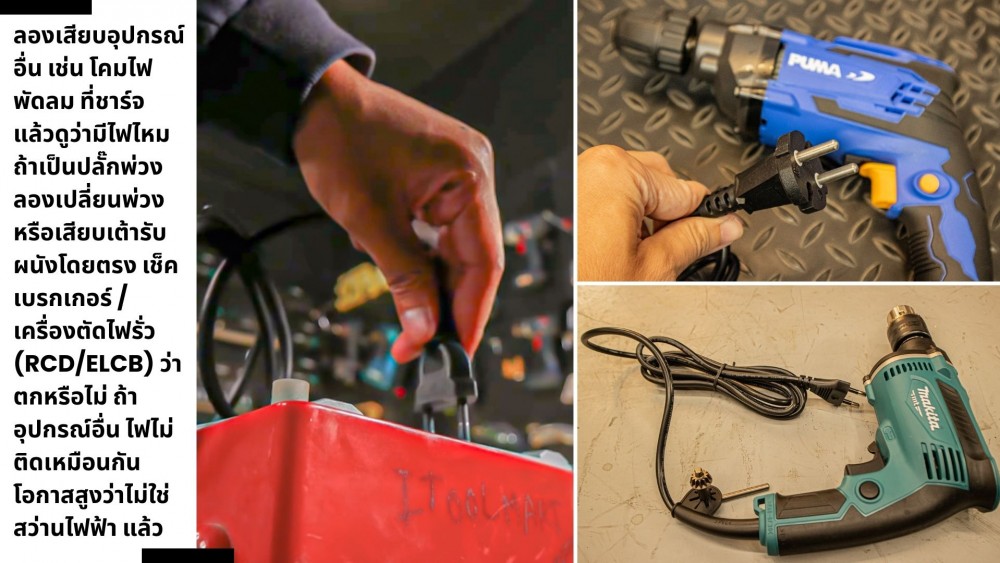
Extension Cord is Too Long or Too Thin, Causing Voltage Drop
Have you ever used an extremely long extension cord and noticed your power tools seem underpowered? Or sometimes they “refuse to start turning” because the voltage drops so much that the switch/motor cannot operate properly.
A common sign is pressing the trigger and the electric drill makes a faint “hum” but doesn't spin, or cuts in and out during heavy drilling. If you experience this, try unplugging the long extension cord and plug directly into a nearby wall outlet. If a long cord is necessary, use one with a larger wire gauge—extremely thin cords will cause voltage drops.
Internal Wire Break in the Electric Drill's Cord (Even Though the Outside Looks Fine)
This is one of the “top causes” for corded electric drills that won't turn on. The power cord gets bent, folded, dragged, pinched by doors, crushed, and scraped against sharp table corners day after day.
Wire Broken Near the Plug Base or Handle Base
Sometimes the power cord isn't broken with exposed copper wires, but it's broken “inside,” causing power to connect intermittently before cutting out completely.
A safe initial check method is to unplug the electric drill first. Inspect the cord near the plug base and where it enters the handle for permanent kinks, swelling, or tears. If there are no tears, plug it back in and gently wiggle the cord while pressing the trigger. If it cuts in and out when moved, there is a high chance of an internal wire break. If you suspect an internal break, stop using it immediately, as it could cause a short circuit.
Loose Strain Relief / Cord Protector
On some electric drills, the strain relief boot helps relieve pulling stress, but if it is loose or brittle, it allows the cord to bear the full strain, leading to premature internal breakage. Check whether the cord base is abnormally loose or if there is a rattling sound where the cord enters the handle.
Electric Drill is Completely Silent When Pressed: The Trigger Might Be the Cause
If the home power supply is normal and the drill's cord has no internal break, the next likely culprit is the “switch” or trigger assembly. This component takes a heavy beating because we constantly squeeze and release it with our fingers.
Worn Switch / Trigger or Burned Contacts
Many electric drill switches feature variable speed control (the deeper you press, the faster it spins). The contacts arc (produce small sparks) every time you switch on/off. Under heavy use and frequent triggering, these contacts can burn out.
Listen for the switch's “click.” If you press it and feel no switch actuation at all, internal parts may be broken or dislodged. However, if pressing it causes sparking or a hissing sound inside the handle, stop using it immediately and have it serviced by a technician.
Some Electric Drill Models There is a trigger lock-on button for continuous operation. If this button gets stuck or the mechanism breaks, it can also cause the trigger to "not function properly." Check whether the lock-on button springs back, and try pressing and releasing the trigger several times to see if it resets properly.
The forward-reverse switch can also cause an electric drill to not turn on.
Many people don't think about this because they only focus on the trigger, but actually, if the forward/reverse switch is stuck in the middle or its contact points are dirty, it can cause the drill to "not work."
Drilling steel or concrete produces fine dust that gets into every crevice. If it accumulates in the switch, it can cause poor contact or unusual conductive residue.
Check whether the switch position is fully locked in place. Use compressed air or a brush to clear external dust around the switch area (do not spray water or unknown substances). If you have drilled steel and fine metal shavings are clinging to it, be mindful of short circuits.
Electric drill is silent, but the inside is stuck on the carbon brushes
Now we come to the classic issue with brushed motors. Corded electric drills often use carbon brush motors to conduct current to the rotor. If the carbon brushes are worn out, too short, or stuck in their holders, the drill really might not turn on when pressed.
Drilling Concrete with an Electric Drill: What to Look For, and Does It Need an Impact System? If you have used the drill for a long time, frequently doing heavy-duty drilling at high speeds, jobs requiring prolonged pressing, or drilling hard materials until the motor overheats, the carbon brushes will naturally wear out because they constantly rub against the commutator. The more carbon dust accumulates, the hotter the contacts get and the faster they wear. The symptoms develop subtly until the drill goes completely silent when pressed, as if it just broke down out of nowhere.
Symptoms of electric drill carbon brush issues, such as:
- More sparks than usual at the electric drill's ventilation vents
- Drop in RPM and power; having to press the trigger deep for it to rotate
- Cracking or popping sounds resembling electrical arcing
Check the manual or the tool body to see if there is an external "carbon brush cap" you can unscrew (some models have accessible caps). If there is one and you have basic skills: unplug the tool, open the cap, and check the length of the carbon brushes. If they are very short, cracked, or burned, they should be replaced. But if you are unsure, do not force the tool open; sending the electric drill to a service center is safer.
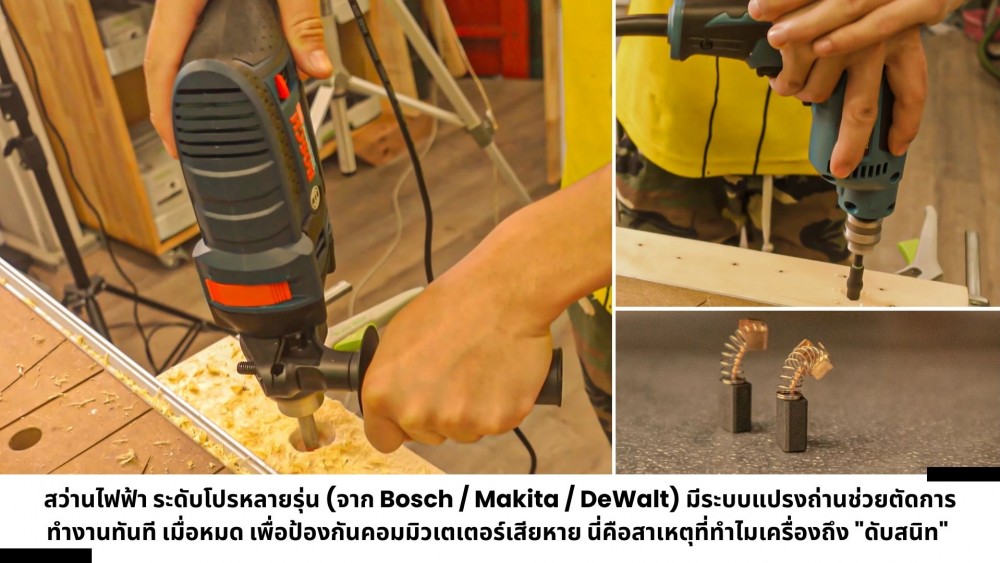
Carbon brush stuck due to dust / grime
Sometimes the electric drill's carbon brushes aren't worn out, but accumulated carbon dust makes them stiff so they don't press firmly against the commutator, preventing current flow. The solution is to remove the carbon brushes and check if they slide smoothly in their holders. If they are stiff or stuck, have a technician clean them properly.
Electric drill commutator is dirty, burnt, or has winding issues
If you evaluate the electric drill and find that it's not the power supply, cord, switch, or carbon brushes, we enter the actual "motor" zone. In many cases, fixing this yourself is not cost-effective or safe.
An electric drill's commutator is the copper ring that the carbon brushes make contact with. If it has heavy burn marks or worn grooves, the current won't transfer properly, and the drill may not turn on or may run erratically. Clear signs include excessive sparking in the past, a distinct burning smell, or spinning with vibration and unstable RPM before eventually cutting out. For basic checking, dismantling the tool yourself is not recommended because it requires properly removing the gear assembly, rotor assembly, and inspecting their condition.
Some electric drills feature thermal protection devices (thermal fuse / thermal protector). If the tool overheats, it cuts power to prevent fire; once cooled, it may resume, or in some cases it trips permanently. Signs can range from shutting off out of nowhere under heavy use and then not turning on, or the body getting extremely hot before shutting down. If it shuts down while overheating, let the tool rest until cool and try again. But if it still won't turn on, stop forcing it; if there was a burning smell or smoke earlier, sending it to a technician immediately is recommended.
The electric drill isn't "broken", but is stuck due to mechanical parts
This also happens: power actually reaches the motor, but the gear set, chuck, or bearings are so stiff that the motor cannot turn. This is especially true for some models where concrete dust enters and turns the grease into sludge.
If an electric drill has damaged bearings, you might first hear a whining noise that gradually gets worse until the drill won't turn on. If you encounter this, unplug it first, then try turning the chuck by hand. If it is a standard drill and not a rotary hammer, it should turn reasonably smoothly. If it is stiff or catches intermittently, it could mean there is an issue with the bearings.
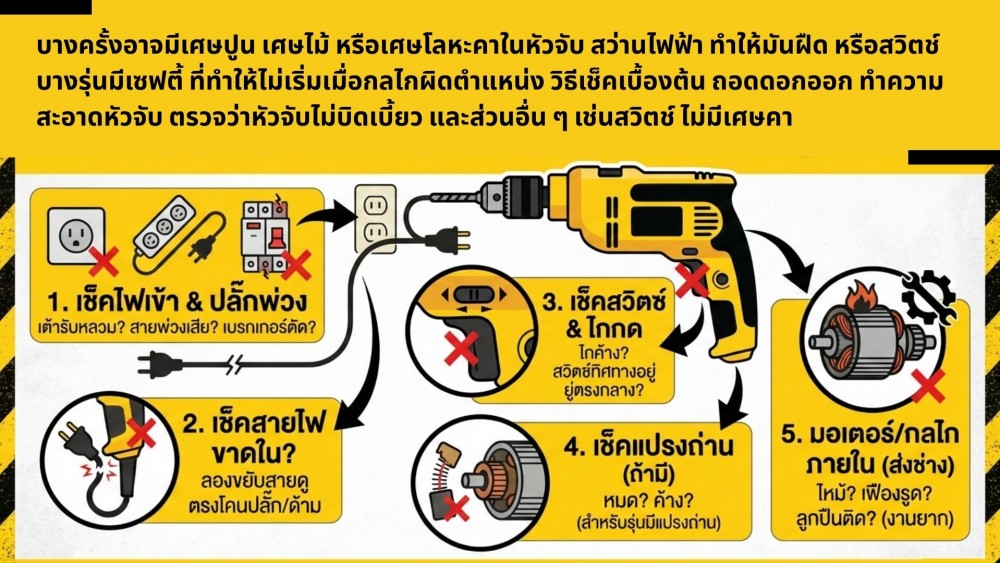
Summary: When an electric drill "won't turn on," there's usually an answer if you troubleshoot the right spots.
When a corded electric drill won't turn on, don't rush to conclude that it's broken. Troubleshooting in this order is faster and safer.
- Check the power supply: Is the outlet working? Is the extension cord okay? Did the circuit breaker trip?
- Check the cord and connections: Is the cable swollen, kinked, or cracked? Are the plug base and handle base loose?
- Check the switches that "can prevent it from turning on": Is the forward/reverse switch pushed all the way (not stuck in the middle)? Does the trigger click and spring back?
- Check the carbon brushes (if it's an easy-to-open model): Are the carbon brushes worn short? Are there burn marks or cracks?
- If you've checked everything and it still won't turn on, it's likely the motor, commutator, windings, or internal circuitry. Sending it to a service center or a technician is more cost-effective and safer.
Remember this phrase: an electric drill that won't turn on doesn't always mean the whole tool is ruined. If you encounter this issue, troubleshoot step by step starting from the power supply, cord, switch, and carbon brushes. Then decide whether to fix it yourself or send it to a technician—this will save you a lot of time and money.
If Electric drills If yours won't turn on, don't panic. Just check the right spots, and you'll know what it's trying to tell you.