


 EN
 ไทย


Customers Also Purchased


Piston Air Pump What used to fill the tank in just a few minutes one day starts taking longer and longer. What happens is the gauge needle climbs slowly, sometimes getting stuck before reaching the cut-off point, and the motor runs continuously. These symptoms quite clearly indicate that there is an air back-leak somewhere in the pump head, because the machine sound is unchanged, the motor is still spinning at the same speed, but less air reaches the tank.
The question is: do you need to replace the entire pump head assembly, or is it time to buy a new machine? In reality, a piston air compressor head has only a few parts that prevent air backflow. Each part shows different symptoms when damaged. If you can read the symptoms, you can replace just the faulty component, which is an advantage of piston air compressors, being easier to repair part-by-part than screw compressors.
Let's check each point along the airflow path, from the filter, reed valves, piston rings, cylinder head gasket, down to the check valve at the tank, along with DIY testing methods and indicators of when to stop using it immediately rather than attempting a self-repair.
How Piston Air Compressors Compress Air and Where Air Can Leak Back
The operation of a piston compressor pump head is divided into two strokes. During the downstroke, the intake valve opens, and air from the filter flows into the cylinder. During the upstroke, the intake valve closes, compressing the air until its pressure exceeds that in the tank, opening the exhaust valve to deliver air through the discharge pipe into the tank, with a check valve at the tank inlet preventing air from flowing back. Meanwhile, the piston rings seal the gap between the piston and the cylinder wall.
This is comparable to a bicycle pump: if the rubber cup in the barrel is worn or the valve at the end of the hose leaks, you exert the same effort, but the tire inflates much slower. How Long Can a Piston Air Compressor Run Continuously? Is Duty Cycle Really That Important? Piston air compressors differ from screw compressors, which compress air continuously with twin rotating screws, have no valves opening and closing every cycle, and have no piston rings, so their failure points are completely different.
A piston air compressor builds pressure quickly when all the air compressed in the cylinder reaches the tank without leaking back anywhere. There are four leakage paths: back through the intake valve, down into the crankcase past the rings, out through the cylinder head gasket, and back from the tank through the check valve.
Timing Full Tank Compression: Tell if the Piston Compressor is Worn Out or Just Undersized for the Job
Often when it feels like pressure builds slowly, the reality is that we are using more air—such as adding a new pneumatic tool with high air consumption. This test eliminates the air consumption variable.
Turn off the machine, open the drain valve beneath the tank to release all air and water until the gauge reads zero, then close the valve. Close all outlet valves and do not connect any air hoses or tools. Then, turn on the machine and start a timer until the pressure switch cuts out. Note the time on the machine and compare it with the value recorded when the unit was new or the value specified in the manual.
If the time is close to original, it means the pump head is still good; the problem is that the air demand of the job exceeds what the machine can produce, requiring an adjustment in compressor size or usage method. If the time is significantly longer or the pressure fails to reach the cut-off point, proceed to the following sections.
Clogged Filters and Dropping Pump RPM Restrict Air Intake at the Source for Piston Compressors
Before suspecting internal components, check these two external issues that are the easiest to fix.
Air Filter
The piston can only draw in as much air as passes through the filter. A filter clogged with dust or soaked with oil prevents the cylinder from taking in full air on every stroke. Remove it and hold it up to the light; if it is opaque, replace it. Crucially, never run the machine without an air filter just to build pressure faster; dust entering the unit will quickly abrade the rings and cylinder walls.
Loose belt on belt-drive air compressors and voltage drops on direct-drive air compressors
Belt-drive air compressors are piston air compressors that transfer power from the motor to the pump head via a belt. If the belt is loose or slipping, the pump head will spin slower than it should, often accompanied by a squealing noise upon startup.
Adjust the tension according to the manual after unplugging the machine. As for direct-drive models where the motor couples directly to the pump head without a belt to slip, they are more sensitive to voltage drops. If connected through a long extension cord, the RPM may drop, resulting in slow pressure buildup even when the pump head is in good condition.
Leaking valve reeds or carbon buildup: the most common internal cause in piston air compressors
Valve reeds are thin spring steel plates that open and close with every piston cycle while the piston air compressor is running. Heat and oil vapor cause carbon to build up on the valve seat, preventing it from sealing completely, or causing the plate to fatigue and crack.
When the intake valve reed leaks
A portion of the compressed air will blow back out through the air filter. If you place the back of your hand near the filter inlet while the machine is running, you will feel warm air pulsing outward instead of a steady suction inward.
When the discharge valve reed leaks
High-pressure air flows back into the cylinder during the intake stroke, causing the piston to re-compress the same batch of air. The pump head and discharge pipe may become unusually hot, and the tank pressure builds much more slowly as it reaches higher levels.
The solution is to replace the valve reed kit along with a new set of gaskets, which are available as spare parts sold separately by piston pump head model. However, before opening the cylinder head, you must unplug the machine, release all tank pressure to zero, and wait for the pump head to cool down. If you have never opened a cylinder head before, an air compressor technician can handle this job in no time.
Worn piston rings and cylinder cause the piston air compressor to lose air into the crankcase
When the rings are worn or the cylinder wall is scored, the air being compressed by the piston air compressor can blow by the side of the piston into the crankcase where the oil is kept.
To check for this, look at the breather hole or oil filler cap while the machine is running. If air is blowing out forcefully in pulses accompanied by oil mist, it means air is leaking past the rings. Accompanying symptoms include rapid oil consumption and an increased oil film in the water drained from the tank.
For Oil-free piston air compressors or silent air compressors These do not have oil in the crankcase and instead use piston rings or cup seals made from self-lubricating materials. These parts wear down normally with operating hours. The symptom is a gradual decrease in pressure buildup speed, with no oil involved.
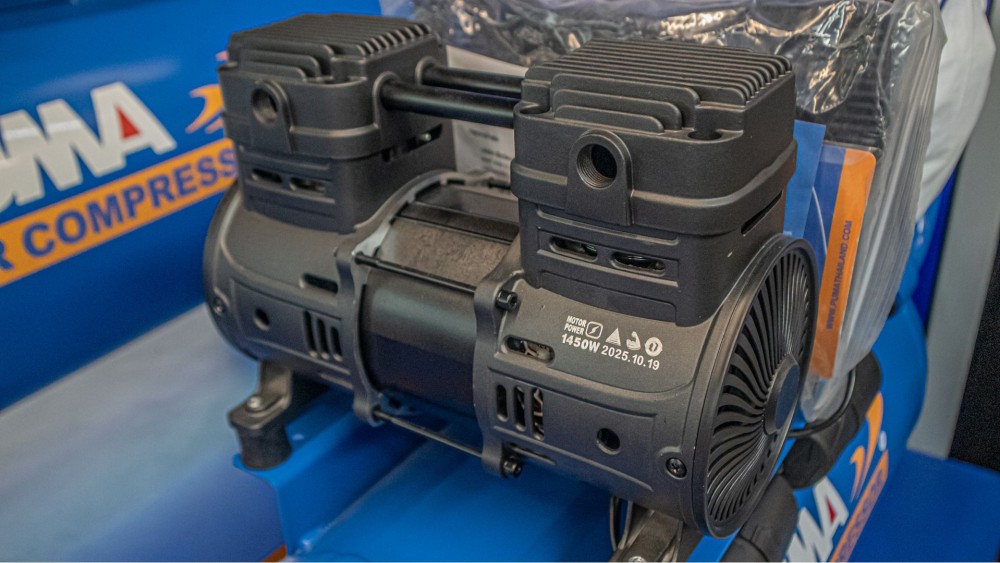
The solution is to replace the piston ring kit or piston assembly according to the model. If the cylinder wall is deeply scored enough to catch your fingernail, replacing only the rings will not last long; you must replace the cylinder block or the entire pump head. Have a technician assess it before ordering spare parts.
A leaking cylinder head gasket causes the piston air compressor to hiss at the head and fail to reach full pressure
The gasket is the sealing sheet between the cylinder, the valve plate, and the cylinder head. Repeated heating and cooling cycles can cause the gasket to harden and crack, or cause the cylinder head bolts to loosen.
A compilation of simple ways to check for air compressor leaks on your own without hauling it to a service center If it leaks externally, you will hear a rhythmic hissing sound following the piston cycle and notice black deposits around the cylinder head edge. You can test this by applying soapy water around the joints while the unit is running and looking for bubbles. If it leaks internally between the suction and discharge chambers inside the cylinder head, there will be no sound and no bubbles, but the symptoms will be similar to a leaking valve reed; therefore, you should always replace the gasket whenever changing the valve reeds.
Replace the entire set with new gaskets; do not use glue or silicone instead, and tighten the cylinder head bolts in a diagonal crisscross pattern to the torque specified in the manual. Overtightening can warp the cylinder head and cause recurring leaks.
The check valve and unloader valve are points that cause piston air compressors to lose air after the motor stops.
The check valve is located at the end of the discharge tube right at the tank inlet, serving to let air enter the tank in one direction only. Meanwhile, the unloader valve on the pressure switch releases residual air in the discharge tube every time the piston air compressor motor stops, allowing it to start easily on the next cycle. A short hissing sound when the machine cuts out is therefore normal.
However, if that hissing sound does not stop and continues steadily after the machine cuts out, it may indicate that the check valve is not sealing completely. The air in the tank is flowing backward through the unloader valve. The pressure will drop on its own even when no air is being used, causing the machine to cycle frequently, and the motor may struggle to start due to backpressure trapped at the cylinder head.
The solution is to remove the check valve to clean off carbon buildup or replace it with a new one. You must always discharge the air in the tank to 0 before loosening the threads; loosening the check valve while the tank is pressurized is extremely dangerous.
Signs that you should stop using your piston air compressor immediately, whether it builds pressure slowly or quickly
- The machine runs without cutting out even when the pressure gauge needle exceeds the tank's maximum pressure limit or the safety valve pops open.
- There is a rhythmic metallic knocking sound coming from the pump head.
- The tank shows signs of rust corrosion, water seepage, or air leaks on the tank body and weld seams.
- The pump head is so hot that the paint is scorched, or there is smoke coming from the pump head or motor.
- The oil level falls below the lower mark, or the oil turns milky white.
Turn off the machine, unplug it, vent all air from the tank, and have a technician inspect it. Never plug, adjust, or remove the safety valve to keep the piston air compressor running. Never weld or patch a leaking or corroded tank to continue using it; it must be replaced. A pressure tank with thinned steel walls can rupture without warning.
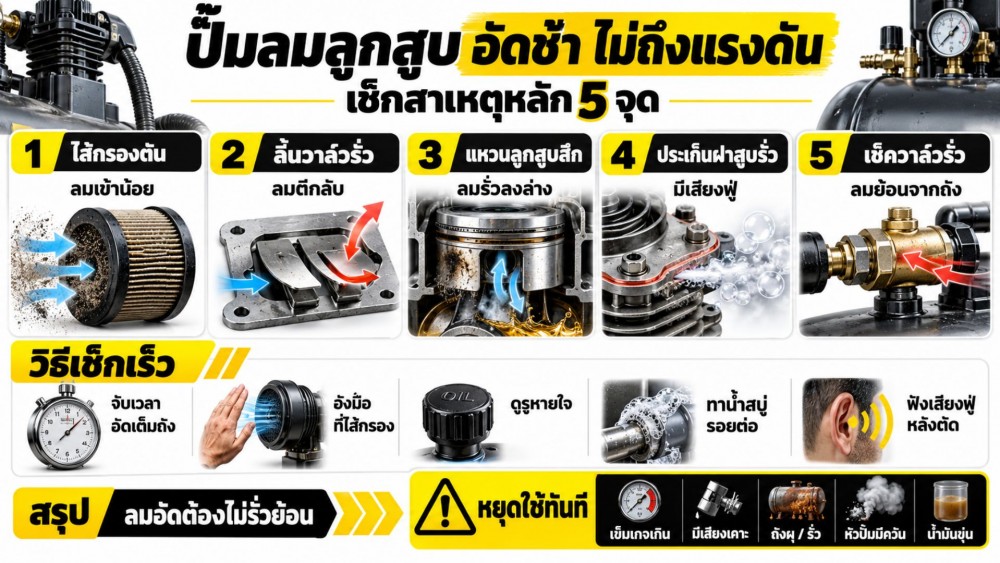
Summary: A piston air compressor builds pressure quickly when all the air compressed in the cylinder reaches the tank without leaking back anywhere.
Slow air buildup in a piston air compressor does not necessarily mean the machine is ruined; it just means the compressed air is leaking back at some point. The recommended sequence to troubleshoot is: time how long it takes to fill the tank to distinguish whether the machine is worn out or air consumption is too high; check the air filter, belt, and motor power supply; place your hand over the filter inlet to check the intake valve; observe heat at the pump head to check the discharge valve; check for air from the crankcase breather to inspect the piston rings; apply soapy water around the cylinder head to check the gasket; and listen for hissing after the machine cuts out to check the check valve.
Most importantly: for any task that involves opening the pump head or loosening fittings, always unplug the machine and release all air beforehand. Never tamper with the safety valve, and corroded or leaking tanks must be replaced without hesitation. If the cylinder is deeply scored or making a knocking sound, have a technician evaluate it before spending money on spare parts.
If after checking you find the pump head is fine, but your work demands more air than the machine can supply, check out the Air Compressors category Piston Air Pump and air compressor spare parts, then compare them with the pneumatic tools you are using.