


 EN
 ไทย


Customers Also Purchased

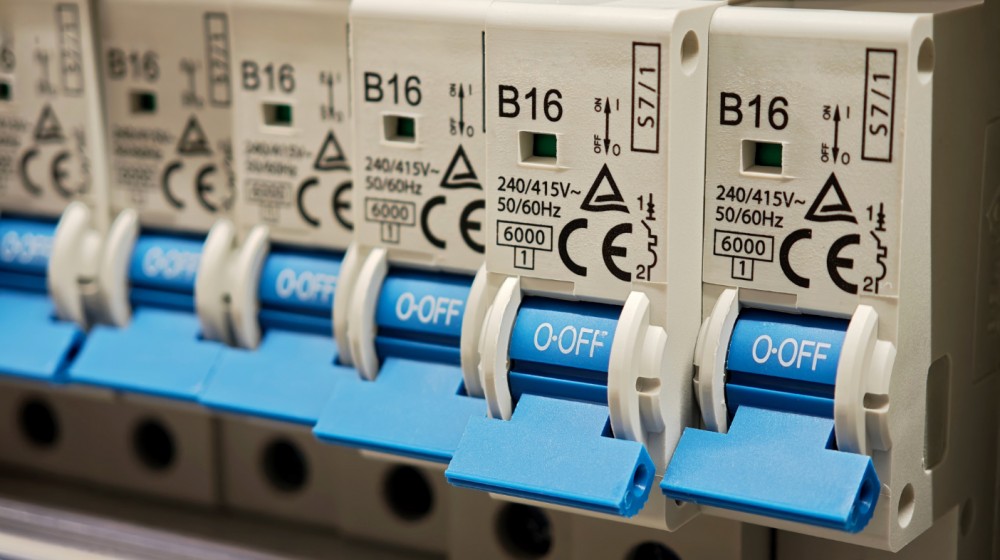
Has it ever happened to you that a short circuit occurred at just a single outlet or appliance, but when you checked the electrical panel, you found that not only the branch circuit breaker had tripped, but the main breakerCircuit Breakerstripped as well? A problem that seemed like it should only cut power to part of the system ended up causing a blackout across the entire house or facility. This naturally leaves you wondering: if there's already a branch breaker providing protection, why does the main breaker also trip?
This behavior doesn't automatically mean the branch breaker was too slow or that the main breaker has a defect. During a short circuit, abnormal current flows not only through the branch breaker, but also through the upstream main breaker. If the current is high enough to enter the operating trip zones of both breakers, there is a chance that both the branch and the main will trip together.
This is why electrical systems employ a concept called Selectivity. This concept isn't about making breakers "trip better," but about coordinating multiple levels of protective devices so that the breaker closest to the fault trips first, reducing the chance that a single circuit fault needlessly cuts power to the rest of the installation.
Short Circuit on a Branch Circuit: Why Is the Main Breaker Affected Too?
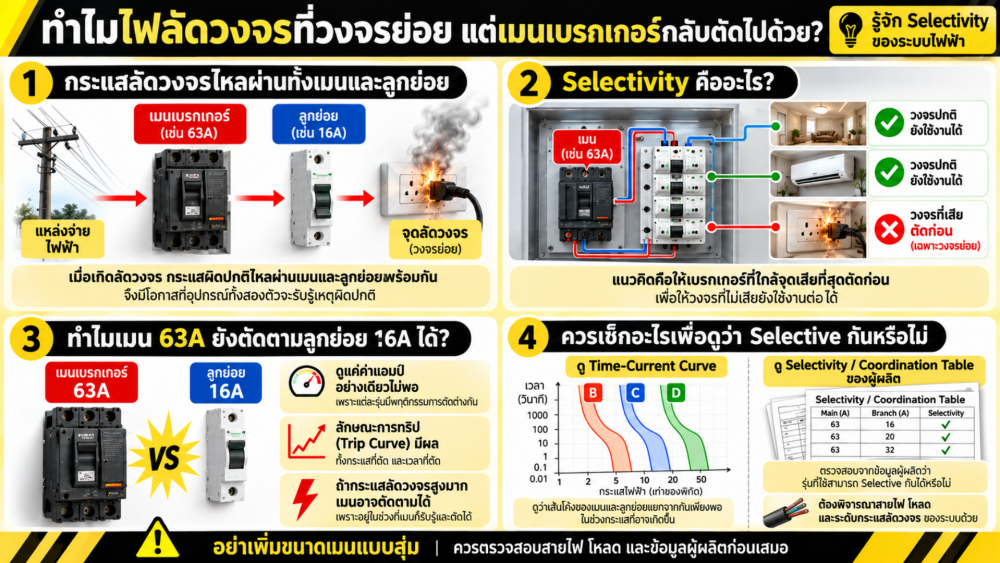
Consider the path of electrical current in a panelboard in simple terms: current from the supply passes through the main breaker first, and is then distributed to individual branch circuit breakers—such as lighting circuits, outlets, air conditioners, or water heaters. Therefore, if a short circuit occurs at an outlet, the fault current flows along the path from the power source, through the main breaker, through the outlet branch breaker, and finally to the fault point.
That means during the event, both the main and branch breakers experience the fault current. What is needed is not to hide the short-circuit current from the main breaker, but to make each protection level respond to the event appropriately and distinctly. With proper coordination, the breaker for the faulted circuit will trip first, while the main breaker continues supplying power to the other circuits.
Suppose a home has separate circuits for lighting, outlets, air conditioning, and a water heater. If a short circuit occurs on an outlet circuit, the goal is for only that outlet's breaker to trip, while lighting and appliances on other circuits remain operational. This is the simplest illustration of what Selectivity aims to achieve in an electrical system.
Selectivity: Ensuring the "Right Device" Trips First
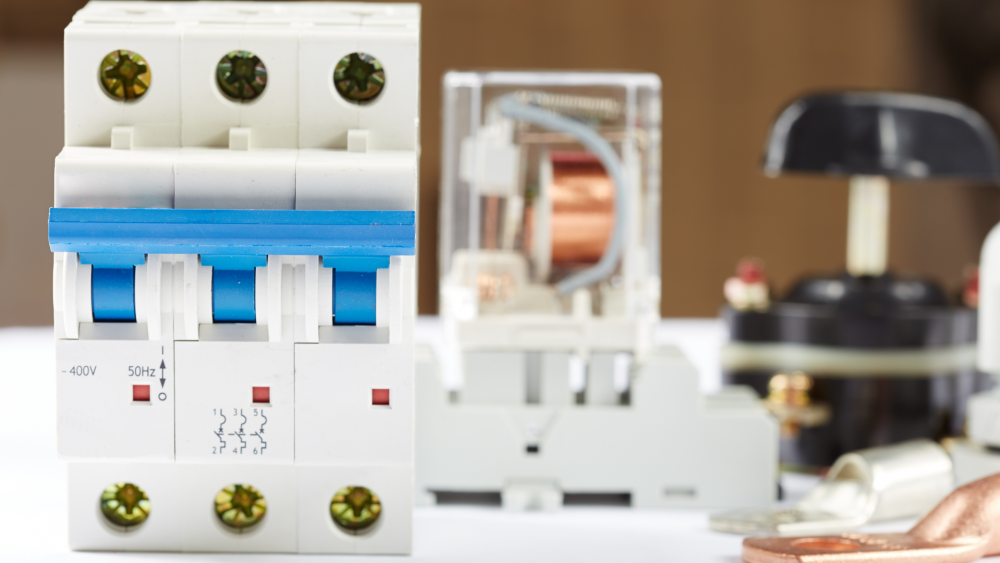
The term Selectivity in electrical engineering refers to the coordination of multiple levels of protective devices so that when a fault occurs, the device closest to the fault point clears it first, while upstream devices remain in operation unless cutting the entire system is necessary.
The key point is not just whether a breaker can interrupt the circuit, but also *which* breaker interrupts it. If every time a branch circuit experiences an issue the main breaker trips as well, the system may successfully clear the fault current, but the affected outage area will be far larger than necessary.
In a residential setting, the consequence might just be losing power to the whole house instead of a single room. But in offices, factories, retail shops, or buildings where multiple systems operate, having a single fault take down most of the facility causes far greater disruption. Selectivity is therefore about both protection and continuity of service, not just whether a breaker trips or not.
Main 63A, Branch 16A: Why Can the Main Still Trip?
This is where many people get confused. Looking at the numbers on the face of the breakers—for example, a 16A branch and a 63A main—it is natural to assume that 16A must always trip before 63A. In reality, the rated current printed on a breaker does not tell the full story regarding tripping order.
Breakers do not respond to all levels of current in the same amount of time. Under a mild overload, tripping can take some time. However, when a short circuit occurs, current can surge extremely fast, and the breaker's instantaneous magnetic trip mechanism engages much faster than in an overload condition. When the fault current is high enough, both the upstream and downstream breakers can enter nearly identical operating zones, even if their rated currents differ significantly.
This ties directly into breaker sizing, because ratings like 16A, 32A, or 63A are only part of the information you need to consider. If you are still unsure what the amperage and breaking capacity values on a breaker indicate, you can read more in the article "Circuit Breakers: How Many Amps Are Enough? How to Choose?" which further explains the fundamentals of sizing breakers, calculating loads, and understanding breaking capacity ratings.
The key point regarding Selectivity is that even if the main breaker has a current rating many times higher than the branch breaker, you still shouldn't conclude solely from the two amp values that the branch breaker will trip before the main breaker every time.
Besides amps, the "tripping characteristic" also plays a crucial role
Each circuit breaker model responds differently to current, which is why there is what's known as the Time-Current Characteristic—the relationship between current levels and the time the breaker takes to trip. Simply put, as current increases, a breaker doesn't just trip or not trip; the time it takes to trip changes as well.
For MCBs, we often see letters like B, C, or D in front of the current rating, which indicate the magnetic response range to high currents. These letters are another reason why breakers with the same current rating do not all behave identically. If you want to understand this topic further, you can read the article "What are Circuit Breaker Curves B, C, and D? Choosing the wrong one might prevent tripping when it should." which specifically explains the meaning of Trip Curves and their impact on selecting breakers for various applications.
However, when it comes to Selectivity, you cannot simply look at which Curve the main breaker is and which Curve the branch breaker is to conclude whether they will coordinate. You must also consider the characteristics of both breakers combined with the actual potential short-circuit current in the system.
Sometimes Selectivity is only achieved up to a certain current level
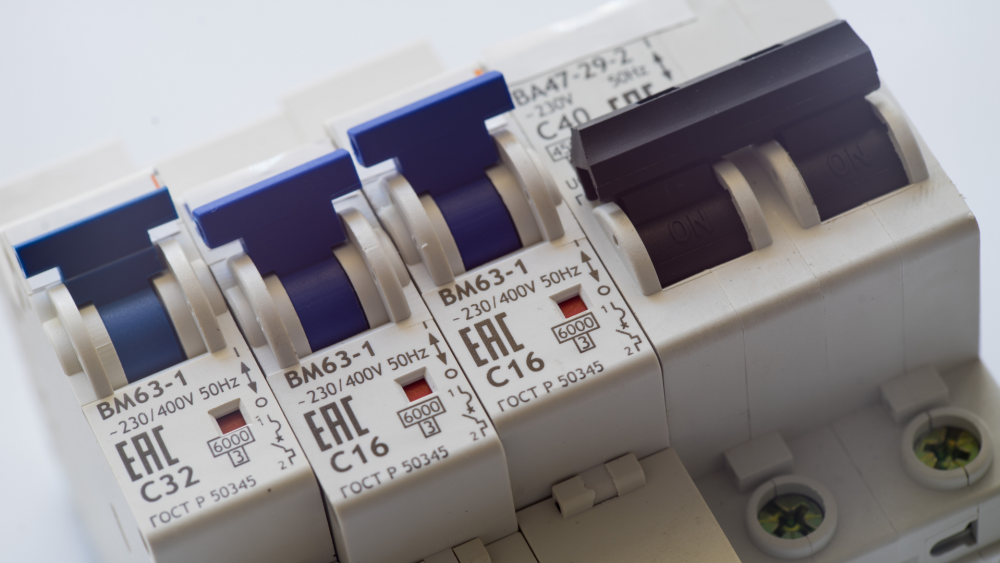
Another point that explains why a fault sometimes trips only the branch breaker but other times also trips the main breaker is that some breaker pairs only coordinate well within a specific current range. Once the short-circuit current exceeds that threshold, there is no longer a guarantee that only the downstream breaker will trip.
Technically, this is referred to as Total Selectivity and Partial Selectivity. Total Selectivity means coordination is maintained throughout the specified range for that application. Partial Selectivity means selective tripping is achieved up to a certain current limit, but above that limit, upstream tripping cannot be ruled out.
General users don't need to memorize both terms in detail. What is important to understand is that just because a pair of breakers didn't trip simultaneously in one event does not mean the outcome will be the same across all short-circuit levels. The higher the short-circuit current, the more you need to consult the specific data for that pair of devices.
Short-circuit current is not equally high at every point
Short-circuit current levels are not a single uniform number across the entire system. Instead, they depend on many factors, including the fault location, source impedance, transformers, wiring, and the path the current must travel. Generally, points closer to the power source with lower total impedance can have a higher potential short-circuit current than points further away along the line.
This means that even with the same panel and set of breakers, a short circuit at different locations can generate different fault currents and lead to different tripping sequences. One incident might trip only the branch breaker, while another with higher current might also cause the main breaker to trip. Therefore, a single incident should not be used to judge whether that pair of breakers will behave the same way in all situations.
This is also why designing Selectivity in a real system requires knowing more than just the amp rating printed on the breaker face. You must consider the potential short-circuit current at the installation point and how the upstream and downstream devices respond to that current.
Want the branch breaker to trip before the main? Can you just increase the main breaker size?
Once you realize that the main breaker might trip because it enters its operating zone at the same time as the branch breaker, you might think of a simple solution: increase the main breaker size so it is harder to trip. However, you should not solve the problem this way without first verifying the system, as breaker selection is not based on Selectivity alone.
Breaker ratings must correlate with wiring, loads, installation conditions, breaking capacity, and circuit protection requirements. If you simply replace a breaker with a larger size just to stop the main breaker from tripping, protection for downstream cables or equipment may no longer conform to the original design.
Selectivity is therefore not just about making the main breaker "hold out longer," but about selecting and coordinating upstream and downstream breakers appropriately for the entire system.
So how do you know if two breakers are Selective?
In the overload range, a Time-Current Curve can be used for comparison. This curve shows approximately how long each breaker takes to trip as the current increases. If the operating characteristics of upstream and downstream devices are properly separated, it helps indicate the trend of selectivity.
However, in very high short-circuit current ranges, this becomes more complex because looking solely at ratings or basic curves may not be sufficient for certain breaker types and pairs. Manufacturers therefore provide Selectivity Tables or Coordination Tables to specify which breaker model paired with another can coordinate tripping up to what current level.
Therefore, if you need to properly evaluate selectivity, the question should not just be "how many amps for the main and how many amps for the branch?" but you must also know the breaker brands, models, tripping characteristics, and whether the manufacturer provides coordination data for that device pair. This is especially critical for building or factory systems where a total shutdown from a single fault point can have severe impacts.
Does the main and branch breaker tripping together mean there is a problem with the system?
You should not jump to conclusions based on a single incident. If a real short circuit occurred and both the branch and main breakers tripped, it may be because the fault current level fell into the operating range of both breakers or exceeded the selectivity threshold that the pair could achieve. Furthermore, some systems may not have been designed with total selectivity across all current levels in the first place.
What should be prioritized more is finding the root cause of why the short circuit occurred. If there are burn marks, a burning smell, hot connections, repeated trips, or if it trips again immediately after resetting, do not force continued operation or upsize the breaker to make it harder to trip. Instead, isolate that circuit and have a qualified professional inspect it, because breaker tripping is merely the result of a fault; the true cause may lie in the wiring, connections, or electrical equipment connected to the circuit. And you should never intentionally cause a short circuit to test whether the main or branch breaker trips first, because actual short-circuit currents can be high enough to generate heat, mechanical forces, and electric arcs that are hazardous to both equipment and personnel nearby.
Once you understand selectivity, you will see that circuit breakers do not operate in isolation.
When talking about choosingCircuit Breakers we usually look at each unit individually—how many amps it handles, its breaking capacity, or what type of load it suits. But when multiple breakers operate within the same system, another crucial factor to consider is how those breakers coordinate with each other when a fault occurs.
If a short circuit occurs in a branch circuit, the goal is for the device closest to the fault to trip first, isolating the outage strictly to the faulty section while allowing other circuits to continue operating. That is the core of selectivity.
So next time you see a branch breaker trip followed by the main breaker, don't immediately conclude that the main breaker is faulty or the branch breaker was sized incorrectly. Behind this symptom could be the short-circuit current level and the coordination between both levels of breakers. This is why selecting a breaker system cannot rely merely on "how many amps"; when an actual problem arises, the question is not just whether a breaker will trip, but which breaker should trip first.