


 EN
 ไทย


Customers Also Purchased
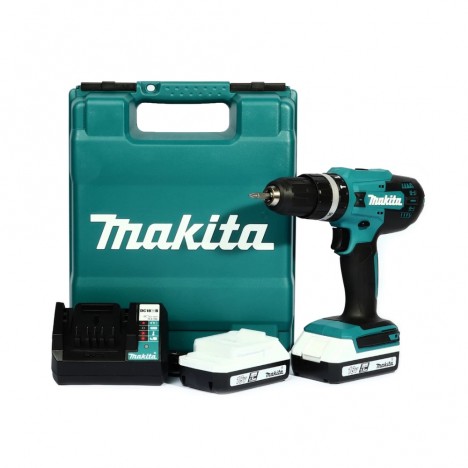
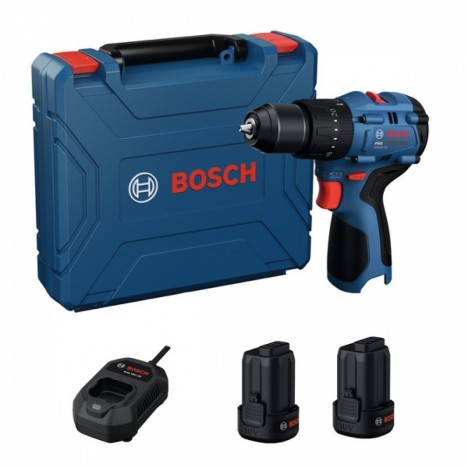


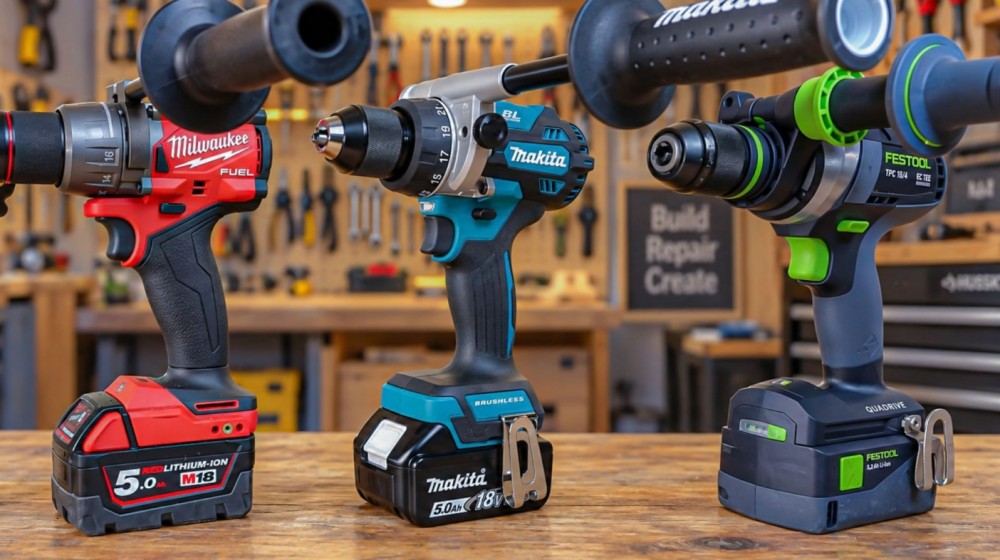
If you pick up Cordless drill a tool—whether it's a drill driver, hammer drill, or another cordless tool like an impact driver or cordless impact wrench—one thing you'll find almost universally across all models is the battery mounted at the base of the handle, creating a shape we've all grown familiar with.
Many might assume this is just a design trend manufacturers copied from one another. In reality, placing the battery under the handle is no accident; battery placement affects everything from balance, weight, control, and fatigue, down to the internal space required for the motor, gear assembly, and cooling system inside the cordless drill itself.
Is It True That Newer Cordless Drills Focus More on Battery Platforms Than the Tool Itself? The answer is Real As modern cordless drills are engineered with higher power, batteries have naturally grown larger and heavier. Exactly where to place a component that can weigh several hundred grams is therefore extremely crucial.
First, you might wonder: Can you choose a cordless drill by its battery? What's the difference between 12V, 18V, and 20V? However, no matter how powerful the motor, how long the battery lasts, or how feature-packed a cordless drill is, if its weight is poorly distributed, it can feel awkward to hold and cause fatigue much faster than it should. Therefore, placing the battery under the handle is a design detail that impacts the user experience far more than you might think.
Battery: One of the Heaviest Components of a Cordless Drill
Before understanding why the battery is positioned under the handle, let's look at the overall construction of a cordless drill. The upper section of a cordless drill consists of the chuck, gearbox, motor, and on some models, an impact mechanism or electronic systems. The handle serves as the point where your hand controls the tool, while the battery—comprising multiple cells, control circuits, and a protective housing—also accounts for a considerable amount of weight.
If the battery were placed at the front or near the chuck, nearly all the weight from the motor, gearbox, and battery would be concentrated at the front of the drill, requiring more wrist effort to support the drill head. Therefore, the area under the handle becomes the ideal location, as it brings the mass of the battery closer to the hand's grip axis and helps counterbalance the motor assembly above.
Weight Distribution Matters More Than Total Tool Weight
Two cordless drills may have the exact same total weight, yet feel entirely different in hand if one has superior weight distribution.
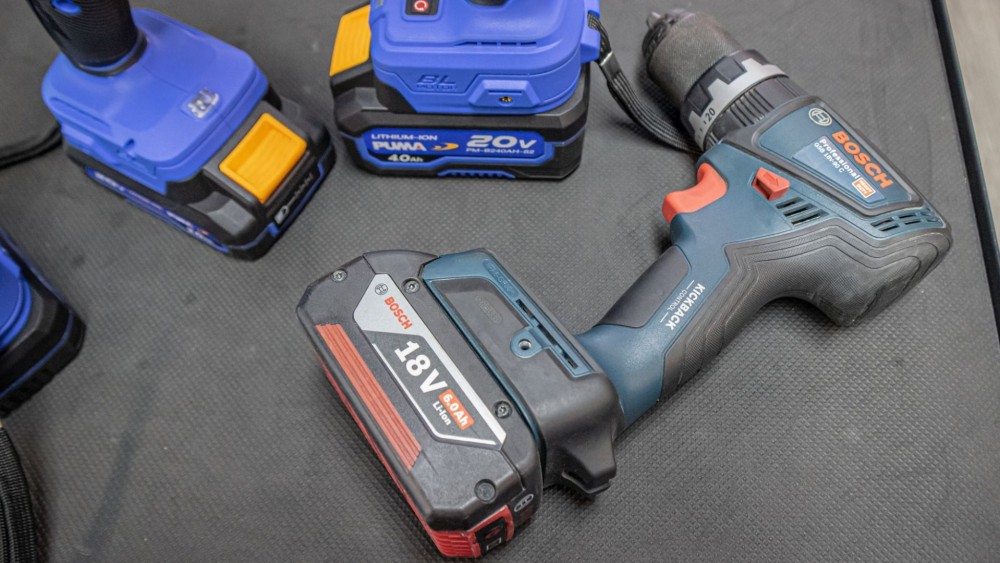
Placing the battery beneath the handle brings part of the tool's weight closer to your hand. Although the battery isn't located directly in the center of your palm, this position helps minimize the sensation of the tool tipping forward. Especially in high-power drills with larger motors and gearboxes, the battery acts as a lower and slightly rearward counterweight, making the tool much easier to control.
Helps Balance the Drill Head with the User's Hand
When holding a cordless drill, you aren't just lifting the weight of the tool; you must also keep the drill bit aligned with the work surface, press the trigger, regulate speed, and counteract the reactive torque as the bit bites into the material. If the drill is poorly balanced, these tasks become significantly harder.
This is one reason why modern cordless drills—despite being far more powerful—often feel much easier to control than older models that were longer and front-heavy.
This balance is extremely beneficial during repetitive or prolonged tasks, such as: Driving numerous screws, assembling furniture, installing framing, or drilling multiple holes. Because you don't have to constantly strain your wrist to keep the drill head up, the difference good balance makes becomes even more apparent over long work periods.
Why Not Place the Battery at the Rear Like Other Power Tools?
Many people might wonder if placing the battery at the rear of the drill would similarly counterbalance the front. The issue is that cordless drills need to be short and maneuverable, especially when driving screws inside cabinets or tight spaces. If the battery were at the rear, the overall tool length would increase, making it much harder to fit into confined areas.
Adding too much weight far back also creates leverage in another direction. When lifting the tool or adjusting your wrist angle, a battery positioned far from your hand exerts greater strain on your wrist.
The Space Under the Handle Accommodates Larger Batteries Without Interfering with the Motor
Another crucial reason is internal tool space. A cordless drill must house numerous components in its upper body: chuck, gear set, clutch system, brushless or brushed motor, electronic control module, and cooling system. If the battery also had to fit in this same area, the drill would inevitably become bulky and unwieldy.
Separating the battery by placing it at the base of the handle provides a clear division of space. The upper body can be designed short and compact, while the base can accommodate batteries of various capacities—such as 2.0Ah, 4.0Ah, or 5.0Ah—without altering the drill's core structure.
The Battery Base Allows the Drill to Stand Upright
Another benefit that is easy to see but sometimes overlooked is that the battery under the handle acts as a base for the tool. Many cordless drill models can stand upright on a table or floor without needing to be laid on their side, especially when using a flat battery pack with a wide contact surface.
In practical work, this small function is quite useful because tradesmen can set the cordless drill down while changing bits, picking up screws, or positioning workpieces before picking up the tool to continue working immediately. However, standing it upright should be done on a flat, stable surface because when using long drill bits or heavy accessories, the tool's center of gravity may shift and cause it to tip over.
Reduces fatigue during continuous cordless drill use
Ergonomics, or designing for the user's anatomy, is another key core of modern power tools. In certain installation tasks,
tradesmen may have to hold a cordless drill and drive hundreds of screws in a single day. A seemingly small difference in weight, as well as the position of that weight, therefore significantly impacts fatigue.
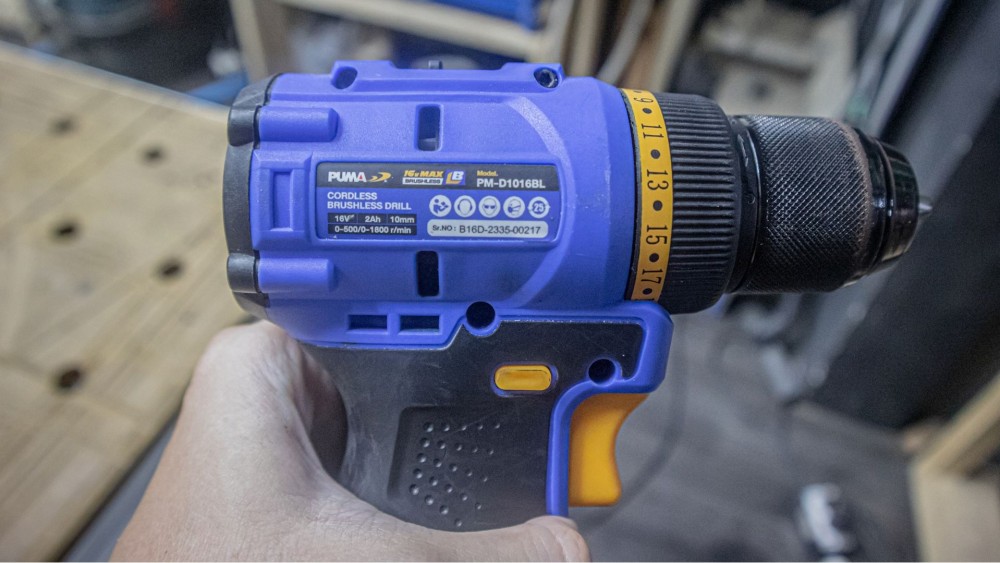
When the battery is under the handle, the major mass is located relatively close to the arm line, while the hand grips the handle between the motor above and the battery below. This arrangement helps provide better control over the tool's rotation without requiring wrist muscles to support all the weight from any single side.
However, an oversized battery can still alter the balance. For example, with a compact cordless drill designed for use with a small battery pack, switching to a higher-capacity battery may cause the tool to feel heavy at the bottom and the base of the handle as well. Therefore, when choosing a battery, you should not only consider the Ah rating, but also the nature of the work and the required maneuverability.
Some cordless drill models have the battery inside the handle
While most drills use a detachable battery under the handle, some small drills, electric screwdrivers, or platforms may have battery cells built directly into the handle. The main reason is that these tools need to be compact and have low power demands. A small number of cells can be accommodated inside the handle without making it too bulky to grip comfortably.
However, for drills that require high torque and continuous use, the power demand is higher, and the number of battery cells increases accordingly. Packing all those cells into the handle would make it too large and awkward to grip. Using a separate battery located under the handle is therefore suitable for higher-powered cordless drills.
Battery position relates to cordless drill heat dissipation
Separating the battery from the motor is also beneficial for thermal management. When a drill works hard, the motor, electronic control unit, and battery cells all generate heat. If all parts are packed into a single space, temperature control becomes more complicated.
With the battery at the bottom, the motor's ventilation system on the upper body can be designed more freely, while the battery pack has its own structure and temperature monitoring system. In professional-grade cordless drills, electronic systems typically monitor current, temperature, and voltage to prevent operating beyond the limits of both the tool and the battery.
The battery position under the handle is therefore not just a matter of aesthetics, but part of dividing functions between the drive system and the power system.
Could cordless drills change battery positions in the future?
Battery form factors have continuously evolved, from the stick-style batteries inserted into handles in the past to the slide-pack batteries positioned along the base of the tool today. As cell technology continues to advance, we may see battery packs that are thinner, lighter, or deliver higher power without significantly increasing in size.
However, the fundamental principles of balance and human ergonomics remain the same. No matter how much battery technology develops, manufacturers must still position the tool's weight close to the hand and minimize leverage strain on the wrist as much as possible.
Even if battery shapes change, the concept of placing the power source for cordless drills, impact drivers, impact wrenches, and similar tools near the base of the handle remains well-justified.
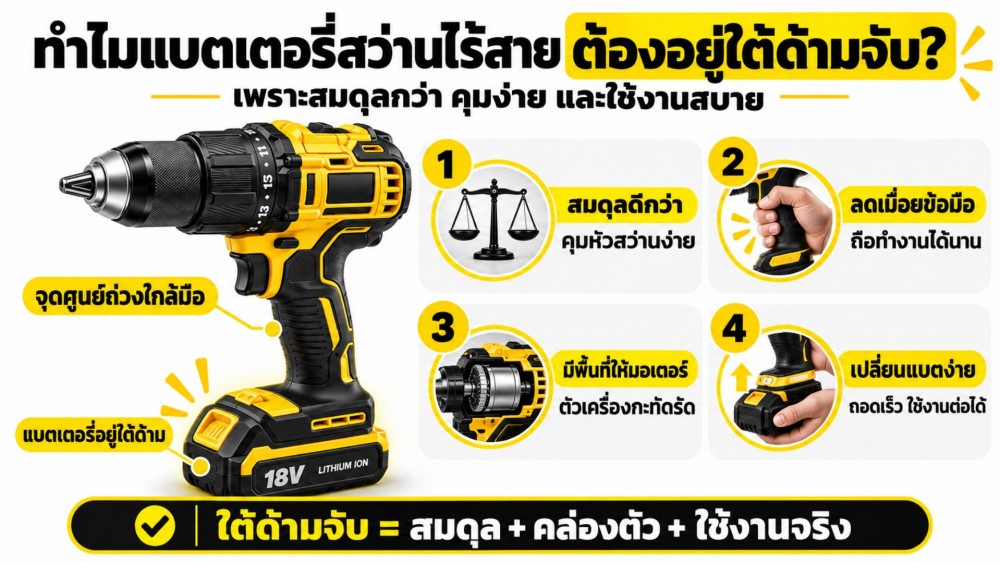
Summary: Why is a cordless drill battery located under the handle?
Placing the battery under the handle of a cordless drill is the result of multiple design aspects working together, not merely finding an empty space to plug in a battery. This position helps distribute the tool's weight, prevents front-heavy imbalance, keeps the center of gravity closer to the hand, frees up space for a compact motor and gearbox at the top, allows for quick battery swaps, and enables the battery base to serve as a stand for the tool as well.
Most importantly, it allows high-powered tools with large batteries to still be handled naturally. In drill design, torque figures, rotational speed, or battery capacity are not the only factors determining whether a tool performs well; weight distribution and the placement of each component play an equally crucial role.
Every time you pick up a drill and feel that it's well-balanced, not overly front-heavy, and can stand upright conveniently on a workbench, take another look down at the battery below the handle. This seemingly mundane position is actually the result of solving multiple engineering challenges at once. To provide Cordless drill power, maneuverability, and comfort of use all in one tool.