


 EN
 ไทย


Customers Also Purchased


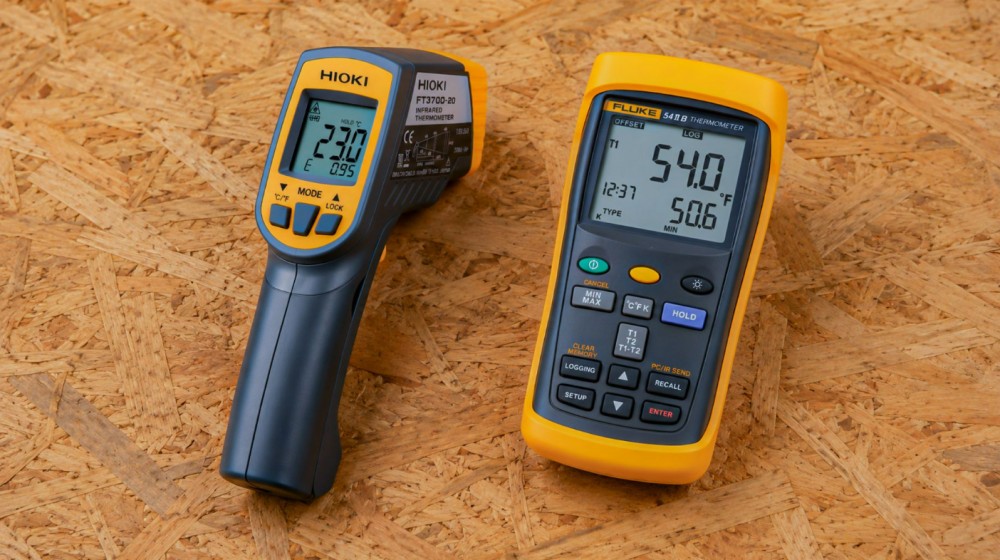
When choosing to buy Moisture Meter Whether it's an infrared thermometer, a probe thermometer, a food thermometer, or a thermal imaging camera, we often see in the specifications that the device can display both °C and °F or Celsius and Fahrenheit.
Aside from the question of How do thermometers and thermal imaging cameras differ? Which one is right for you? for users in Thailand, almost everything around us uses Celsius, from air temperature and air conditioners to the technical specifications of many types of machinery. It makes one wonder: Is the built-in Fahrenheit really necessary, or is it just a feature that is included but rarely used?
The answer is: for general work in Thailand, we might use Celsius alone throughout the entire lifespan of the thermometer. However, supporting Fahrenheit has its own reasons, as measuring instruments are often designed to be sold globally, and there are certain types of work where Fahrenheit is encountered regularly or manufacturers use different unit systems. The ability to switch units may not always seem vital, but in certain situations, it can greatly streamline steps and reduce errors.
Celsius and Fahrenheit are the same temperature, just using different scales
Before asking whether a thermometer needs two units, it's important to understand that Celsius and Fahrenheit are not two different types of temperature, but rather Unit systems used to express the same temperature on different scales Conversion between the two units can be calculated using the formula °F = (°C × 9/5) + 32 and °C = (°F − 32) × 5/9 For example, 100°C equals 212°F, while 86°F equals 30°C
- In the Celsius system, the freezing point of water is approximately 0°C
- The boiling point is approximately 100°C under standard atmospheric pressure
- Fahrenheit defines the freezing point at 32°F
- The boiling point is approximately 212°F
- The range between the freezing point and boiling point is thus divided into 180 degrees, whereas Celsius is divided into 100 degrees
Switching from Celsius to Fahrenheit does not make the thermometer measure better or more accurately. The sensor still measures the same temperature; the device's internal circuitry simply calculates and displays the measured value in the selected unit.
If using a thermometer in Thailand, is Celsius enough?
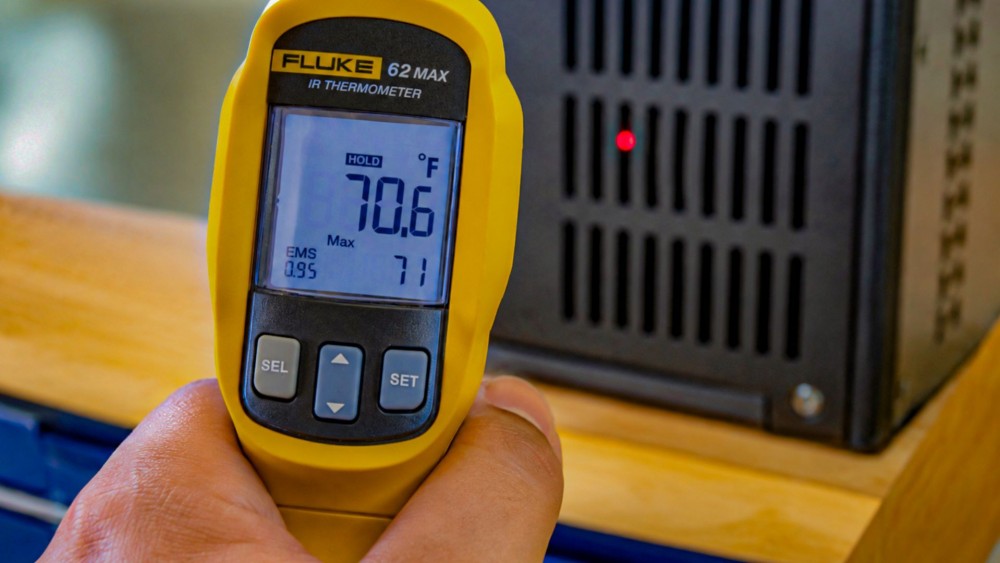
For daily life applications and general maintenance tasks in Thailand, Celsius is considered sufficient for using thermometers in most applications. We check air temperature as 30–40°C, set air conditioners to about 24–26°C, and use thermometers to inspect machine surfaces, measure motors, check HVAC systems, or measure food temperature primarily using °C anyway.
Therefore, having a thermometer that supports both °C and °F doesn't mean you have to switch back and forth between both units. Some users might just set it to Celsius and never change it again, which is perfectly fine.
However, what makes Fahrenheit still useful is that we don't always work exclusively with data from Thailand. When reading foreign machine manuals, datasheets from manufacturers, or browsing international websites, you may encounter figures specified in Fahrenheit. This is precisely where the unit-switching function makes work more convenient.
Why do almost all thermometers include both °C and °F?
The main reason is A single thermometer model is often designed for sale in multiple countries Indeed, manufacturers might sell the same model in Thailand, the United States, or other countries. Producing separate Celsius and Fahrenheit models for each market is practically unnecessary, because in modern thermometers, unit conversion can be easily handled via software or the device's processing circuit.
The sensor does not measure Fahrenheit separately from Celsius. The thermometer captures the same initial temperature reading from the sensor first and then converts the number based on the selected unit. Thus, adding the °C/°F option allows a single model to serve a broader market without requiring any changes to the core hardware.
This is why even Infrared thermometer Many entry-level models commonly feature a C/F function as standard, rather than it being an exclusive feature reserved for expensive devices.
Thermometers with 2 units help reduce conversion errors
If you only need to convert values once or twice, using a phone calculator might not be much trouble. But when dealing with dozens of data points or comparing multiple temperatures, constantly converting back and forth between Celsius and Fahrenheit quickly becomes tedious.
- Some types of units can be easily multiplied or divided by 10, 100, or 1,000.
- Converting between Celsius and Fahrenheit involves multiplication, division, and adding or subtracting 32.
- There is a higher chance of error if the formula is misremembered or rushed on-site.
- If a maximum temperature is specified at 194°F—which actually equals 90°C—even a slight misunderstanding or miscalculation could alter whether the equipment is deemed to be operating within a safe range.
For maintenance tasks, Quality Control (QC), or sharing data with international teams, setting the thermometer to the same unit used in the manual or reference standard is simpler and eliminates unnecessary conversions.
Culinary applications are an area where thermometers might use Fahrenheit more than you think
Beyond machinery work, the culinary field is an area where users in Thailand frequently encounter Fahrenheit, especially when following international recipes.
Recipes may call for oven temperatures of 350°F, 375°F, or 425°F, or specify internal meat temperatures in Fahrenheit. When using a food thermometer that can switch between °C/°F, you can simply set the device to match the recipe and read the values directly without having to pause your cooking to convert numbers every time. For home users, this might just be a matter of convenience; but in commercial kitchens, restaurants, or for anyone regularly working with recipes from various countries, aligning the unit with your reference documentation helps minimize confusion.
However, for workflows requiring quality control, the standard operating unit should be clearly defined and maintained consistently without switching back and forth unless necessary.
The pitfall to watch out for is accidentally misreading the unit
Another thing to look out for, following 6 precautions when using non-contact thermometers, is this: suppose you are used to Celsius and aim an infrared thermometer at a surface, and it displays 104. Looking only at the digits, you might assume the workpiece is at a scorching 104°C. But if the corner of the screen indicates 104°F, the actual temperature is only about 40°C. This difference is significant enough to completely alter the interpretation of the workpiece's condition.
This type of issue easily occurs in devices where a single button performs multiple functions—such as pressing once to turn on the backlight, but pressing and holding to switch between °C/°F—or where the Mode button is located near the grip, causing the user to accidentally press it while working. The easiest way to prevent this is to always check the °C or °F symbol on the screen before recording any critical temperature value.
As a rule of thumb, a room temperature of around 25–30°C corresponds to roughly 77–86°F. If the thermometer is measuring ambient temperature and reading around 80–90, check first whether the device was accidentally switched to Fahrenheit.
Having both °C and °F does not mean the thermometer has a wider measuring range.
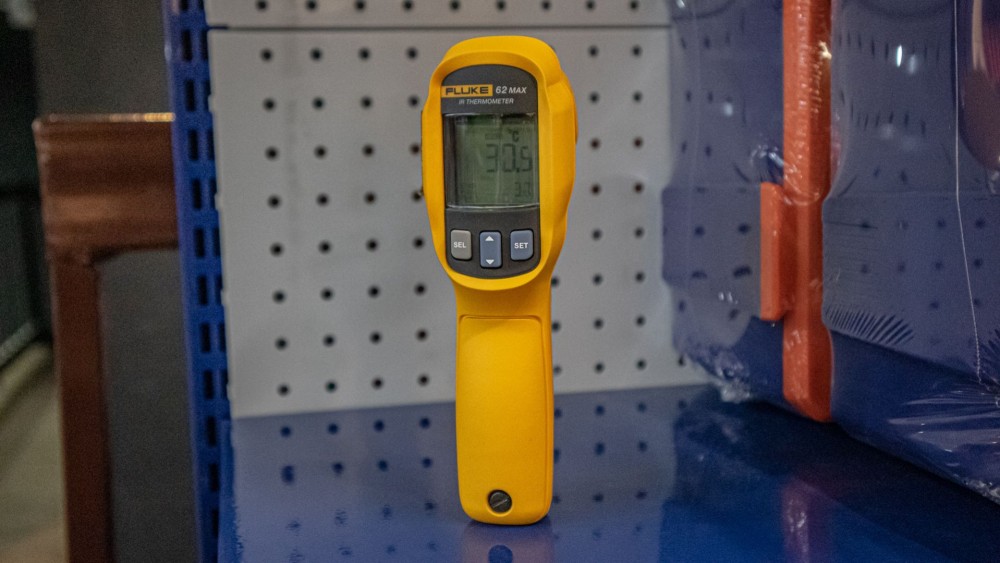
Another point to watch out for when reviewing thermometer specifications is not to directly compare Celsius and Fahrenheit numbers without checking the units.
- One device specifies a measurement range of -50°C to 550°C. When converted to Fahrenheit, that same range is approximately -58°F to 1022°F.
- The number 1022 looks much higher than 550, but it does not mean the device can measure higher temperatures.
- Both numbers represent the exact same maximum temperature.
- When buying a thermometer, do not just assume a model goes up to "over 1,000 degrees"; always verify first whether that number is in °C or °F.
- What should truly be compared is the Measurement Range after converting all devices to the same unit.
Does switching to Fahrenheit make the thermometer measure with higher resolution?
Another common misconception is that because one degree Fahrenheit represents a smaller temperature interval than one degree Celsius, switching the device to display in °F might make the measurement more detailed or accurate.
In practice, that conclusion should not be made.
The accuracy of a thermometer depends on the sensor, electronic circuitry, calibration, the temperature range being measured, and the instrument's accuracy specifications; it does not change simply because the user presses the C/F button.
If the thermometer reads the temperature from the same sensor, switching from 25.0°C to 77.0°F is merely a change in display format; it does not make the sensor measure temperature any more accurately.
Therefore, when choosing a thermometer, what you should focus on more is Accuracy, such as ±1°C or the values specified by the manufacturer for each measurement range, along with other display resolution capabilities, and What is Emissivity? One reason why infrared thermometers give inaccurate readings.
Who should pay special attention to the °C/°F function?
For maintenance technicians, engineers, factories using imported machinery, quality control departments, anyone who needs to read manuals from the US, or people who regularly cook using international recipes, the ability to switch units is quite clearly beneficial.
Especially in situations where values from the thermometer must be compared immediately with figures in a manual, using the same unit makes it easy to see whether the temperature is below, near, or above the specified value without needing a conversion step in between.
If an organization or workflow standardizes entirely on Celsius, the Fahrenheit function may have virtually no impact on operations, and the thermometer should be set to Celsius to prevent accidental unit changes.
Summary: Does a thermometer really need both Celsius and Fahrenheit?
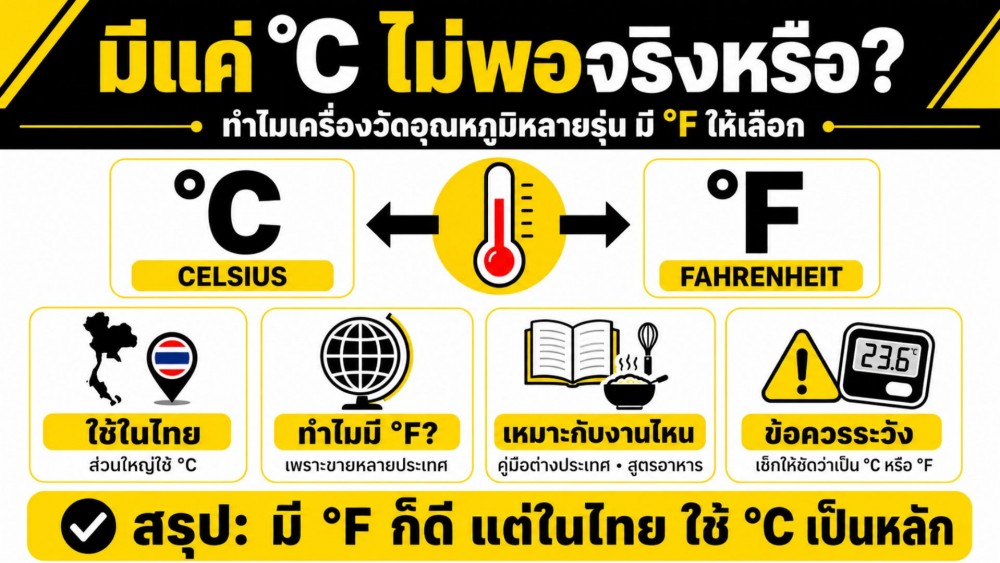
If you ask whether everyone needs both units, the answer is: not necessarily. For use in Thailand, Celsius alone already covers most applications, and many people might use a dual-unit thermometer for years without ever switching away from °C.
Fahrenheit is still genuinely encountered in documents, manuals, machinery, recipes, and communications with overseas users. Having a C/F toggle switch increases flexibility, allowing a single tool to work with multiple data formats and reducing errors from manual conversion.
Ultimately, Celsius and Fahrenheit are simply two different ways of writing the same temperature. Moisture Meter They do not measure differently, nor does changing the unit make it more accurate.