EN
 ไทย


Customers Also Purchased


People who use hammer drill tools to regularly drill into walls, bricks, or concrete are likely very familiar with the white or gray dust that billows out during work. This dust can settle on the tool body, chuck, ventilation vents, battery, and surrounding area. You might wonder: if you drill every day like this, will the concrete dust entering the drill cause it to break down faster, or is it merely surface grime that just needs to be wiped clean?
The answer is Concrete dust can cause impact drills to deteriorate faster if used continuously in heavily dusty environments. However, the lifespan of an impact drill also depends on the amount of dust, frequency of use, heat dissipation, post-use maintenance, as well as the build quality and dust protection system of each specific model.
Therefore, if you have to use an impact drill for masonry work every day, it's essential to understand how concrete dust gets into the tool, which components it affects, and how to operate and maintain it to prevent premature wear.
How is concrete dust generated during impact drill use?
If you ask whether How does an impact drill mechanism work? The answer is: when the masonry drill bit rotates and the hammer mode engages onto the material's surface, the carbide tip of the bit continuously grinds and pulverizes the brick, mortar, or concrete into fine fragments. The flutes on the drill bit then help channel these debris out of the hole.
However, this process generates a massive amount of fine particles, some of which fall to the floor, cling inside the drilled hole, or disperse into the air.
- The drier the material, the higher the speed, or the more consecutive holes you drill, the more dust is generated.
- When drilling overhead, a significant amount of dust can fall directly onto the chuck and the tool body.
- When drilling walls horizontally, some dust hovers around the drilling point and gets pulled into the ventilation vents by the airflow from the drill's cooling fan.
Most impact drills rely on an internal fan to dissipate heat from the motor. As the motor spins, the fan draws in outside air through the vents, circulating it over internal components before expelling it through the other side. If the surrounding air is laden with concrete dust, that dust travels inside along with the airflow.
Concrete dust does not damage the tool purely through mechanical means; it affects the impact drill across multiple areas, from overheating and component wear to electrical issues. The impact may not be immediately noticeable, but it gradually accumulates until symptoms begin to show after a period of use.
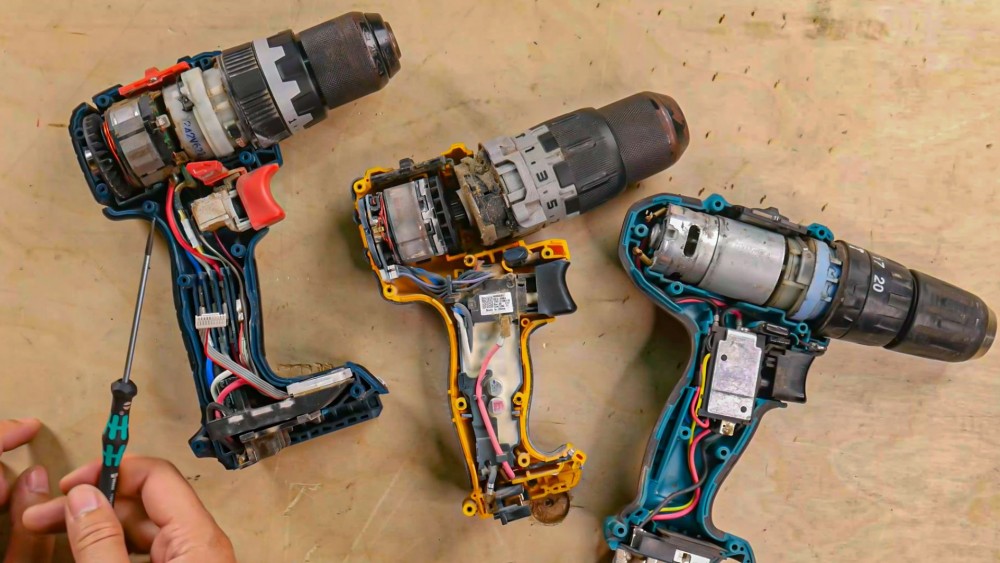
Dust clogging ventilation vents causes heat accumulation
An impact drill's motor naturally generates heat during operation, especially when drilling concrete, using large bits, applying heavy pressure, or working continuously. When vents are clean, the internal fan draws in air to dissipate heat as designed. However, when concrete dust accumulates on the grilles, vents, or airflow pathways, the volume of air flowing through the tool can decrease.
You may start noticing that the tool heats up faster than before even under the same workload, motor odors become more noticeable, RPM drops easily, or thermal overload protection trips more frequently. If this condition is allowed to recur regularly, the tool's lifespan can be significantly reduced.
Fine dust may adhere to the motor area
In brushed impact drills, carbon brushes contact the commutator to deliver electrical current to the rotating parts. Concrete dust accumulating here can mix with carbon dust from the brushes, making the interior dirtier and increasing the chances of abnormal sparking, uneven electrical conductivity, or wear on both the carbon brushes and the commutator.
Although most concrete dust is not a good electrical conductor like metal shavings, when mixed with moisture, grease, or other contaminants, it can degrade the internal environment of the tool. Dust particles can also act like fine abrasives when blown past or brought into contact with rotating components.
For brushless impact drills, there is no carbon brush wear issue, but bearings, gear assemblies, circuit boards, sensors, and cooling systems can still be affected by dust and heat.
Concrete dust can accelerate wear on bearings and gear assemblies
High-speed rotating parts like bearings rely on lubricants and seals to reduce friction. If fine dust penetrates into the bearing area, it can mix with the grease to form a contaminated paste that acts like an abrasive compound, causing the contact surfaces inside the bearings to wear out faster.
As wear begins, you might hear whining, grinding, or rougher running sounds than usual. The tool may vibrate more, and the chuck may begin to wobble. If you continue forced operation, damage can spread to the shaft and internal gear sets.
The impact drill's gear assembly is responsible for transferring power from the motor to the chuck, and on some models, it is also involved in gear shifting and the impact mechanism. Grease must be clean and of the proper viscosity. If dust or debris mixes in, lubrication deteriorates and gear teeth can wear out faster than normal.
Dust accumulation in switches and speed control systems
The trigger switch of an impact drill does not merely turn the tool on and off; on many models, it also regulates speed based on how far the trigger is pulled. Inside, there are both electrical contacts and small control circuits.
When concrete dust accumulates, users may experience a stiff trigger, delayed startup upon pressing, inconsistent RPM, or intermittent operation. At first, these symptoms may occur intermittently, leading to the mistaken belief that the battery is low or the power cord has an issue. However, if it happens frequently, it may stem from a dirty and degrading switch or circuit.
Forward/reverse selector switches, trigger locks, and mode selector rings can also be affected. If dust gets into the grooves or gaps, the buttons may become stiff and fail to shift smoothly as before.
Will drilling concrete every day always cause the tool to break quickly?
Many professional-grade tools are designed specifically to operate in dusty job site environments. What makes a difference in lifespan is whether the tool is matched properly to the job, Is it true that you must use hammer mode every time you drill concrete with an impact drill? whether it is pushed beyond its limits, and how well it is maintained.
A compact impact drill designed for DIY or home use may be capable of drilling masonry, but if it is used to drill concrete continuously every day, the tool will be operating near its limits for prolonged periods, causing heat and wear to develop much faster.
In addition, user technique makes a significant difference. Operators who apply excessive downward force, use dull drill bits, let dust clog the hole, or drill continuously without pausing can cause the tool to overheat and wear out much faster than those who use the appropriate bit, retract the bit periodically, and let the impact mechanism work naturally.
Concrete dust is one factor that causes impact drills to wear out quickly, but it is not the only cause. Selecting the wrong type of tool, using unsuitable drill bits, and overloading the drill can cause just as much damage.
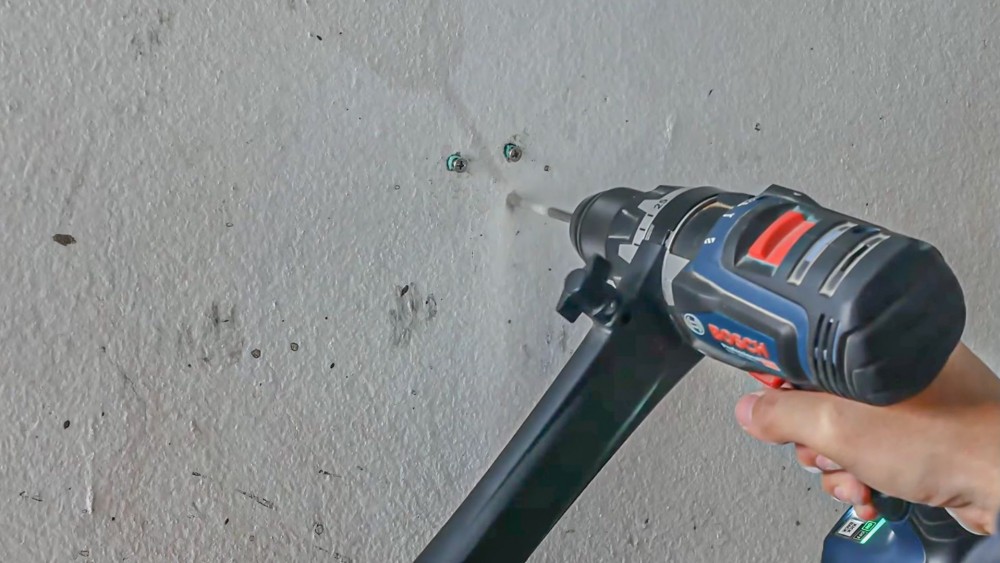
Habits that allow more concrete dust to enter the tool
- Drilling overhead without a dust collection accessory
- Using a high-pressure blower that forces dust into ventilation vents
- Placing the tool down on a dust-covered floor
- Working in an enclosed space with heavy dust accumulation
Drill bits affect drilling speed, the amount of dust generated, and the load placed on the tool. If you use a dull masonry bit, a worn carbide tip, or select a bit that is not suitable for the material, the drill will take longer to make a single hole, leading to pressing harder or running the tool continuously for longer periods.
Ways to reduce concrete dust before it enters the impact drill
The most effective way to care for your tool is to minimize dust at the source, rather than letting it accumulate and trying to clean it out later, such as:
- Use a dust extraction attachment at the drilling point
- Use a dust cup or dust catcher
- Position a vacuum cleaner close to the drilled hole
If you don't have dedicated accessories, you can hold or place a vacuum nozzle close to the drilling point without letting it touch the drill bit. This method effectively reduces airborne dust, but be cautious with power cords, vacuum hoses, and hand positioning to stay clear of rotating parts.
Warning signs that an impact drill may have internal dust buildup
An impact drill with accumulating dust or debris inside may show various symptoms, such as heating up faster, dropping RPM easily, making abnormal motor noises, emitting a burning or overheating smell, having thick dust deposits on ventilation vents, or blowing dust out of the casing when powered on.
- On brushed models, you may notice more sparking around the motor than usual.
- The switch may become hard to press, rpm may become inconsistent, or the tool may shut off when moving the power cord or trigger.
- The chuck may feel wobbly, fail to clamp securely, or make it difficult to remove drill bits.
- Whining or grinding noises, or increased vibration, may be related to the bearings and gear set—a clear sign to stop and inspect before more severe damage occurs.
If the hammer drill emits a strong burning smell, smokes, or produces unusual sparks, stop using it immediately, unplug it or remove the battery, and send it for inspection. Do not repeatedly turn it back on to see if the issue resolves itself.
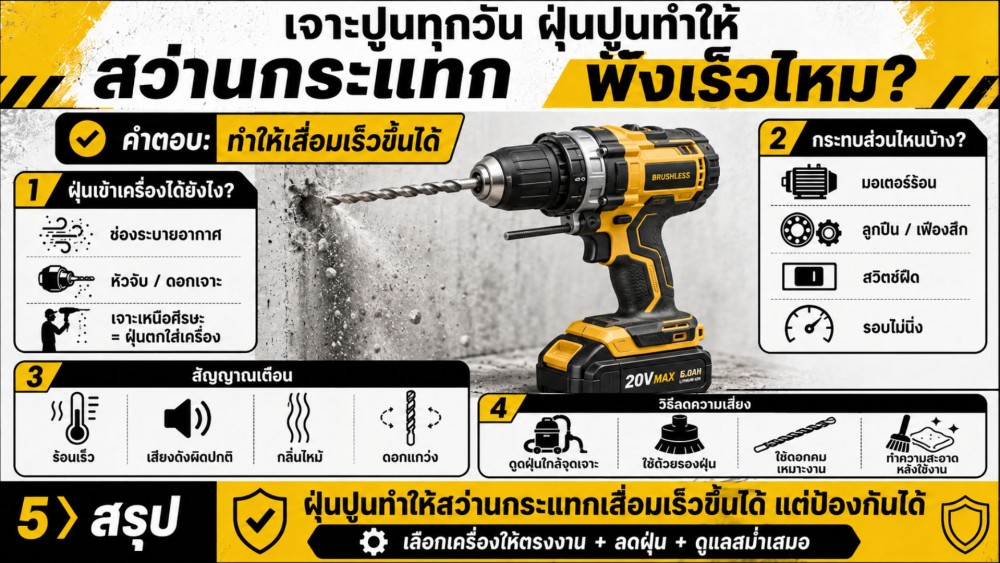
Conclusion: Does drilling concrete every day cause concrete dust to break a hammer drill faster?
Concrete dust can indeed cause hammer drills to break down faster, especially when dust clogs ventilation vents, accumulates around the motor, mixes with grease in bearings and gears, or interferes with the operation of the switch and chuck.
However, concrete dust does not ruin the tool instantly, and drilling concrete every day does not always mean the drill will have a shorter lifespan.
If you choose the right tool for the job, use suitable drill bits, avoid applying excessive pressure, minimize dust right at the drilling point, and clean it regularly after use, a hammer drill can operate at full efficiency for a long time.
For anyone who needs to drill concrete continuously, choosing a rotary hammer or a professional-grade tool that supports dust extraction systems may be more worthwhile than forcing a small hammer drill to endure heavy work every day. Beyond helping complete the job faster, it also reduces heat, lowers motor load, and minimizes the risk of premature damage.
Ultimately, what causes a hammer drill to break down quickly is not just concrete dust, but the cumulative effect of tool selection, bit selection, operating technique, environment, and maintenance.
Taking care of all these aspects together will reduce both dust and damage, allowing you to use hammer drill it with better long-term value.