


 EN
 ไทย


Customers Also Purchased
Metal welding today is not limited to just one process. You may encounter MIG welding, TIG welding, stick welding (MMA), as well as plasma cutting. Each process produces noticeably different light intensity, heat, sparks, welding fumes, and weld pool visibility requirements.
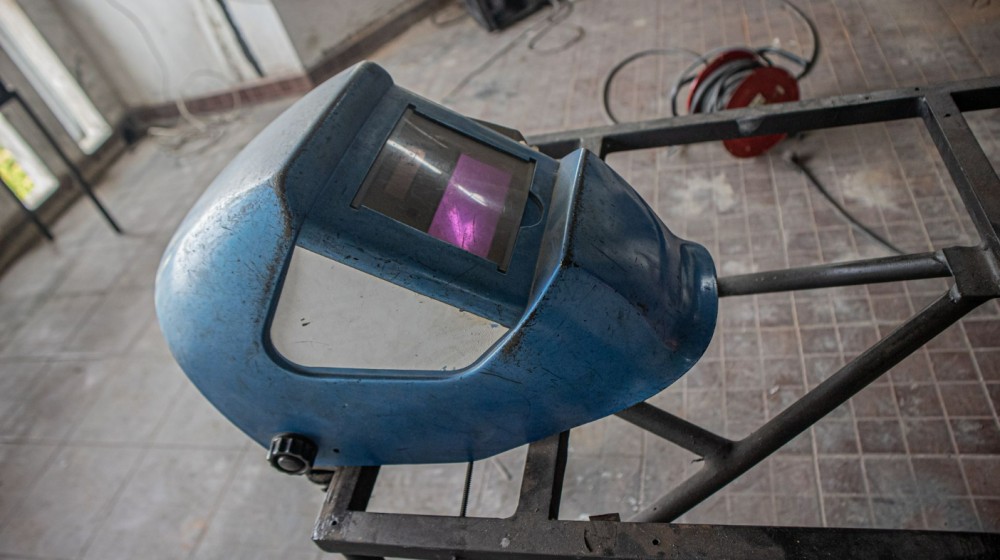
Choosing Welding helmet Therefore, you shouldn't just look at whether it's an auto-darkening helmet or consider only the price. You should choose one tailored to the actual welding processes you perform, ensuring a clearer view of the weld seam, more precise work, and superior protection for your eyes, face, and skin against welding light and sparks.
Many people assume any welding helmet will do as long as it blocks light. In reality, each welding process produces different types of light. This is especially true for TIG welding, which often uses low amperage and requires high precision; a helmet that is slow to respond, unclear, or lacks sufficiently sensitive sensors can make striking an arc and starting a weld difficult.
Choosing a welding helmet should therefore consider shade levels, the auto-darkening system, lens switching speed, viewing area size, weight, comfort, and extra features that enhance work efficiency.
Understand each welding process before choosing a welding helmet
Before choosing the most suitable welding helmet, in addition to Important factors that are often overlooked , you should first understand how the light and sparks behave differently in each welding process.
Although MIG, TIG, MMA welding, and plasma cutting all involve heat and arc light, their operating characteristics are completely different. Choosing a welding helmet without considering the application may leave you with a helmet that functions, but is
- uncomfortable on the eyes
- unsuitable for the job site
- does not help you work at full efficiency as it should
MIG welding: clear vision and effective spatter management
MIG welding is widely popular for structural work, repairs, manufacturing, and metal fabrication because it allows for continuous passes, fast operation, and high efficiency. However, the advantages of MIG also come with sparks, spatter, and relatively continuous welding light.
For MIG welding, you should choose an auto-darkening welding helmet with a shade range around DIN 9–13 or similar, allowing you to adjust the lens darkness according to the welding current and job site lighting conditions.
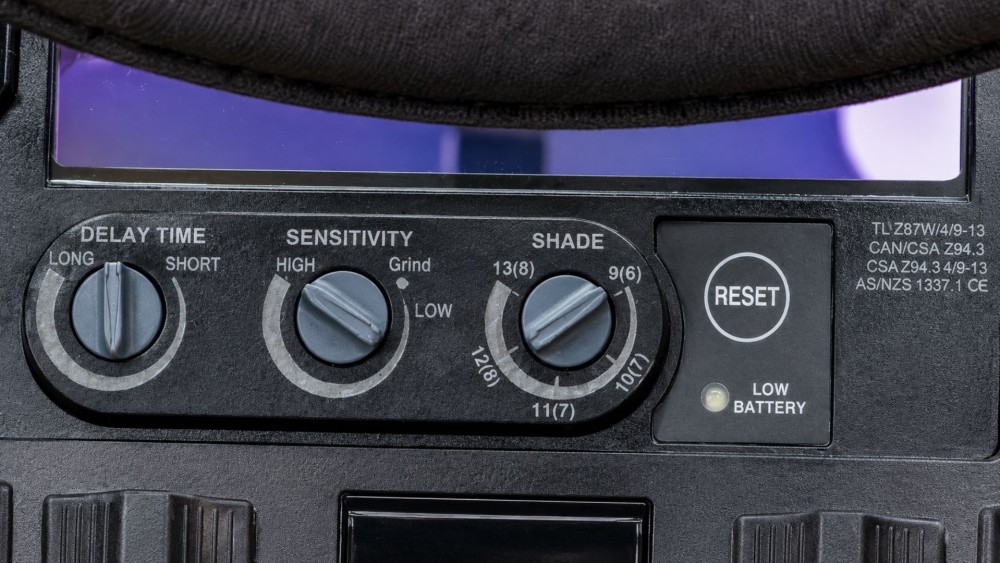
In addition, choose a welding helmet with comprehensive facial coverage, durable, spatter-resistant shell material, and an adequately sized viewing area. MIG welding often requires moving continuously along the weld seam; if the viewing window is too small, you may need to move your head frequently, causing fatigue and breaking your rhythm.
The delay adjustment function, or delay time after the arc is extinguished, is also very useful and is one of the techniques for selecting and using a welding helmet to best protect your eyesight, because after stopping welding, the weld pool remains bright for a moment. If the lens switches back to light too quickly, it can cause eye strain. Adjusting the delay properly helps make viewing more comfortable, especially during prolonged continuous welding.
TIG welding: emphasizing sensor responsiveness and lens clarity
TIG welding requires higher precision than general welding. You must precisely control the torch, filler rod, arc length, and weld pool. TIG is often used for stainless steel, aluminum, piping, thin materials, or jobs requiring aesthetically pleasing weld beads.
Welding helmets for TIG should place special emphasis on lens clarity, especially True Color systems or natural color lenses, as they help you clearly distinguish the molten pool color, weld lines, and workpiece edges better than overly greenish or excessively dark lenses.
Another crucial point for TIG welding is the auto-darkening system's responsiveness, especially when welding at low amperages. If the helmet has too few sensors or an insufficiently sensitive detection system, the lens may flicker, switch back to light while welding, or fail to detect the arc continuously, causing eye strain and impacting weld quality.
If your focus is on TIG welding, select a welding helmet specified for low-amp TIG performance, equipped with multi-point sensors, fine sensitivity adjustments, and optical clarity suitable for detailed work. Standard helmets suitable for general MIG or MMA may not meet the high precision demands of TIG welding.
MMA or stick welding: emphasizing durability and spatter protection
MMA welding, or stick welding as many call it, is very common in general workshop and fabrication work. Its advantages are ease of use, no shielding gas required, and suitability for diverse site conditions. However, the drawbacks are significant amounts of smoke, spatter, and slag.
Welding helmets for MMA should therefore focus on durability, heat resistance, spatter resistance, and full facial coverage. Avoid overly thin helmets or those with minimal protective coverage, as weld spatter can easily fly into the face and neck area.
- Most MMA welding uses helmets adjustable within the DIN 9–13 range, similar to MIG.
- Adjust according to the actual welding current
- If using higher currents, adjust the lens darker to reduce glare and ensure greater eye comfort.
- Grinding mode is also a very useful function for MMA work, as you often need to chip slag, grind weld beads, or deburr after welding.
Plasma cutting requires choosing a helmet that handles intense glare and provides clear visibility of the cut line
Plasma cutting involves high heat and produces intense bright light. Even though it is not a welding process, proper eye and face protection is still required.
A welding helmet for plasma cutting should offer clear visibility of the cut line, as cutting requires maintaining a straight and continuous path. If the lens is too dark, you might not see the marking lines on the workpiece; if it is too bright, it can cause eye strain.
Therefore, a helmet with precise DIN shade adjustments will make operation much easier. Additionally, a wide viewing area is an advantage, allowing the user to better see the cutting torch position, spark direction, and cut line—especially when navigating curves, following patterns, or working on large workpieces.
Are handheld welding shields suitable for MIG, TIG, MMA, and plasma cutting?
Handheld welding shields, or hand-held welding masks, can still be used for certain types of work, especially light welding, general repairs, or non-continuous jobs. Their key highlights are ease of use, affordability, and lack of complex settings. How safe are handheld welding shields, when should they be used, and how do they differ from head-mounted helmets?
The limitation of a handheld welding shield is that one hand must hold the shield at all times, leaving only one hand free to work. As a result, it may not be suitable for tasks requiring precise control of the welding torch, filler rod, or cut line.
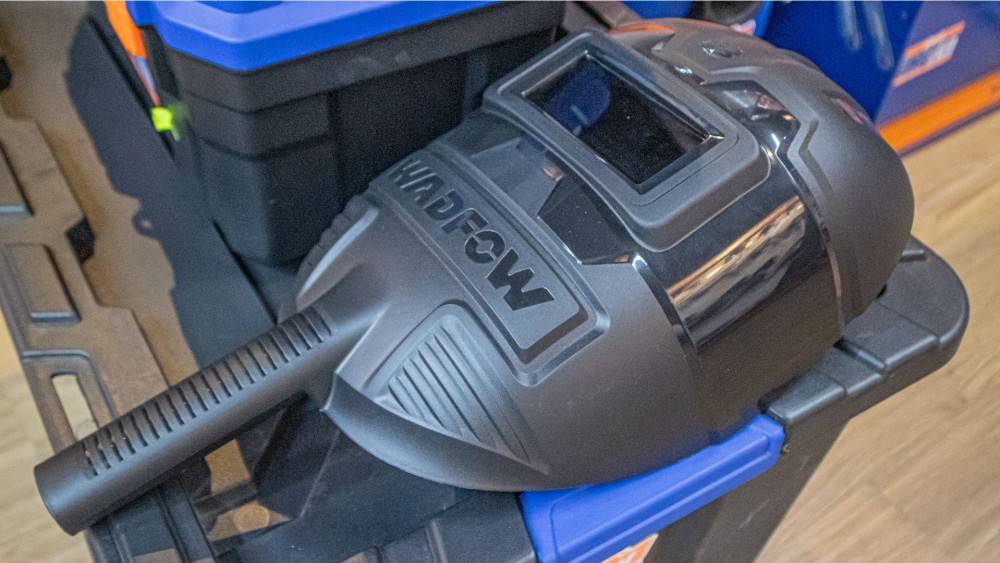
- MIG Welding: Can be used for short weld passes or general repairs; however, for continuous welding, long seams, or heavy-spatter jobs, an auto-darkening head-mounted welding helmet should be used.
- TIG Welding: Not very suitable for handheld shields because it usually requires both hands simultaneously—one to hold the torch and the other to feed the filler rod—while also demanding a detailed view of the weld pool.
- MMA or Stick Welding: A handheld shield can be used, particularly for general repair or occasional welding. However, if you weld frequently, for long periods, or in difficult positions, a head-mounted helmet should be used, as MMA produces considerable spatter, fumes, and slag.
- Plasma Cutting: Can only be used for short or simple cuts. A head-mounted helmet allows for better torch control and reduces the chances of cutting mistakes.
Handheld welding shields are suitable for light tasks, minor repairs, and jobs that do not run continuously for long periods. However, if you regularly perform MIG, TIG, MMA, or plasma cutting, you should choose an auto-darkening head-mounted helmet for better safety, agility, and a clearer view of the work line.
Choosing a welding helmet by application: A simple guide
For MIG, choose an auto-darkening helmet that resists spatter, offers a wide DIN range, provides Delay and Sensitivity adjustments, and features a viewing area that facilitates continuous welding passes. For TIG, focus on high optical quality lenses with true color, sensitive arc sensors that support low amperage, and fine-tuning capabilities. For MMA, prioritize a durable, spatter-resistant helmet with good face coverage and a grinding mode for post-weld clean-up. For plasma cutting, select a helmet with shade levels suited for cutting, clear visibility of the cut line, and effective spark protection.
What should you do if you want a single welding helmet that can do it all?
- Look for a model that supports MIG, TIG, MMA, and plasma cutting all in one.
- Has a shade range of approximately DIN 5–13, or at least 9–13.
- Features both welding and grinding modes, with adjustable sensitivity and delay.
- Equipped with multiple sensors.
- Uses a True Color lens or a lens of sufficient quality for detailed work.
If your primary task is TIG or high-aesthetic stainless steel welding, you should opt for a welding helmet with a better lens than entry-level models, as clarity directly impacts your work quality.
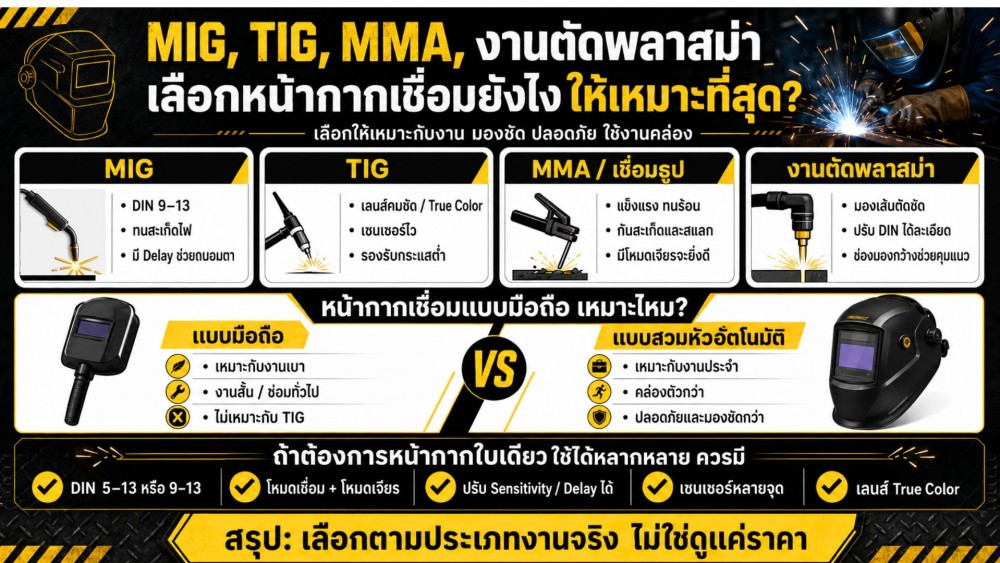
Summary: What to look for in a welding helmet for MIG, TIG, MMA, and plasma?
Selecting the right welding helmet for MIG, TIG, MMA, and plasma cutting should mainly be based on your actual work requirements, rather than just aesthetics or the lowest price. Each process has different light levels, spatter, precision requirements, and workpiece viewing conditions.
If you need a versatile welding helmet for all-around use, choose an auto-darkening model with a wide DIN range, adjustable sensitivity and delay, a grinding mode, a clear viewing area, comfortable weight, and solid facial protection. Having a True Color lens or high optical quality makes welding even easier, provides clearer vision, and significantly reduces eye fatigue.
Ultimately, Welding helmet The best choice must be the model that fits your type of work, frequency of use, and gives you confident safety every time you strike an arc.