


 EN
 ไทย


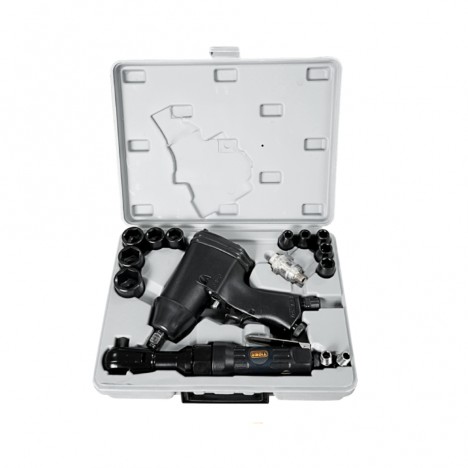
Customers Also Purchased


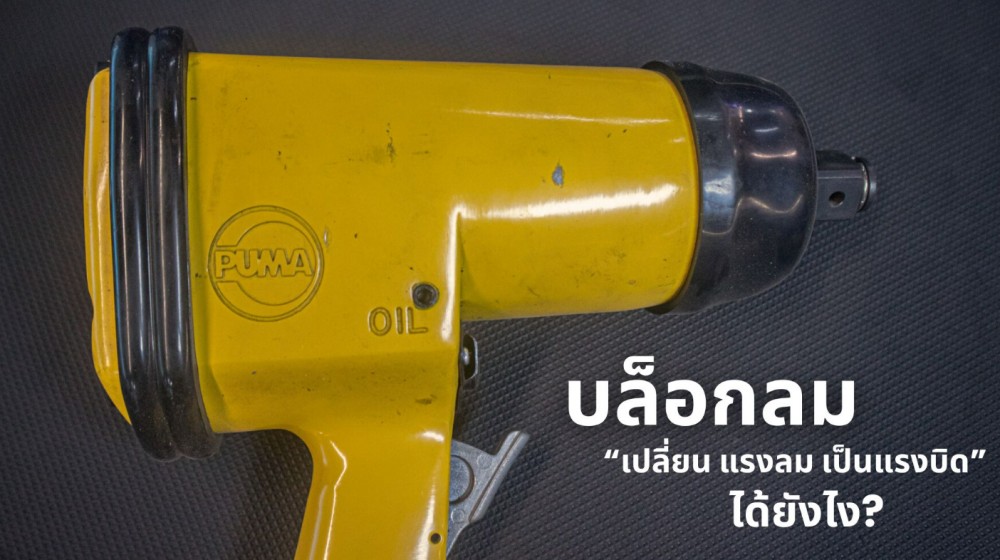
Would you believe it if someone said that just air could loosen bolts as tight as those on truck wheels? Many of you have likely seen this before: a technician holding a pistol-like tool takes just a few seconds, and a bolt that seemed fused to the steel comes loose effortlessly—whereas doing it by hand or with a regular wrench would take heavy sweating and strain your wrists.
One of the tools that can do this is Air Impact Gun . But have you ever wondered how it does it—using just air, yet generating that much torque?
How does something seemingly weightless, invisible, and intangible turn into power that overcomes steel, fights rust, and loosens the tightest bolts? Why have air impact wrenches barely changed their design or core concept for decades? And more importantly, why is a tool subjected to repeated impacts known to be so rugged, durable, and long-lasting—often serving workshops and factories for decades while performing just like new?
In this article, we'll unpack the inner workings of an air impact wrench together, viewing this tool from a different angle: from where compressed air enters the tool to the moment torque is transferred to the bolt head. Discover why many technicians say, "Without an impact wrench, the job stops," and how it differs from other fastening tools.
How does an air impact wrench differ from regular pneumatic tools?
At a glance, an air impact wrench is just a type of fastening tool: it has a handle and a square drive to fit sockets, not looking vastly different from ordinary fastening tools. But its real difference doesn't lie in its external appearance—it lies in the "power source used" and how that power is converted into torque.
An air impact wrench uses Power from Compressed Air Instead of electricity or human strength, it is the compressed air stored in the air compressor tank that is continuously delivered through the air hose into the tool. Then, the air converts internal energy into both rotational and impact force at the same time. Simply put, Air doesn't just make the tool rotate, but it also allows it to "strike hard" in rhythmic bursts.
How Is an Air Impact Wrench Different from Other Pneumatic Tools?
If you compare it to other air tools like paint spray guns, blow guns, air drills, or sanders, the difference is quite clear. General pneumatic tools usually focus on continuous rotation and smooth torque for easy, precise control, but they are not designed to withstand particularly high resistance.
Air impact wrenches are built specifically to tackle resistance head-on. Their internal mechanism is designed to build up force and release it as an impact to overcome the friction of stubborn, tight bolts.
Air Impact Wrench vs. Electric Impact Wrench
When comparing it with electric or cordless impact wrenches, the difference becomes even clearer. Electric impact wrenches also use electrical energy to generate rotational and impact force, offering high convenience and mobility. However, in continuous heavy-duty use, heat limits and power supply are factors to consider. Meanwhile, with an air impact wrench, as long as the air supply system is ready, it can run heavy-duty continuously with almost no drop in torque.
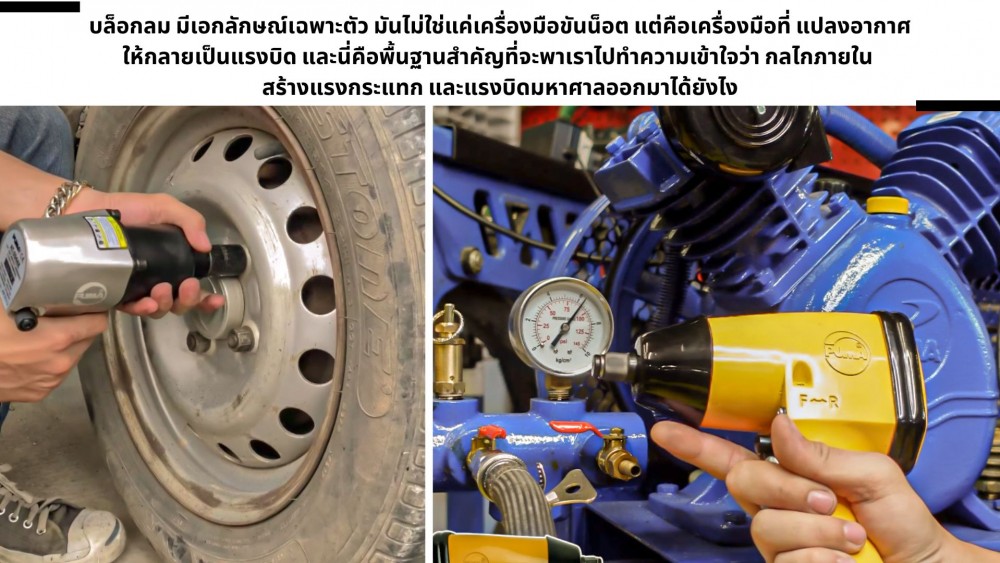
The Journey of Air: From the Tank to Torque at the Bolt
The air that an air impact wrench uses doesn't just appear out of nowhere; it travels through several stages, from the air tank through the hose, with speed and volume regulated before driving the internal mechanism. Every step affects the torque delivered to the bolt, and this is one reason why why an air impact wrench suffers a sudden loss of power and why sometimes the same air impact wrench produces noticeably different results when used with different air systems.
1. The Starting Point Is the Air Compressor, Not the Impact Wrench
Many people focus mainly on the impact wrench itself. In reality, all the torque begins back at the air tank. If you ask, What air compressor size is really needed for an air impact wrench? What happens if it's too small? The answer is A tank that is too small, or an air compressor that cannot keep up with air demand, causes the pressure to drop before it even reaches the tool. No matter how powerful the air impact wrench is, if the air supply at the source is insufficient, the output at the bolt will never reach its full potential. This is why professional workshops or factories prioritize the air system just as much as the tool itself.
2. Air Hoses and Fittings: The Overlooked Variables
After leaving the tank, the air must travel through hoses and various fittings, which are prime spots for pressure drop. A hose with too small a diameter, clogged fittings, or even minor leaks can weaken the air reaching the impact wrench. In many cases where mechanics feel the impact wrench is "not as strong as before" even though the tool itself is fine, the cause usually lies right here.
3. Before Entering the Mechanism: Proper Air Regulation Is Essential
Once the air reaches the impact wrench, it doesn't mean it's used immediately. The air pressure and flow volume must be regulated to suit the air motor. If the pressure is too high, it may hit unnecessarily hard; but if the pressure is too low, the impact mechanism won't achieve its full cycle. The journey of air is not just about raw power, but about "proper balance" that directly affects the torque delivered to the bolt.
How Does "Air" Turn into Torque?
To explain it in the simplest terms: an air impact wrench doesn't use air to directly turn a bolt like turning a wrench or a drill. Instead, it uses air to drive an internal mechanism that delivers repeated impacts to the drive shaft. The energy from the air builds up for a brief moment before being released as a striking force against the shaft right at the point of greatest resistance.
Imagine a small hammer swinging continuously to strike the drive shaft. Each strike delivers a burst of torque. It’s not just one hard hit, but repeated blows at a very high frequency. When this rhythmic striking happens continuously, the total torque delivered to the bolt becomes exceptionally high—far greater than what human muscle or smooth rotational force could ever produce.
Why Stubborn, Rusted Bolts Loosen So Easily
These impacts don't try to overcome all resistance at once; they gradually break the binding grip stroke by stroke—whether it's friction, rusted threads, or severe overtightening. Once that binding hold begins to yield, the bolt turns out smoothly. This is why air impact wrenches are ideal for heavy-duty applications, excessively tight fasteners, or tasks requiring immense force right from assembly.
How Does the Mechanism in an Air Impact Wrench Actually Work?
Inside an air impact wrench is an air motor that converts compressed air energy into rotational motion. This motor requires no electricity, produces no sparks, and stands up remarkably well to tough working conditions. Incoming compressed air pushes the vanes or rotor to spin at high speeds, and this rotation is then transmitted to the impact mechanism.
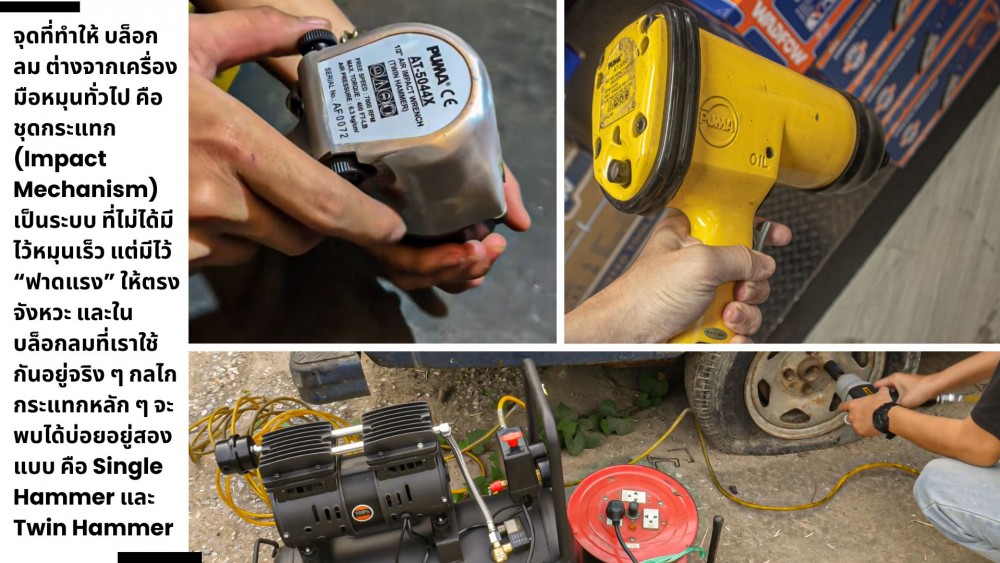
Single Hammer: Simple Yet Delivers Rhythmic Power
The single hammer mechanism uses just one hammer, building momentum briefly before striking the anvil once per cycle. Think of a hammer lifting and striking in a distinct rhythm; the resulting power comes in pronounced, individual pulses rather than a constant stream.
The advantage of this system is its straightforward design, fewer moving parts, easy maintenance, and outstanding durability. It is well-suited for small-to-medium air impact wrenches or models where ruggedness and long-term endurance in harsh environments are the main priorities.
Twin Hammer: Two Hammers Working Together for Maximum Power
The twin hammer mechanism utilizes two hammers working alternately or simultaneously in each rotation, delivering impacts that are "more continuous and significantly heavier" compared to a single hammer design. In simple terms, instead of striking from one side at a time, it strikes from both sides simultaneously, producing smoother and much higher torque. This makes it ideal for true heavy-duty tasks such as truck lug nuts, heavy machinery, or exceptionally tight fasteners.
Whether it's a single hammer or twin hammer air impact wrench, the core principle remains the same: rather than forcing rotation against heavy resistance, it relies on rapid, repeated impacts to break the friction bit by bit until the fastener finally breaks free.
Why Are Air Impact Wrenches So Powerful and Long-Lasting?
Looking purely at torque, an air impact wrench might seem like a tool that "has plenty of power, but must break down easily" because it endures constant, repeated impacts. In reality, the opposite is true. Many air impact wrenches serve reliably for decades without major overhauls. The key reasons lie in their internal construction and traditional design philosophy.
Simple Construction with Few Moving Parts
An air impact wrench has no electric motor, no circuit boards, and no batteries. Inside, you'll find only an air motor, an impact assembly, and mechanical components engineered to absorb high impact directly. Fewer parts mean fewer points of failure, and when wear does occur, it can be serviced directly at just a few straightforward spots.
Heat is the Enemy, but Air Impact Wrenches Barely Feel It
Most power tools are susceptible to overheating, but air impact wrenches are powered by compressed air, which naturally draws heat away from the tool as it exhausts. This allows for continuous operation over extended periods without the need to stop and let the motor cool down like many electric tools require.
Designed to Withstand Heavy Impact from the Ground Up
Another vital factor is that air impact wrenches are engineered to handle high impact as normal operating conditions, not an overload state. The internal structure, metallurgy, and load-bearing surfaces are specifically designed to endure tens of thousands or even hundreds of thousands of blows. That is why air impact wrenches are renowned for their rugged durability, outlasting expectations in workshops and industrial plants worldwide.
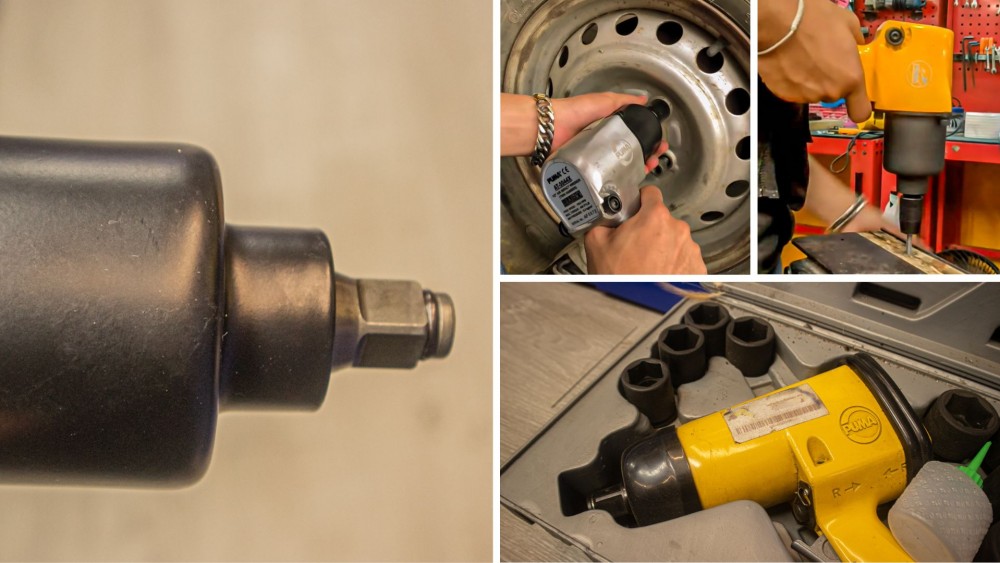
Conclusion
To put it simply, an air impact wrench converts lightweight, invisible energy like air into massive torque through a pneumatic compressed air system consisting of a powerful air compressor, an ingenious, durable mechanism, and a straightforward working concept, including:
- Using repeated impact force instead of forcing rotation against resistance
- Using air as the primary energy source, allowing continuous operation without heat buildup
- An uncomplicated internal structure engineered directly to withstand impacts
It might not be as convenient as cordless tools, but for heavy-duty and continuous work, air impact wrenches remain the tool trusted by professional technicians—and this is yet another reason Why air impact wrenches are still widespread in the era of power tools and why every maintenance technician should get hands-on and try using one at least once.
If you understand it and know its limitations, Air Impact Gun it won't just be a loud tool in the garage, but an assistant that truly puts heavy-duty work under control.