


 EN
 ไทย


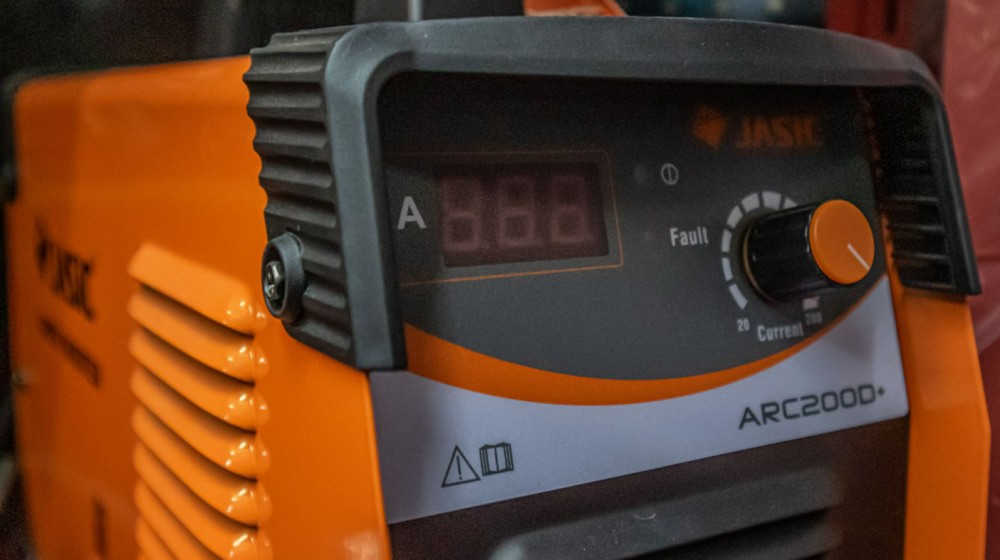
When buying Welding machine or welding machine Some people might look at the amperage rating first, or perhaps focus on 5 Key Factors in Choosing the Current (Amps) for Each Type of Welder Because the higher the amperage, the more powerful the machine should be, leading to better welds.
In reality, there is another equally important rating: Duty Cycle, or what many simply call the welder's "operating cycle." This value tells you how long a welding machine can operate continuously and how long it needs to rest to prevent overloading, overheating, thermal cutout, or impacts on its service life.
People who encounter issues with a brand-new machine might assume it is defective, broken, or lacks sufficient amperage. In reality, the problem often stems from unknowingly exceeding the machine's duty cycle—such as using a small welding machine continuously for long periods like a large industrial unit, or running high current for extended periods without letting it rest.
Because understanding Duty Cycle helps us operate welding machines more properly, more safely, and select the right unit for specific job requirements with greater precision.
What is Duty Cycle?
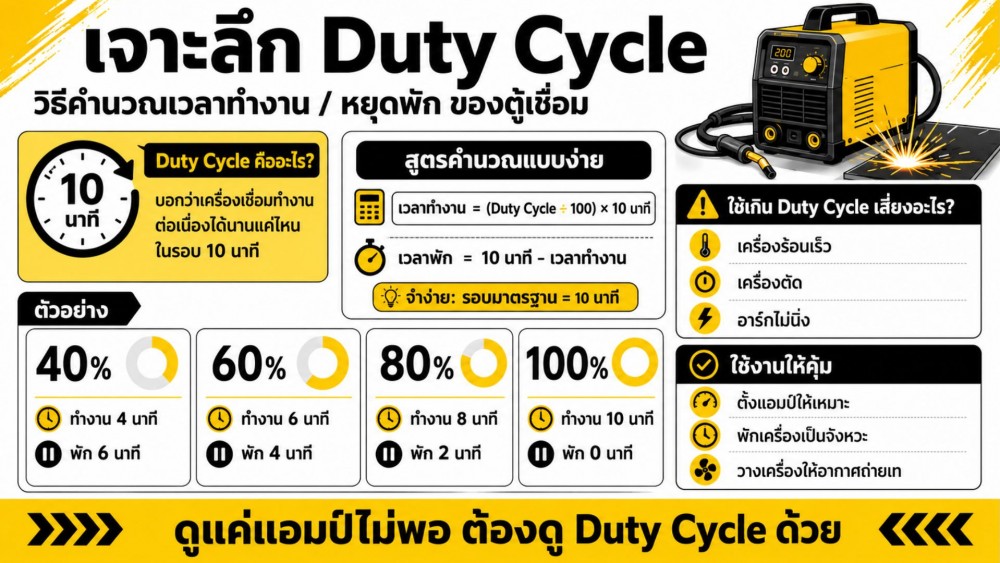
Duty Cycle is a rating used to indicate a welding machine's capability for continuous operation within a standardized test period. It is typically referenced over a 10-minute cycle. For example, a 60% Duty Cycle means that within a 10-minute period, the machine can weld for approximately 6 minutes and should rest for approximately 4 minutes to dissipate heat before welding resumes.
Put more simply, Duty Cycle indicates "how well a welder can handle continuous operation" at a specified current level.
How to Read Duty Cycle Ratings on Welder Specs
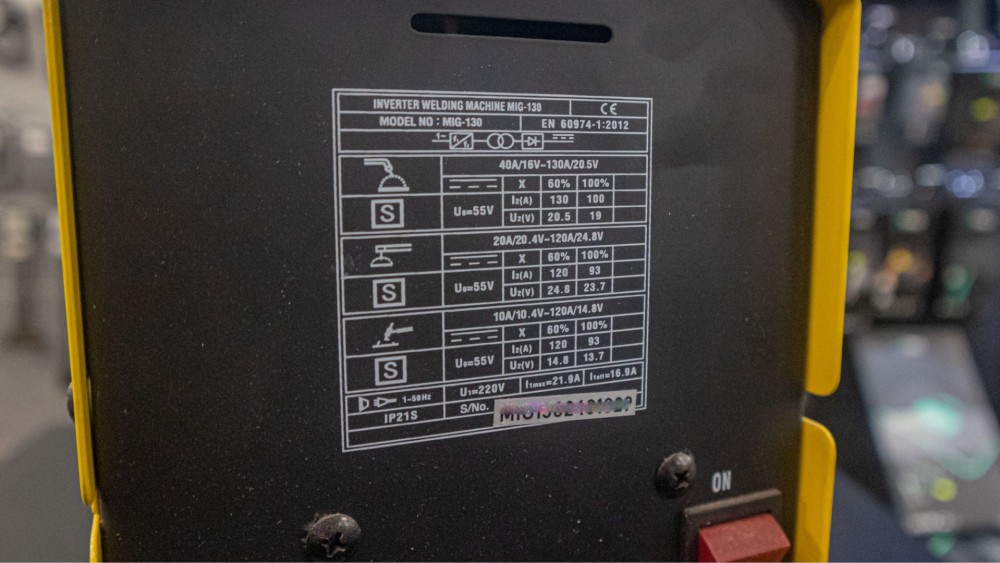
When reading welder specifications, you might see notations such as: 60% @ 200A or 100% @ 155A This means the welding machine can operate continuously for the specified percentage at that current level. For example, a 60% @ 200A rating means that when running at 200 amps, the machine can weld for about 60% of a 10-minute cycle (approximately 6 minutes) and should rest for about 4 minutes.
A rating of 100% @ 155A means that when operated at 155 amps, the machine can run continuously for the full cycle without resting according to standard Duty Cycle calculations. However, in actual work, ambient conditions should still be taken into account, such as:
- Ambient temperature around the machine
- Ventilation
- Dust, moisture, and accumulated working time
Even if a welding machine has a high Duty Cycle, if used in an extremely hot environment or with dust clogging the ventilation vents, the machine can still overheat faster than normal.
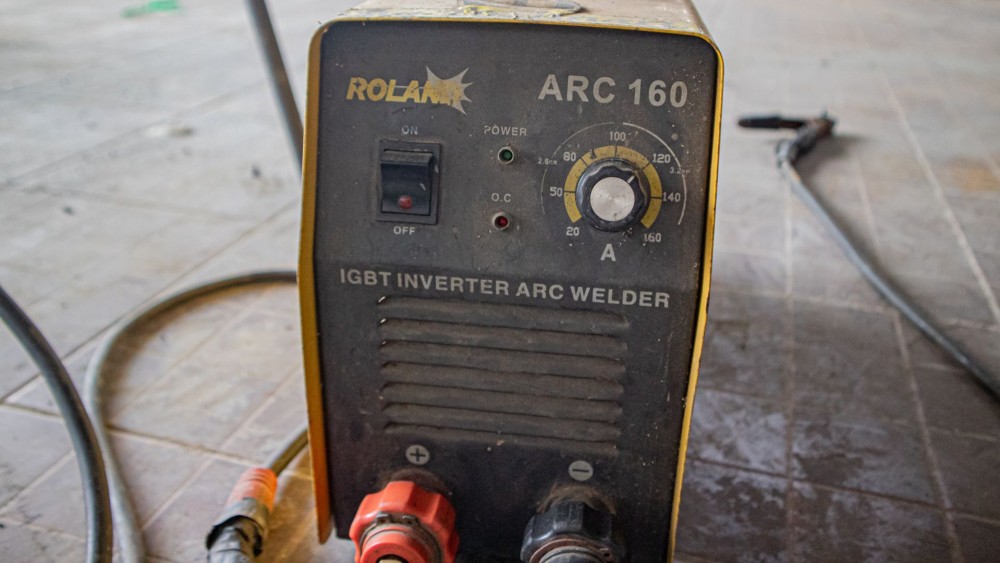
Duty Cycle must always be read alongside the amperage, because this value changes according to the current used. Generally, the higher the amperage, the lower the Duty Cycle tends to be; conversely, if the amperage is lowered, the machine can run longer. For example, a welding machine might have a Duty Cycle of 40% at 200A, but if reduced to 120A, it can operate continuously for much longer.
Simple Duty Cycle calculation formula
The simplest way to calculate Duty Cycle is based on a 10-minute cycle, as it is the standard commonly used to describe the duty cycle of welding machines.
The formula is: Work Time = Duty Cycle ÷ 100 × 10 minutes and Rest Time = 10 minutes - Work Time
For example, if the welding machine has a Duty Cycle of 60%, calculate 60 ÷ 100 × 10 to get 6 minutes. This means the machine can weld for about 6 minutes and should rest for about 4 minutes.
- 40% means the machine can weld for about 4 minutes and rest for about 6 minutes.
- 80% means it can weld for about 8 minutes and rest for about 2 minutes.
- 100% means that at the specified current level, the machine can operate for 10 minutes without needing to rest.
This calculation makes it easier to visualize, especially when planning work. For instance, knowing that the machine can weld for 4 minutes and should rest for 6 minutes prevents pushing the machine beyond its capacity and helps pace the workflow appropriately.
Weld for one session, then use the machine's resting time to realign workpieces, chip slag, grind weld beads, prepare wire, or check the next position. This method lets the machine cool down without wasting work time.
Can you use a welding machine continuously for more than 10 minutes?
Another common question is: if the welding machine's Duty Cycle is referenced at 10 minutes, can we weld for longer than 10 minutes? The answer is: "Yes," but you need to understand the principle correctly. Because 10 minutes is a calculation cycle; it does not strictly mean you cannot weld for longer than 10 minutes total.
In real work, we might not weld continuously for minutes at a time. Some may weld for only 30 seconds and rest for 40 seconds, which fits well within the 10-minute cycle rating and keeps the machine safe.
The key is to maintain the proportion of operating time to resting time in accordance with the Duty Cycle. For example, if the machine has a 60% Duty Cycle, you can weld continuously for 6 minutes, rest for 4 minutes, then weld again for 6 minutes and rest for 4 minutes. Repeating this cycle allows you to work beyond 10 minutes without straining the machine.
Does a Higher Duty Cycle Always Mean a Better Welder?
Generally, a high duty cycle is an advantage because it shows that the welder can handle continuous operation better at the specified current level. However, this does not mean that a machine with a higher duty cycle is always suitable for everyone, as actual usage patterns must also be considered. If you are welding small jobs, welding intermittently, and naturally have frequent pauses, a mid-range duty cycle welder might be sufficient and more cost-effective.
However, if you need to weld every day, have a large volume of work, use high current, or perform repetitive production work, a high duty cycle is very important. It helps reduce downtime, prevents overheating shutdowns, and keeps the work flowing more smoothly. Welders with a high duty cycle are therefore typically suitable for automotive shops, factory work, structural work, or welding applications requiring greater continuity and reliability.
The question to ask before choosing a welder is not just "What duty cycle is good?", but "What duty cycle is sufficient for our work?"
For light usage, choosing a machine with an unnecessarily high duty cycle may result in paying more without fully utilizing its potential. On the other hand, for heavy-duty usage, choosing a machine with too low of a duty cycle will definitely lead to problems and may force you to spend money on a replacement sooner than expected.
Signs You Might Be Exceeding the Welder's Duty Cycle
Common symptoms when exceeding a welder's duty cycle include:
- The machine heats up quickly
- The cooling fan runs heavily
- The machine shuts off automatically
- The thermal overload indicator light turns on
- After welding for a while, the arc feels less stable than at the beginning
Sometimes it might seem like the machine is broken, but in reality, the welder's thermal protection system has kicked in to prevent internal damage.
Another sign is that the machine takes longer than usual to cool down before it can be used again, or it cuts out repeatedly shortly after restarting. This usually happens when the machine has not had enough time to dissipate heat, yet welding is resumed immediately. Forcing the machine like this frequently can cause internal components to deteriorate faster than normal.
When encountering these symptoms, you should pause and let the machine rest, inspect the ventilation slots for dust blockages, place the machine in a well-ventilated area, and review whether you are using higher amperage than necessary. For jobs that take a long time, pace your workflow with periodic rest breaks rather than welding continuously until the machine cuts out, because that means you are pushing the welder too close to its limit.
How to Use a Welder Without Exceeding Its Duty Cycle
Start by reading and understanding the machine's specifications: check what current the duty cycle is rated for, then assess what current your actual job requires. If the job does not require maximum amperage, set the current appropriately for the welding electrode and workpiece thickness, without running it unnecessarily high, as this could also burn through thin workpieces or make the weld bead harder to control.
Another method is organizing the workflow so the machine can rest without wasting time—such as welding a section, then pausing to reposition the workpiece, clean the weld bead, prepare the next piece, or inspect completed welds. This approach gives the machine time to dissipate heat during the workflow without causing noticeable delays in your work.
In addition, place the welder in a well-ventilated area, avoiding walls or piles of materials that could obstruct the vents. Avoid using the machine in heavily dusty, humid, or excessively hot environments unnecessarily, as the surrounding environment directly affects the machine's heat dissipation. Even if a machine meets its duty cycle specifications, these precautions are all Simple ways to extend your welder's lifespan for many years of use.
Common Misconceptions
- Assuming Duty Cycle is unimportant because welding for short periods won't cause issues In reality, even if the work seems light, running at high amperage continuously or working in a hot environment can cause the machine to heat up quickly.
- Assuming a machine with higher amperage is always better for continuous use In fact, a machine with high amperage but a low Duty Cycle may not perform as well in continuous use as a lower-amperage machine with a higher Duty Cycle.
- Assuming that when the machine trips due to overheating, you can just wait for the light to go off and resume welding immediately In some cases you can, but if the machine trips repeatedly, it means it is being pushed too hard.
If the welder is overloaded, you should reduce the current, adjust your work pace, or choose a machine capable of handling heavier workloads. It should not be considered normal to let this happen continuously.
Summary: Duty Cycle helps you use your welder more efficiently and safely
Duty Cycle indicates how long a welder can operate continuously and how long it must rest within a 10-minute cycle. Understanding this formula helps users plan their work better and reduces the risk of unintentionally overloading the machine.
For anyone choosing a welder, you shouldn't just look at the maximum amperage rating. You should also check the machine's Duty Cycle at the actual current level you need to use, because the right machine is one that supports your work requirements continuously without being forced.
For light use, a small welder with an appropriate Duty Cycle is sufficient. But for heavy-duty, continuous welding or commercial use, choose a machine with a higher Duty Cycle and greater reserve capacity.
Ultimately, Duty Cycle is essential information that helps us use Welding machine the machine with a better understanding.