


 EN
 ไทย



Customers Also Purchased


Picture this: you have Rotary hammer only one tool, and you have to use it on wood. The immediate question many would ask is, "Can it really be used, or will using it just risk ruining the workpiece?" Will it have too much power? Will the wood split? Will the hole tear out, or will the finish not turn out as neat as expected?
This point is quite crucial because woodworking requires more stability and manual control than masonry or concrete. So even though a rotary hammer can drill wood technically, it doesn't mean it's always appropriate. Using the wrong mode, wrong drill bit, or pushing too hard can ruin the workpiece more easily than you think. Ultimately, can it really drill effectively, produce acceptable results, or yield a professional finish?
In this article, we'll take a clear look at just how usable a rotary hammer is for woodworking, what conditions you should know before starting, what specific precautions to take during each phase of drilling, and where you should never force it—so you can make confident decisions before use and minimize the chance of unnecessary damage to your woodwork.
Can rotary hammers really be used for woodworking, or is it just a makeshift solution?
Everything you should understand about rotary hammer drills before using them—in 5 minutes To answer bluntly, Rotary hammers can be used to drill wood , but only in rotary-only mode. That's because the tool is designed for hard materials like masonry, brick, and concrete, whereas wood requires steady rotational power rather than impact force. If you use the wrong mode, the hole may look untidy, the edges may tear, or the wood could easily split.
Having the word "drill" in its name might lead us to think that a rotary hammer can replace regular drills entirely. In reality, "usable" and "suitable" are not the same thing. Being able to drill through wood doesn't mean it will be easy to control or deliver results neat enough for fine woodworking like furniture, cabinet doors, or holes that require high precision.
If you only have one tool and need it for basic home repairs or installations, a rotary hammer can still do the trick. You just need to understand its limitations and not expect the same level of finesse as a tool purpose-built for woodworking.
Key differences between rotary hammers and woodworking drills
Deep dive into rotary hammer mechanisms: How does the piston hammer system work? The essential difference isn't just power, but "how power is delivered." Rotary hammers typically have high torque, are relatively heavy, and use an SDS chuck system geared toward impact action and heavy-duty drilling. In contrast, woodworking drills, electric drills, cordless drills, and general hammer drills offer smoother speed control with more delicate trigger response, better balance, and are better suited for materials requiring precision. Drilling wood isn't just about punching through; it's about controlling the entry bite, feeding through the center, and easing off pressure right before breaking through the other side.
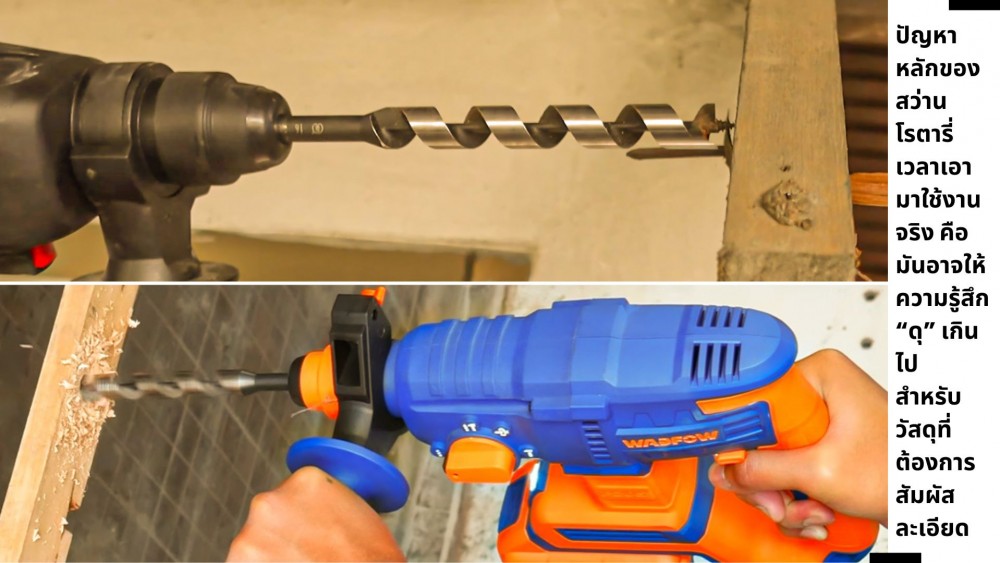
Starting too fast with a rotary hammer makes it easy for the bit to skate across the wood's surface. If you don't have a firm grip or haven't marked a pilot spot, the bit can slip and ruin the workpiece from the very first second. And because the tool is heavier, the slightest deviation in hand pressure can cause the hole to drill crooked.
Crucial precautions when using a rotary hammer to drill wood
If you ask what the most important takeaway is: understand from the start that a rotary hammer's core operating principle wasn't designed for clean woodworking finishes. So if you're going to use one, you must pay attention to the key points—otherwise, the workpiece can be ruined very quickly.
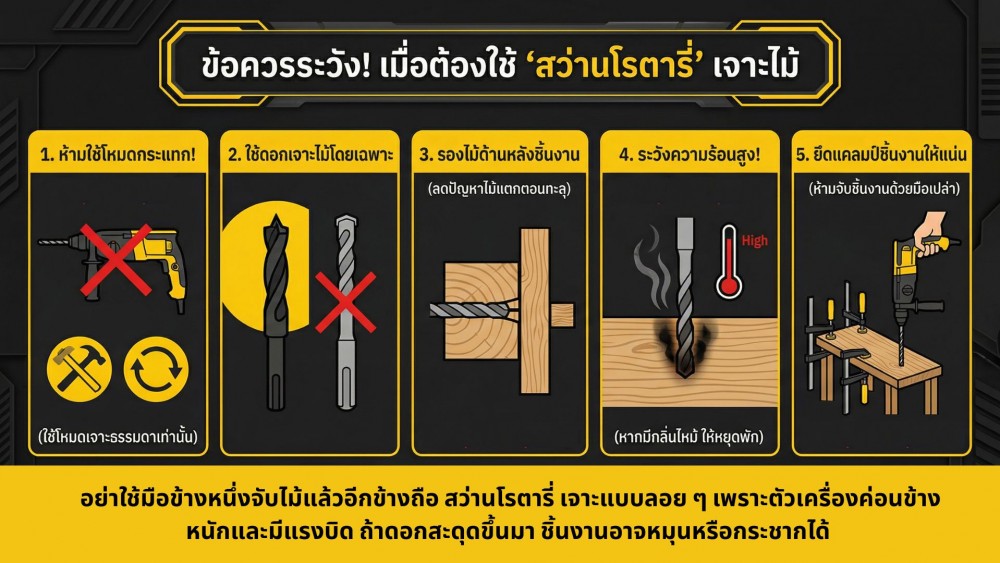
- Never use the hammer/impact mode (hammer icon) Because the vibration will cause the wood to chip, crack, and leave messy hole edges.
- Use the right type of drill bit It should be a wood drill bit, not a masonry bit.
- Start drilling with moderate speed and pressure Do not press too hard when starting the hole
- Watch out for the bit slipping off the mark Especially on smooth or coated wood surfaces.
- Carefully manage the breakthrough on the other side Because that is when wood is most prone to blowout and splitting.
- Do not let the drill bit overheat Because it will cause burn marks and damage the workpiece surface.
If you ask whether Why is a rotary hammer ideal for masonry drilling? And how well does it perform on wood and metal? Many people think that as long as it spins, it can be used on wood. But in reality, what separates an acceptable result from a neat and beautiful finish lies entirely in these details.
Watch out for wood splitting as the drill bit breaks through the other side
One of the most common problems when using a rotary hammer on wood is that the front looks fine, but the back splinters. This happens because breakthrough is the moment when the drill bit's pressure rapidly pushes out the final layer of wood.
- Always support the back with scrap wood if you want a clean breakout hole.
- Ease off the pressure when nearing breakthrough—do not press down with full force.
- If both surfaces will be exposed, it is advisable to drill a pilot hole or drill from both sides toward the center.
This technique may seem minor, but it helps prevent damage more than most people realize.
Watch out for heat buildup and burning smells
Another crucial point not to overlook during drilling is heat buildup. When using a rotary hammer to drill wood, if the bit is dull, the wrong type of bit is used, or you apply continuous pressure for too long, burn marks can easily form.
Warning signs that indicate you should stop immediately
- Noticeable burning smell
- The wood chips coming out are unusually dark
- The edges of the hole are starting to blacken
- The drill bit heats up abnormally fast
If these symptoms occur, pause to let it cool, then check the drill bit, check the mode, and check your applied pressure before continuing with the rotary hammer.
Which types of woodworking are acceptable with a rotary hammer, and which should you avoid pushing it on?
To put it simply and clearly: a rotary hammer is acceptable and performs adequately on certain woodworking tasks, but you should never force it on jobs that demand high precision and a pristine finish.
Acceptable jobs
- Small household repair jobs
- Drilling to fasten fixtures onto structural wood frames
- General installation jobs where surface aesthetics are not critical
- Temporary jobs or when a rotary hammer is the only drill available
Jobs where you shouldn't force it
- Furniture making
- Exposed-surface woodwork
- Built-in cabinetry and installations
- Drilling for dowels or hardware that require high precision and straightness
- Laminated or coated boards that chip easily
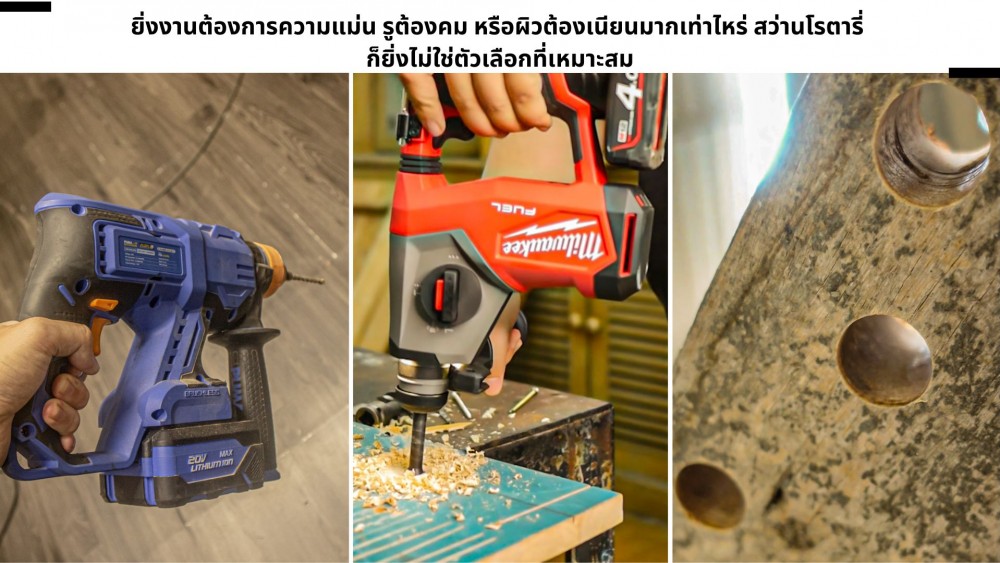
Coated wood requires even more patience than usual
Particle board, plywood, melamine-faced MDF, or materials with decorative film finishes are surfaces that require extra caution when using a rotary hammer. The surface chips much more easily than you might think; any slight jerk as the bit bites leaves an unsightly mark, breaking through the back without a sacrificial board often causes breakout rings, and if the bit is dull or the tool vibrates heavily, the laminate coating may flake around the hole perimeter. Even if structurally sound, it immediately ruins the visual quality of the work.
Therefore, if you really must use it, clearly mark the drilling location, consider applying masking tape over the entry area to reduce chipping, start at low RPM, press straight down, and back the piece with scrap wood every time. While these techniques won't turn a rotary hammer into a true woodworking drill, they significantly reduce the risks.
Tips for using a rotary hammer on wood safely and with cleaner results
If you really need to use a rotary hammer on wood, focusing clearly on a few crucial steps is much better than trying to do everything and missing the main essentials.
- Set to Rotary-only mode every time before starting work
- Yes Wood drill bit or drill bits specifically meant for wood
- Make a center punch mark first to prevent the bit from wandering
- Start drilling with moderate pressure; do not slam or force into the workpiece.
- Hold the tool perpendicular to the wood surface from the start.
- Place a backing board underneath if drilling through.
- Hold or clamp the workpiece securely; do not just support it loosely with bare hands.
Just follow these 6–7 points thoroughly, and the results from your rotary hammer will improve noticeably.
Drilling a pilot hole before using a rotary hammer reduces risk more than you might think.
Drilling a pilot hole is a highly recommended step, especially when using a rotary hammer on woodwork that requires precise positioning. Pilot holes help by, for example:
- Helping the main drill bit follow the line more easily
- Reducing the chance of wood splitting, especially near the edges
- Reducing resistance when using large drill bits
- Allowing for better directional control than drilling in a single pass
Often, a step that seems to slow things down actually gets the job done faster because you don't waste time fixing mistakes.
A question many still wonder: If you're only drilling once or twice, is it really necessary to take it seriously?
The answer is yes, you need to take it "seriously"—which in this case means thinking it through carefully beforehand. Once woodwork is damaged, it is often difficult to repair it back to a seamless finish, especially on visible surfaces. Using a rotary hammer with care right from the start is always worth it. Even if it's just one hole, if that hole is misplaced, chipped, or cracked, the entire piece can be ruined overall.
The final verdict for DIYers
If you are a DIYer and already own a rotary hammer, it doesn't mean you need to rush out and buy a new tool right away. Instead, learn how to use it properly for woodworking first. Start with simple tasks, use the right bits, turn off hammer mode, clamp the workpiece securely, and gradually practice hand control. Once you understand its limitations, you'll naturally know which jobs are manageable and which ones you should give up on and switch to a more suitable tool—and that is the mindset of someone who truly knows how to use tools.
Only Have a Rotary Hammer Drill? What Accessories Should You Buy?
If you occasionally need to use a rotary hammer drill for woodworking, what's truly worthwhile isn't forcing it as-is, but investing in the right type of drill bits and basic accessories, such as: Good quality wood drill bits, a chuck adapter if supported by the tool, Clamping tools, and scrap wood for backing during breakthrough. These may sound like minor things, but they elevate the results far more than many people think.
Summary: Rotary Hammer Drills for Woodworking—Usable, but Know the Limits
To summarize as clearly as possible: rotary hammer drills can indeed be used on wood, but they are not the best tool for every woodworking job, and there are several points that require extra caution—especially turning off hammer mode, bit selection, rotational speed, controlling feed pressure, backing the rear side with wood, and clamping the workpiece firmly in place.
If you understand the tool's nature and don't push it beyond its limits, a rotary hammer drill can handle basic woodworking tasks fairly well. But if you expect fine work, a showcase surface finish, or furniture-level precision, a drill designed specifically for wood will meet your needs much better.
Ultimately, to the question of whether special care is needed, the answer is "you need to be more careful than you think," because Rotary hammer it excels at a different type of job. And when we use a heavy-duty tool on a material that requires finesse, we must compensate with greater understanding and more precision.