


 EN
 ไทย


Customers Also Purchased


Actually, the secret behind the capability of a rotary screw compressor does not come from the motor or the machine's appearance, but lies in the heart of the system called the "Airend" or rotary screw element. This is precisely what sets a rotary screw compressor completely apart from other types of compressors.
So, what is an airend? How does it work? If it breaks, do you just replace it with a new one? Or is there more you should know? This article will give you an in-depth look at the airend in a way that even non-technicians can easily understand.
What is an airend? Why is it so important to a rotary screw air compressor?
When talking about machinery used in both large industrial factories, auto repair shops, or small machine shops, rotary screw air compressors are considered machines that contribute immensely in terms of efficiency and reliability. Whether it's spray painting, opening valves, powering pneumatic tools, or certain automation systems, all rely on compressed air from compressors, and rotary screw air compressors are renowned for their stability and durability.
And what makes a rotary screw compressor different from a standard air compressor is inevitably this Airend. And if this component breaks, everything else fails with it. So what is it? How does it work? And how should we maintain it? Today, we will explore this together.
What is the function of the airend in a rotary screw air compressor?
Now let's take a look at what the airend does in a rotary screw compressor system, and why it is so crucial that if it breaks down, the entire compressor is rendered virtually unusable.
The airend doesn't just rotate aimlessly
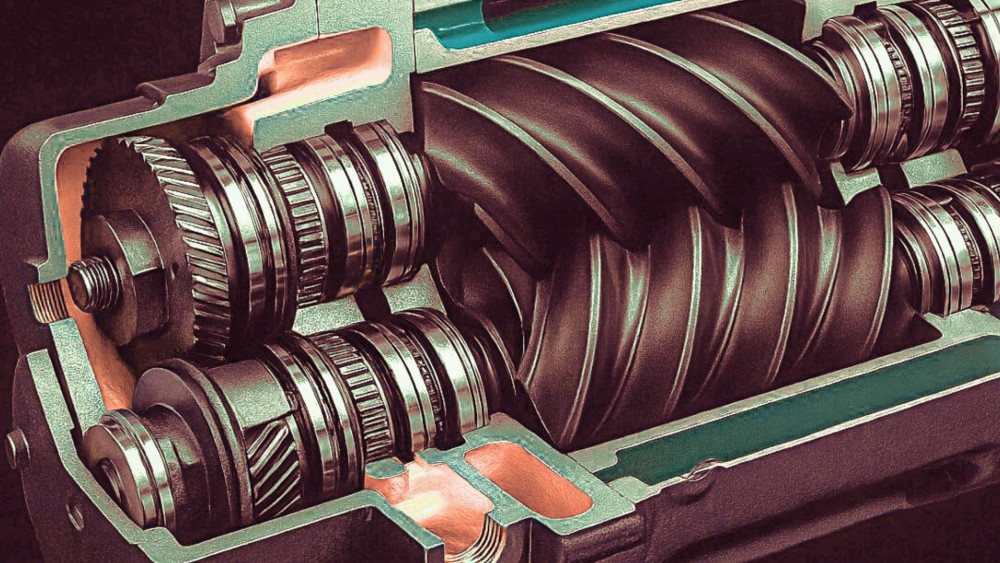
The Airend, or screw element, is the main component of a rotary screw air compressor responsible for compressing air to generate pressure. Inside, there are two "rotors" with intermeshing helical screws that rotate toward each other, pushing the intake air along the axial path and compressing it into an increasingly smaller volume until it reaches high pressure before being discharged to an air receiver tank or downstream system.
Simply put, a rotary screw compressor is a type of air compressor that utilizes a helical rotary mechanism instead of a reciprocating piston suction, allowing it to operate continuously, smoothly, and much more quietly.
Why is the airend so important?
- It is the heart of air compression; without it, the compressor is just an empty metal box.
- High cost, accounting for 30–50% of the entire rotary screw compressor's price.
- While it is durable and hard to damage, if it breaks down, repair costs are very high (sometimes it's not cost-effective to repair and better to replace).
How the airend works: easy to understand
Some might think that a rotary screw compressor just lets air in, spins it around, and puts out high pressure—is that all? But actually, there is much more behind the mechanism of the airend, including precision design, counter-rotation of the rotors, and the clearance control between the screws that directly impacts compression efficiency.
Let's take a look in an easy-to-understand way at the operating steps of a rotary screw compressor's airend—from the intake of air to its discharge for use, how it functions, and what key points require special attention.
1. Starting with the air intake
When the screw air compressor starts running, the Airend begins drawing outside air in through the air filter. This filter serves to prevent dust, impurities, or moisture mixed in the air from entering the system. The drawn air must undergo a certain level of purification before entering the compression chamber inside the Airend to prepare for the compression process.
2. Entering the Compression Stage
Both rotors in the Airend, engineered with opposing male and female helices, rotate toward each other at high speed. This rotation creates cavities between the helical lobes where air is trapped and driven continuously along the axial path from the intake to the discharge side. Along the way, the volume of the air steadily decreases as the screw lobes mesh closer together, causing the pressure to increase according to thermodynamic principles.
In addition, lubricating oil (in oil-injected systems) helps dissipate heat, dampens noise, and seals clearances between the rotors and the compression chamber walls to maximize air compression efficiency.
3. Discharge into the System
Once the air is compressed to the preset target pressure, it is discharged from the Airend into the oil separator assembly to separate the lubricating oil from the compressed air. It then passes through the air filtration unit and into the air receiver tank, awaiting downstream utilization. The compressed air exiting the screw compressor system will feature the pressure and purity levels suitable for industrial applications or manufacturing processes.
How Many Types of Screw Compressor Systems Are There, and How Do They Differ?
When talking about screw air compressor systems, many might assume there is only one type suitable for all applications. In reality, they feature distinct designs and configurations depending on operational requirements, such as the required pressure levels, continuous demand, as well as installation and maintenance costs.
Some applications only require simple configurations, while others demanding high precision and stability require specialized screw compression units. Let's explore the primary types used and see which ones suit specific applications.
Single-Stage Type (Single Compression)
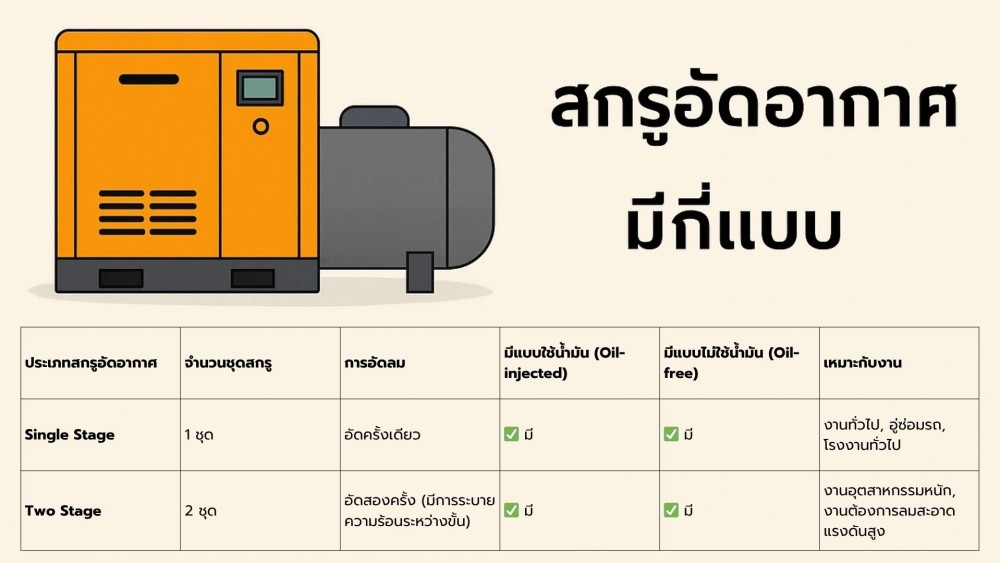
Used in screw air compressors suited for general applications in manufacturing plants, auto repair shops, or systems requiring medium compressed air pressure (approx. 7–13 bar). It offers a straightforward structure, lower cost, easy operation, and uncomplicated maintenance.
Two-Stage Type (Double Compression)
This type of rotary screw air compressor compresses air twice using 2 separate sets of screws—it does not use a single set for a second compression cycle. The principle is that the first screw set compresses air from atmospheric pressure to a certain higher level, then the air is routed through a cooling system (intercooler) and compressed once more by the second screw set to achieve a higher pressure than a single-stage model.
The advantages of this system include consistent pressure delivery and higher efficiency, especially in industrial applications requiring high airflow, such as heavy industries, chemical sectors, or systems requiring ultra-clean air (such as oil-free systems).
And just like single-stage models, two-stage configurations are available in both oil-injected and oil-free variants, depending on the specific application requirements.
How Can We Tell if the Airend Is Still in Good Condition?
This question sounds easy to answer, but screw air compressors involve intricate details that many overlook. The Airend doesn't show sudden, obvious symptoms of failure like typical electrical components. In many cases, it deteriorates gradually until the entire system starts malfunctioning, and failing to detect the warning signs in time could unexpectedly cost a fortune.
I'd like to encourage you to watch for early warning signs, as this can significantly extend the equipment's lifespan and drastically reduce expenses. Let's look at the signs that indicate your Airend may be developing issues.
1. Strange Noises
If loud noises, whining, or abnormal vibrations begin to occur, it may indicate that the internal bearings have begun to wear out or that the rotors are starting to rub against each other.
2. Compressed air output is gradually decreasing
Sometimes this can be caused by the rotors inside the airend starting to wear down, resulting in less tight compression and noticeably reduced output pressure. If you encounter this symptom, you should check it immediately.
3. Oil leaking from the Airend
For oil-injected rotary screw air compressors, if there are oil leaks from joints or seals, it may be a sign of deteriorated seals or leaks that need to be addressed before worsening.
4. Abnormally high temperature
If the temperature gets high enough to trip the machine or trigger warning lights, it means heat is building up inside the screw mechanism, which could be due to blockages, poor lubrication, or the rotors starting to seize.
How to maintain the airend for a long service life
Frankly speaking, even though the airend of a screw compressor is designed to be durable and run continuously for long periods, it doesn't mean you can just let it run indefinitely without any maintenance. Neglecting small things like checking oil levels or replacing air filters can cause major problems in the long run.
So I’d like to encourage everyone to look back and see how much time and money taking good care of our equipment from the start can save, while also keeping our rotary screw compressor running at peak performance for a long time.
1. Check oil levels and change oil according to schedule
For oil-injected rotary screw compressors, oil is the lifeblood of the Airend. It lubricates, dissipates heat, and helps seal against air leakage. Importantly, you should change the oil every 2,000–4,000 hours, depending on the model.
2. Use high-quality air filters and oil filters
Using quality filters will help prolong the lifespan of the Airend by preventing contaminants from entering the system.
3. Regularly clean the cooling system
Because if the cooling system gets clogged or the fan stops working, heat will accumulate inside the Airend and cause premature wear.
4. Check rotor clearance
Some screw compressor models allow adjustment of the clearance between screw rotors (rotor gap) to maintain maximum compression efficiency and prevent excessive air blow-by. If it exceeds specifications, adjustments or part replacements may be needed.
Conclusion: How important is the airend to a rotary screw compressor?
If I were to compare the airend to something familiar, I’d say it is like the heart pumping blood to nourish various parts of the body. Without it, everything stops running. And since you have it, you must take good care of it—it's not cheap, and replacing or repairing it requires specialized technicians.
Anyone already using a rotary screw compressor shouldn't forget the importance of regular airend maintenance. And for those planning to buy a rotary screw compressor, be sure to choose a model with a high-quality airend and a reliable service center.
Because in the end, if the airend is durable and performs at full efficiency, Screw Air Compressor it will be a long-lasting, cost-effective tool that truly brings value to your work.