


 EN
 ไทย



Customers Also Purchased


When deciding to purchase Electric Wire hoist In addition to considering lifting capacity (Load Capacity), size, and various safety systems, another crucial factor that should not be overlooked is the power supply (Power Supply) and control system (Control System)—especially when choosing between household power (Single Phase/1 Phase) and 3-phase power (Three Phase). To maximize electric hoist efficiency and minimize troublesome issues during operation, this article will guide you through the advantages and limitations of both power supplies, along with techniques for choosing an electric hoist that best fits your job.
1. Understanding Single-Phase vs. 3-Phase Power
Household Power (Single Phase / 1 Phase)
- Typical Voltage Most commonly used in households is 220 volts.
- Advantages
- Easy-to-find power supply, as almost every home or office already has this type of power available.
- No need to invest in installing transformers or special wiring.
- Suitable for lifting tasks that do not require high power, such as light-to-medium loads using small electric hoists.
- Electric hoists for single-phase power are usually more affordable and accessible for general users.
- Limitations
- Single-phase motors generally do not have as much power as 3-phase motors, which prevents residential electric hoists from being used in heavy industrial applications.
- There are limitations in heat dissipation because electric motors for single-phase electric hoists are typically not designed for continuous long-term operation.
- If lifting heavy loads or operating in demanding environments, heat accumulation may occur, requiring frequent rest intervals and reducing work efficiency.

Three-Phase Power (3 Phase)
- Typical Voltage 380/400/415 volts (depending on regional standards)
- Advantages
- 3-phase motors provide higher torque, superior power, and operational stability for continuous duty, making them ideal for industrial electric hoists used in production lines, raw material transport, or heavy component assembly.
- More energy-efficient in the long run for heavy lifting, as 3-phase systems offer better power distribution efficiency, allowing the electric hoist to operate continuously without power loss.
- Ideal for industrial plants or jobsites requiring frequent heavy lifting with large electric hoists, such as heavy-duty crane hoists built for all-day operation.
- 3-phase electric hoists often come in a wide variety of models and power ratings, allowing users to choose according to their specific needs.
- Limitations
- It may require permits and the installation of a dedicated electrical system (if in a residential building or an area without an existing 3-phase supply), such as running additional wiring or installing an appropriate transformer.
- There are additional electrical system installation costs, as well as electrical maintenance that may require specialists.
- For small-scale or light lifting tasks, such as lifting in small shops or for personal use, investing in a 3-phase electric hoist may not be worthwhile due to higher initial costs.

2. How to Choose the Right Electrical System
Assess Lifting Capacity and Nature of Work
- If most of the work involves light-to-medium lifting, such as 100-500 kg, and is used occasionally, a single-phase electric hoist is considered suitable because it is easy to install and has lower costs.
- For work requiring heavy lifting, such as 1,000 kg and above, or continuous, all-day operation on factory production lines, a 3-phase electric hoist is a better fit because it can efficiently handle heavy-duty tasks and high power demands.
Frequency of Use (Duty Cycle)
- Electric hoists have a rating indicating the operating duty ratio over a certain period of time, such as 20% ED, which means the motor should run for only 20% of a 10-minute cycle (2 minutes running, 8 minutes resting). If your work requires frequent and continuous use, choosing 3-phase power will help the motor perform at full efficiency and have a longer service life.
- If your usage is relatively intermittent, such as lifting loads only a few times a day, a single-phase power system may be quite sufficient.
Cost and Installation
- Installing a 3-phase electric hoist may require modifications to the on-site electrical system, such as installing transformers or additional accessories, which may incur extra costs.
- If the installation site already has 3-phase power, such as a factory or commercial building, choosing a 3-phase electric hoist will provide benefits in terms of both power and long-term cost-effectiveness.
- For those on a limited budget or operating in areas without a 3-phase power supply, a 1-phase electric hoist will help reduce costs more effectively.
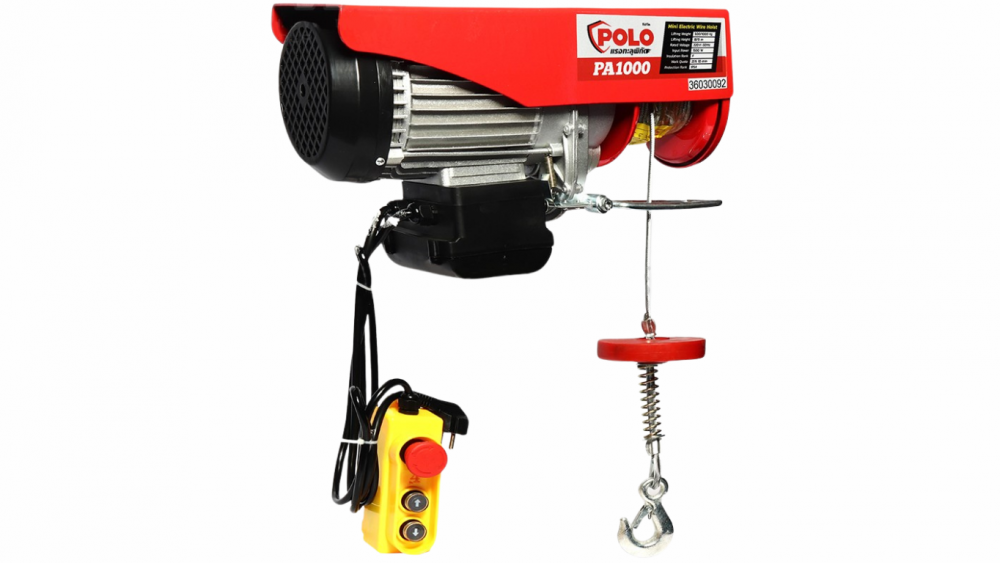
3. Types of Electric Hoist Control Systems and How to Choose
3.1 Pendant Control
Controlled via a switch pendant suspended from the electric hoist, featuring user-friendly push buttons such as up-down controls and an emergency stop.
- Advantages
- Robust, durable, and usually waterproof and dustproof, making it suitable for heavy-duty work in challenging factory environments such as dust or moisture.
- No need to rely on batteries or transmitters, reducing maintenance complexity.
- Limitations
- Must be near the electric hoist to operate it, which may place the operator in an unsafe position in some cases, such as lifting loads in confined or high spaces.
3.2 Remote Control (Wireless Remote)
Operated via a radio remote control connected to the electric hoist through radio waves, allowing the operator to control operations from a distance.
- Advantages
- The operator can stand in a safe position and clearly see the lifting point.
- Eliminates the problem of tangled control cables and increases work mobility in wide areas.
- Suitable for tasks requiring precision and speed, such as work in warehouses or shipping docks.
- Limitations
- Requires special care for the remote's batteries; running out of battery during operation may cause delays.
- Higher cost than using a pendant switch, and may require configuration or radio signal checks in areas with interference.
3.3 Integrated Crane Control System
Commonly used in large electric crane systems that control both lifting and the movement of the crane girder, as well as the electric hoist within the same system.
- Advantages
- Helps make operations more systematic and allows multi-directional motion control, such as left-right, forward-backward, and up-down.
- Reduces complexity in the control system by integrating all functions into a single system.
- Suitable for large-scale factories requiring precision and speed when lifting large, heavy loads.
- Limitations
- Higher installation and maintenance costs.
- Requires skilled operators with system expertise for maximum operating efficiency.
- The system is complex, requiring time for learning and proper configuration tailored to specific tasks.

4. Tips for Choosing Power Supplies and Control Systems
Check Job Site Readiness
- Check the type of power available at the job site. If 3-phase power is already available, choosing an electric hoist that supports 3-phase power will significantly enhance convenience and efficiency.
- If the job site only has 1-phase residential power, consider an electric hoist specifically designed for 1-phase power, which is suitable for light to medium-duty work.
- Inspect the surrounding environment, such as area safety, power supply availability, and installation convenience.
Evaluate the power and specifications of the electric hoist
- Carefully read the electric hoist specifications, including voltage, frequency, and motor rating, to ensure compatibility with your existing power supply.
- Calculate the lifting weight and operating time to select a motor power that provides sufficient capacity.
- Consider special requirements, such as quiet operation or dust and water resistance capabilities.
Test before use or consult with experts
- Contact distributors or manufacturers for specific advice regarding your intended electric hoist application.
- If possible, request a real-world test run of the electric hoist to assess performance and inspect the control system before making a purchase decision.
- Use this opportunity to ask about product maintenance and warranty.
Invest in an appropriate control system
- If the workspace has safety or visibility limitations, a wireless remote control system will enhance both convenience and safety.
- For applications requiring high durability and ease of use, a pendant control remains a reliable choice.
- If lifting tasks are complex—such as requiring multi-directional control or integration with an overhead crane—an integrated control system will boost efficiency in the long run.

5. Conclusion
Choosing the right power supply and control system for Electric Wire hoist It is an important factor affecting the efficiency and safety of lifting operations. For light-duty use or where 3-phase power is unavailable, a 1-phase system may be the right solution because it is easier and more convenient to install. However, for heavy lifting or continuous duty, 3-phase power is the preferred choice for energy savings and consistent lifting power.
Selecting an electric hoist control system should be based on the nature of the work and the operating area. For example, if durability and operation in confined spaces are required, a pendant control is a good option. However, if safety and mobility are top priorities, a wireless remote control system responds better—especially in dynamic environments or for tasks requiring high precision.
To extend the service life of an electric hoist, ensure proper installation and perform regular maintenance. Selecting the right equipment and keeping up with proper care will ensure the electric hoist operates at full efficiency and delivers a long service life.