


 EN
 ไทย


Customers Also Purchased


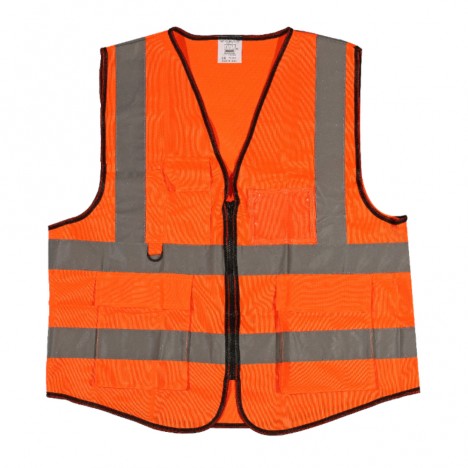
What is a reflective vest? How do the different colors differ?
Many people are probably already familiar with Reflective Vest it; it is a Safety Vest worn for protection when staying in hazardous areas, where vehicles, machinery, or life-threatening flying objects could hit, collide with, or strike you.
Wearing a reflective vest allows others to see you from a distance or even while traveling at high speeds. Once they see someone, they become more cautious and try to avoid anything that could endanger that person.
In another case, it is worn to indicate your role or the task being performed to passersby or people nearby. In an emergency or urgent situation, others will know whom to turn to for help and won't hinder the operation. The color of the reflective vest worn roughly indicates the job responsibilities, for example:
- Orange : Construction site workers, trekking guides, highway personnel, highway police, civil defense volunteers (OPOR).
- Yellow : Police officers, night-shift security guards, emergency personnel, night-shift construction workers.
- Green : Outdoor tour guides, park attendants, cleaners, outdoor safety officers.
- Red : Firefighters, construction site workers.
- Blue : Police officers, bodyguards/event security, beach lifeguards, security guards, indoor cleaners, warehouse workers.
- Purple : Personnel handling or recovering certain hazardous materials.
In addition, you should also look at the logo or text on the reflective vest along with the color to help identify the profession more easily. Some professions use multiple colors depending on the working environment—whether it is dark or bright, open or cluttered.
Read more >>> How Do Different Colors of Reflective Vests Differ? <<<
Read more >>> Essential Features and 7 Ways to Choose the Best Reflective Vest for Your Work <<<

How Many Types of Reflective Vests Are There?
The type is linked to the quality of the reflective vest in the next topic. In reality, there are only 3 types according to HVSA regulations, which govern all safety apparel—whether shirts, shoes, hi-vis pants, jumpsuits, jackets, eyewear, and more. However, in this article, one extra special type is added, which may or may not be certified under HVSA, to categorize things clearly and make it easier for readers to understand, as follows:
1. Type O Reflective Vest
Stands for Off-Road, a type of reflective vest for use off traffic routes or along road shoulders, such as street sweepers and drain dredgers, which only uses Class 1 garments (details of each Class will be discussed in the quality section).
2. Type R Reflective Vest
Stands for Roadway, a reflective vest type worn for road work such as road repairs, paving, and emergency incident response teams. Available in both Class 2 and Class 3, depending on visibility conditions and surrounding areas.
3. Type P Reflective Vest
Stands for Public Safety, a type of reflective vest for emergency responders and law enforcement officers. Available in both Class 2 and Class 3 as well.
4. Special Type Reflective Vests
Refers to other types of reflective vests, such as Modacrylic Vests with flame-resistant and chemical-resistant properties, Surveyor Safety Vests for survival situations or surveyors due to numerous pockets and zippers made of extra durable materials, or MTA-NYCTA Safety Vests for US transit personnel, which stand out for their retroreflective tape—a special fluorescent yellow stripe on the vest, strictly regulated in manufacturing and use. Currently, this tape is also being used on certain reflective vest models.

How to Identify a Good, High-Quality Reflective Vest?
Mainly, there are 5 key points compiled to consider or assess the quality of a reflective vest, including:
1. Is the Class specified?
The Class is essential to help identify the work area and indicate whether the reflective vest has adequate quality according to safety reflectivity standards. If no Class is specified and the performance is lower than required, wearing a reflective vest while working may not help at all.
Reflective vest classes are divided into 3 levels according to HVSA regulations, as follows:
⦿ Class 1 Reflective Vest : For work areas with the lowest risk, being areas safe from traffic or with very little traffic, but where accidents can still occur, such as residential communities or enclosed areas. Vehicle speeds are restricted to less than 40 km/h, and the surrounding environment must not be complex or make objects difficult to see. The reflective vest used must have reflective strips covering at least 155 square inches of the vest's surface area. Class 1 vests are suitable for:
● Parking lot attendants
● Mining workers
● Gas station and oil refinery workers
● Warehouse and shopping mall shopping cart retrieval staff
● Cleaning and public area maintenance personnel

⦿ Class 2 Reflective Vests : Used for workers in regular traffic areas with vehicle speeds restricted between 40-80 km/h. Reflective vests will be highly visible whether during the day or night, and can be seen from greater distances than Class 1 vests.
A compliant reflective vest must have at least 217 square inches of reflective strips with a width of 1 inch or more. It is best if the reflective tape is retroreflective or made of combination materials, as it will reflect light much brighter than ordinary reflective strips.
Examples of people who need to use Class 2 reflective vests include:
● School crossing guards / security guards
● Public transit workers
● Railway workers
● Electrical and cable repair technicians
● Airport ground personnel
● Surveyors
● Road construction and maintenance workers

⦿ Class 3 Reflective Vests : The material must strictly be retroreflective, combination materials, or materials with even better light reflection, because the wearers work in high-risk areas with poor visibility and traffic exceeding 80 km/h. They must also have sleeves to provide a larger visible surface area from a distance than Class 1 and 2. Reflective strips must also be wider and brighter, with an area of at least 1,000–1,240 square inches, a width of 50 mm for the gray strip, and 25 mm for the contrasting color border.
Examples of people who need to use Class 3 reflective vests include:
● People working near trucks and trailers
● People working near industrial vehicles, such as backhoes, concrete mixer trucks, etc.
● Fire scene investigators
● Emergency vehicle responders / roadside assistance personnel
● Utility workers
● Road construction workers (50mph+)

2. Is there a label with essential information for users?
In addition to the vest's class, the label must always provide important details about that reflective vest. Most required information includes the manufacturer's name, date of manufacture, place of manufacture, type, class, FR rating and test method, ARC rating, size, materials, care and cleaning instructions, hazard warnings, etc.

3. Is the price reasonable?
The price of reflective vests varies across each brand depending on materials, design, and special features or functions. For example, standard reflective vests cost around 100-200 THB, but if they are made from flame-resistant or tear-resistant materials, have storage pockets, or are adjustable for fit, the price will be higher. Interestingly, Class 1 reflective vests are often the most expensive because having fewer regulations allows manufacturers to incorporate more features.
4. Is the fabric of good quality?
Good material does not necessarily have to be too thick, as that is unsuitable for Thailand's climate. Mesh fabric provides better ventilation and reduces dampness. A reflective vest does not need to be washed frequently, but it should be made of easy-to-clean material—not necessarily by conventional laundering methods, but perhaps by wiping clean with disinfectant solutions to remove germs or dirt, for instance.
5. What additional features are there?
For certain jobs, if a reflective vest can do more than its primary function, it helps make work safer and more convenient, reducing the hassle of carrying other accessories. The reflective vest industry competes by offering several interesting additional features, for example:
- Flame-Resistance
- Arc Rated: Helps protect workers from electrical arc flashes in work environments where electrical hazards pose a threat.
- Water and splash resistance (Water Resistant or Waterproof) and good breathability for wet working conditions
- Tear resistance
- Multiple pockets for storing specific items, or clear pockets for displaying ID or credentials
- Hook and loop break-away design: If the vest gets caught in machinery, it allows the vest to break away from the wearer instead of pulling them into the machine. The hook and loop fasteners are placed on the sides and shoulders for easy release when necessary.
- Features mic tabs on the shoulders for attaching a radio microphone or speaker
- Features a D-ring opening for fall protection, with an opening on the back for threading harness loops or suspension equipment
Read more >>> Reflective Vest <<< more

