


 EN
 ไทย


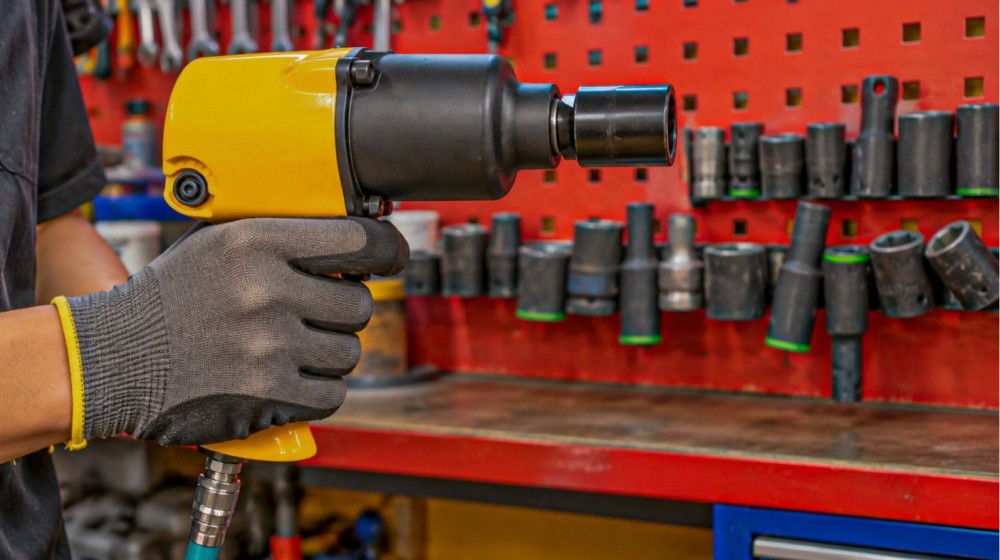
Customers Also Purchased


Imagine when you need to connect Air Impact Gun to the air hose before removing car wheels, but you can't find the black impact socket of the size you need. In the wrench box, there happens to be a shiny chrome-plated socket of the exact same size. The square drive is identical and fits snugly onto the tool's anvil. But after pulling the trigger just a few times, the socket splits with a long crack along its side.
You might wonder: since it's the same steel and the same size, why can't it be used as a substitute? How exactly is the black socket better or more durable? The truth is that impact sockets and standard sockets differ not just in color, but in steel composition and wall thickness. They are made to withstand completely different types of force, and the force delivered by pneumatic and power tools is something hand sockets may not be able to handle.
Therefore, let's explore how the force from power tools—especially air impact wrenches—differs from manual force, how the two types of sockets differ, whether adapters and extension bars require the same considerations, and what condition of a socket means it should be discarded, even if it is a genuine impact socket.
Why do air impact wrenches shatter regular sockets?
When tightening with a hand wrench or ratchet, the force increases gradually and steadily. The socket absorbs continuous, smooth torque from start until the bolt is tight. But pneumatic tools don't twist like that. Inside, there is a steel hammer mechanism that swings and strikes against the anvil repeatedly, multiple times per second. The resulting output is delivered in short, intense impact pulses—each blow extremely powerful, then dissipating, and striking again.
It can be compared to pushing a nail with your hand versus driving it with a hammer. The applied weight might be the same, but brittle materials that can withstand compressive force may not be able to handle impact shocks and can shatter more easily. When Air Turns into Torque: Let's See How Air Impact Wrenches Work
Sockets used with air impact wrenches must be ductile enough to absorb shock loads, not just the hardest possible. Hardness, which is an advantage for hand sockets, immediately becomes a weakness under impact force.
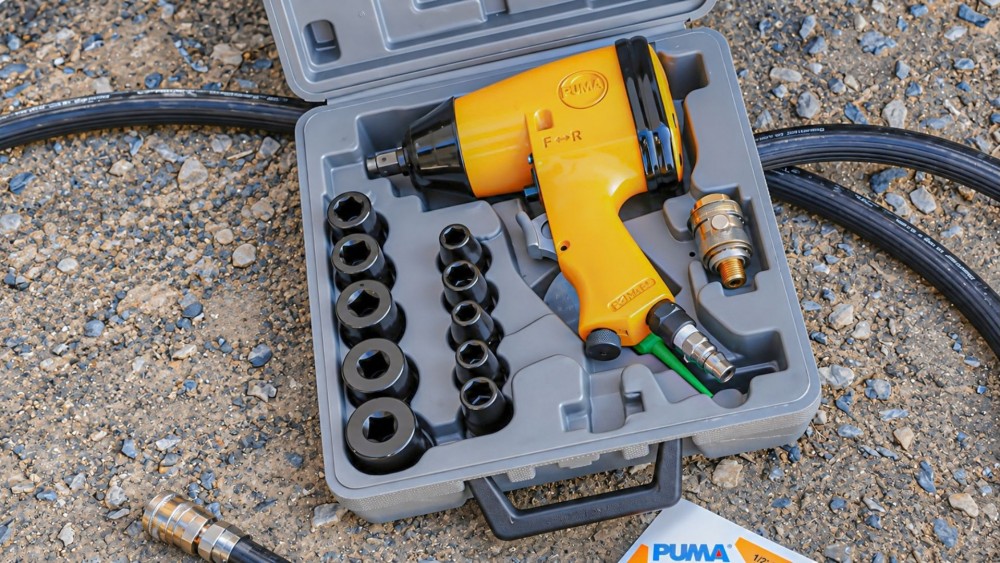
Hand Sockets vs. Impact Sockets: Different Steel, Wall Thickness, and Finish
These three differences can be seen and felt by hand without needing measuring tools.
Steel Composition
Hand sockets are made from highly hardened steel so that the walls can be thin without deforming, while resisting wear at the corners. However, The downside of hardness is brittleness. On the other hand, air impact sockets (impact sockets) use a different alloy formula that is less hard but more ductile. Under excessive load, they stretch or deform first instead of shattering into pieces.
Wall Thickness
Because the steel is softer, manufacturers must compensate with thicker walls. Impact sockets of the same size are noticeably bulkier and heavier.
Surface Coating
The shiny chrome finish on hand sockets is a hard, brittle coating. Under impact, it can chip into sharp flakes and fly off. Air impact sockets therefore use a matte black oxide finish that does not peel into flakes; the black color is a result of the coating process, not painted-on paint.
The most reliable way to tell them apart is to check the stamped markings on the socket and the information on the packaging. Some hand sockets also have a black finish, so do not judge by color alone.
Can I use regular sockets with an air impact wrench for just a few bolts?
This is the most frequently asked question, and the answer is: You shouldn't, no matter how few bolts there are.
The reason is that you never know when the socket will shatter. It might survive ten bolts and shatter on the eleventh, or shatter on the very first if that bolt is heavily rusted. A socket that survives isn't necessarily safe either; invisible microcracks may have already formed, and it could shatter later when you use it back on a hand ratchet.
What's at risk is much more than just a single socket. Shards of hardened steel that shatter while the tool is spinning will fly off at high speed, while your hands and face are less than an arm's length away. A single impact socket is inexpensive and not worth taking this level of risk.
Conversely, using impact sockets with a hand ratchet is completely safe and fine; however, the thicker walls might make it harder to access tight spaces.
Extension bars, adapters, and universal joints used with air impact wrenches must also be impact-rated.
Many mechanics buy air impact sockets correctly, but connect them using chrome extension bars from hand wrench sets. The result is that the breaking point simply moves from the socket to the extension bar instead, because every piece between the tool's anvil and the fastener head absorbs the exact same impact force.
Step-down reducers require special caution. When a large tool is connected through a reducer to use a smaller socket, the tool's full torque is transferred to the smaller square drive, which was never designed to handle that level of stress, potentially causing the drive anvil to twist and shear off.
Another thing to know is that every added extension steals part of the tool's power. The longer the extension bar, the less torque reaches the bolt, as the bar twists and absorbs the impact energy itself. The rule of thumb is: keep it as short as possible. If the tool fails to loosen a bolt even with full air pressure, try removing the extension bar before blaming the air compressor.
Can electric impact wrenches use the same socket set as air impact wrenches?
Many people believe that black sockets are only for pneumatic tools connected to an air hose. When switching to an electric or cordless impact wrench, they go back to grabbing chrome sockets thinking electric tools have less power—both assumptions are completely wrong.
While the power sources differ—one uses compressed air and the other an electric motor— electric impact wrenches, which are commonly used for wheel removal, share the same ultimate mechanism: a hammer repeatedly striking an anvil. Therefore, the socket experiences the exact same impact forces. Moreover, modern cordless impact wrenches deliver no less torque than air tools of the same size. A single set of impact sockets can be used with both tools, provided the drive size matches.
There are two differences to note. First is how the socket is retained on the anvil: some tools use a friction ring (hog ring) allowing removal by hand, while others use a pin detent that must be pressed to release. Check your tool's anvil before purchasing sockets.
The second difference is safety: when changing sockets on an air impact wrench, disconnect the air hose; on an electric impact wrench, always unplug the cord or remove the battery first.
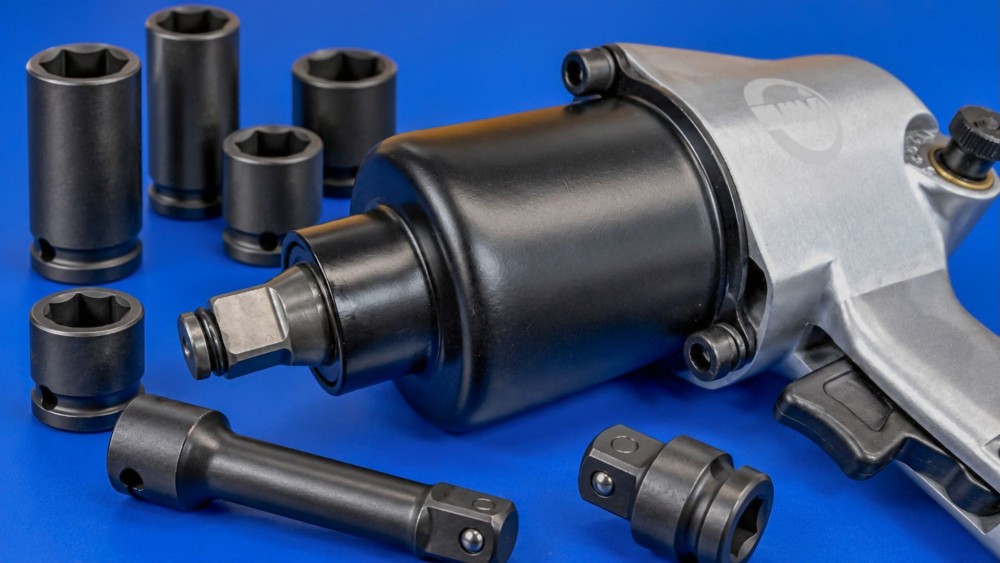
Deep-dish alloy wheels: Choose thin-wall sockets for air impact wrenches
The thick walls of impact sockets create one issue: they cannot fit into the lug nut recesses of certain alloy wheels, or they fit but rub against the rim, scratching the paint. This leads many people to grab thin-wall chrome sockets instead, which is solving one problem by creating a far more dangerous one.
The proper solution is thin-wall impact sockets specifically designed for wheel service. These are still made of impact-rated steel and usually feature a protective plastic sleeve to prevent scratching the wheel's rim. Before buying, measure or compare them with your actual wheel's lug nut holes.
For lug nuts covered with a thin metal cap, use only properly sized 6-point sockets. 12-point sockets grip near the corners and will easily round off the lug nut head when subjected to impact forces.
Retaining pins and O-rings on impact sockets prevent sockets from flying off
Large impact sockets feature a cross-hole through the base and a groove around the body, which hand sockets lack. The hole is for inserting a retaining pin through the tool's anvil, while the groove holds a rubber O-ring to keep the pin from slipping out.
If your tool uses a pin retainer, always use the matching pin and O-ring set. Never substitute with nails, wire, or small bolts; these can shear under repeated impact stress, and any protruding ends can catch on gloves or sleeves while the tool is spinning.
Signs it's time to retire an impact socket, even a genuine impact-rated one
Impact sockets are tough, but they don't last forever. Visually inspect them before every use, especially the sizes you use regularly.
- Cracks—whether on the side walls or at the corners of the square drive hole.
- The inside corners on the bolt head side are rounded or flared out, fitting abnormally loose
- The square drive hole on the tool side is loose, causing the socket to wobble when the tool spins
- The socket opening has bell-mouthed or the walls are twisted and deformed
- The locking pin hole is stretched into an oval shape
A socket with rounded corners will strip bolt heads, and a stripped bolt head is many times harder to fix than buying a new socket. As for cracked sockets, discard them immediately; never keep them as spare parts or attempt to weld-repair them, as the welding heat permanently alters the steel's properties.
Always wear safety glasses when using an air impact wrench, no matter how confident you are in your sockets.
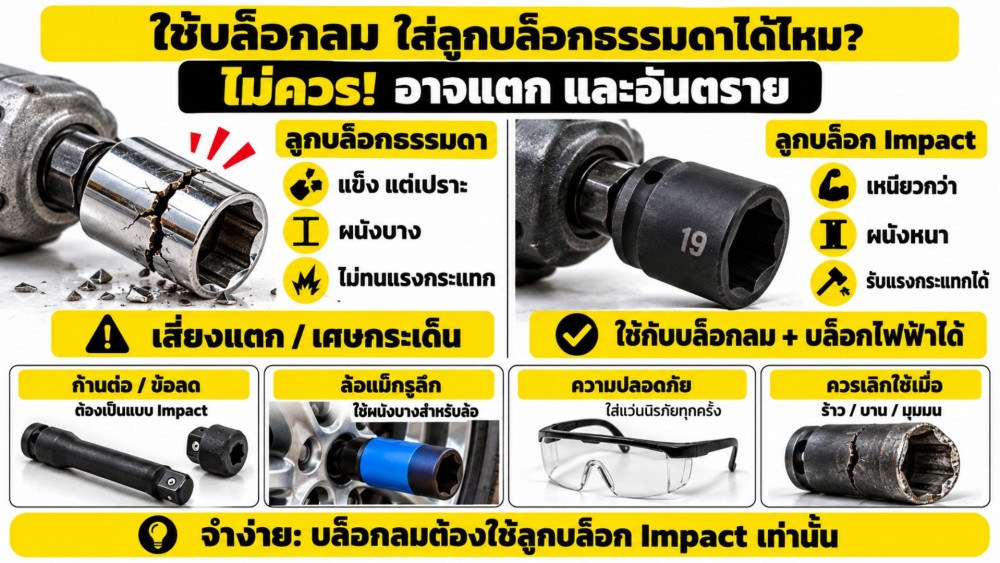
Conclusion: Air impact wrenches require sockets that are ductile enough to absorb impacts, not the hardest ones.
Standard sockets cannot be used with an air impact wrench because they are engineered to be hard for manual torque, not tough enough to withstand repetitive hammering from the tool's mechanism. Whether removing wheels, unfastening rusted suspension bolts, or assembling steel structures, the force from the tool is impact force all the same.
What you should do is distinguish the two types of sockets by the markings on the socket itself and the package information, not by color. Use impact-rated extension bars, adapters, and universal joints throughout the entire assembly, keeping them as short and few pcs as possible. Choose thin-wall impact sockets for deep-dish alloy wheels, use the exact hex size needed, and install genuine locking pins and O-rings when the tool requires them. You can use this same impact socket set with cordless impact wrenches too, and always disconnect the air line or battery before changing sockets.
The most crucial point is that there is no such thing as "just tightening a few bolts." Chrome sockets shatter without warning, sending shrapnel flying toward the operator. Meanwhile, impact sockets that are cracked, rounded at the corners, or flared out can be thrown away without regret.
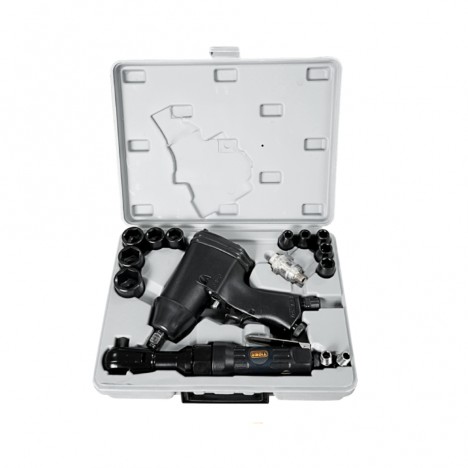
If you're assembling a pneumatic tool set for automotive work, check out our Air Compressors category Air Impact Gun and Air Tools, then select sockets that match your tool's anvil drive size.