EN
 ไทย


Customers Also Purchased


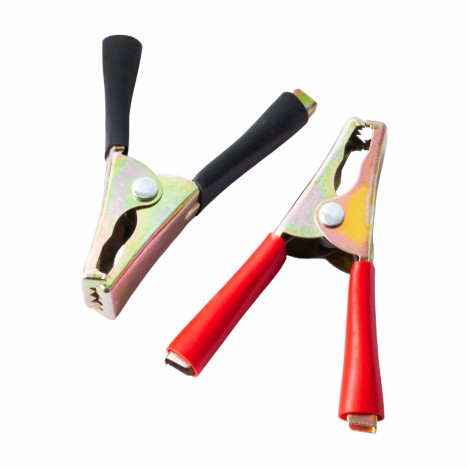


The morning you're in the biggest rush is usually the morning you turn the ignition key only to hear a faint click. Your car is right there in the driveway, completely stranded. In the end, you find yourself knocking on a neighbor's door to jump-start the battery, followed by driving around for half an hour just so the alternator can charge it back up.
After this happens a few times, the obvious question is whether you should keep a Battery Charger at home, and if you do, can you safely leave it plugged in to charge overnight while you sleep?
The answer is: yes, you can leave it charging overnight, but only with a battery charger that features an automatic shut-off circuit when fully charged. For manual chargers where you have to adjust the current by hand and that lack an auto-cut system, leaving them plugged in overnight can accelerate battery degradation, dry out the electrolyte, or in the worst case, cause the battery to swell and become unusable. The difference doesn't lie in the brand or the price, but in whether the charger knows when to stop on its own.
Types of battery chargers: differentiated by auto-shutoff systems
Battery chargers can be categorized in several ways, such as: Portable vs. Floor-Standing Car Battery Chargers: What's the Difference? However, to categorize them in an easy-to-understand and practical way for making decisions, battery chargers on the market can be divided into two main groups: manual control and electronic circuit-controlled.
Manual type: cheaper, but requires monitoring
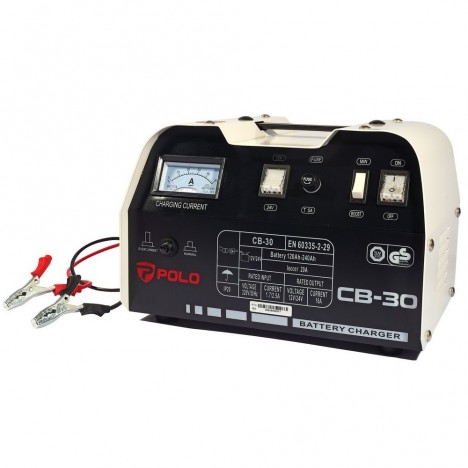
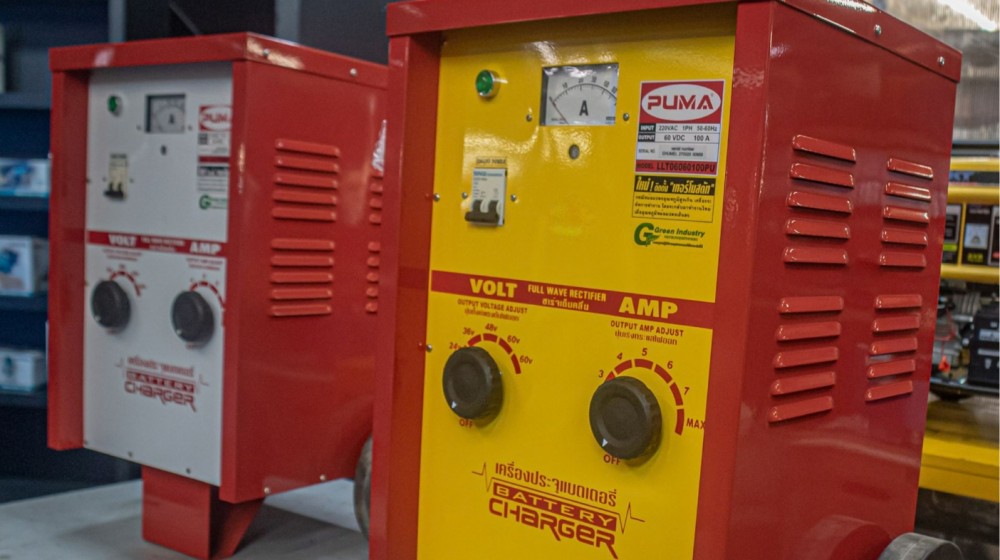
A manual battery charger converts household AC power into DC power and feeds it into the vehicle's battery according to the set level. All control relies entirely on the user—you have to estimate the time, check the meter, and unplug it yourself. Its strengths are a simple structure, easy repairability, and usually the ability to handle high current for fast-charging needs.
However, the downside of this type of charger is that if you forget to unplug it, the unit will keep supplying power even when the battery is full. This causes heat buildup and internal gas generation, accelerating battery deterioration. Anyone planning to regularly leave it plugged in overnight should not choose this type.
Automatic type: charge and leave unattended
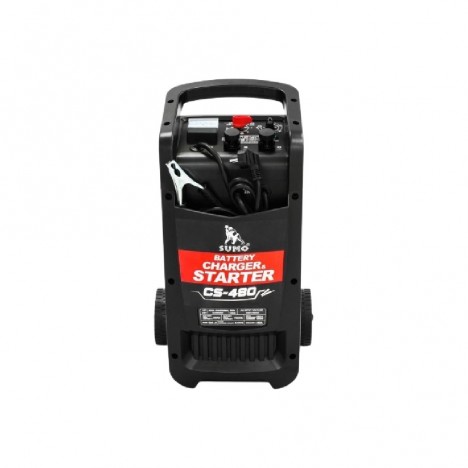
An automatic battery charger has circuitry that reads the battery voltage and adjusts the current according to its status. Initially, it delivers high current for quick charging, reduces the current as it nears full capacity, and stops charging or switches to a maintenance mode once fully charged. This is the type that can be left plugged in overnight without supervision.
Chargers in this group are also ideal for vehicles left parked for long periods, such as a second car or a weekend-only vehicle, because the maintenance mode keeps topping up the battery to a ready-to-use level the entire time it is plugged in.
Charging overnight: which types of battery chargers can do it?
The single criterion for deciding whether a battery charger can be left plugged in is whether it can automatically stop supplying power when the battery is fully charged.
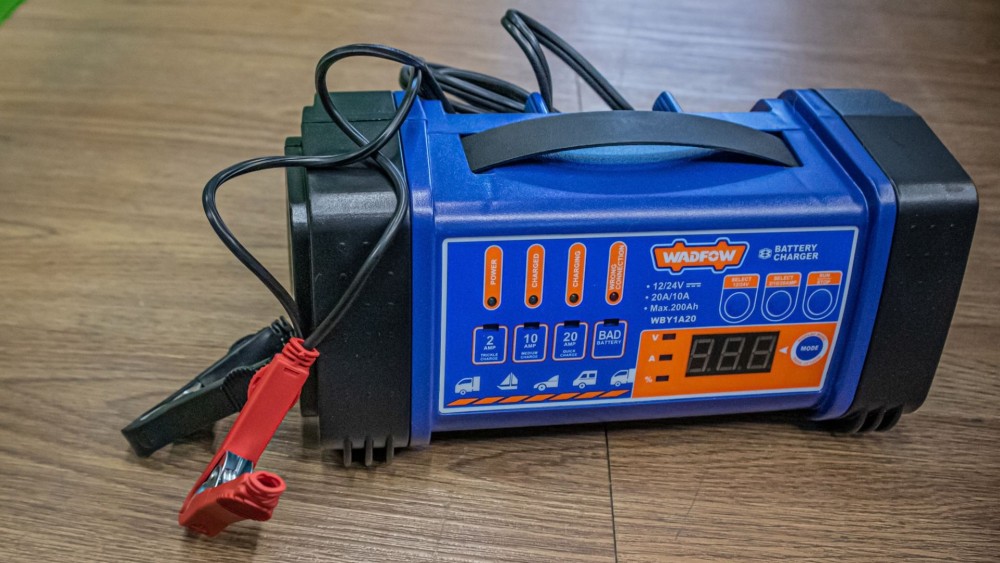
If the front panel has an indicator showing that it is full or features a maintenance mode, it means the charger is designed for continuous connection. As for chargers that only have an on/off switch and an analog needle meter, always consider them as requiring constant monitoring.
Imagine plugging in a manual charger at 10:00 PM and waking up at 7:00 AM; that equals nine continuous hours of power delivery, even though the battery might have been fully charged since 2:00 AM. The remaining five hours simply overheat the battery and can degrade it without any benefit.
However, even when using an automatic charger, you should still avoid charging in an enclosed room without ventilation, especially with flooded lead-acid batteries, as flammable gases are generated during charging. Suitable locations include a well-ventilated garage or an open ground-floor area.
Battery chargers vs. jump starters: different in function, not just size
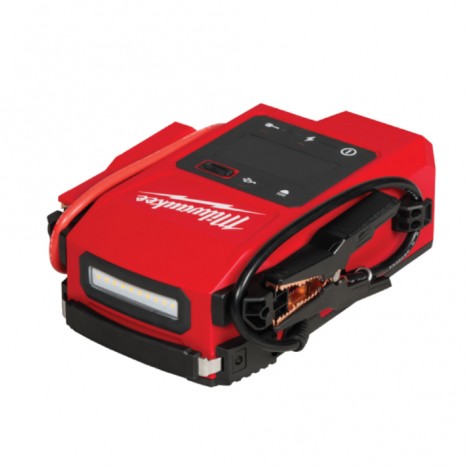
Battery chargers and jump starters (or booster packs) are often confused with one another, which is why many people end up buying the wrong device.
A charger replenishes power back into the battery
The function of a battery charger is to gradually replenish the charge into the battery until it is full. This takes anywhere from several hours to overnight, depending on the battery capacity and the current the charger can supply. It is suitable for situations where the car is parked and you have time to wait.
A jump starter temporarily borrows power to start the vehicle
A jump starter is designed to deliver very high current for a short burst to crank the starter motor; it does not charge the battery to full capacity. Once the engine starts, the power going into the battery comes from the vehicle's alternator instead. It is suitable for roadside emergencies where there is no time to wait for a charge.
To simplify your choice: if the car is parked at home and you want to fix the root cause, start with a car battery charger. But if you travel long distances often and fear breaking down along the way, keep a jump starter—or at least jumper cables—in your car. These two serve different functions, and having both is not redundant.
However, frequently jump-starting a car without ever fully charging the battery creates a cycle that kills the battery faster. The alternator is designed to maintain charge levels while driving, not to recharge a completely drained battery back to full. Driving for another twenty minutes after a jump start is not equivalent to a full charging cycle, which is why households facing recurring starting issues should own a battery charger rather than relying solely on jump-starting.
Battery Type Determines Which Battery Charger Mode to Use
There are several commonly used car battery types, and modern battery chargers often feature a switch to select the mode according to the battery type, as each type accepts charging differently. While using the wrong charging mode won't cause immediate damage, it silently shortens the battery life.
Flooded (Wet Cell) vs. Maintenance-Free (MF) Batteries
Flooded batteries that require distilled water refills tolerate high-current charging better than other types, but you must check the distilled water level before charging every time. If the level is below the mark and charging continues, the exposed plates will suffer permanent damage.
Sealed (Dry Cell) and AGM Batteries
Batteries in this group are more sensitive to overvoltage than flooded batteries, so you should use a charger with a dedicated mode for sealed or AGM batteries. Automatic chargers with a battery type selector switch are safer than units that output power identically for all battery types.
If you are unsure which battery type your car has, check the label on the battery first. If you are still unsure of the battery's condition—whether to use a battery charger or replace it—using a battery tester provides answers faster than guessing based on starting symptoms.
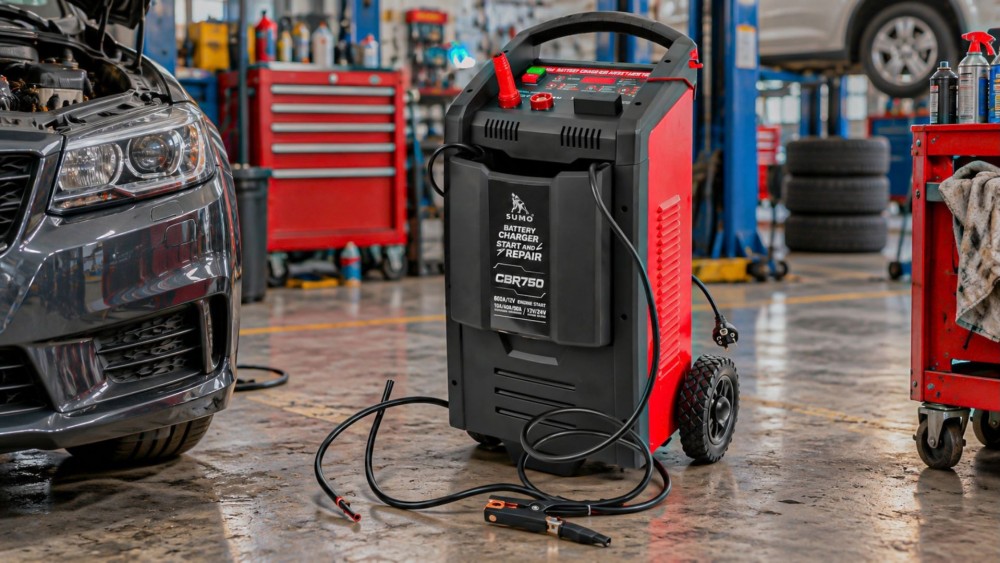
A Higher-Current Battery Charger Doesn't Mean It's Better
The general rule of thumb is that the ideal battery charger current for standard charging is about one-tenth of the battery capacity. Batteries with higher capacities can proportionately accept more current. Charging at this rate takes longer, but generates less heat and delivers a longer-lasting charge.
A high-current fast-charging mode is useful in an emergency when you need the car right away, but it shouldn't be used regularly because internal heat buildup accelerates plate degradation. A charger capable of high output current is therefore not automatically better; what matters is whether it can adjust the current based on the battery's status.
However, if the battery is frequently allowed to drain completely, no matter what current you charge it with, it won't last long. Repeated deep discharges destroy the battery even more than frequent charging.
Connecting the Battery Charger Clamps in the Wrong Order Is a Common Mistake
The most common mistake isn't choosing the battery charger, but rather attaching the clamps. The safe sequence is to connect the red clamp to the positive terminal first, then connect the black clamp to the negative terminal.
When disconnecting, reverse the order: always disconnect the black clamp first. Crucially, turn off the charger or unplug it before touching the clamps every time—never connect the clamps while the charger is actively delivering power.
Another overlooked issue is the condition of the battery terminals themselves. If there is white or green corrosion buildup, the voltage transmission drops, making it seem like the battery won't take a charge no matter how long it is plugged in. Scrub off the corrosion to ensure a clean contact surface before charging. If the terminal is corroded to the point of being loose, replacing it with a new terminal is more worthwhile than temporarily bending it to fit snugly.
If, during charging, you notice the battery becomes excessively hot, makes unusual boiling noises, smells like rotten eggs, or shows visible swelling on the case, unplug the charger and keep your distance until it cools down. These symptoms are warning signs that should be inspected by a technician; do not attempt to fix them yourself.
Which Battery Charger Should You Buy?
- For daily driving with home parking, an automatic battery charger with moderate power is sufficient. Its main job is to top up the charge on nights when starting feels sluggish, not for weekly use.
- For a second car or vehicles parked for extended periods, choose a battery charger with a maintenance (trickle/float) mode. The issue with these vehicles isn't rapid battery drain, but rather power slowly dissipating while parked until the car won't start when you need it.
Repair shops or individuals managing multiple vehicles should have a battery charger with selectable battery types and multiple current levels to accommodate different batteries. It should also be paired with a battery tester to quickly determine which batteries can continue to be used after charging and which should be replaced.
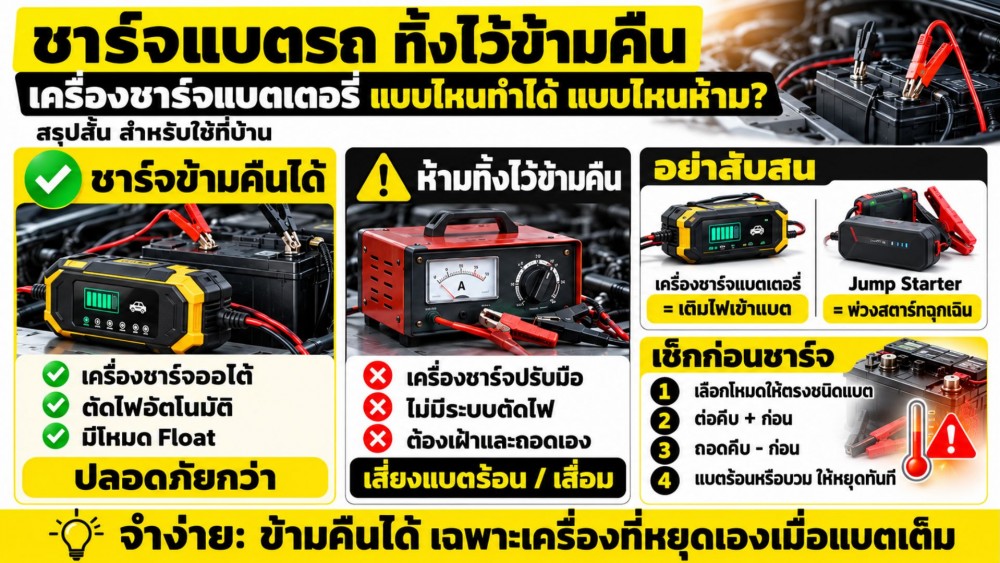
Conclusion: A battery charger that can be left plugged in overnight is one that shuts off automatically.
Leaving a battery charger plugged in overnight isn't wrong, but it is only safe when the charger automatically stops supplying power once full and the mode matches the type of battery in use. Learn more from the article. Charging mistakes change everything! Common errors to avoid when using a battery charger
If you plan to buy a charger for home use and don't want to set an alarm to unplug it in the middle of the night, rule out manual chargers and choose an automatic one that lets you select the battery type. Invest the remaining budget into good-condition battery terminals and a battery tester, which will help you know your battery's status well before a morning when your car refuses to start.
Look for two things on the Battery Charger you have your eye on: whether it features an auto shut-off when full and whether it allows you to select the battery type. These two features eliminate almost all of the most common issues encountered.