


 EN
 ไทย


Customers Also Purchased


Anyone who has ever shopped for Pneumatic System Fittings on their own has likely run into a similar problem: at first, all you wanted was to upgrade your pneumatic system with high-quality air hose fittings or connect a line from an air compressor to an air blow gun, impact wrench, paint spray gun, or any pneumatic tool
Yet once you actually start looking, you are bombarded with terminology—male couplers, female couplers, plugs, sockets, one-touch fittings, straight connectors, elbows, tees, hose barbs, male threads, female threads, as well as sizes like 1/4 inch, 3/8 inch, 6 mm, 8 mm, and 10 mm. Suddenly, these tiny fittings become much easier to choose incorrectly than you might think.
In reality, Air hose fittings are not very complicated if you understand the function of each part. Most problems arise from trying to memorize model names or remembering what fitting appearance goes with what application. But if you change your mindset by asking step-by-step questions—such as what are you connecting to what, is one end a hose or a thread, what size is it, does it need frequent disconnection, and how much airflow is required—you will eliminate confusing options.
Therefore, you don't need to memorize every type of air hose fitting. Just break down the common questions pneumatic users often have when choosing fittings each time, and you'll be able to review specifications and make decisions more easily.
What are air hose fittings, and why are there so many types?
The basic function of an air hose fitting is to connect the path of compressed air from one point to another, such as from the air tank to the air hose, from the air hose into the air filter unit, from the pressure regulator to an air tool, or branching from one air line to multiple devices.
The reason there are many types of fittings is that each position in a pneumatic system has different requirements. Points requiring air tool changes several times a day are suitable for quick couplers, whereas PU tubing inside machinery might be better suited for one-touch push-in fittings for easier plugging and unplugging. In tight installation spaces, a 90-degree elbow may be needed instead of a straight connector; and if the air must be split into two lines, a tee fitting should be used.
Before buying, don't ask "Which air hose fitting model is good?" First, ask: what needs to be connected to what at this point? The answer to this question narrows down more than half of the fitting types.
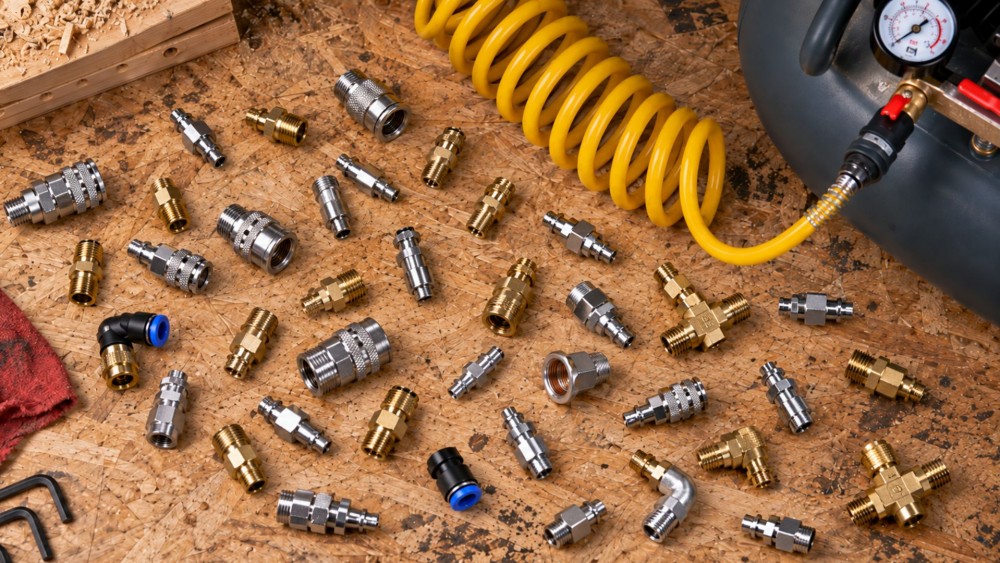
First question: What is the difference between male and female couplers?
Besides Why are air hose fittings called "copper/coupler" even though they aren't made of copper? the terms "male" and "female" are among the most confusing topics. A single air fitting can feature both a plug/socket head and a threaded end. For quick couplers, there are generally two main sides: Plug and Socket Where the plug is the part inserted into the other side, and the socket is the receiving side with a locking mechanism. Some models feature a sleeve to slide or pull to release the plug.
In common usage, The plug is usually referred to as the male coupler, while the socket is typically called the female coupler. However, the point to be careful about is that the other end of the plug or socket can also be male thread, female thread, or a hose barb.
For example, one plug might have a plug head with a female thread at the back, while another plug might share the same head but feature a male thread at the back.
An easy way to remember:
Always divide the air fitting into two sides. First, determine whether one side is a plug or a socket. For the other side, check whether it is a male thread, female thread, or hose barb. Thinking this way avoids much more confusion than simply calling everything male or female.
Air Hose Fittings: How to tell Male Thread from Female Thread?
The simplest rule is: if the thread is on the outer surface of the fitting, it is called Male Thread (external thread) On the other hand, if it is a hole with threads on the inside, it is called Female Thread (internal thread)
When choosing an air hose fitting, check the equipment side first. If the equipment has an internal female threaded hole, you need to use a male threaded fitting with matching size and standard. But if the equipment has a protruding male thread, you need to use a female threaded fitting.
A common point of confusion to watch out for is that some people use the word "male fitting" to mean "Plug", while others use "male" to mean "male thread". Therefore, it is much clearer to specify completely, such as "Male Thread Plug" or "Female Thread Socket".
Do Air Quick Couplers require a matched Plug and Socket pair?
If you want to quickly disconnect and switch tools, you typically need an air fitting Plug and Socket designed to be compatible with each other. For example, a Socket is usually attached to the end of the air hose, while each pneumatic tool is fitted with a Plug. When ready to use, simply connect the tool to the hose; when done, disconnect it and switch to another tool immediately. This is extremely useful for jobs requiring frequent tool changes.
Many Socket models also feature an internal air shut-off valve. When disconnected, the valve automatically shuts off the airflow, eliminating the need to turn off the upstream valve every time you switch tools. However, you should check this detail from the specifications of each model, as the internal construction of air hose fittings varies.
What do the numbers on an air hose fitting mean?
Another common reason for choosing incorrectly is seeing numbers in the air fitting's name and interpreting them literally. Numbers in the model name can indicate a series, thread size, hose size, or tube size, depending on the product design.
For example, if an air fitting specifies 8 mm x 1/4 inch The number 8 mm may indicate the outer diameter of the PU tubing inserted into it, while 1/4 inch indicates the thread size on the other side; the two numbers describe different dimensions. At the same time, some quick coupler families use numbers like 20, 30, or 40 as part of the series name. Do not assume that 20 means a 20 mm diameter, as each manufacturer's model designation follows a different naming convention.
A safer rule is to look for terms like Thread Size, Tube O.D., Hose Size, Connection Size, or Port Size in the product specifications instead.
How are sizes like 1/4 inch, 3/8 inch, and 1/2 inch determined?
Inch sizes are typically found on the thread side or hose side. However, a 1/4 inch size does not mean measuring the air fitting with a ruler will yield exactly 6.35 mm, because pipe threads use a nominal sizing system that does not correspond one-to-one with the actual outer diameter.
Many people measure a thread diameter of around 13 mm and wonder why the pneumatic fitting is labeled as 1/4 inch, even though 1/4 inch mathematically equals about 6.35 mm.
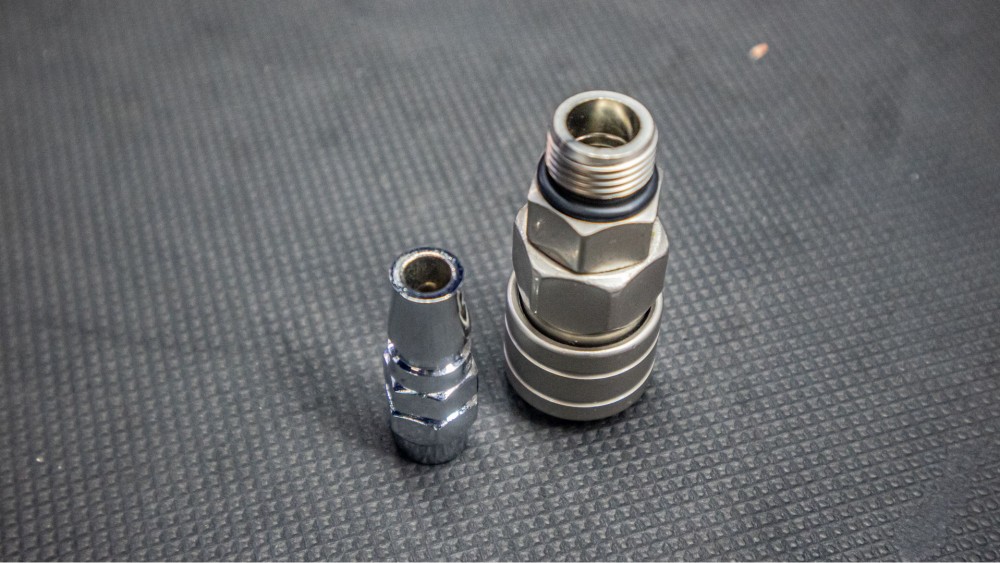
When replacing an existing fitting, a more accurate method is to check the equipment specifications or the part code on the old fitting. If that information is unavailable, then measure the thread diameter and pitch to compare against standard charts.
Are One-touch Fittings different from Quick Couplers?
The phrase “push to connect and lock” leads many people to think that One-touch Fittings and Quick Couplers are the same type of pneumatic fitting, but in reality, their functions are quite different.
- Quick Coupler Designed for frequent disconnection and replacement of tools or hoses, such as connecting an air hose to an air blow gun, air impact wrench, or various pneumatic tools.
- One-touch Fitting Used with small tubing, such as PU or Nylon tubing in pneumatic systems. To use, push the tube all the way into the fitting; the internal mechanism grips the tube surface and seals the air. To disconnect, simply press the outer release ring and pull the tube out.
One-touch Fittings are more commonly found in machinery, air cylinders, solenoid valves, air preparation units, and automation systems rather than being used for switching blow guns or impact wrenches throughout the day.
Are PT, R, Rc, BSPT, and NPT threads the same?
In pneumatic equipment from Japan and Asia, you might encounter terms like PT, R, or Rc, which relate to the BSPT pipe thread standard. Meanwhile, equipment from the United States or certain brands may use NPT. The issue is that some thread types may appear similar enough to start threading together, but the tooth shape, thread angle, or pitch may differ. Forcing them together can damage the threads, and even if threaded in, they might not seal properly, resulting in air leaks.
Therefore, if the original pneumatic fitting specifies a thread standard, select according to that standard rather than looking only at designations like 1/4 inch or 3/8 inch.
Why can't pneumatic fittings of the same size be plugged into each other?
This is a very common problem with quick couplers. What determines whether a plug and socket will fit together is not just the thread size, but also: Coupling profile or the shape of the plug tip
Two plugs may both feature 1/4-inch threads and screw into the same pneumatic tool, but their plug tips might follow different standards. When inserted into an existing socket, one works while the other fails to lock.
This is why factories or workshops using pneumatic tools should standardize their pneumatic fittings across the entire system. Having multiple series mixed together causes hose-related issues, such as when replacing just a single fitting without knowing its original standard.
What is the difference between valved and non-valved pneumatic fittings?
Many quick coupler models feature a valve inside the socket. When the plug is inserted, the valve opens to allow airflow. When the plug is disconnected, the valve automatically shuts off the air supply.
The advantage is the convenience of swapping tools without needing to shut off the air from the main supply every time. However, when disconnecting under pressure, residual air may remain in the tool or hose section. Therefore, always disconnect according to the manufacturer's specified procedure and control the hose end to prevent whipping.
In addition, there are unvalved pneumatic fittings, double shut-off valved fittings, or safety couplers designed to vent residual pressure before release, which are ideal for workplaces prioritizing higher safety.
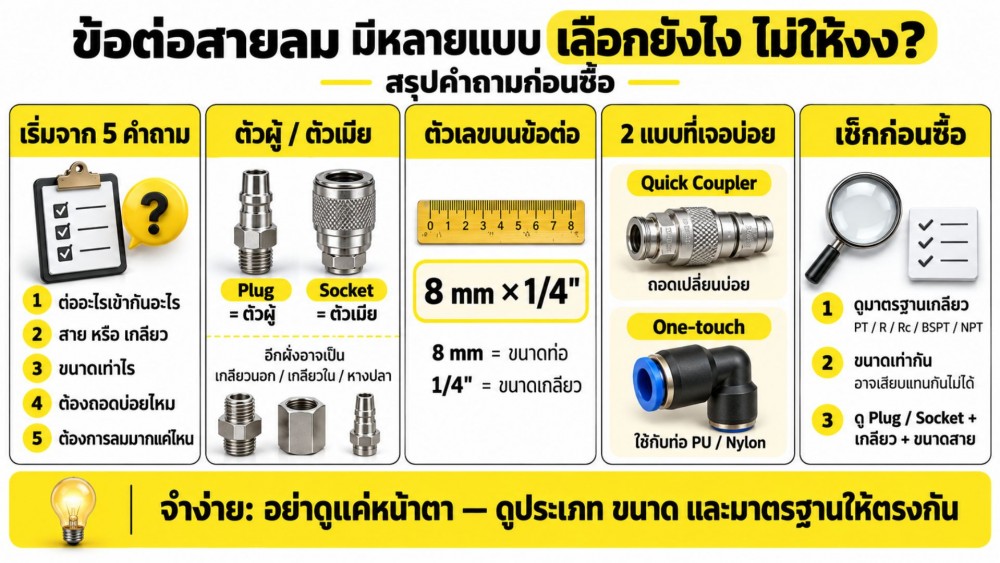
Summary: There are many types of pneumatic fittings, but you don't need to memorize them all
The reason pneumatic fittings seem so difficult to choose is that a single fitting contains multiple pieces of information at once: fitting type, plug style, thread type, thread size, hose size, material, seals, flow rate, and connection standards.
If you try to memorize every name, every part number, and every appearance, it is bound to be confusing. Instead, asking step by step: What are you connecting to what? What hose size are you using? What thread type? Does it need frequent disconnection? And how much airflow is required? will make things much easier.
The most important thing is not to choose a fitting based purely on appearance, and do not assume that just because two fittings are 1/4 inch, they can be used interchangeably. Thread size, thread standard, and plug/socket design are entirely different matters.
Once you understand these principles, terms like male coupler, female coupler, one-touch, straight fitting, elbow, or tee are no longer names you have to memorize, but rather factors in choosing Pneumatic System Fittings based on the function of the pneumatic system.