


 EN
 ไทย


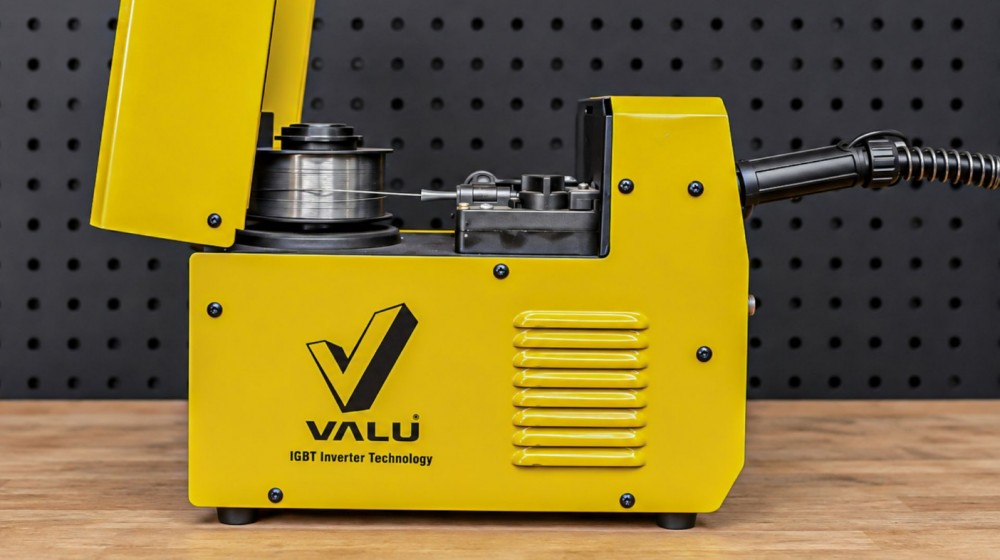
While using a MIG welder in the middle of a weld, the wire suddenly feeds intermittently, yet looking back, the MIG welder display is still on, the fan is running, the breaker hasn't tripped, and the welder seems to have no faults at all. This situation leads many to wonder: is the MIG welder failing, is the wire drive motor having issues, or do they actually need to replace the entire MIG torch assembly?
Symptom Wire feeding issues in a MIG welder are a problem that definitely deserves attention. A MIG setup consists of more than just the MIG welder and wire. A single strand of MIG wire must travel from the wire spool, pass through the feed roller assembly, enter the liner inside the torch cable, before exiting at the contact tip and into the weld pool. Passing through this entire path creates resistance for the wire, and if there is a flaw anywhere along the line, the wire may slow down, jerk, or stop intermittently while the MIG welder's electrical system continues to function normally.
Therefore, when encountering this symptom, the first thing to do is not to rush into adjusting the voltage or concluding that the welder is broken, but to inspect the entire wire feed path from the wire spool all the way to the torch tip, and systematically locate where the wire is being obstructed.
Start with the wire spool before checking the components inside the MIG welder
When experiencing wire stuttering, many people open the MIG welder cover and look at the rollers or drive rolls first. But in reality, you should step back and start checking right from the wire spool. Before the wire enters the rollers, the spool must unwind smoothly without binding and without freewheeling excessively.
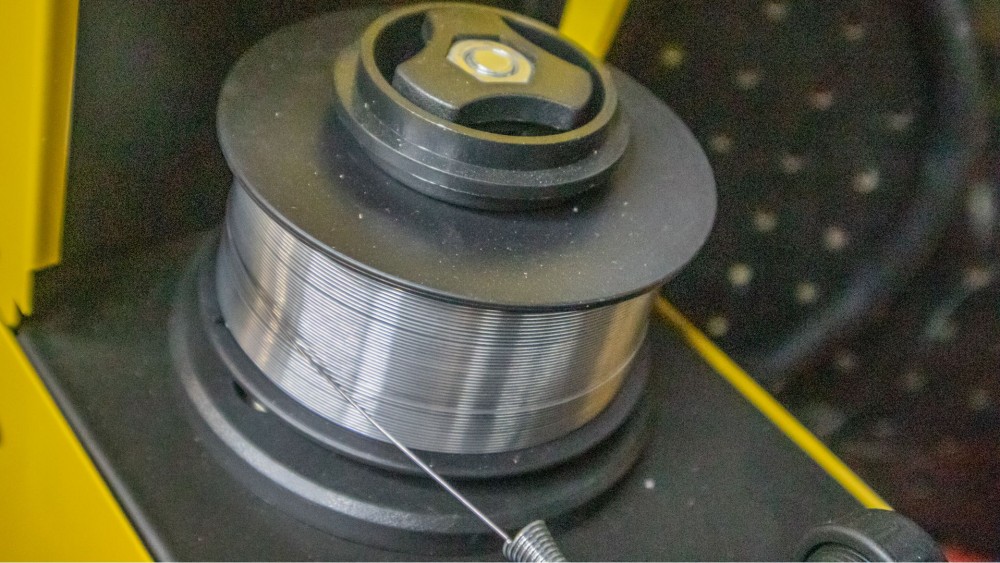
Additionally, the spool spindle hub usually features a resistance system or spool brake to prevent the spool from continuing to spin on its own after the motor stops. If the brake tension is set too high, the wire feed unit has to pull the wire off the spool with more force. Once the resistance exceeds what the rollers can transfer, the wire may feed slowly, stutter, or the rollers may slip on the wire surface.
If the wire stuttering problem just started occurring after changing to a new wire spool, this should be one of the first areas to check, because the issue might not be with the MIG welder at all, but rather with spool installation, brake tension adjustment, or crossed wires.
Drive rolls in a MIG welder directly affect feeding
After the wire leaves the spool, the next point is the drive roll, or wire feed roller, which receives power from the feed motor and pushes the wire into the torch cable. The roller pressure must be within an appropriate range. If the tension is too low, when resistance at the output increases—such as from a bent torch cable or a tight contact tip—the rollers will start slipping over the wire surface instead of pushing it forward.
Symptoms can be observed at the torch end, such as the wire feeding fast then slow, or pausing momentarily before feeding again, resulting in an inconsistent weld bead and sometimes causing burnback into the contact tip. Many people try to solve this MIG welder issue by tightening or over-tightening the roller pressure, which can help if the root cause truly is insufficient tension, but cranking it all the way down is not always the right solution.
Too much pressure can cause problems just the same
If you apply too much drive roll pressure onto the welding wire, the rollers can crush and deform the wire, especially soft wires. Once the wire surface is deformed or metal shavings are scraped off, those shavings can accumulate inside the liner and steadily increase friction. What began as a minor issue at the rollers turns into a wire jam inside the cable.
MIG welder users should check for both too much and too little drive roll pressure when encountering wire feeding issues; simply increasing the pressure is not recommended. In addition, you must verify whether the rollers used match the type and size of the wire, as drive rolls do not come in a one-size-fits-all design for every type of wire.
Drive roll grooves used with a MIG welder must match the wire size
Suppose you are using 0.8 mm wire but choose a roller groove that is not suitable for it; even if the MIG welding system can still somewhat feed the wire, the grip may not be fully efficient. Beyond sizing, the roller groove profile must also correspond to the wire type.
Solid steel wire, flux-cored wire, and aluminum wire all have different physical properties. You should not assume that a single roller type is suitable for all wire types. For example, systems for solid wire typically feature V-grooves, while some wires may require rollers designed to transfer force without damaging the wire.
The liner in the MIG welding torch cable is a cause hidden from external view
One of the major culprits behind MIG welder wire feeding stutter is the liner, or wire guide conduit, located inside the welding torch cable. This area is very difficult to inspect visually from the outside. The torch cable might look brand new with no cracks or burn marks, but the inside could have accumulated dust, metal shavings, or damage.
Every time wire passes through the guide, slight friction occurs. Over extended use, what should be an open path begins to encounter higher resistance. The motor still spins and the rollers still push, but the wire requires more force to move until it eventually begins to feed unevenly.
A damaged or kinked liner produces a similar effect, especially on heavy-duty welding torches where cables are draped over table edges, crushed under heavy objects, or regularly coiled tightly. The exterior may not look severely damaged, but friction points can develop along the inner wire path.
When the wire feeds well with the cable laid out straight but starts stuttering when it is curved, this is a sign directing our attention specifically to the liner and cable condition. Manufacturers often recommend keeping the MIG welder cable as straight as possible when diagnosing wire feeding problems.
Do Not Coil the Welding Cable into Loops When Testing the Wire
A common sight in work areas is a MIG welder positioned close to the welding table while several meters of cable are coiled into loops next to the machine, pulling out only the end section to weld. This may look neat, but it adds continuous curves, which introduces extra friction.
Is It True That Uneven MIG Welding May Be Caused by an Overly Long Cable? The longer the cable and the more bends it has, the more likely the wire is to contact the inner wall of the liner. Rigid steel wire might tolerate this condition to some degree, but when the liner is dirty or the drive roll is worn, these combined factors can cause wire feed stuttering.
Try uncoiling the torch cable, laying it out as straight as possible, and testing the wire feed again. If the issue noticeably improves, it at least indicates that the resistance problem lies in the path from the feed unit to the torch tip, rather than originating directly from the MIG welder.
Contact Tip: The Tiny Component That Can Stop the Entire Wire System
After prolonged use of a MIG welder, the contact tip can wear down and accumulate spatter, causing the wire to fuse at the tip. If the wire orifice narrows or becomes blocked, the drive motor continues to push, but the wire cannot exit normally.
The symptoms can sometimes resemble slipping drive rolls: you hear the motor running, but the wire stops or jerks.
Therefore, when the wire starts acting abnormally, the contact tip is one of the first components to check, as it is easy to inspect and is already a consumable part. If the tip is the wrong size, deformed, or clogged, replacing this small part may solve the problem without having to touch the MIG welder at all.
Wire Feeds Well When Pulling the Trigger, but Stutters During Actual Welding: What Should You Check?
Why Must MIG Welder Voltage and Wire Feed Speed Be Synchronized? If the wire feed rate does not match the arc energy, the burn-off characteristics of the wire change, which can make it feel like the wire is feeding abnormally.
At the same time, do not overlook the contact tip heating up during actual welding. A component that works fine when cool can create resistance under higher temperatures. Moreover, if the tip is already worn, incorrectly sized, or damaged, symptoms may only appear after welding has been underway for a while.
Another area to inspect is the ground clamp and connection terminals of the MIG welder system. If contact is poor, the arc may become unstable, mimicking the feel of discontinuous wire feeding. For this reason, listening to the arc sound alone may not be enough to pinpoint the root cause; you must also observe the movement of the wire.
When Should You Suspect the Wire Feed Motor in the MIG Welder?
If you have eliminated resistance from the system, such as:
- Checking that the wire unspools smoothly from the reel
- The torch cable and liner are not clogged
- The contact tip has no issues
- The drive roll is the correct type and the tension is set properly
However, if the roller speed fluctuates or the motor makes abnormal noises, then move on to inspect the motor, gear assembly, wiring, control circuit, or speed control board.
This part of the work involves the electrical system and internal components of the MIG welder. If opening the electrical enclosure is necessary, turn off and disconnect the machine from the power source according to the manual, and let a technician or service center inspect it.
A simple way to think about it is to find "where the wire starts binding."
The easiest way to analyze the symptom of MIG wire feed stuttering is to view the wire path as a single continuous line, starting from the wire spool to the spool hub, passing through the drive rolls, on to the liner, and out at the contact tip, then asking where abnormal resistance could occur.
Step-by-step troubleshooting helps reduce unnecessary spare parts replacement and, most importantly, keeps us from prematurely concluding that the MIG welder is broken just because the wire does not feed smoothly from the torch.
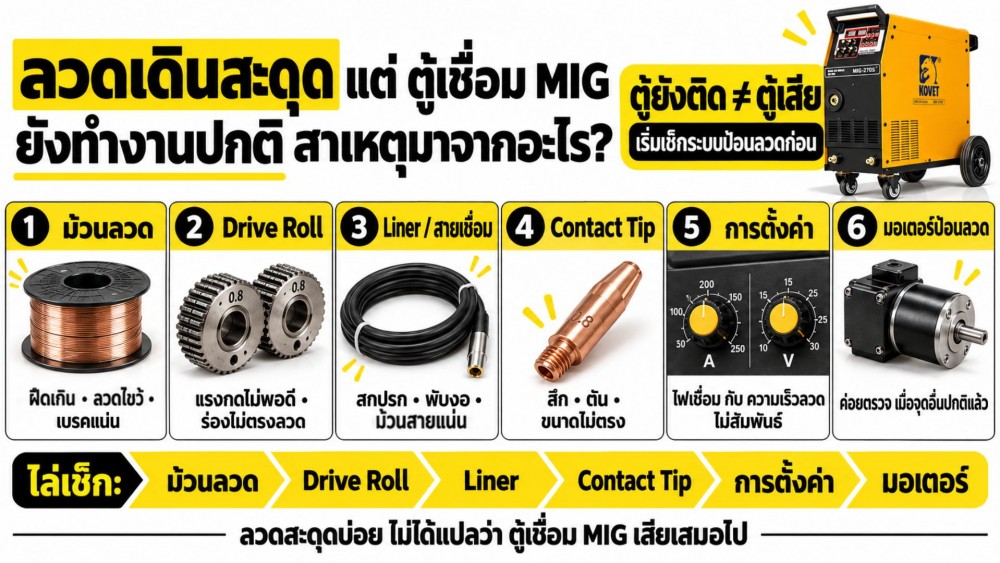
Summary: MIG Welder Works Normally but Wire Stutters? Look at the Entire Feeding System
Wire feeding stutter does not have a single cause, nor does it necessarily mean the MIG welder is broken. Between the wire spool and the torch tip, multiple components must work in sync: the spool brake tension must be properly adjusted, the drive rolls must match the wire size and type, the roller pressure cannot be too high or too low, the liner must be clean and not deformed, the torch cable must not be overly coiled or kinked, and the contact tip must be the right size without blockages.
If you only look at the machine's display and ask, "The MIG welder is still on, why won't the wire feed?", you might not be seeing the whole picture. The MIG machine may generate arc power normally, while resistance in another part of the wire feed system prevents it from operating at full efficiency.
Once you understand that the wire feeding system operates as a single continuous path from the spool to the torch tip, finding the root cause becomes much easier, and you will know whether to adjust, clean, replace spare parts, or send it MIG welder to a technician for a thorough inspection of the wire feed system and circuitry.