


 EN
 ไทย


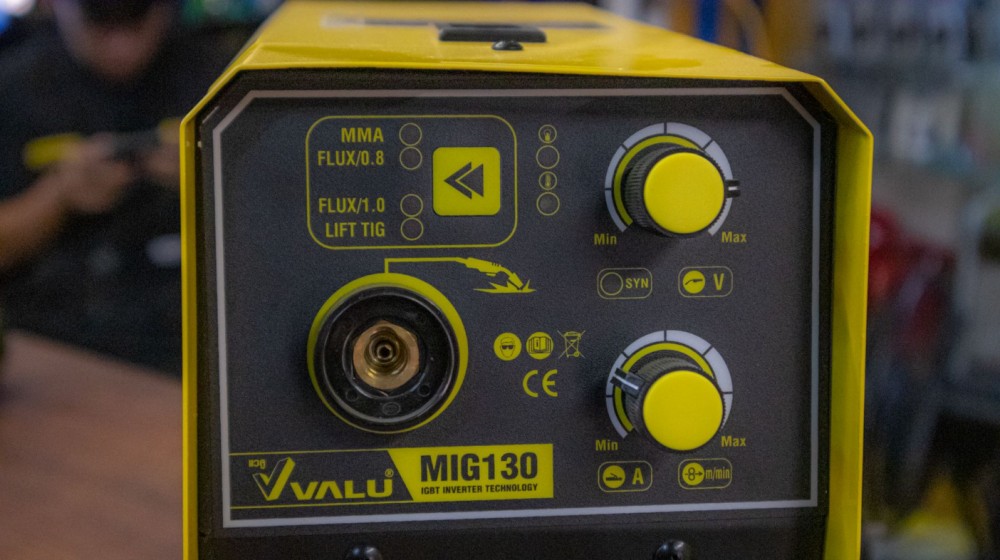
When adjusting MIG welder we usually encounter two main operating parameters: welding voltage (Voltage or V) and current (A) or wire feed speed (Wire Feed Speed/WFS). We might assume these two values operate independently—for instance, if you want more power, increase the voltage, or if you want the wire to come out faster, dial up the wire feed speed. In reality, even a slight change to either value can instantly alter the arc sound, weld pool characteristics, spatter volume, and bead profile of a MIG welder.
Know Before You Choose: How to Read MIG Welder Specs in 5 Minutes The key reason is that in a MIG welder or MIG welding machine system, the wire is not just a filler metal, but also an electrode continuously fed into the arc. The MIG welder must melt the wire at a rate that matches the speed at which the wire feeder pushes it out. Feeding the wire fast without the appropriate energy and arc length will cause the wire to stub against the workpiece; conversely, if the arc is too long for the amount of wire, it may burn back toward the contact tip inside the welding gun.
In a MIG welder, voltage and wire feed speed are like two people who must walk in lockstep. One controls the arc characteristics and length, while the other determines wire volume, welding current, and deposition rate. Walking too fast or too slow relative to each other will throw the entire welding process out of balance.
Voltage affects arc length and characteristics
In MIG, MAG, and Flux-Cored processes on a MIG welder, the voltage value directly correlates with the arc length—meaning the distance between the melting wire tip and the molten weld pool on the workpiece. Increasing the voltage generally lengthens the arc, while lowering the voltage shortens it.
- Increased voltage widens the arc, making the weld bead flatter and wider than before.
- Molten metal can flow and fuse into the toes of the weld more easily under proper conditions.
- This doesn't mean that higher voltage is always better, because an overly long arc may become unstable, increasing spatter, making the weld bead excessively wide, or causing undercut.
- Lower voltage results in a shorter arc concentrated in a narrower area, making the weld bead tend to be narrower and more convex.
- If it is too low relative to the wire speed, the wire will not have enough time to melt properly before reaching the workpiece, resulting in wire stubbing or bumping into the molten puddle.
The voltage adjuster on a MIG welder doesn't just increase or decrease heat; its primary role is determining the arc condition and the shape of the weld bead.
Wire feed speed affects current and deposition rate
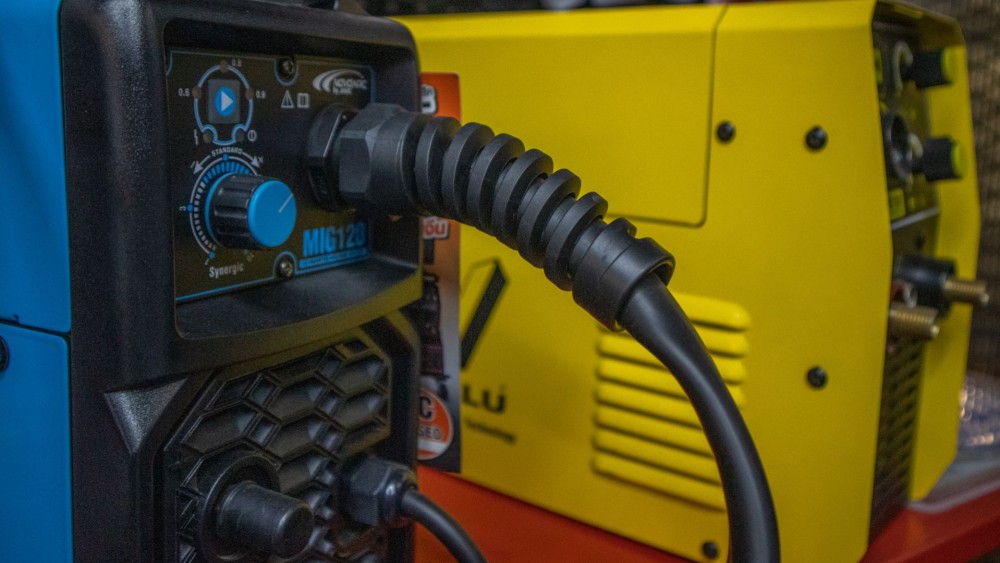
Wire feed speed is the rate at which the wire feeder pushes the welding wire through the torch cable and contact tip to the arc. In a MIG welder using a Constant Voltage power source, increasing the wire feed speed generally increases the welding current because more wire enters the arc area, requiring more current to melt the wire fast enough to match the feed rate.
When you increase the wire feed speed, the amount of wire entering the weld per unit time also increases. The weld bead may gain more filler metal, the current increases, and proper voltage is needed to maintain a stable arc. If wire speed and voltage are not matched, the wire may push into the workpiece faster than the arc can melt it.
Conversely, if the wire speed on a MIG welder is too low relative to the voltage, the arc may burn the wire tip back faster than the feeder can supply it. The arc will become long and unstable, and burnback into the contact tip can occur.
Why MIG welders must balance these two values
Reasons why MIG welders are known as "smart welders" The operating principle of a MIG welder's Synergic system is matching the "wire feed rate" to the "rate at which the arc melts the wire" along the weld. This is why a MIG welder maintains a relatively constant arc length, consistent welding sound, easy-to-control puddle, and uniform filler deposition.
Imagine the wire feeder constantly pushing the wire forward while the arc melts the tip shorter. If the wire is pushed faster, the arc must burn and melt the wire faster as well, which usually means higher welding current and a voltage suitable for that operating point.
However, if the arc melts the wire faster than it is fed, the wire tip will back away from the workpiece, the arc will lengthen, and the process will become unstable. Therefore, even though users see separate knobs for voltage and wire speed, in practice both values function as a single system and neither can be chosen without considering the other.
If wire speed is high but voltage is too low
The most common symptom is wire feeding out of the MIG welder faster than the arc can melt it. The wire tip stubs or pokes into the workpiece and puddle; you may feel the torch pushing back, hear intermittent popping sounds, and see excessive spatter.
Under these conditions, the arc is typically too short; the wire may touch the workpiece, causing prolonged short circuits before explosively clearing. The weld bead may be excessively crowned, fail to wet out at the edges, and have an uneven surface.
Beginners might assume wire stubbing means the MIG welder lacks power, so they increase the wire speed thinking it will add more heat. While higher wire speed does increase the current, it also increases the volume of wire the system must melt at the same time. If voltage and other operating parameters are not matched, the stubbing may become even worse.
If voltage is high but wire speed is too low
When the voltage is too high relative to the wire feed speed, the MIG welder's arc tends to lengthen. Less wire is fed while the arc rapidly melts the wire tip back. The welding sound may become high-pitched, diffused, or intermittent, and sometimes the wire tip may burn back close to the contact tip.
- The weld bead may be too flat and wide.
- Insufficient weld metal relative to the bead width.
- Spatter or undercut along the edges of the weld bead may occur.
- Penetration is reduced in certain conditions, while wire speed that is too low causes an unstable arc.
This condition can sometimes feel easy to weld with because the wire doesn't push against the workpiece and the molten pool appears wide. However, a weld bead that looks flat or smooth on the outside does not guarantee complete fusion of the joint. If the heat input, wire volume, and travel speed are inappropriate, issues such as lack of fusion or insufficient weld deposit can occur.
Travel Speed Related to MIG Welder Voltage
Although travel speed is not a parameter on the control panel, it directly affects the amount of heat input and weld deposit accumulated at each location.
Moving too slowly causes excess molten metal and heat to accumulate; the weld bead may become wide, convex, or burn through thin materials, even if the MIG welder's voltage and wire speed are already well-balanced.
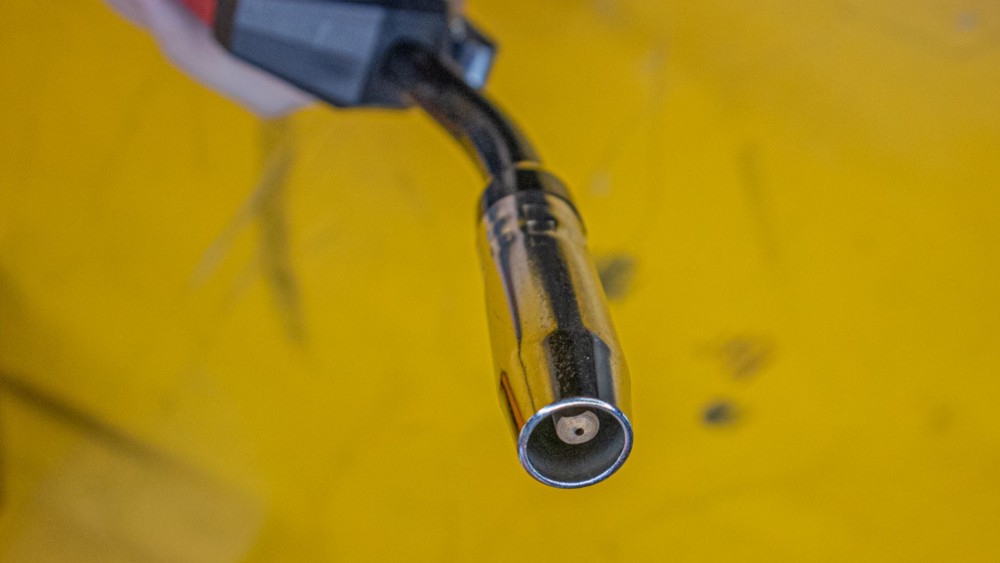
Therefore, even with a properly set MIG welder, the weld bead won't turn out the same every time if the operator varies their travel speed, fails to maintain a consistent stick-out distance, or changes the torch angle mid-weld; the results can vary significantly.
How Does a Synergic System Keep These Two Values in Sync?
Many modern MIG welders feature a Synergic system, which simplifies initial setup and reduces the chance of voltage and wire speed drifting too far apart. However, this does not mean you don't need to observe the weld bead. Many machines also offer Voltage Trim or Arc Length Correction to slightly shorten or lengthen the arc, adapting to different joints, welding positions, and desired bead profiles.
Therefore, Synergic should be viewed as a system to help find a baseline and maintain parameter ratios, rather than a system that makes every job perfect without considering the material and on-site conditions.
MIG Welder Issues May Not Always Stem from Settings
If the MIG welder's voltage and wire speed worked well previously but the arc suddenly begins to sputter, do not rush to adjust the machine's settings. It could be caused by the wire feeder or the torch assembly, such as: Is It True That Uneven MIG Welding May Be Caused by an Overly Long Cable?
- A worn contact tip or a hole size that does not match the wire size
- A dirty or kinked liner
- Incorrect drive roll size
- Drive roll pressure that is too high or too low
- A coiled or kinked torch cable
- Wire spool jammed or rusted
- Poor ground clamp contact
- Inappropriate shielding gas
If the wire is not fed at a consistent speed, the speed displayed on the screen may not match what actually reaches the arc. Users may then feel the machine settings are unbalanced, even though the root cause is friction or snagging within the wire feed system.
Safety of MIG Welding Machines is More Important than Guessing Settings on Your Own
MIG welding machines use high electrical currents and involve electric arcs, radiation, heat, molten metal, fumes, and compressed gases. Setting adjustments or test welding should therefore be conducted in a properly prepared area that is well ventilated, free of flammable materials, and equipped with standard work safety gear.
Do not attempt to increase voltage or wire speed beyond the manufacturer's specified range, and avoid using settings found on social media for structural work without verifying the wire type, gas, polarity, and joint specifications. Additionally, when pushing wire speed so high that amperage surges, remember to calculate duty cycles based on standard 10-minute test cycles to prevent heat buildup from burning out the circuit board.
Using a MIG welding machine for load-bearing or safety-critical applications should be carried out by skilled welders in accordance with certified welding procedures.
Summary: Why Must MIG Welder Voltage and Wire Feed Speed Be Synchronized?
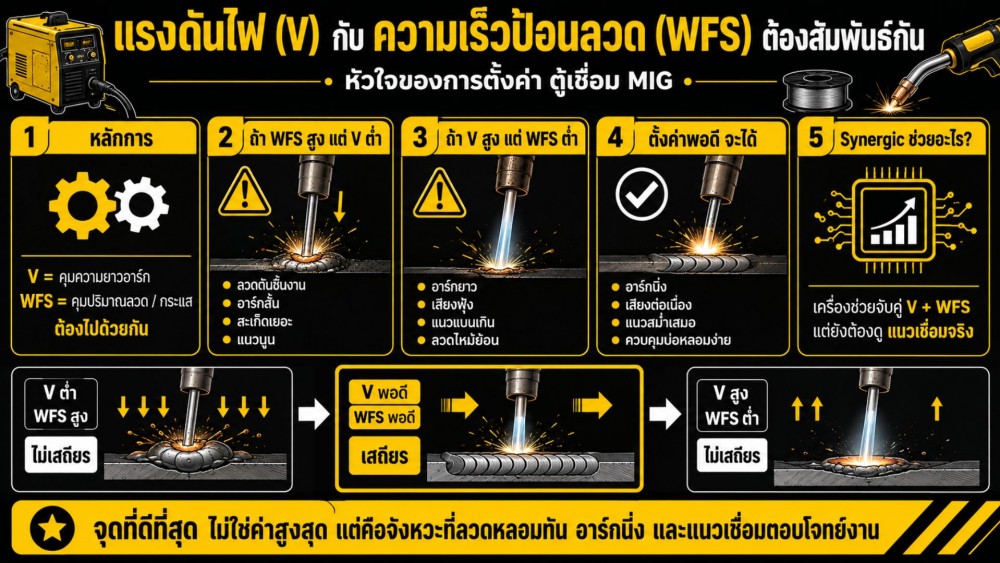
MIG welder voltage and wire feed speed must be synchronized because the welding wire is continuously fed into the arc and melted. Wire speed determines the wire volume, welding current, and deposition rate, while voltage controls arc length and weld bead profile. If these two values are out of balance, the arc will either fail to melt the wire fast enough or burn it back too quickly.
When wire speed is too high relative to voltage, the wire may stub against the workpiece, causing a short arc, loud popping, and increased spatter. Conversely, if the voltage is too high relative to wire speed, the arc may become long, unstable, resulting in a flat bead and an increased risk of wire burnback.
However, there is no single fixed formula for the relationship between voltage and wire speed for every job, as it also depends on wire size and type, shielding gas, material thickness, joint design, welding position, stick-out distance, travel speed, and the technology of each specific welding machine model.
Modern MIG welding machines with Synergic systems make it easier to match various parameters together, but users still need to understand what the machine is adjusting and continuously observe the arc behavior and weld bead.
For MIG welder Furthermore, the sweet spot is not found at the highest or lowest numbers, but at the point where wire feeding and melting stay in sync, the arc remains stable, and the weld bead meets the requirements of the workpiece.