


 EN
 ไทย


Customers Also Purchased
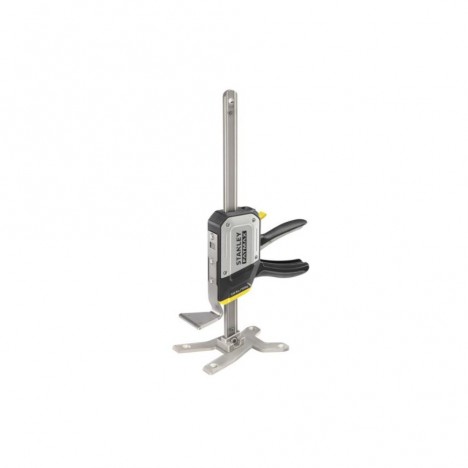


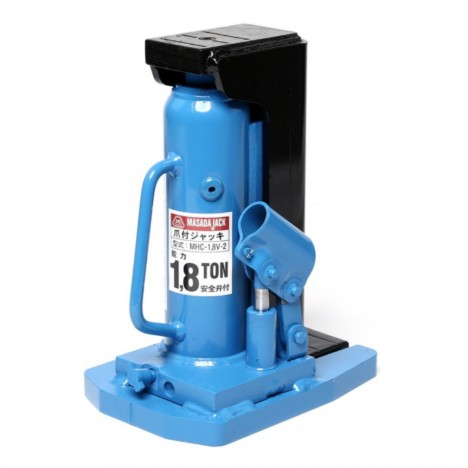
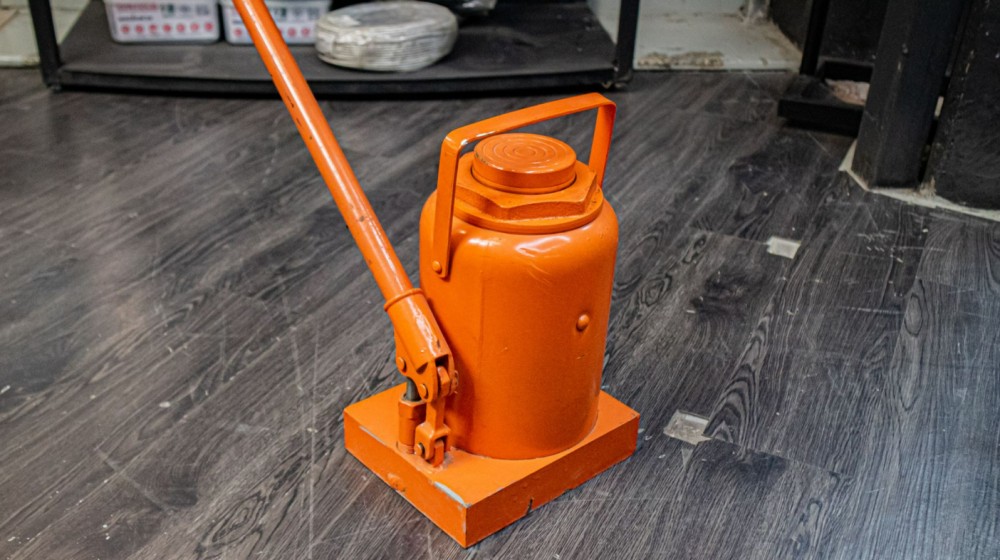
When choosing a Bottle Jacks bottle jack, the first thing we usually look at are numerical specs, such as 2 tons, 3 tons, 5 tons, 10 tons, 20 tons, up to 100 tons. This leads to a simple assumption that all these bottle jacks only differ in "how heavy a load they can lift."
If the vehicle isn't too heavy, you use a 2-ton bottle jack; for larger vehicles, step up to 5 tons; or for trucks and machinery, go for 10–20 tons or 100 tons just to be safe. It sounds straightforward, but once you put them to actual use, you'll realize load rating is only part of the story. As lifting capacity increases, the bottle jack's shape, hydraulic cylinder build, base dimensions, minimum height, lifting stroke, tool weight, and even the pumping feel can all change dramatically.
This is why a 10-ton bottle jack might sometimes be unsuitable for a passenger sedan, even though its capacity is multiple times greater than a 2-ton jack. Conversely, a compact 2-ton jack doesn't mean it's right for every vehicle. You must look beyond "how many tons it holds"—check whether the jack fits under the lifting point, lifts high enough, provides a stable base, and how much pumping effort is required under real load.
How Bottle Jacks Work: Why Can a Small Cylinder Lift Multiple Tons?
Why can a bottle jack lift heavy loads despite its compact size? Bottle jacks operate using a system Hydraulic that utilizes fluid or hydraulic oil pressure to multiply force. Applying force or pumping the jack handle allows a small pump to deliver oil into the main cylinder. As more oil is forced in, the bottle jack's piston gradually moves upward, lifting the object placed on top.
The hydraulic system of a bottle jack multiplies force based on the piston's surface area, converting input force into a much greater lifting force.
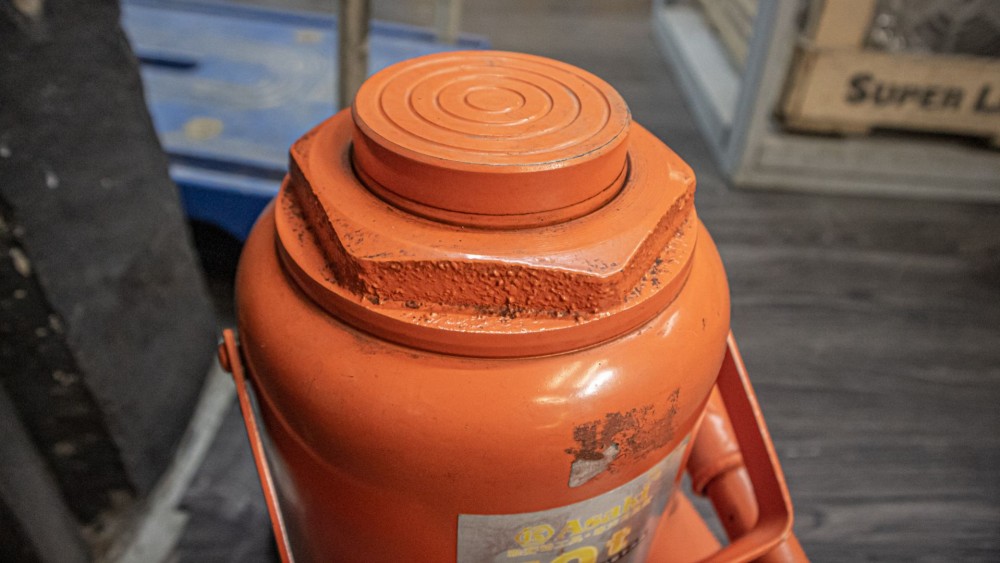
2 tons, 3 tons, 5 tons, 10 tons, and 20 tons—what do these numbers mean?
The rated capacity of a bottle jack refers to its ability to handle the maximum lifting load specified by the manufacturer under operating conditions for that model. However, this should not be interpreted as simply, "If the vehicle weighs 5 tons, buy an exact 5-ton jack," and call it a day.
In vehicle lifting applications, you must distinguish between the total vehicle weight and the actual load on the lifting point. For example, when changing a tire, you are not lifting the entire vehicle off the ground at once; you are only lifting a portion of it. Even so, when choosing a bottle jack, you should allow for an adequate safety margin rather than operating near the maximum limit, especially for vehicles carrying luggage, tools, or heavy cargo all the time.
A 2–3 ton bottle jack is not simply a 10–20 ton jack that is "less strong"
2-ton and 3-ton jacks are typically designed for general passenger vehicles, maintenance work, or lifting moderately sized workpieces. The jack can be compact, easy to transport, and easily slid under a car.
Moving up to a 5-ton bottle jack, many models feature a thicker, heavier structure suitable for pickup trucks, vans, garage work, or heavier loads. Meanwhile, ratings of 10 tons, 20 tons, or 100 tons are meant for trucks, machinery, marine vessels, factory operations, installation, or heavy equipment maintenance. The jacks themselves noticeably increase in size and weight.
Importantly, these are general trends rather than fixed rules, as 5-ton jacks from two different brands may have different minimum heights, stroke lengths, and base sizes. Therefore, when making a purchase, you should always check the actual model specifications alongside the weight capacity rating.
Minimum height changes as bottle jacks handle greater loads
One piece of information that buyers of bottle jacks often overlook is the "minimum height" or the height of the jack before it starts lifting. This value can be the deciding factor in whether that jack model will work with your vehicle or not.
Imagine a sedan with very little ground clearance to the jacking points. If you buy a large 10- or 20-ton jack thinking "bigger is safer," the problem you will run into is that the jack is too tall to slide underneath the lifting point.
Jacks that support heavier loads also require stronger cylinders, pistons, and bases. Many bottle jack models therefore increase in height accordingly. While this doesn't mean that every higher-rated model is always taller, the likelihood of a larger body size is much higher.
Therefore, for sedans, lowered cars, or machinery with limited clearance underneath, factors like "can lift 10 tons" might be less important than "can it fit under the workpiece or not."
Lifting height does not directly scale with tonnage
Many people think that a bottle jack with a higher weight capacity should naturally lift higher as well—for example, a 20-ton jack must lift higher than a 5-ton jack. But in reality, "load capacity" and "lifting range" are two completely different variables.
The lifting range of a bottle jack refers to the distance the piston can travel up from its lowest position to its highest position. Some bottle jack models also feature an extension screw at the saddle, which helps add a bit of height before pumping begins. This allows users to position the saddle closer to the jacking point before starting work, reducing the number of pump strokes needed.
Some high-capacity jacks may focus more on "lifting force" rather than a long stroke length, so they might not lift much higher than smaller models. Meanwhile, some smaller jacks might be designed with a higher lifting stroke to suit automotive work. Therefore, before choosing, you should check both Minimum Height, Lifting Stroke, and Maximum Height, not just the tonnage rating.
The base size of a bottle jack is more important than many people think
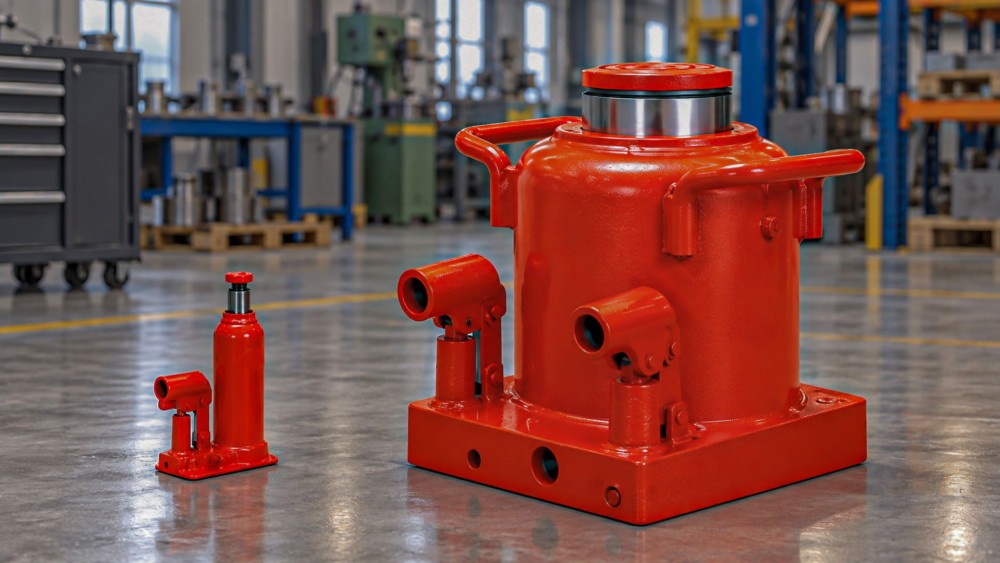
When a jack has to support more weight, the "base" becomes an extremely crucial component. The force from the object is transferred through the cylinder down to the ground. A base with an appropriate size and structure helps distribute the load and allows the jack to stand more stably.
For this reason, a 10-ton jack or a 20-ton jack feels distinctly more robust than a 2–3 ton model. The base may be wider, the steel thicker, and the overall weight heavier to withstand the massive forces generated during lifting.
A bottle jack with a large base doesn't mean it's safe in every situation; the supporting surface is just as important. If placed on soft soil, sloping ground, gravel, or unstable surfaces, even with a high-capacity jack, the base can still tilt or sink. It should always be placed on a hard, flat, and load-bearing surface.
The more weight it supports, the more pumping effort required—is that true?
The answer is "not necessarily directly proportional." The hydraulic system is already designed for mechanical advantage. A 20-ton jack doesn't mean you have to exert 10 times more force on the handle than you would on a 2-ton jack.
A deep dive into bottle jack anatomy: which part is the real force multiplier? What manufacturers can adjust includes the pump piston size, main cylinder diameter, handle length, and mechanical leverage ratio. If designed to deliver less oil per stroke, the user may exert less effort at the handle, but will need to pump more times to reach the desired height. Conversely, if designed to deliver more oil per stroke, the lifting distance per cycle may increase, but the effort felt in hand might change accordingly.
Easy to pump at first, but feels heavier once it takes on the load?
Before the jack saddle touches the workpiece, the piston encounters almost no resistance. Pumping the handle therefore feels light. But as soon as the saddle makes contact with the lifting point and starts bearing weight, the system must build up pressure to overcome the downward force of the object. Consequently, each pump naturally begins to feel heavier.
If during lifting you notice unusually high effort is required, the jack rises slowly, sinks, leaks oil, or fails to maintain height, stop and inspect it immediately. Do not jerk the handle with extra force or try to push the jack beyond its limits, as these symptoms could be related to overloading, hydraulic system issues, or the condition of the bottle jack itself.
A bigger bottle jack is not always better
Looking strictly at strength, many might think buying a single 20-ton jack is the best value because it should handle any vehicle regardless of weight. In reality, a larger jack comes with several trade-offs.
First is the jack's own weight—moving it in and out of a vehicle or around a workshop becomes more cumbersome. Next is the minimum collapsed height; if the bottle jack is too tall, it might not fit under the vehicle. There is also the base size and working space—some spots are simply too confined to position a large jack. Another factor is maneuverability; for changing tires on small cars or roadside emergencies, a properly sized jack is far more convenient.
The selection rule is therefore not "the more tons, the better," but rather: Sufficient capacity, appropriate size, reaching height + adequate stroke, stable placement
How to choose how many tons for a bottle jack: what should you look for?
Before buying a jack, the first step is to estimate the weight of the vehicle, machinery, or object to be lifted, and select a jack capacity that provides an adequate safety margin. Next, check the minimum height to ensure it fits under the lifting point, and then check the maximum height to verify that at full extension, it raises the vehicle or workpiece to the desired level.
Next, examine the base size, especially for heavy-duty lifting, as surface contact and stability are crucial. Also consider the jack's own weight; if you must carry it in a vehicle at all times, a very heavy jack may be impractical, even if it has a high capacity.
For workshops, factories, or machinery maintenance where jacks are used regularly, beyond weight capacity, build quality, oil seals, handle strength, release valve design, and spare parts availability or after-sales service are also critical factors to consider.
A bottle jack directly bears high loads, so you should never choose one based on numbers like price or tonnage alone.
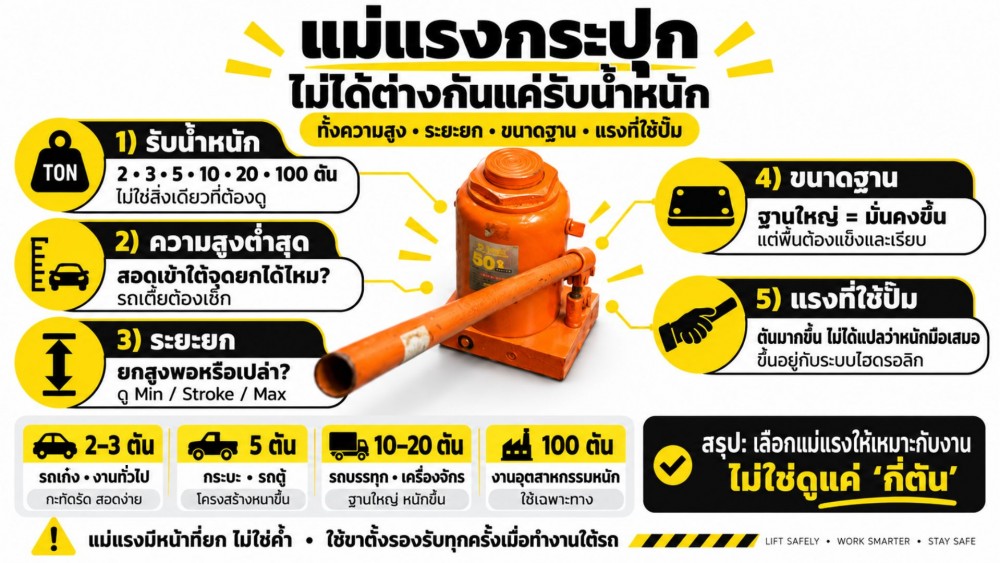
Summary: Bottle jacks differ by much more than just the "tonnage" figure
When comparing 2-ton, 3-ton, 5-ton, 10-ton, and 20-ton bottle jacks, what changes is not just the load capacity. Increasing the tonnage rating also affects the overall design of the jack system, such as:
- Piston and hydraulic cylinder sizes
- Minimum height, maximum height
- Lifting stroke, base size
- Structural thickness
- Body weight, down to the feel of the force applied while pumping
So next time you see two bottle jacks that look similar, but one says 3 TON and the other says 10 TON, don't just assume the difference is simply "one can lift heavier." Behind those numbers is an entire system design that may be completely different.
Bottle Jacks The right jack is one whose rated capacity matches the load, can access the lifting point, reaches the desired height, rests stably, and has a size suited for the actual task.