


 EN
 ไทย


Customers Also Purchased


For anyone who has just started using Air stapler or pneumatic nailer for the first time, you might be quite startled by the sound produced when pulling the trigger. Even though the tool itself isn't large, the moment you fire, it creates a sound that is loud, short, and sharp. Some models use high air pressure or drive nails into hard materials, making the noise sound even louder. This might make you wonder whether your equipment is developing a problem or if loud noise is simply a normal characteristic of this type of tool.
The answer is It is normal to a certain extent for an air stapler/nailer to make a loud noise while firing, because the internal mechanism includes compressed air, a piston, a driver blade assembly, and an exhaust system all working simultaneously in a fraction of a second. However, not every kind of sound should be considered normal. If the sound changes from usual, such as metallic clattering, continuous air leakage, or weak firing accompanied by an unusual noise, it could be a sign that certain parts are worn out or the internal system needs to be inspected.
When considering whether the air stapler/nailer's sound is abnormal or not, the key is not just to see "how loud" it is, but also when the noise occurs, what it sounds like, and whether the tool's firing performance has changed from before.
Why is an air stapler/nailer loud even though it doesn't have a motor?
Is an air stapler/nailer really easy to use? What do you need to know to prevent misfires? From the outside, an air stapler/nailer might look like a tool without a very complex mechanism.
- Most have no rotating motor
- no high-speed gears
- and no impact mechanism like power tools.
In reality, however, the inside of an air stapler/nailer converts energy from compressed air into impact force in an extremely short period of time. This very process is the main reason behind the distinctive "pop!" or "bang!" sound.
When you pull the trigger, an internal valve quickly opens to let compressed air into the cylinder. The air pressure drives the piston and driver blade downward, impacting the nail or staple and driving it into the workpiece. Afterward, the air used to drive the piston must be exhausted from the tool so the mechanism can return to its ready-to-fire position for the next shot. All of these steps happen almost simultaneously, causing us to hear a combined sound that is brief yet powerful.
The sound heard from an air nailer/stapler is the combined result of compressed air, piston movement, the driver mechanism impact, and the fastener entering the workpiece. The more powerful the tool, the larger the fastener, or the harder the material, the louder the noise can be.
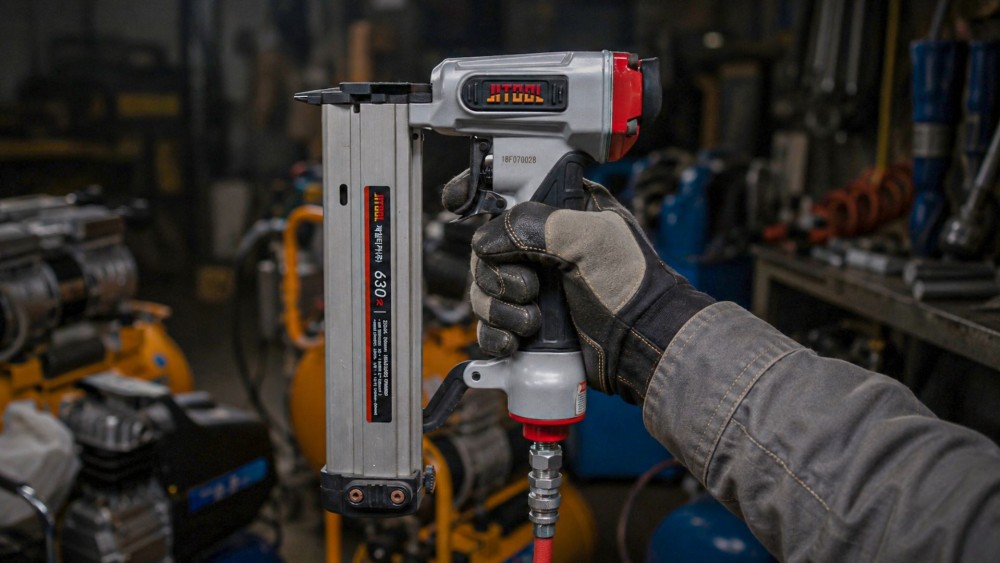
Exhaust Air Sound: A Major Cause of Loud Air Nailers
Air nailers need to exhaust air from the cylinder after the air pressure drives the piston. Many models feature an exhaust port at the top or rear of the tool. With each shot, you may hear a sudden rush of air rushing out along with the impact sound of the staple or nail. How Does an Air Nailer's Impact Differ from Hammering?
A "Hiss" or Burst of Air After Firing Can Be Normal
This type of sound is generally part of normal operation. Higher air pressure means more air is discharged with each shot, making the sound seem heavier or louder. However, what you should look out for is that the air sound should occur in short bursts matching the firing cycle, not as a continuous air leak after releasing the trigger.
If you connect the air hose and hear a persistent "hissing" sound from the handle, cap, nose, or trigger even before firing, this is no longer normal operating sound and may indicate a leaking seal, O-ring, valve, or internal part.
Impact Sound from the Piston and Driver Is the Primary Noise of an Air Nailer
Another unavoidable sound comes from the piston and driver blade, which are the parts that receive energy from compressed air and drive down to strike the nail. The mechanism operates in a very short time, but the internal parts move at high speed and must stop abruptly after driving, constantly generating internal impact force.
- Some air nailer models therefore include internal components called bumpers
- to absorb the impact at the end of the piston stroke,
- reduce shock between components,
- and ensure smoother operation.
- If they are still in good condition, the sound of the tool usually feels heavy yet solid and consistent with every shot.
However, when the bumper begins to harden, crack, collapse, or degrade over time, the sound of the air nailer can change from a solid thud into a harsh impact, metallic clatter, or an unusually loud noise. This should not be overlooked, especially if the abnormal sound is accompanied by increased vibration or recoil.
Setting Air Pressure Too High Can Also Make an Air Nailer Louder
A relatively common cause, especially among those who want fasteners driven deeper, is raising the pressure from the air compressor or regulator higher than necessary. Many people might think it helps, but in reality, setting the pressure higher than required by the tool and workpiece does not always offer advantages.
When air enters the pneumatic nailer at higher pressure, the piston and driver assembly receive more force accordingly. The movement becomes more violent, the exhaust vent sound gets louder, and the impact force at the end of the stroke also increases. Even if the tool can still shoot normally, certain components will bear more load than necessary, which in the long run may cause bumpers, seals, O-rings, or internal mechanisms to wear out faster.
The proper method is to start with the pressure within the range specified by the manufacturer, and use the lowest pressure that can still consistently drive nails to the desired depth. If you have to increase the pressure higher than normal to sink nails flush, you may need to check other factors, such as nail size, workpiece hardness, component condition, or the air volume supplied to the tool.
Different Workpieces Cause the Pneumatic Nailer to Sound Different
Often the tool has no problem at all, but the sound changes because of the material. Driving nails into softwood, hardwood, MDF, plywood, or composite materials can produce noticeably different sounds because materials have different densities and shock absorption capacities.
On softwood, the wood grain can absorb part of the impact force, making the sound deeper and less harsh. But when firing into hardwood or high-density materials, the impact sound can reflect back more, making the pneumatic nailer seem louder even though the air pressure and the tool itself remain unchanged.
The workbench also has an effect. If the workpiece is placed on a metal table, a concrete floor, or a hollow structure, the impact sound travels through the material and gets amplified, unlike working on a thick wooden bench or a table with shock-absorbing material.
If you find that the pneumatic nailer is only loud during certain types of work but returns to normal when switching workpieces, it may not be a sign that the equipment has a problem.
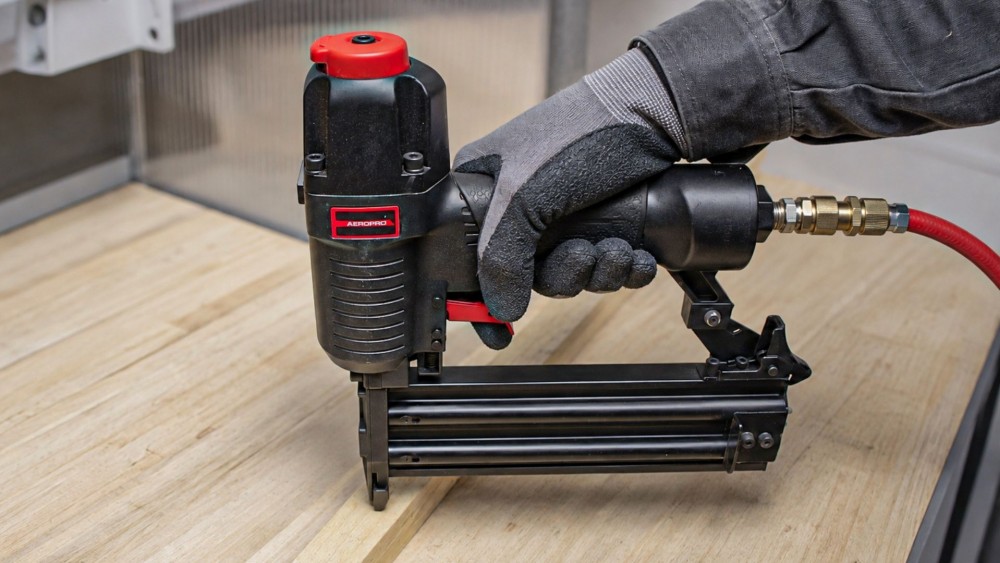
Enclosed Rooms and Echoey Spaces Make Pneumatic Nailers Sound Louder
Firing a pneumatic nailer in an open space, a large factory, or an outdoor construction site allows sound to dissipate in multiple directions. However, if used in a small room with concrete walls, tiled floors, metal partitions, or low ceilings, sound waves bounce back rapidly, which can make the tool feel louder and harsher on the ears.
Especially when firing multiple shots in succession, reflections from walls can overlap, making the ambient environment feel extremely loud even though the source sound from the tool hasn't increased. Therefore, you shouldn't judge the condition of a pneumatic nailer solely on perceived volume level; you should also listen to the "character of the sound" of each stroke.
What Kind of Pneumatic Nailer Sounds Are Warning Signs?
People who have used a pneumatic nailer for a while can usually recognize the regular sound signature of their tool. Therefore, if the sound changes noticeably one day—especially if there is an abnormally sharp metallic clanking sound—you should stop and inspect it before continuing to use it for an extended period.
From a "thud" sound to a metallic "click" or "clank"
Metallic sounds may be related to internal components, the piston assembly, the bumper, or mountings that have started to wear out or loosen. If hard parts are allowed to collide without proper cushioning material, damage can spread from minor components to other mechanical assemblies.
Continuous air leaking sound even without pulling the trigger
This symptom is easy to distinguish from the normal exhaust sound. If air continuously escapes after connecting the air hose, or if a hissing sound doesn't stop after firing, it means there may be an air leak in the system.
- The location of the sound can help guide troubleshooting to some extent:
- Leaking around the air hose connector may be an issue with the coupler, thread seal tape, or the O-ring at the air inlet.
- If the sound comes from the trigger area, tool nose, or top cap, it may be related to internal valves or seals, which requires disassembly and inspection by someone who understands the tool's structure.
Louder noise accompanied by nails not driving flush
If the pneumatic nailer gets louder but loses driving power, that is definitely a symptom to pay attention to. Normally, pneumatic energy should be directed to drive the piston and sink nails. If a certain amount of air leaks or is lost internally, the tool may produce a lot of air noise while driving force at the tip decreases.
In this case, check the actual air pressure supplied to the tool, the air hose, fitting size, air compressor output, as well as the internal seals and valve assembly of the nailer. Sometimes the gauge on the compressor shows sufficient pressure, but when the trigger is actually pulled, the pressure at the end of the hose can drop significantly due to a hose that is too small or too long, or flow-restricting fittings.
Checking "whether the sound has changed" is more important than "how loud the nailer is"
Different models of pneumatic nailers can vary greatly in noise levels depending on tool size, pressure, exhaust system, piston weight, nail size, and internal design. There is virtually no single sound profile that can be used to judge whether every pneumatic nailer is "too loud."
What is easier to observe is whether the tool's sound today is the same as when it was working normally. If you are using the same pressure, the same nails, and driving into similar workpieces, but the sound becomes harsher, has added metallic noise, exhibits air leaks, or the impact force changes, that is much better information to judge by than assessing loudness alone.
Knowing your tool's regular sound is therefore also part of maintaining a pneumatic nailer, as many malfunctions often start with subtle changes before developing into clear breakdowns.
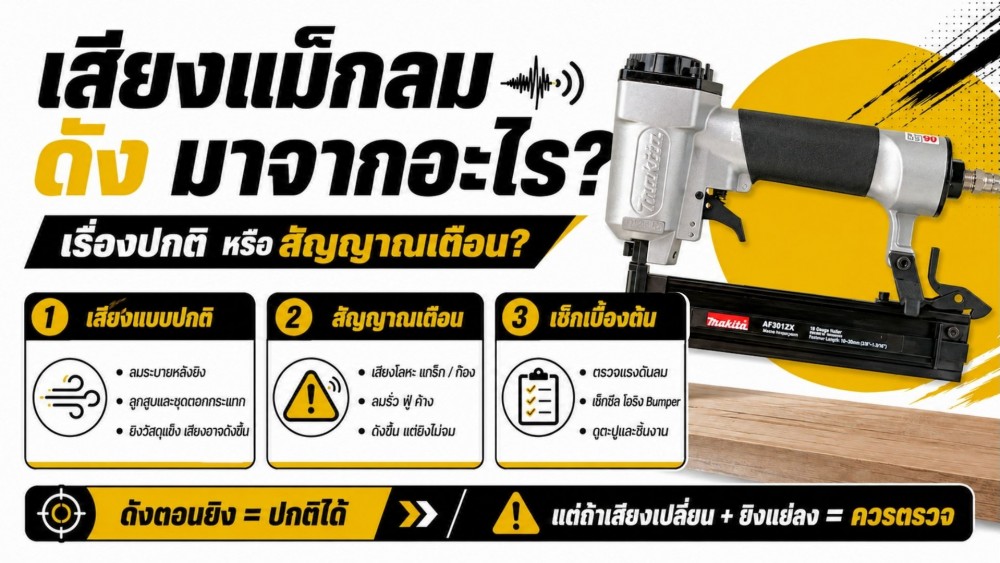
Summary: Is a noisy pneumatic nailer normal, or should you be concerned?
A loud noise when firing a pneumatic nailer is considered normal. The tool works by releasing compressed air to drive the piston and driver blade at high speed, then exhausting the air in a split second. Therefore, both air rushing and impact sounds occur simultaneously, especially when using high pressure, firing large nails, working on hard materials, or operating in enclosed spaces.
What should not be overlooked is: A sound that deviates from the tool's original character, such as:
- A metallic clattering noise
- A persistent air leak sound after releasing the trigger
- Nails not sinking flush accompanied by abnormally loud air noise
- Increased tool vibration or stronger recoil
- More frequent jamming than usual
These symptoms may be related to improper air pressure, leaking seals or O-rings, a deteriorated bumper, driver blade issues, or using the wrong type of nails.
If you feel that Air stapler it is very loud, do not immediately assume the tool is broken, but also do not dismiss it with "it is always this loud" in every case. Try listening to where the sound comes from, check the air pressure, inspect for air leaks, and examine the nails and driving performance simultaneously.