


 EN
 ไทย


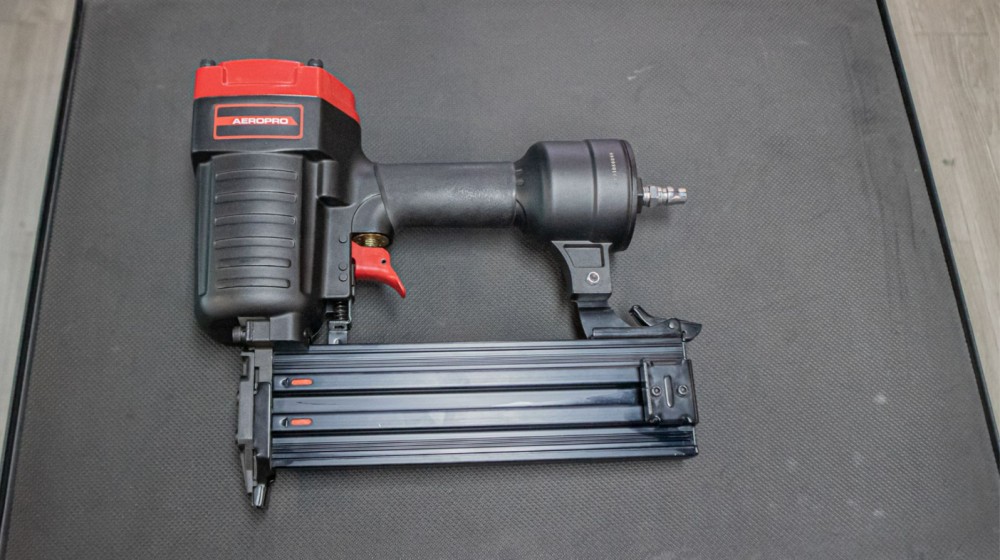
Customers Also Purchased


Many people picture driving nails one by one with a hammer as the timeless, fundamental method in carpentry, woodworking, and construction. But as tools have evolved, Air stapler pneumatic nailers or nail guns have begun playing a much larger role, especially in repetitive fastening tasks or work requiring high speed and consistency.
An interesting question is: How does the impact force of an air nailer differ from that of a hammer? Since both achieve a similar outcome—driving a nail flush into the workpiece—how do their operating principles fundamentally differ? And how does this difference directly affect speed, neatness, precision, user fatigue, and the finished quality of the workpiece?
Why Do Air Nailers Drive Nails So Fast?
What is an Air Nailer? A pneumatic tool that uses compressed air from an air compressor to drive nails, brads, or staples into materials. The tool features a magazine containing a strip of nails or staples. Once the nose piece is pressed against the workpiece and the trigger is pulled, an internal system releases air pressure to drive a piston or striker assembly rapidly. Force from this piston is transferred to the internal driver blade, driving the fastener out of the magazine tip and sinking it into the wood or target material in a fraction of a second. The key advantage of a pneumatic nailer lies in its ability to deliver repeated force faster and more consistently than manual hammering.
- Pneumatic nailers do not directly rely on the user's arm strength.
- They use air pressure regulated by an air compressor system and the tool itself.
- When the air pressure is properly adjusted, each nail is driven with nearly identical force.
- Pneumatic nailers help achieve a consistent nail depth.
For jobs requiring hundreds or thousands of nails driven each day, using a hammer takes significantly longer, and with every strike, the hand pressure, hammer angle, and rhythm of impact all make a difference. A pneumatic nailer directly addresses this problem.
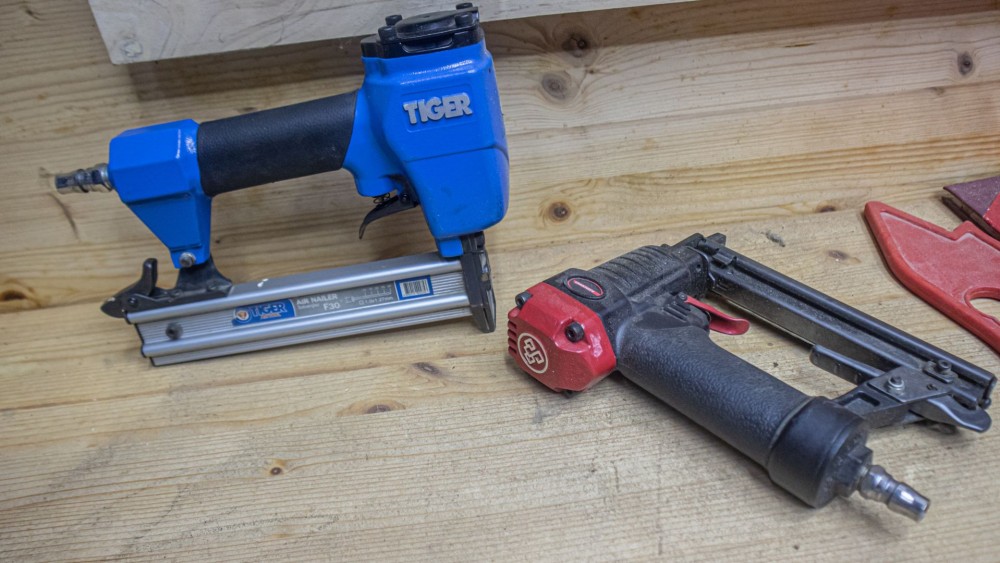
- Is an air stapler/nailer really easy to use? What do you need to know to prevent misfires?
Air pressure transforms into driving force in a fraction of a second
When the trigger is pulled, an internal valve opens to allow high-pressure air to push the piston down at high speed, and transfers the force to the driver blade to drive the nail or staple out of the magazine track. The entire movement happens in an instant, driving the fastener almost immediately upon pulling the trigger. Once the air exhausts, the piston returns to its original position, ready for the next shot.
This type of impact is short, heavy, and fast, unlike a hammer where the force comes from swinging the arm and striking the nail head directly. A single hammer strike might only sink the nail partially, especially with longer nails or harder materials, requiring multiple blows to fully drive it flush.
Pneumatic nailers are designed to drive nails to a preset depth instantly. Provided that the air pressure, nail size, and material type are properly matched, work progresses significantly faster.
The force of a pneumatic nailer is controlled by air pressure and the tool itself
- The impact force of a pneumatic nailer can be controlled to an extent via air pressure from the air compressor.
- Some models also feature a tool-free depth-of-drive adjustment on the body.
- Increasing the air pressure generally drives the nail deeper.
- Too low air pressure can cause nails to not sink completely, leaving the heads proud or resulting in underpowered drives.
- Choosing the right air pressure must therefore match the fastener size, nail type, wood hardness, and the specific application.
A hammer controls force primarily through the user's hand strength. Experienced tradespeople can strike lightly or heavily as needed, but for many, maintaining consistent force is difficult, and occasional missed strikes can dent the work surface. Pneumatic nailers offer superior consistency for high-volume jobs, whereas hammers retain their advantage in small jobs, localized touch-ups, or tasks requiring tactile hand control.
Hammers impact from the outside; pneumatic nailers drive directly along the tool's axis
The force of a hammer comes from external impacts on the nail head, requiring you to aim precisely so the hammer face strikes the nail head dead center. If the angle is off even slightly, the nail can tilt or bend, or the hammer head could slip and mar the workpiece surface—especially when driving small nails or working near the edge of wood.
An air nailer drives nails out of its nose along an engineered track, keeping the nail's trajectory much more consistent. When the tool tip is pressed flush and held at the correct angle, the nail fires immediately in the exact orientation of the nose.
Another Common Misconceptions About Air Nailers You Might Not Know Using this tool does not mean there's zero chance of making a mistake. If the tool is held at an angle, not pressed flush, loaded with the wrong nail size, operated with improper air pressure, or fired too close to the material edge, nails can still blow out the side, split the wood, or sink to the wrong depth.
Working Speed: The Clearest Difference Between an Air Nailer and a Hammer
When it comes to speed, an air nailer holds a clear advantage over a hammer because it can drive a nail in a single stroke, eliminating the need to pick up nails individually, set them in place, and hammer repeatedly. In jobs requiring numerous nails, the time difference is greater than many realize. Using a hammer requires one hand to hold the nail, the other to hold the hammer, all while being careful not to let the nail tilt. In contrast, an air nailer allows continuous firing once loaded into the magazine, maintaining a steady work rhythm and drastically cutting down sub-steps.
This speed also helps achieve more consistent work quality, because without excessive physical exertion, fatigue is reduced, and positioning and tool control remain better throughout the job. This speed directly boosts efficiency, even though for small tasks such as driving just a few nails, temporary hanging, or minor repairs, a hammer might still be more convenient since it doesn't require setting up an air compressor, air hose, fittings, and preparing the system before use.
Air Nailers Effectively Reduce Surface Marks on Workpieces
One reason air nailers are popular in furniture making and decorative work is their ability to minimize impact marks on the workpiece surface. When using a hammer—especially with small nails or in tight spots—there is a risk that the hammer face might miss and strike the wood, causing dents, bruises, or surface damage that requires extra puttying, sanding, or touch-ups. An air nailer, however, places its nose directly on the target point and drives the nail straight down, reducing the chance of impact damaging the surface around the fastening spot.
In baseboard installation, wood moldings, decorative trim, or finish-grade pieces, this neatness is crucial, as even small surface blemishes can become glaringly visible after painting or clear coating.
An air nailer matched with the proper nail size leaves a smaller nail hole and is easier to finish.
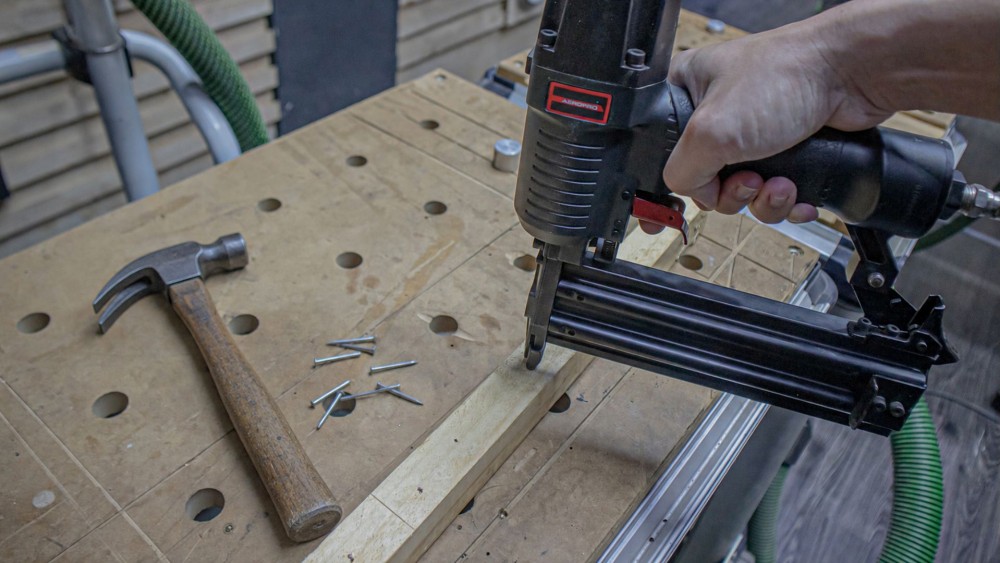
Knowing that the differences between single-pin (brad/finish) and double-pin (stapler) air nailers and how they are used is therefore important. Moreover, setting the air pressure too high can overdrive the nail head, creating an unnecessarily deep hole. Thus, a neat finish doesn't rely solely on the tool itself, but also on selecting the right air pressure, choosing the right nail size, and performing test shots on scrap material before starting the actual work.
Precision and Force Consistency
Air nailers deliver superior force consistency because the driving power comes from a relatively stable pneumatic system. When air pressure in the system is adequate without significant drops, each nail is propelled with near-identical force, ensuring uniform driving depth.
With a hammer, precision depends primarily on the user's skill. Skilled tradespeople can hammer straight and cleanly, but over extended continuous hammering, arm strength fades, leading to uneven driving depth. In jobs demanding both high speed and high consistency, an air nailer minimizes human variability much better.
What Types of Work Are Air Nailers Better Suited For Than Hammers?
Air nailers are ideal for applications requiring a large volume of nails driven in a short period, as they save time, reduce physical effort, and enhance consistency, such as:
- Wooden crate making
- Pallet assembly
- Furniture making
- Wooden framing
- Molding and trim installation
- Plywood fastening
- Interior finishing requiring a neat result
Using an air nailer helps craftsmen work faster and reduces fatigue from hammering repeatedly all day.
Air nailers are also suitable for jobs with small, hard-to-hold fasteners, such as finishing nails or small staples, because using a hammer with tiny nails carries a high risk of slipping. An air nailer holds nails in a magazine and fires them rapidly, eliminating the need to handle nails one by one and making precision work much more convenient.
For small jobs and spot fixes, a hammer is still useful
Although an air nailer is faster and more consistent, a hammer is still not a tool that can be completely replaced. A hammer is ready to grab and use immediately without accessories or electricity, offering direct, straightforward force control. In addition, for tasks that require gentle tapping, leveling, or aligning workpieces, a hammer is more suitable than an air nailer because it is designed for tapping and adjusting.
Precautions Regarding Impact Force from an Air Nailer
When using an air nailer, you should prioritize proper settings and safety, as it fires nails with high force and at great speed. Choose an air pressure suited to the tool's specifications and do not exceed the manufacturer's limit. Check the air hose, fittings, and nailer nose before use. Also, select the right nail size for your workpiece; using nails that are too long on thin wood may cause them to poke out the back, and using excessive pressure on soft materials can damage the surface or split the wood.
Something that should not be overlooked is test-firing the air nailer on scrap material before starting actual work, especially when changing wood types, nail lengths, or air pressure.
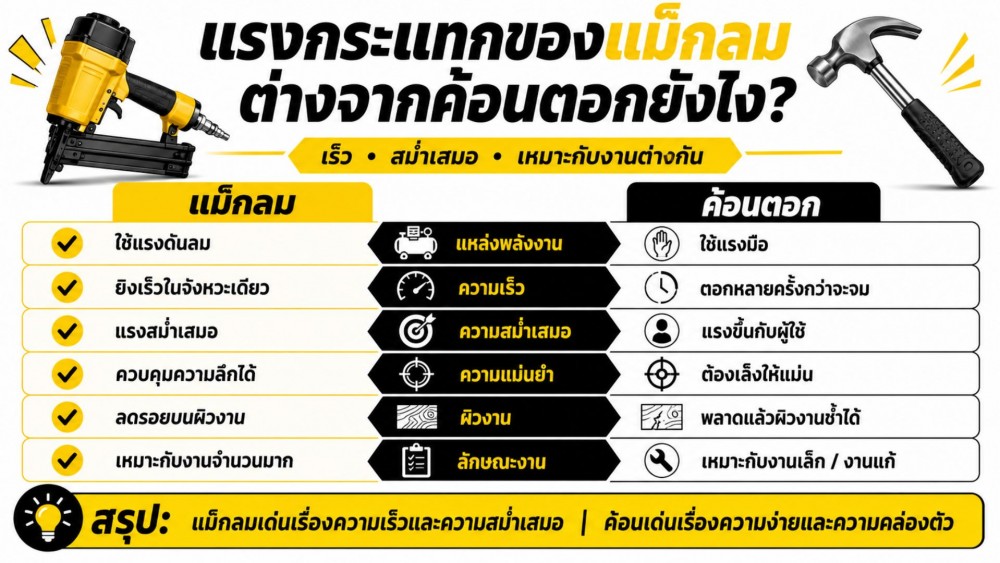
Conclusion: The impact force of an air nailer is not just stronger, but more consistent and faster
The impact force of an air nailer differs from using a hammer in that it utilizes pneumatic pressure to generate force inside the tool, driving nails into the workpiece rapidly and consistently. A hammer, on the other hand, relies on human force swinging the hammer head directly against the nail head, meaning it depends on hand strength, striking angle, and user skill An air nailer is therefore ideal for tasks demanding speed, continuity, and neatness, such as mass production, while a hammer remains suited for small jobs, spot repairs, and tasks requiring grab-and-go mobility.
Comparing an air nailer to a hammer is not about which tool is definitively "better," but rather about choosing the right tool for the job
If you need speed, reduced fatigue, and consistent driving force Air stapler is the answer. But for small tasks, temporary fixes, or jobs that require gentle tapping and fine adjustments, a hammer is still an indispensable basic tool.