


 EN
 ไทย


Customers Also Purchased


When choosing a Reciprocating saw and Jigsaw Blades The first thing we notice is that each blade model features distinct tooth geometry. Some jigsaw blades have small, densely packed teeth, while others feature larger, widely spaced, and coarser teeth. This has led to the common belief that clean-cutting jigsaw blades must have fine teeth and therefore cut slowly, whereas fast-cutting blades have coarse teeth that leave noticeably rough cut edges. But just how accurate is this common assumption?
The answer is In principle, it is generally true, but that doesn't mean fine-toothed jigsaw blades are slower than coarse-toothed blades in every single situation.
The cutting speed of a fret saw or jigsaw doesn't depend solely on tooth density, but also involves:
- Number of teeth engaged with the workpiece
- Tooth geometry
- Gullet width (chip clearance)
- Material thickness
- Tool power
- Stroke speed / RPM
- The pendulum or orbital action setting of the jigsaw
If you want to choose the right jigsaw blade for your actual job, you first need to understand why smooth-cut blades typically cut slower, and why coarse-cut blades can advance through the workpiece much faster.
What is the difference between clean-cut and rough-cut jigsaw blades?
The most obvious difference when comparing clean-cut jigsaw blades to fast-cut blades is the tooth size and tooth spacing. Clean-cut blades usually have smaller, closely spaced teeth, so as the blade moves up and down, multiple teeth contact and cut into the material simultaneously. The advantage is that the force exerted on the material per tooth is not as aggressive, helping to reduce tear-out along the cut edge—especially on materials like plywood, MDF, laminated sheets, or wood requiring a clean finished edge.
Jigsaw blades designed for fast cutting or rough cutting typically feature larger teeth with wider spacing between them. Consequently, each stroke of the blade removes a larger volume of material. The resulting cut is usually rougher with more splintering and may not be suitable for work requiring an immediate finished surface. What TPI should a woodworking jigsaw blade start at for clean cuts?
The number of teeth per distance, or TPI, directly affects performance
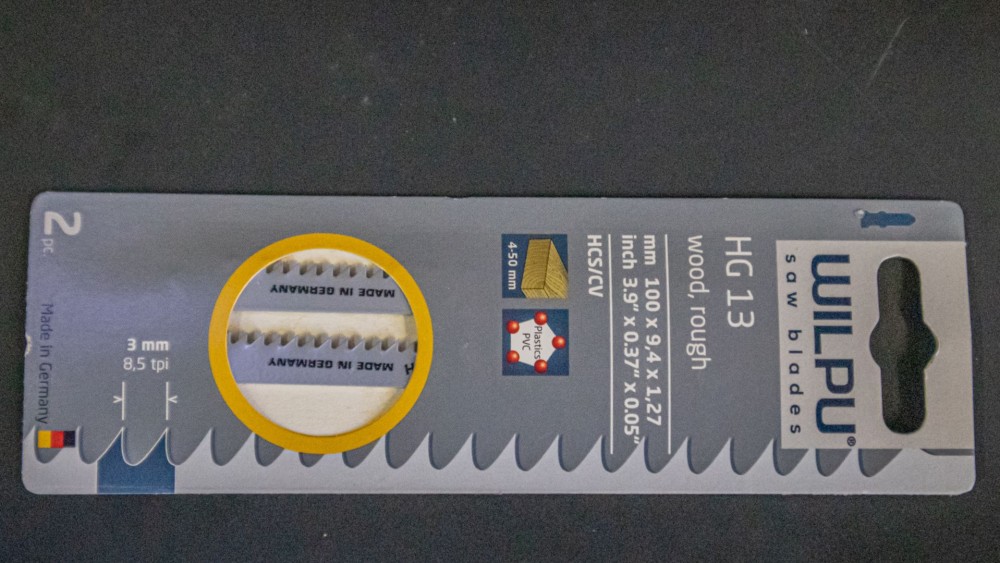
One of the specifications used to evaluate all types of saw blades, including jigsaw blades, is TPI, or Teeth Per Inch, which indicates the number of teeth per inch of blade length.
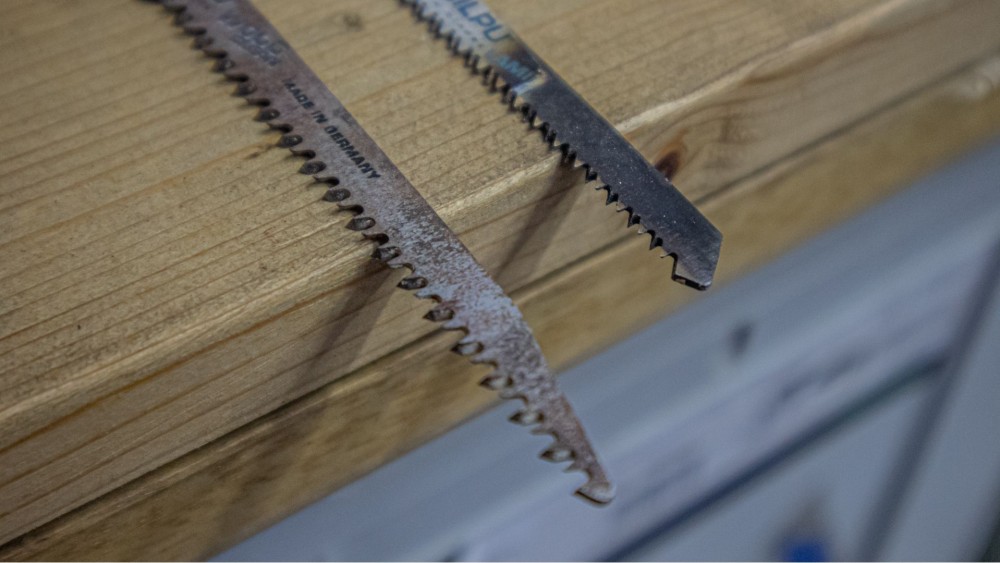
- Low-TPI blades are ideal for woodworking and cuts requiring speed, because each tooth can remove material in larger chips.
- High-TPI blades are suitable for materials requiring controlled cut edges or thin materials such as sheet metal, thin plastic, or wood panels where edge splintering needs to be minimized.
- You shouldn't choose based on the TPI number alone; each brand may use different tooth geometries, tooth angles, and grinding techniques, so blades with similar tooth counts might not deliver identical cutting speeds and cut surface qualities.
Why do coarse-tooth jigsaw blades cut faster?
Think of using a spoon to scoop dirt. If you use a small spoon to scoop a little bit at a time, you get fine control, but it takes many scoops to move a large amount of dirt. Conversely, if you use a large shovel, you can remove a lot of dirt with each scoop. Cutting with a saw blade works on a similar principle.
Fast-cutting jigsaw blades typically have larger teeth and remove material in larger chips with each stroke of the blade. When a jigsaw operates at thousands of strokes per minute, the difference in the amount of material removed each stroke accumulates, resulting in a significant difference in cutting speed.
The gullet (the space between the teeth) on a coarse-tooth jigsaw blade is also larger, allowing it to efficiently clear wood shavings or debris out of the cut kerf. When chips don't pack tightly between the blade and the workpiece, the teeth can continuously bite into fresh material, reducing the chance of blade overheating caused by friction with trapped debris in the kerf.
Chip clearance gullets are more important than you think
While a jigsaw blade is cutting wood, we may only see the blade moving up and down, but in reality, every time the teeth bite into the workpiece, debris is generated. If these chips cannot exit the cut kerf in time, they will pack tightly between the saw teeth and the workpiece, reducing cutting efficiency.
This is one reason why Fine-tooth jigsaw blades usually cut slower when used on thick wood Because the space between teeth has limited capacity, advancing the tool too fast causes wood chips to form faster than the blade can clear them from the kerf, making the tool feel sluggish or requiring more forward pushing force.
Why do clean-cut jigsaw blades usually require finer teeth?
The primary function of a clean-cut blade is to control fiber blowout and reduce chipping along the cut edge. When multiple small teeth gradually shave off material in tiny increments, the tearing force exerted on the wood fibers per stroke is much lower than with a coarse blade, resulting in significantly less surface tear-out.
If you need to cut plywood to make cabinets, shelves, or furniture and want the cut edges ready for assembly without extensive sanding, choosing a fine-cut jigsaw blade provides a more suitable result, even if it requires a slower feed rate.
Does a fine-tooth jigsaw blade always mean slow cutting?
The idea that a jigsaw blade with "fine teeth cuts slowly" is obvious when comparing blades on the same material and similar thickness. However, if the material changes, this relationship might not hold entirely true.
A clear example is cutting thin sheet metal. If you choose a blade that is too coarse, only one or two teeth might engage the material at a time. As the blade moves upward, the teeth can catch aggressively on the metal edge, causing tool vibration, blade chatter, or chipped teeth.
In this situation, a fine-tooth jigsaw blade can cut efficiently because multiple teeth engage the workpiece simultaneously, ensuring continuous material removal and easy control.
The key principle is not to pick the jigsaw blade with the coarsest teeth just for speed, but to choose a tooth count suited to the thickness and type of material.
Thin materials should have multiple teeth engaging the workpiece
A general rule for selecting blades for thin materials is that several teeth should engage the material simultaneously throughout the cut. If the material is much thinner than the tooth pitch, the blade teeth may catch and snag the workpiece rather than shearing the material smoothly.
This is why jigsaw blades for metal cutting typically have finer teeth than those for wood, even though metal is a harder material; the goal is to have enough teeth sharing the load and reducing the impact on each individual tooth.
A pendulum action system can help the blade cut faster
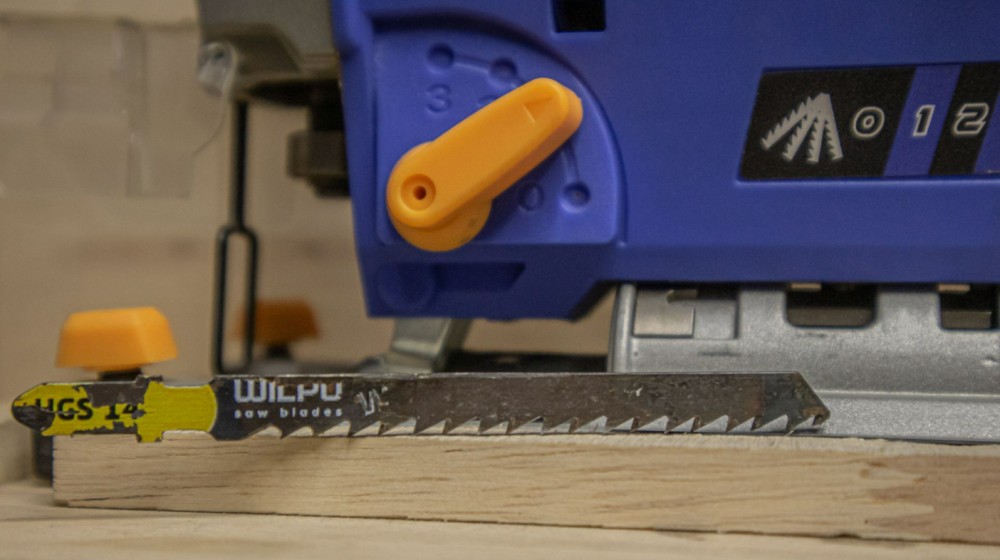
Besides the blade type, the jigsaw itself also affects cutting speed, especially models equipped with a Pendulum Action or Orbital Action which moves the jigsaw blade not only up and down vertically, but also swings it forward on the cutting stroke.
What is the Pendulum / Orbital Action on a jigsaw used for? Setting the pendulum to a higher level causes the blade teeth to bite into the workpiece at a more aggressive angle, removing more material and opening up space for chips to clear easily, which increases cutting speed—especially when cutting softwood or thick lumber.
However, the trade-off is just like with a coarse-tooth jigsaw blade: The higher the pendulum setting, the rougher the cut usually is. If you need to cut laminate sheets, make tight curved cuts, or require a clean cut surface, reducing the pendulum level or turning it off entirely generally yields better results.
Therefore, if you feel that one blade cuts much faster than another, the difference might not come down to the jigsaw blade alone, but also the tool's settings.
Can you achieve both fast cutting and clean cut edges?
If you ask whether there are jigsaw blades that are both fast and provide a clean cut, the answer is that certain types can do so to some extent.
- Today's saw blade technology has evolved tooth geometries and grinding methods to better balance cutting speed with cut quality.
- Some blade models are designed with moderately sized teeth combined with a shape that clears chips efficiently, allowing faster cutting than typical fine-tooth blades while still leaving a relatively clean cut.
- In practice, there is still a trade-off: if the goal is maximum cutting speed, the cut usually won't be as smooth as blades designed specifically for fine cuts.
- If you need a very clean cut, you will have to compromise by reducing the tool's feed rate.
Choose based on the priority of the task. For example, if cutting framing timber where edges will later be covered or concealed, speed may matter more than smoothness. However, for visible furniture components, cutting slower to get a smoother finish will save time on sanding and finishing.
Which jigsaw blade should you choose between fast cut and smooth cut?
For general wood cutting, framing work, cuts that won't be visible, or processing large quantities of workpieces, choosing a coarse-tooth blade will save time. But for furniture, plywood, laminates, or workpieces requiring clean edges, you should choose a fine-cut blade, even if it requires feeding the tool more slowly.
For metals and thin materials, you should mainly match the tooth count to the thickness of the workpiece, because using a blade that is too coarse does not necessarily cut faster and can instead cause tool vibration or blade tooth damage.
For long straight cuts prioritized for speed, a rigid blade with coarse teeth works well. But for tight-radius curves, the jigsaw blade should be narrower to navigate cuts more easily, which may come at the expense of maintaining a straight line.
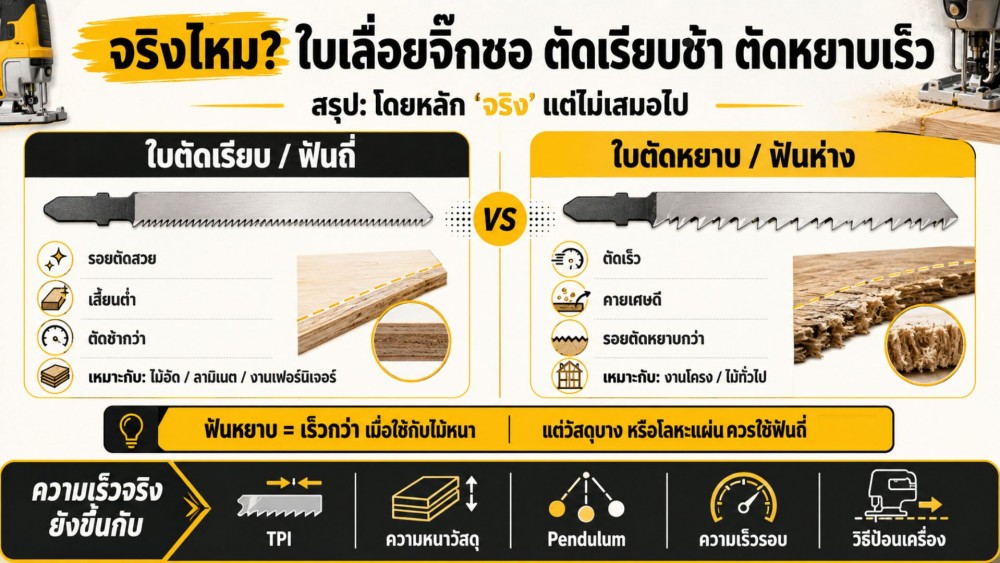
Summary: Is it true that smooth-cut jigsaw blades are slow and coarse-cut blades are fast?
Overall, the answer is yes. Jigsaw blades designed for smooth cuts usually have small, closely spaced teeth that remove material gradually, resulting in a cleaner and easier-to-control cut, but requiring more time to pass through the workpiece.
Fast-cutting blades remove a larger amount of material and have larger gullets for chip clearance, allowing the tool to move faster, but with a higher chance of splintering and chipping.
Do not assume coarse teeth are always fast and fine teeth are always slow in every scenario. The performance of a Reciprocating saw and Jigsaw Blades also depends on the material, thickness, tooth geometry, rotational speed,
operating mode, and tool feed technique as well.