


 EN
 ไทย


Customers Also Purchased


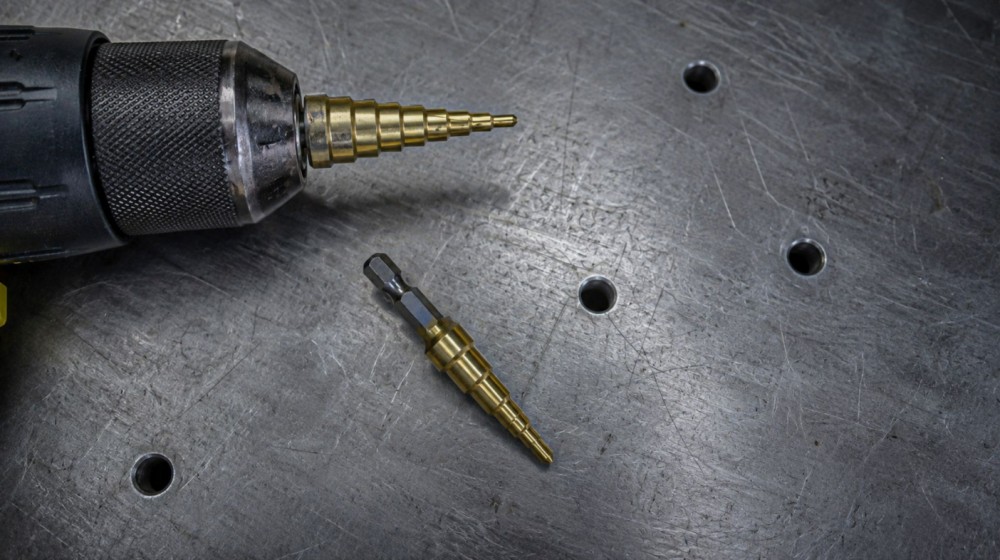
Step Drill Bit Also known as pagoda drill bits or step drill bits. This is a hole-drilling tool where a single bit can drill multiple hole sizes according to the stepped tiers arranged along the body. There is no need to swap drill bits every time you want to enlarge a hole from small to large; the resulting holes have smooth edges, and the next step can conveniently deburr the rim of the hole simultaneously.
An in-depth look at step drill bits: What are their benefits, how are they used, and what can they do? From their external appearance, step drill bits may look extremely sturdy—large in size, with a thick base, and typically made of high-speed steel (HSS). Some are titanium nitride coated or made from cobalt-alloyed metal for heat resistance. Some people might assume that if the bit can enlarge holes up to 20, 25, or 30 mm, it should be able to drill through thick steel just as easily.
In reality, the ability to drill multiple hole sizes does not mean a step drill bit can drill through materials of any thickness. The stepped design is engineered to incrementally increase hole diameter rather than penetrate deep into thick metal like a twist drill bit. Workpiece thickness is therefore one of the most critical limitations of a step drill bit.
Drilling large holes does not mean drilling deep
A common point of confusion is equating "hole diameter" with "drilling depth capacity," but the two are completely different things.
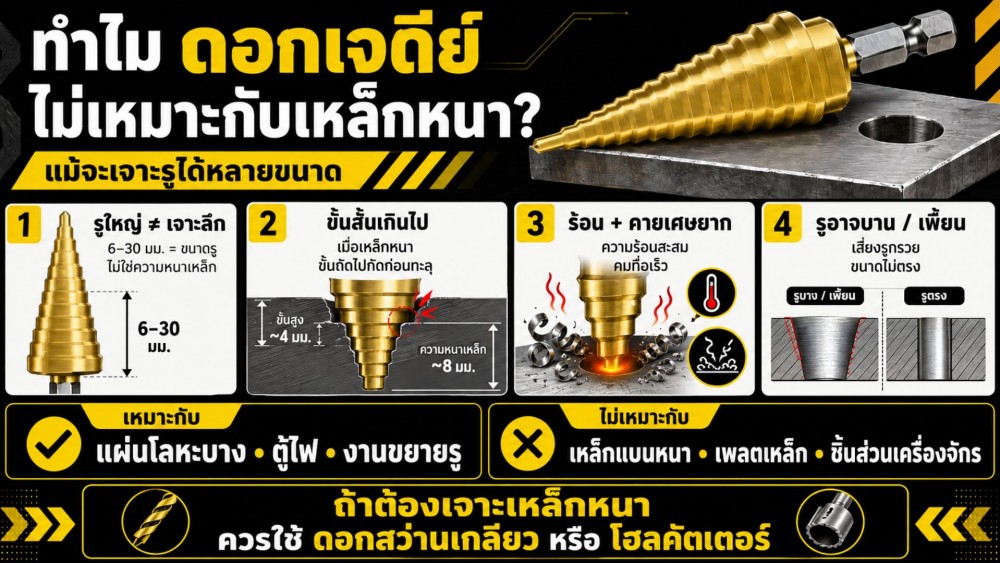
- A step drill bit marked with a 6–30 mm size range means that the bit can produce holes ranging from 6 to 30 mm in diameter across its various steps.
- It does not mean that the bit can drill through steel that is 30 mm thick.
- The depth at which each size can maintain its diameter is limited by the step height.
For example, if a step drill bit has a step height of approximately 4 mm, it is suited for use on thin materials. If used to drill steel that is thicker than the step height, the next step will begin cutting into the workpiece before the current step has fully penetrated through to the other side. This results in an oversized hole or one that is not cylindrical throughout the thickness of the workpiece.
Even if a step drill bit is made of high-quality HSS, well-coated, or more heat-resistant, if the step height is insufficient for the workpiece thickness, the bit still cannot maintain a consistent hole size throughout the depth.
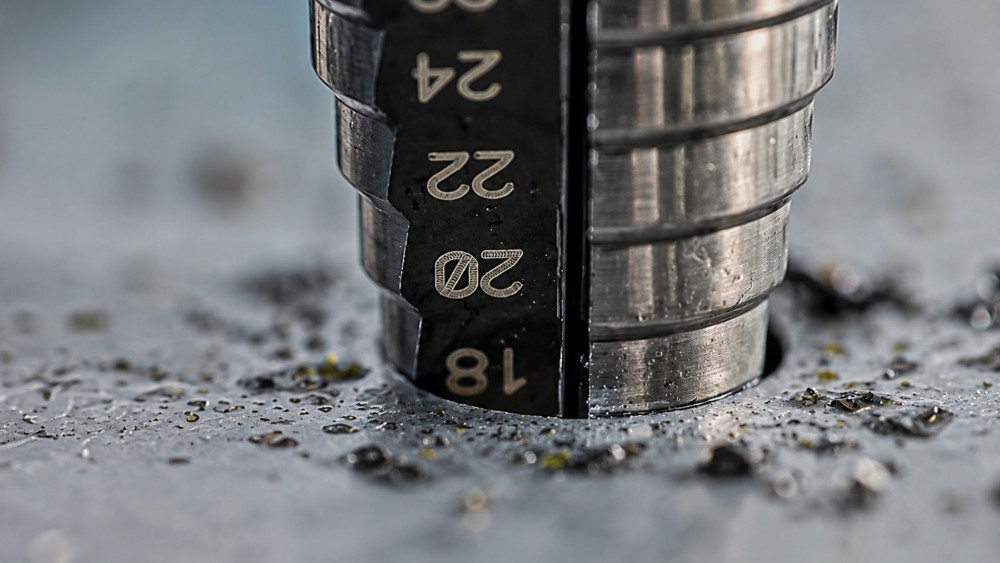
The cutting edge geometry of a step drill bit is designed for "enlarging holes" rather than "deep drilling"
Standard twist drill bits for steel have cutting edges at the tip and continuous flutes running along the body. As the bit rotates, the cutting edges continuously cut material at the bottom of the hole while the flutes evacuate chips out of the hole. Thus, they can drill deeper than their diameter depending on the flute length and overall bit length.
Each step's cutting edge operates for only a short interval
The primary cutting edges of a step drill bit are distributed along the shoulder of each step. Each time the bit advances, the next step enlarges the diameter of the hole opened by the previous step. This cutting method is highly effective when drilling thin sheet metal, where each step engages for only a brief moment before breaking through.
However, when drilling thick steel:
- The cutting edge of each step must remain in the material much longer.
- A larger contact surface area is created.
- It must endure continuous cutting forces far beyond what the bit was designed to handle.
The next step may cut into the workpiece before the current step breaks through
When drilling thin sheet metal, one step of the bit can fully penetrate the workpiece before the next step makes full contact, making it easy to stop at the desired size. With thick steel, however, multiple steps may contact the workpiece at the same time: one cutting edge is drilling deep while upper steps are simultaneously enlarging and chamfering the hole entrance. The load on both the drill and the bit increases rapidly.
Thick steel causes more heat buildup than you might expect
Heat is a major enemy of all types of drill bits. While drilling metal, part of the energy from the motor is used to cut the material, while another part turns into heat from friction. The longer the cutting edge is in contact with the material, the larger the cutting area, the more improper the speed, or the poorer the chip evacuation, the higher the heat generated at the cutting edge.
When drilling thin sheet metal, each step of the step drill bit contacts the material for only a short time and penetrates quickly, allowing less time for heat to accumulate.
However, when drilling thick steel, the bit must operate continuously for a long period. Multiple cutting edges may rub against the hole wall simultaneously, and metal chips have to travel through flutes that do not have the length and open space found in twist drill bits designed for deep-hole drilling.
Using excessively high RPM may cause metal chips to discolor, burn marks around the hole opening, or the bit to darken. On gold-coated bits, the coating may gradually wear away at the cutting edge, while HSS bits exposed to repeated extreme heat can quickly lose their sharpness.
Chip Evacuation Issues When Drilling Thick Steel
Chips generated from metal drilling do not disappear from the hole on their own. Drill bits must have sufficient space for chips to flow out continuously. If chips remain trapped between the cutting edge and the hole wall, they may be re-cut and crushed, creating additional friction and scratching the hole surface. Standard twist drill bits therefore feature continuous flutes running from the tip up the body, allowing chips cut from the bottom of the hole to flow upwards systematically.
Step drill bits also have chip flutes, but because the body is stepped, the cutting area and chip flow direction change each time a new diameter is entered. When used on thin sheets, chips evacuate quickly from the workpiece, but with thick materials, chips can easily accumulate in the flutes or become compacted between the steps.
Common symptoms include:
- The bit begins to cut into the steel more slowly
- The drilling sound turns into a scraping or grinding noise
- The machine vibrates more
- More downward pressure is required
The step drill bit may suddenly grab or bind in the workpiece, commonly referred to by tradespeople as "catching" or "kickback", especially when the cutting edge is about to break through the other side.
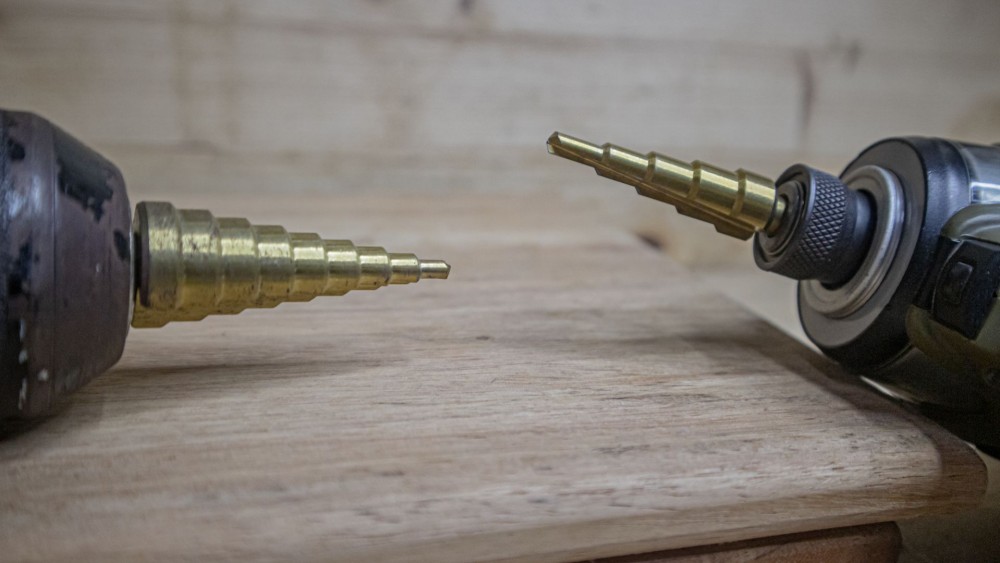
The Resulting Hole May Not Be True to Size Even If the Step Drill Bit Penetrates
When using a step drill bit on thick steel, various dimensional deviations can occur in the hole:
- The hole may differ in diameter between the top and bottom because the next step has already begun enlarging the hole opening.
- The hole may become slanted if using a handheld drill as resistance increases with the bit's step size.
- The hole may be out-of-round due to vibration and loose workpiece clamping.
- The transition between steps can also create internal shoulders or stepped ridges inside the hole, which is unsuitable for applications requiring a straight-walled hole throughout the full thickness.
For general installation work on thin sheets, such as drilling electrical enclosures, minor deviations may not matter much because locknuts and washers can cover the hole edges. However, for holes intended for load-bearing bolts, shaft fits, or subsequent thread tapping, the straightness and precision of the hole are critical. Choosing a drill bit designed for deep drilling will yield far more reliable results.
Does Applying More Pressure Not Help a Step Drill Bit Cut Thick Steel Better?
When the drill bit starts drilling slowly, many people may automatically increase the downward pressure, thinking that the bit needs more force to cut through the steel. This helps a little in cases where the pressure is too light, causing the cutting edge to merely rub against the material's surface. However, if the real cause stems from an improper speed, a dulling cutting edge, clogged chips, or using the wrong type of bit, increasing the pressure will only worsen the problem.
Excessive pressure increases the load on the tip of the step drill bit and on the cutting edges of each step. The bit binds to the workpiece, the drill motor has to generate higher torque, the tool may overheat, the overload protection system may trip, or
Some step drill bit models are designed with a Split Point tip to help start holes easily and reduce bit wandering on metal surfaces. However, this type of tip is not designed to withstand continuous high pressure. Applying excessive feed pressure during the start of drilling is one of the causes of tip damage. Therefore, you should let the cutting edge work with a balanced speed and feed pressure rather than forcing pressure to compensate for choosing the wrong bit for the job; the battery drains quickly, and when using a drill, torque can kick back to the user's hand, causing the tool to twist violently.
If you ask whether Can standard hex-shank step drill bits be used with impact drivers? The answer is yes, but there is a risk of breakage, heat accumulation, or inability to control hole size.
So how thick does steel have to be before it becomes unsuitable for a step drill bit?
There is no fixed number for every step drill bit, because you need to consider all of the following:
- Step height
- Step drill bit material
- Flute geometry
- Number of cutting edges
- Type of metal
- Required hole size
- Drill power
- Manufacturer specifications
The basic concept is that the workpiece thickness must not be so great that the next step begins cutting into the material before the target step has drilled completely through.
Standard step drill bits with a step height of around 4 mm are usually suitable for thin sheet metals within a few millimeters, such as 3.5–4 mm. Some types can be used up to around 6 mm, so it should not be concluded that all models can do the same.
Summary
The reason step drill bits are not suitable for thick steel is not because they lack strength or do not drill steel as well as twist drill bits, but rather because of: The stepped design engineered for drilling and enlarging multiple hole sizes in thin materials The limited height of each step when the workpiece is too thick The next step begins cutting into the rim of the hole before the target size has broken through, resulting in a flared, conical, or inconsistently sized hole throughout its depth.
Furthermore, drilling thick steel keeps the cutting edges in contact with the material longer, leading to greater heat accumulation, difficult chip evacuation, and higher torque demand on the drill. The step drill bit may dull quickly, suffer coating damage, chip at the edges, or experience severe binding on the workpiece.
Step drill bits are therefore ideal for electrical enclosures, chassis, sheet metal, hole enlarging, and installations requiring multiple hole sizes quickly. However, if you need to drill through thick flat bars, structural steel, or machinery components, you should switch to twist drill bits designed for metal or hole saws with an appropriate cutting depth.
Before picking up Step Drill Bit to use, you should ask yourself: "What size hole is needed?" and "How thick is the material?" Because a bit that drills multiple sizes might not be designed to drill through every thickness.