


 EN
 ไทย


Customers Also Purchased


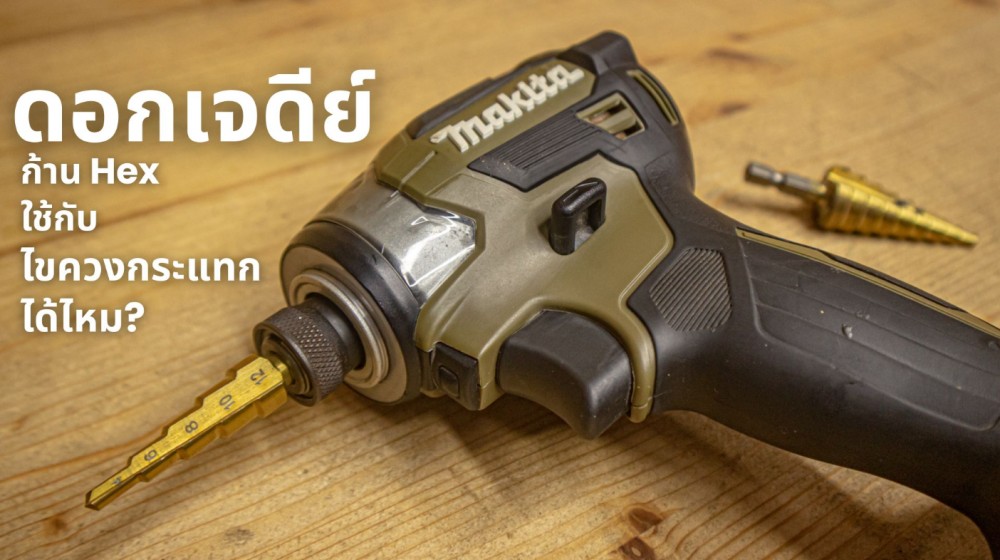
Imagine you pick up Step Drill Bit a newly purchased one, notice that it has a Hex shank, and try inserting it into an impact driver. It fits perfectly—no looseness, no wobbling. You can't help but wonder, "Could it actually work?"
I believe this question arises even more frequently in an era where many power tools share the same chuck type, such as a hexagonal shank or 1/4-inch Hex, which fits drills, electric screwdrivers, and impact drivers alike. The fact that multiple tools use similar-looking chucks makes the line between different types of power tools increasingly blurred.
From familiarity with using Hex bits across various tools, especially when job site schedules are tight and speed is paramount, this thought comes easily. But the question is, should you use it? And more importantly, Is it really safe? Both for the bit itself, the workpiece, and the user.
In this article, we will take a deeper look at what step drill bits are designed for, how impact drivers work, and whether the slight gap between the two causes users to misunderstand, misuse them, and ultimately end up damaging tools, ruining work, or creating unnoticed hazards.
What is a step drill bit, and what is it used for?
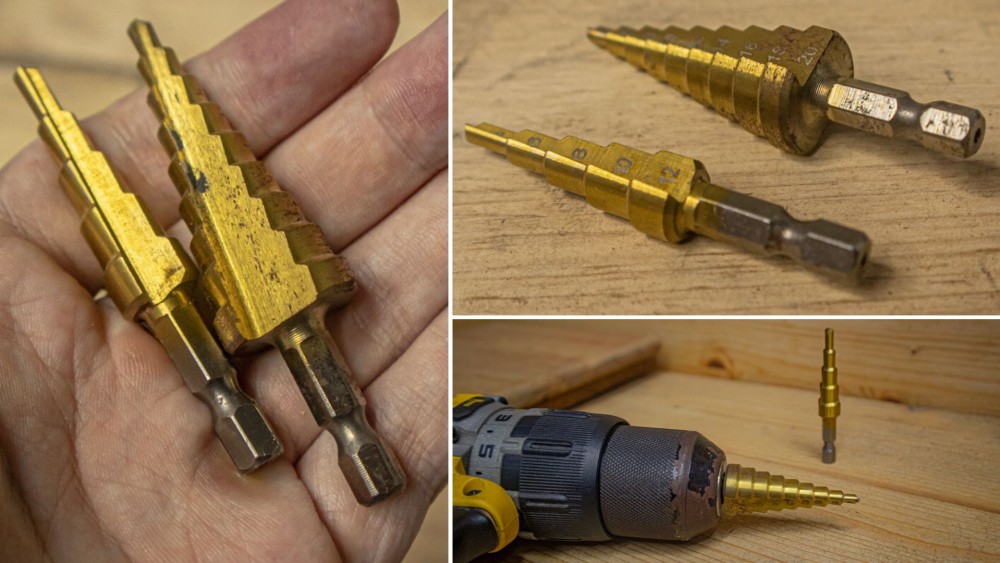
Before asking whether it can be used with an impact driver, I'd like to take a step back and ask a more fundamental question first: A deep dive into what makes a step drill bit good, how to use it, and what it can do. A step drill bit is a drill bit with stepped increments resembling a pagoda or pyramid. Its primary role is not aggressive hole punching like standard drill bits, but rather enlarging holes and controlling hole sizes with precision.
On real job sites, step drill bits are often used for tasks such as drilling thin sheet metal, stainless steel sheets, aluminum, enlarging existing holes, and working on electrical enclosures and control panels.
The key highlights of a step drill bit are the smoothness of the hole edges and precise size control. However, all of this comes with an important condition: it requires steady rotation and controlled force.
Impact drivers vs. drills: Interchangeable, but not for every job
I want to pause here and ask you a straightforward question: "An impact driver spins, and a drill also spins; both can drill, so isn't power the only difference?" If you think that way, let me tell you that you're not alone—and this is precisely where many problems with step drill bits begin.
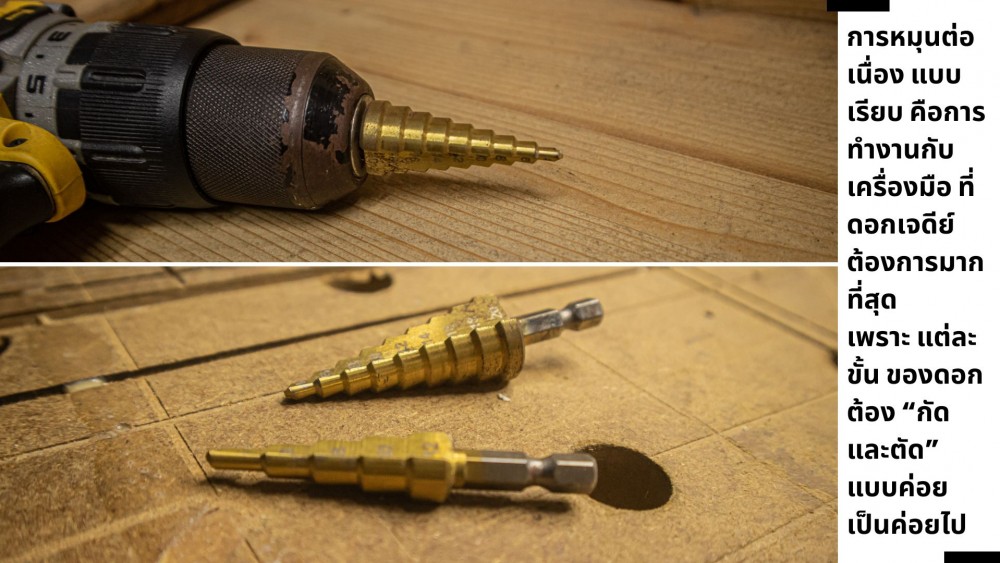
Drills are designed to deliver continuous, smooth rotational force with precise speed control, allowing you to press lightly, apply more pressure, increase or decrease speed as needed. All force is transmitted to the bit consistently.
How Do Impact Drivers Really Work?
Many people view an impact driver as a "powerful drill" because it is commonly perceived as a fast-spinning, loud, compact yet powerful tool. In reality, the working mechanism of an impact driver is quite different from that of a drill, and this exact difference becomes a hidden risk that many people overlook.
An impact driver relies on rotation to build up rotational force before releasing it in repetitive, short bursts of concussive impacts. These impacts occur whenever the load increases, making the rotational behavior irregular compared to a drill. This is a crucial point that must be clearly understood before using an impact driver with a step drill bit.
This impact force is ideal for driving screws, bolts, or self-tapping screws that require high torque in short bursts. But the question is: Is this kind of force suitable for step drill bits?
A Hex Shank Step Bit Fits, But That Doesn't Mean It's Used Correctly
Can an impact driver use any bit as long as it has a hex shank, is that true? This is where quite a few people misunderstand. Seeing that the step drill bit they bought has a hex shank just like a screwdriver bit or impact-rated bit designed for an impact driver chuck, they immediately conclude that "it can be used with an impact driver."
I would like you to remember this phrase: Just because it fits does not mean it's suitable. Because the primary function of a hex shank is to prevent slipping in the chuck and allow quick insertion and removal. It indicates nothing about what type of force the bit was actually designed to withstand.
Actual Problems That Can Occur When Using the Wrong Bit with an Impact Driver
Problems caused by using a step drill bit with an impact driver usually accumulate gradually through repeated use. Before long, the step bit starts drilling poorly, cuts roughly, or breaks down unexpectedly. So, let's take a look at the real issues that can arise from using a step drill bit with a tool not designed for it.
1. Inability to control hole size
Step drill bits require steady and continuous rotational force to cut through material gradually and consistently to achieve the designed hole size. However, when used with an impact driver, the intermittent impacts prevent the bit from cutting smoothly at a single step long enough, causing the bit to "skip" between steps.
The consequence is not just an uneven, rough hole, but the accuracy of the work is directly impacted as well. For example, a hole that should be round becomes misshapen, smooth edges become chipped, and the intended hole size may deviate from standard measurements. For certain applications, these errors can completely ruin the entire workpiece.
2. Inconsistent heat buildup
The concussive force of an impact driver causes irregular, intermittent friction between the bit and the workpiece. Heat does not dissipate evenly like it does during the smooth rotation of a drill; instead, it accumulates at localized spots such as the step transitions of the bit, which are already thinner and subject to higher stress.
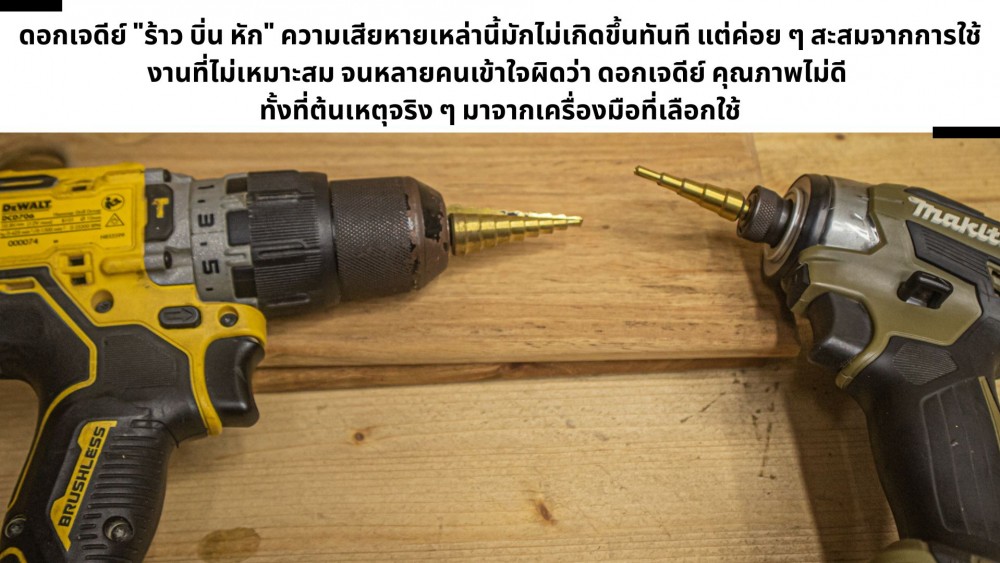
When heat builds up improperly, the cutting edges of the step drill bit degrade faster than usual. The cutting flutes begin to burn or become dull even while the user still feels that the bit is "good enough to use."
This is why many people feel that step drill bits wear out quickly, when in reality it is caused by improper heat buildup, leading to rapid bit wear, a burnt bit surface, and a shortened lifespan.
3. Bit breakage or cracking
Step drill bits are not designed to withstand repeated impact forces, especially at the transitions between steps, which are points of thickness change and high stress concentration. If used regularly with an impact driver, the impact forces will be transferred directly to these points.
Initially, the damage might not be clearly visible. But if continued, tiny cracks or chipping at the step edges will begin to form. Eventually, the bit may snap or break suddenly, posing a serious safety hazard to yourself.
Frequently Asked Questions About Step Drill Bits
After examining the structure of step drill bits, how impact drivers work, and the actual problems encountered on the job, I'm sure many people still have lingering questions. Because on the job site, it's not just a matter of "should" or "shouldn't", but it's filled with constraints, time pressure, urgency, and the tools available right in front of you. So, I'd like to gather these targeted questions addressing the common misconceptions people have about using step drill bits, to help you make easier decisions in real-life situations.
Why can some people use step drill bits with impact drivers without any apparent problems?
Yes, it might work in certain situations—such as with very thin sheets, quick temporary jobs, or knowing the right feathering rhythm. But what is concerning is that just because it works doesn't mean it's right. It doesn't mean it's safe in the long run. Many issues don't show up immediately, but appear later when the bit begins to deteriorate or the drilled holes start having problems down the line.
How should step drill bits be used correctly, and what should they be used with?
The most straightforward answer is Electric drills or drill presses. These tools allow speed control and provide smooth, consistent rotation. And if using a cordless drill, you should use the standard drill mode, run at low speed, and let the bit do the work. Don't rush it, as this is the way step drill bits are designed to perform at their best.
Why don't manufacturers design step drill bits to withstand rotational impact?
This question sounds quite reasonable—why not just make them durable enough? In reality, nowadays, there are some step drill bits designed for use with impact drivers. Look for hex shank step drill bits clearly labeled as Impact Rated or titanium-coated. However, these bits are relatively expensive and still do not perform as well on impact drivers as they do on drills, which are engineered for much smoother, steady rotation.
Generally, the design of a step drill bit emphasizes sharpness, thinness, and the precision of each step. If you increase the thickness and hardness to withstand impact forces, it loses its primary properties: hole size control and edge smoothness. Therefore, most manufacturers choose to design it to "excel at what it's meant to do" rather than trying to make it an all-rounder.
Do step drill bits break because of the tool or the user?
This is a question I really want to leave you to ponder. In many cases, bits do not fail because of poor quality, but because they are used in conditions they were never designed to face.
Every tool has its limits, and step drill bits are no exception. If you use it against forces it's not meant to withstand—even if it has a hex shank, even if it fits perfectly—it doesn't mean it's ready to handle that force.
What should you do if you really need to use a step drill bit on the jobsite?
On the actual jobsite, things aren't always ideal. Sometimes you have limited tools and just need to get the job done. What you can do is:
- Avoid using an impact driver if possible
- Use a drill and set it to standard rotary mode
- Use low RPM
- Don't press too hard; let the bit do the work
- Take breaks to reduce heat buildup
These methods won't make the step drill bit indestructible, but they genuinely help prevent premature damage.
Conclusion
If someone asks me, "Can I use a step drill bit with an impact driver?" I would answer: It fits and it works, sure, but you shouldn't use it carelessly, and you need to be very mindful of control. It won't break immediately or fail right before your eyes on the first use, but you are applying brute force to a job requiring high precision, rapidly accelerating the wear and tear of the step drill bit.
I believe seasoned tradespeople understand well that great tools aren't judged by maximum power or top speed, but by choosing the right tool for the right moment, role, and machine. No matter how high-quality a tool is, if used incorrectly, the results will never be as good as they should be.
If you want your step drill bit to last, drill clean holes, maintain accurate sizing, and truly give you your money's worth, using it with the machine it was designed for is far better than forcing it just to rush a job.
In the end, using Step Drill Bit To truly get your money's worth, use it with tools designed specifically for that job such as corded drills, cordless drills, and drill presses.