


 EN
 ไทย


Customers Also Purchased




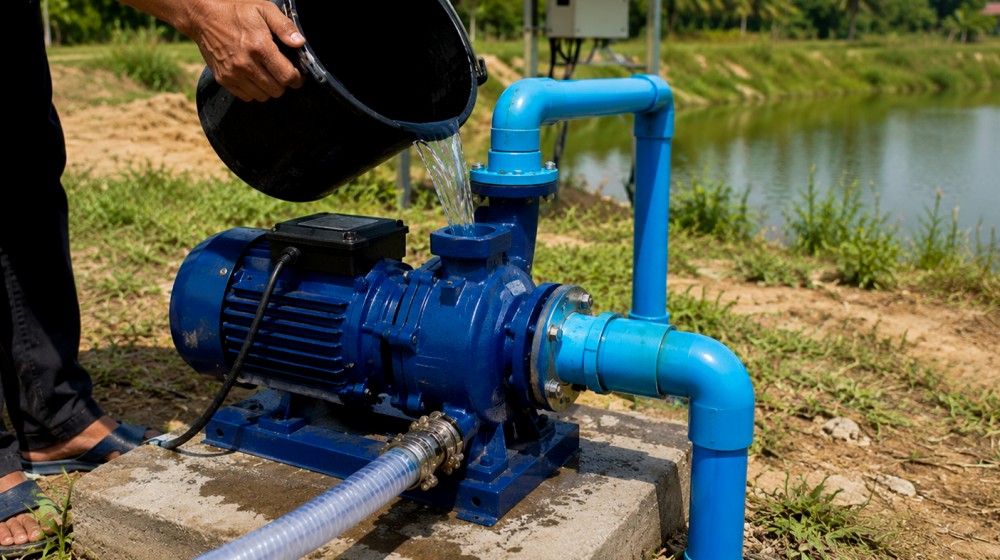
Centrifugal pumps are arguably the most popular type among all water pumps. They are used in homes, gardens, farms, buildings, and factories because they pump large volumes of water, have a straightforward structure, are easy to maintain, and come in various sizes. Many beginners often wonder: why is "priming" (filling the pump casing with water) required every time before turning it on, given that the pump's job is already to draw water?
The answer is Electric Centrifugal Pumps It does not draw air effectively; water must be present inside the pump casing first for the impeller to generate centrifugal force and draw water up. If the pump contains only air, even if the impeller spins and the motor runs, it will fail to pump water. Moreover, running a pump with no water in the casing causes parts to overheat, damages seals, and shortens the pump's lifespan. Priming is therefore not a cumbersome nuisance, but an essential step to ensure the pump operates properly and safely.
In this article, we will explore: How does a centrifugal pump work? Why is priming necessary? Can you turn it on immediately? Do you need to prime it every time? And what should you do if the pump still fails to draw water after being primed?
What is a centrifugal pump?
First, let's get to know the centrifugal pump. A centrifugal pump operates by using a rotating impeller to transfer energy from the motor to the water. When the motor rotates the shaft, the impeller inside the pump casing throws the water at the center outward via centrifugal force, sending it flowing through the discharge outlet and onward into the delivery pipe.
Throwing water outward from the center of the impeller creates a low-pressure area at the pump inlet. Atmospheric pressure pushing down on the water's surface then forces water up through the suction pipe to replace it, creating continuous pumping.
In reality, a centrifugal pump does not suck water like a vacuum cleaner, contrary to common understanding; instead, it reduces pressure at the inlet, allowing atmospheric pressure to push water in. This process works effectively only when the pump casing and suction pipe are completely or nearly full of water, because water transfers energy from the impeller far better than air. As for whether Can a centrifugal pump run continuously 24 hours without a break? The answer is yes, as long as there is constant water circulating in the system to help dissipate heat.
What is priming?
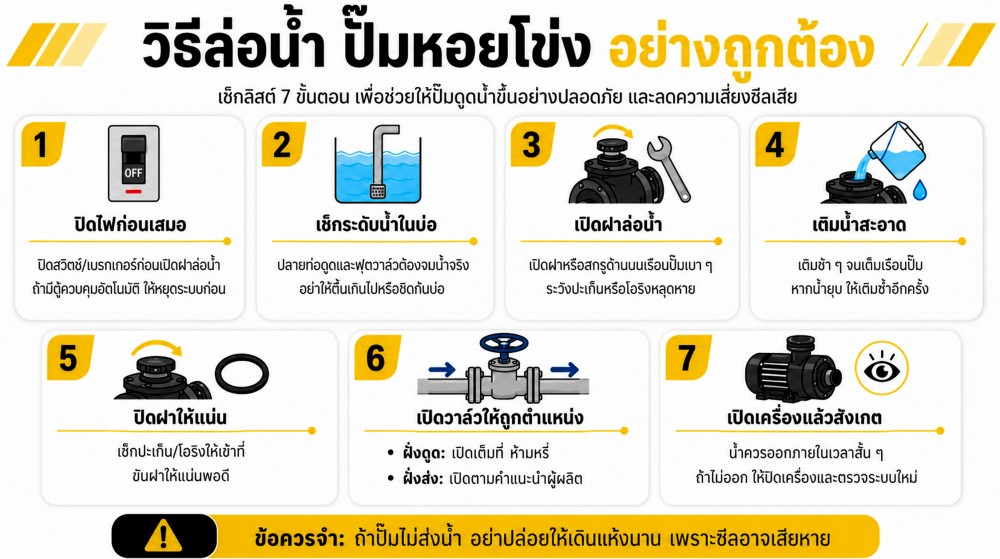
Many people may wonder: what is priming? Simply put, it is the act of filling the pump casing and suction pipe with water before turning on the machine, in order to expel air from the system.
How to do it: Open the priming plug or cap on top of the pump casing, fill it completely with clean water, tighten the cap securely, and then turn on the pump. The crucial goal is to remove as much air as possible—not merely to get the impeller wet. If significant air remains, the pump will not be able to generate sufficient low pressure, preventing water from being drawn up.
If the system has a properly installed foot valve, the water filled during priming will be retained inside the pipe and pump casing rather than draining back into the well, allowing the pump to be turned on immediately next time without having to re-prime.
Why must a centrifugal pump be primed before use?
Because the impeller transfers energy to water better than air
Centrifugal pump impellers are designed to transfer energy to liquids, not air. Since water is much denser than air, when the impeller rotates in water, the power from the motor is transferred to create velocity and pressure in the water before discharging it through the delivery pipe. But if the pump casing contains only air, even though the impeller spins fast, it cannot generate enough pressure to draw water up.
A simple analogy is rowing a boat: when the paddle is submerged in water, minimal effort is needed to move the boat forward. But if you lift the paddle and swing it in the air, no matter how much force you apply, you cannot push the boat. The same goes for the pump impeller—it requires water around it to function as designed.
Because air in the suction pipe prevents the creation of low pressure
For water to flow up the suction pipe, the pressure inside the pipe must be lower than the external atmospheric pressure. If the suction pipe and pump casing are filled with water, the impeller continuously expels water, creating low pressure that draws water in to replace it. However, if there is a lot of air in the system, the air merely circulates inside rather than being continuously expelled like water. The necessary low pressure is not generated, preventing water from being drawn up.
Sometimes the pump has some water inside but contains trapped air bubbles, causing intermittent water flow mixed with air, or slow water intake. This is usually caused by incomplete priming or air leaking into the suction pipe.
Because general centrifugal pumps are not vacuum pumps
Many people believe that when the motor spins, the pump will evacuate air to create a vacuum and draw water up on its own. In reality, general centrifugal pumps cannot evacuate air from the suction pipe as effectively as vacuum pumps or positive displacement pumps. Even if the impeller rotates, if there is only air, it just swirls inside without creating the conditions needed to pump water.
Some pump models are Self-Priming, but that does not mean they can always be run completely dry. You still need to fill them with water before the first use. After that, their internal structure helps retain some water, making subsequent pump startups easier than with standard centrifugal pumps.
Can you start a centrifugal pump immediately without priming?
If the pump is installed above the water level and there is no water inside the pump, you should not turn it on immediately. When powered on, the motor and impeller will rotate normally, but the pump usually cannot deliver water. Many people mistakenly think they should wait for the pump to draw water up on its own and leave it running continuously for several minutes. This will not make the water rise faster; it only increases the risk of pump damage. However, there are some cases where you can turn it on immediately without re-priming, such as:
- The pump is installed below the water level, allowing water to flow into the pump naturally by gravity.
- There is water remaining completely filling the pump casing and suction pipe from previous operation.
Therefore, the key question is not "Do I have to prime it every time?" but rather "Is there currently water inside the pump?"
- Already filled with water: No need to re-prime.
- Water drained back into the well, pump casing is dry, or newly installed system → Must prime before turning on every time.
Conclusion
Centrifugal pumps need priming because the impeller is designed to transfer energy to liquids, not air. Filling the pump casing and suction pipe with water allows the impeller to create low pressure at the inlet, enabling water from the source to flow into the pump continuously. If you run the pump dry, the motor and impeller might spin, but usually no water will be discharged, and you risk overheating and damaging the mechanical seal.
You don't need to re-prime every time if the system has a tightly closed foot valve, the suction pipe does not leak, and water is retained well in the pump casing. However, if you have to refill water unusually often, you should check the foot valve, pipe fittings, suction pipe, priming plug, and the water level at the source.
Before starting a centrifugal pump every time—especially after a new installation or when it has not been used for a long time—make sure there is water in the pump casing. Do not run the machine dry waiting for it to draw water on its own, because stopping to check the system takes only a few minutes, whereas a damaged seal costs far more time and money to repair. Priming is a small step that directly impacts the efficiency, safety, and lifespan of your centrifugal pump.