


 EN
 ไทย


Customers Also Purchased
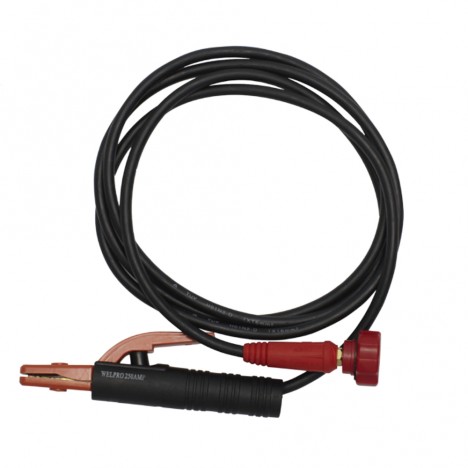


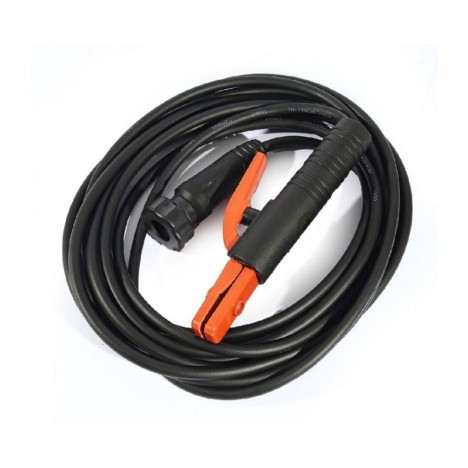

When choosing a MIG welder to use, we might pay attention to voltage, welding current, wire size, wire feed system, or thick steel welding capability first. However, there is another part that directly affects welding quality and should not be overlooked, namely Welding Cable or the MIG torch cable assembly through which the wire travels from the wire feeder to the torch tip.
Some may think that the longer the torch cable, the more convenient it is, because you can weld further around the workpiece without having to move the welding machine often, making it easier to reach work points. Yet when switching from a short torch to a long one, you might find that
- the welding wire starts feeding unevenly
- wire feed speed becomes erratic
- the wire feed motor works harder
- the wire gets stuck inside the liner
Sometimes the wire birdnests around the drive rollers, becoming a problem that is one of the Mistakes in using welding cables that should not be overlooked
This issue is not caused by length alone, but by accumulated friction along the entire path the wire must travel—from the drive rolls, through the liner inside the welding torch cable and the torch neck, all the way to the contact tip at the end of the torch. The longer the path, the more bends it has, or the more dirt accumulates, the higher the resistance the wire feeding system must overcome. Let's understand why a longer MIG welding torch cable is more likely to cause poor wire feeding, where friction occurs, and how it is related to welding torch cables in MIG applications.
A MIG welding torch cable does more than just carry electric current
The "MIG welding torch cable" connecting the welding machine or wire feeder to the welding torch does not just contain power conductors for the welding current; it also includes a wire liner, gas hose, and control wires for the torch trigger.
The welding wire must be pushed into the liner by drive rolls, travel through a welding cable that may be several meters long, pass through the torch neck, and exit through the hole of the contact tip before entering the weld seam.
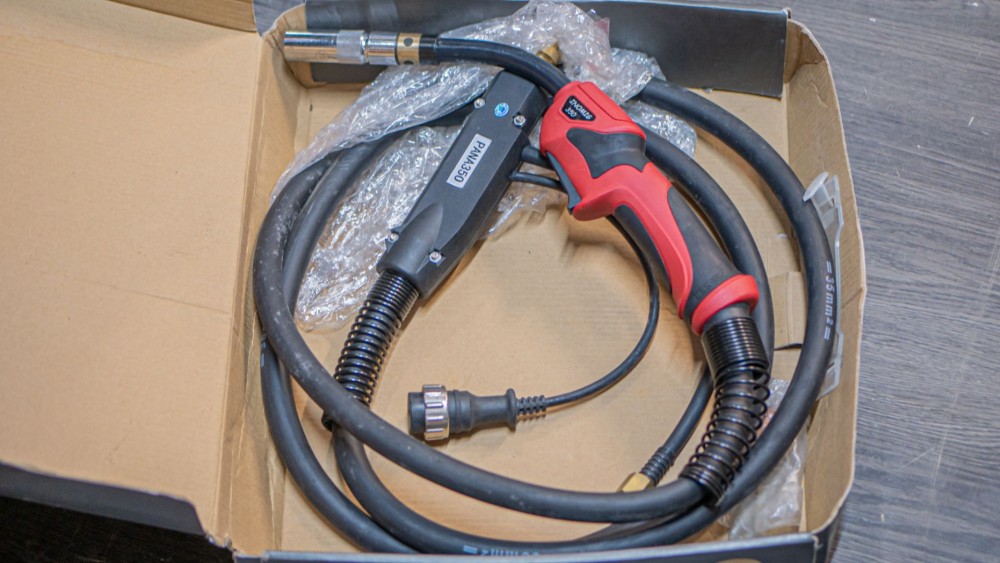
The wire feeding system of typical MIG welders is usually a "Push System," where the motor and drive rolls are at the back, pushing the wire forward along the entire length of the welding torch cable.
Is It True That Uneven MIG Welding May Be Caused by an Overly Long Cable? The answer is true in some cases, because a MIG system works well when the cable has a suitable length, the liner is in good condition, and the cable is not excessively coiled or kinked. However, when the wire must be pushed over a longer distance, resistance along the path increases, requiring more pushing force from the drive rolls to maintain a constant wire speed.
If the resistance exceeds the power that the wire feeding system can overcome, the wire may begin to feed erratically:
- Feeding fast at one moment,
- Slowing down at another,
- Pausing momentarily before surging forward again.
These irregularities directly affect the arc, causing: Inconsistent welding sound, wavy weld beads, increased spatter, and difficulty controlling the weld puddle.
Why does friction accumulate more as a MIG welding torch cable gets longer?
In actual use, the wire does not stay suspended in the center of the welding torch cable at all times, because it periodically contacts the inner wall of the liner, especially at sections where the cable bends. The weight of the wire and the pressure from the wire feeder cause the wire to press against the liner's inner surface. As the cable gets longer, the number of contact points between the wire and the inner wall increases accordingly.
The longer the welding torch cable, the more the effects of wire curvature accumulate, forcing the wire feed motor to exert greater effort.
Bends in the welding torch cable increase lateral pressure
Often, the problem can also stem from how the cable is laid out. A MIG welding torch cable kept straight or laid with wide loops will offer lower resistance than a cable coiled into tight loops, draped over table edges, kinked behind the machine, or crushed under heavy objects. Longer welding cables are more prone to being coiled or draped across obstacles than shorter ones, leading to the perception that long cables cause poor wire feeding—yet part of the cause may simply be the shape and routing of the cable during operation.
Dirt increases resistance inside the liner
With longer welding torch cables, there is more surface area for contaminants to accumulate, and blow-cleaning can be more difficult. When metal shavings or dust are scattered across multiple points, the wire might feed normally at first, but once the cable is bent or the temperature rises, resistance can increase to the point where the wire starts to stutter.
If you have to continually increase the drive roll tension just to keep the wire feeding, instead of rushing to tighten the tension further, you should check the condition of the liner first. Increasing tension may only provide temporary relief, but it makes the underlying problem worse.
How does friction in the welding torch cable affect the MIG wire feeding system?
Why Must MIG Welder Voltage and Wire Feed Speed Be Synchronized? Once the wire feed speed is set, the wire feeding system should smoothly deliver wire out of the torch tip. However, if the friction inside the cable fluctuates constantly, the actual wire speed at the gun tip may become unstable.
For example, while the cable is laid straight, the wire may feed normally. But when you move and bend the cable around a table leg, internal resistance increases and wire feeding slows down. As you move the cable away from that bend, the resistance decreases and the wire may surge forward. This symptom causes the arc length to fluctuate, produces popping sounds at the wire tip, results in an irregular weld bead, and can lead to stubbing or burnback.
Drive rolls slipping on the wire surface
When resistance in the cable is high, the drive rolls must exert more force. The rolls may spin while the wire fails to move, or it moves only intermittently. Slippage marks or burnishing marks from the drive rolls may appear on the wire surface.
Drive rolls that bite too hard into the wire surface also generate additional metal shavings. These shavings get pushed into and accumulate inside the liner, driving friction even higher.
Birdnesting at the wire feeder unit
Birdnesting occurs when the drive rolls continue to push wire forward, but the wire cannot travel through the welding torch cable.
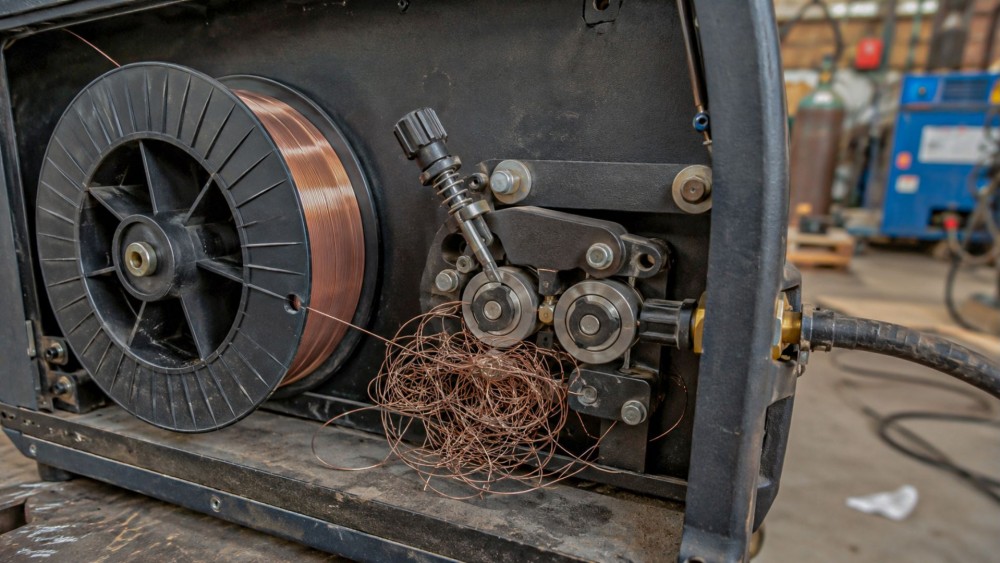
The pushing force causes the wire to buckle and tangle up right in front of the drive rolls. This issue is common when:
- The welding cable is long and tightly coiled
- The liner is dirty
- The contact tip size is improper
- The wire tip burns back and fuses to the contact tip
Different wire types tolerate long cables differently
Common carbon steel wires, such as ER70S-6, are stiff and can handle push force from the feeding system relatively well, making them suitable for standard push-type systems used in typical MIG welders. Steel wire has a lower tendency to buckle or kink inside the liner compared to softer wires. However, if the welding cable is excessively long, severely coiled, or the liner is dirty, steel wire can still stutter and cause birdnesting.
Just because steel wire is stiffer does not mean you can extend the cable length indefinitely, as feed motors, drive rolls, liners, and contact tips all have limitations. When cumulative resistance becomes too high, wire speed will begin to fluctuate even before the wire noticeably kinks or deforms.
Aluminum wire is much more sensitive to friction
Aluminum wire is soft and buckles easily, making it far more sensitive to friction and cable bends than steel wire. If using a rear push system through an overly long welding cable, the wire can easily kink inside the liner or birdnest at the feeder. Using a steel liner with aluminum wire can also increase friction and scrape the wire surface, generating shavings.
Aluminum welding therefore typically uses PTFE or slicker composite liners, paired with U-groove drive rolls that support the wire without crushing or deforming it. Alternatively, a spool gun can be used to mount the spool close to the torch, or a push-pull system can be utilized with both a rear pusher and a pull motor at the torch. These methods shorten the distance soft wire must be pushed through a cable, providing significantly more stable wire feeding.
Flux Core Wire May Deform Under Excessive Roller Tension
Flux-cored or Flux Core wire consists of a metal sheath containing flux inside. Although some types are reasonably rigid, applying excessive roller tension can cause the wire to flatten or deform. Roller selection must therefore match the type of wire. Typically, flux-cored wire uses knurled drive rolls (grooved teeth) to increase grip without overtightening the wire unnecessarily.
How Long Can a Welding Cable Be Before Problems Start?
For MIG welders and each type of wire, there is no single universal number because the usable length depends on the wire drive motor's power, wire type, wire size, liner type, cable quality, cable routing, and maintenance condition.
Standard welding torches included with machines are usually selected to balance reach and feeding capability. However, switching to a significantly longer torch without checking if the drive system can handle it increases the chances of problems.
A slightly longer welding cable may still work well with the proper size steel wire and when routed straight, but that same length might immediately cause issues with aluminum wire or when the cable is coiled on the floor. Therefore, do not judge by length alone; evaluate actual feeding performance as well.
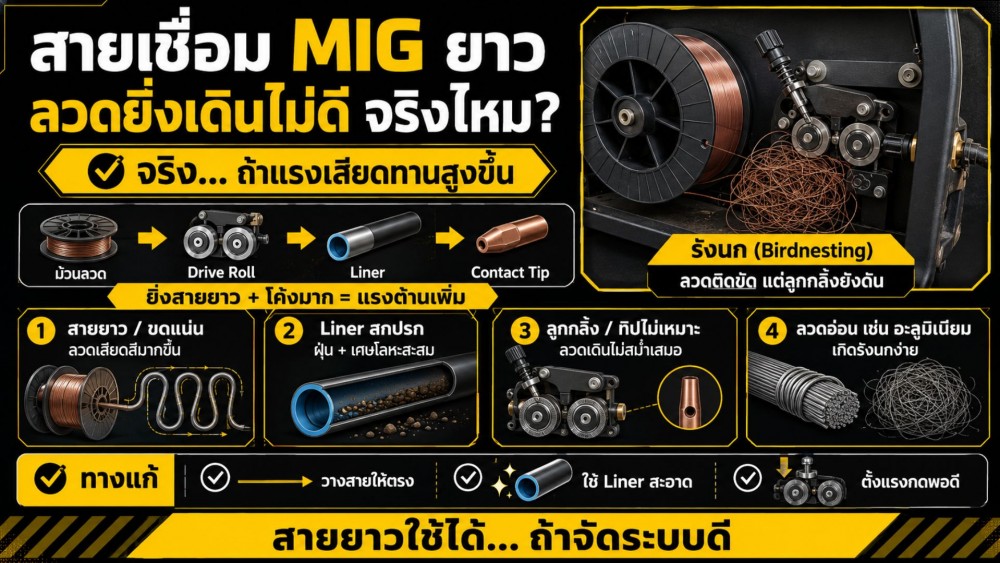
Conclusion: A Longer MIG Cable Isn't Unusable, but Requires Proper Setup
A longer MIG welding cable genuinely increases mobility and reduces the need to move the welding machine. However, that convenience comes at the cost of increased friction and load on the wire feed system. The wire must travel a longer distance inside the liner, navigate more bends, and has a higher chance of encountering dirt or clogs. If using soft wire like aluminum, the impact will be much more noticeable than with standard steel wire.
The key is not deciding whether a long cable is good or bad, but determining whether that length is suitable for the wire, feeding system, and job requirements. Keep the cable straight, select the right liner for the wire type, set the tension properly, check the contact tip and spool brake, and clean the system periodically.
If you must use a very long cable or weld with soft wire regularly, consider a separate wire feeder, a spool gun, or a push-pull system instead of forcing the existing system by overtightening the drive rolls.
Systematic inspection and troubleshooting will help the MIG wire feed through Welding Cable smoothly, ensuring a stable arc, better bead appearance, and reducing downtime caused by wire jams or birdnesting during work.