


 EN
 ไทย


Customers Also Purchased



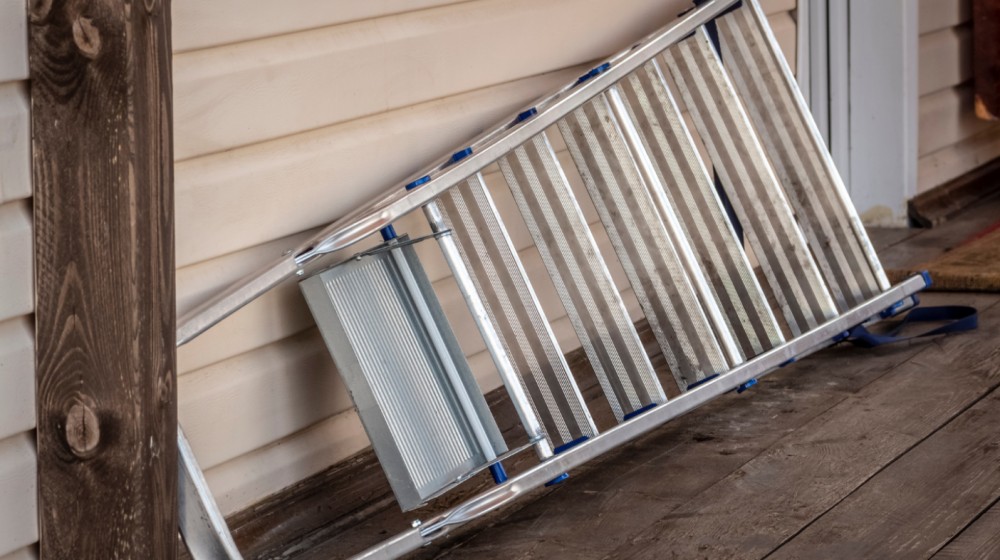
Aluminum Ladders It is an essential tool that many homes, shops, offices, and job sites should have on hand because it is versatile—whether for changing light bulbs, reaching items on shelves, cleaning, installing equipment, or general maintenance work.
Many people choose based primarily on the number of steps or the price, thinking that a cheaper option or a similar appearance means it can be used interchangeably. In reality, ladders are directly related to safety. Making the wrong choice can lead to issues like wobbling, slippery steps, unstable feet, or insufficient weight capacity.
Therefore, before paying for a ladder, you should check several factors beyond just the number of steps to ensure you get a ladder that is suitable for the job, safe, and truly worth the investment.

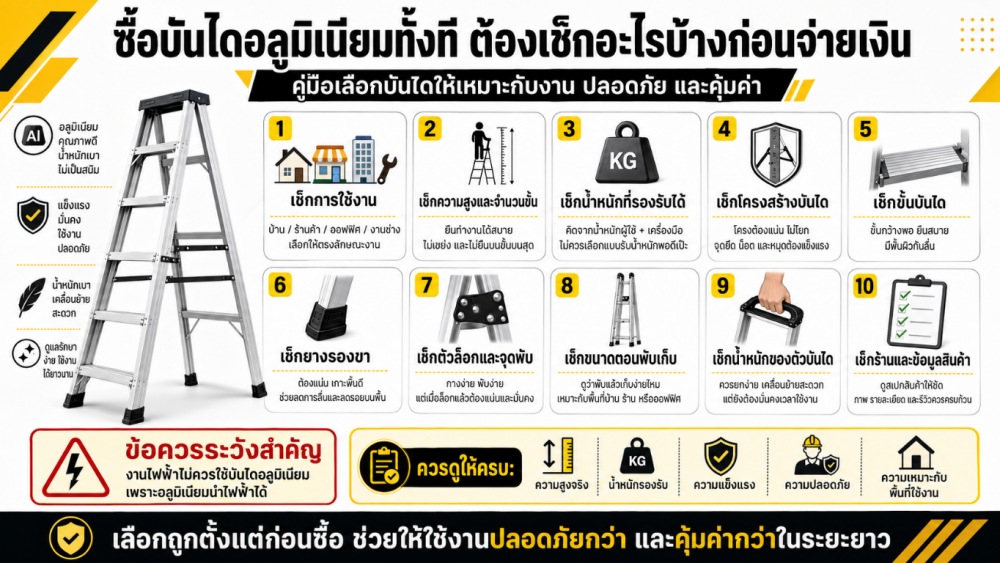
Check what it will be used for first
Before looking at the price and before looking at the number of steps, ask yourself what kind of work you will be using the ladder for.
If used atGeneral Homes For example, changing light bulbs, reaching items on high cabinets, wiping fans, or cleaning air conditioners, you might choose an A-frame step ladder that is easy to set up, convenient to fold and store, and not too bulky for your space.
If used atShops, offices, or warehouses You should choose a ladder that provides stable standing, is easy to move around, and is tall enough to reach items on shelves.
However, if used forTechnician work Installation work or maintenance tasks require extra attention to structural strength, locking mechanisms, hinge points, anti-slip feet, and load capacity, especially since you may need to carry tools or equipment up with you.
Simply put, ladders for household use and ladders for technical job sites should not be selected using the same criteria because their usage demands are vastly different.
Check the height and number of steps to suit your space
Many people only look at the number of steps but forget to check the actual working height. Ladders with the same number of steps may not be the same height because each model has different step spacing, overall height, and design. Before buying, you should consider the number of steps, the ladder height, and the safe reaching height of the user.
For general household use such as reaching items on cabinets, changing light bulbs, or cleaning high spots, an A-frame ladder with about 3–5 steps may be sufficient. However, you should compare it against ceiling height, shelf height, and the actual user's reach before deciding.
The simple rule of thumb is to choose a ladder that lets you work comfortably without tiptoeing, overreaching, or standing on the top step, as standing above the safe height can easily cause you to lose your balance.
Check the ladder's weight capacity
The weight capacity that a ladder can support is extremely important, and you should not consider only the user's body weight. When purchasing, you should calculate it as the "total working weight," such as the user's body weight combined with tools, toolboxes, paint buckets, drills, or items carried up the ladder.
For example, if the user weighs 75 kg and needs to carry another 10-15 kg of equipment, you should choose a ladder that safely supports more than this total weight. You should not pick one where the weight capacity is too close to the limit. Before buying, clearly check the ladder's specifications or label to see how much weight it can support, as not all ladder models are designed to hold the same capacity.
Check the strength of the ladder frame
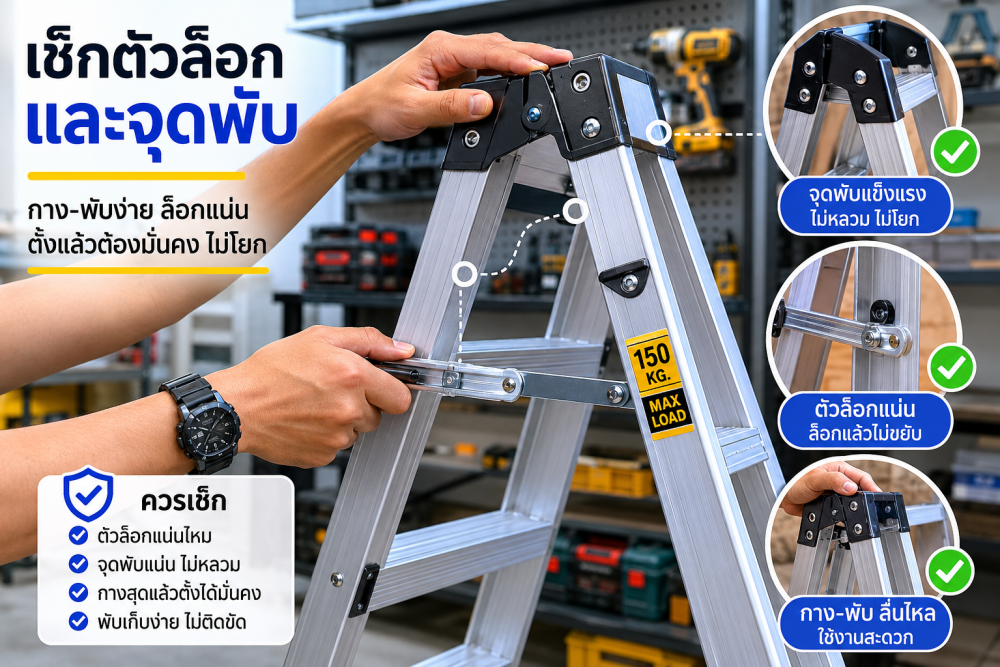
A good aluminum ladder should have a solid structure—not twisting, wobbling, or feeling too thin when handled or test-opened for use. Areas to check include side rails, rungs, joints, folding points, rivets, bolts, and main load-bearing sections. If it wobbles abnormally or creaks when unfolded, it may not be suitable for frequent use or prolonged standing.
Some models look very similar in pictures, but when seeing the actual product, the differences become obvious in material thickness, assembly tightness, and stability during use. Therefore, never choose based on appearance or the cheapest price alone.
Check if the steps are wide and slip-resistant enough
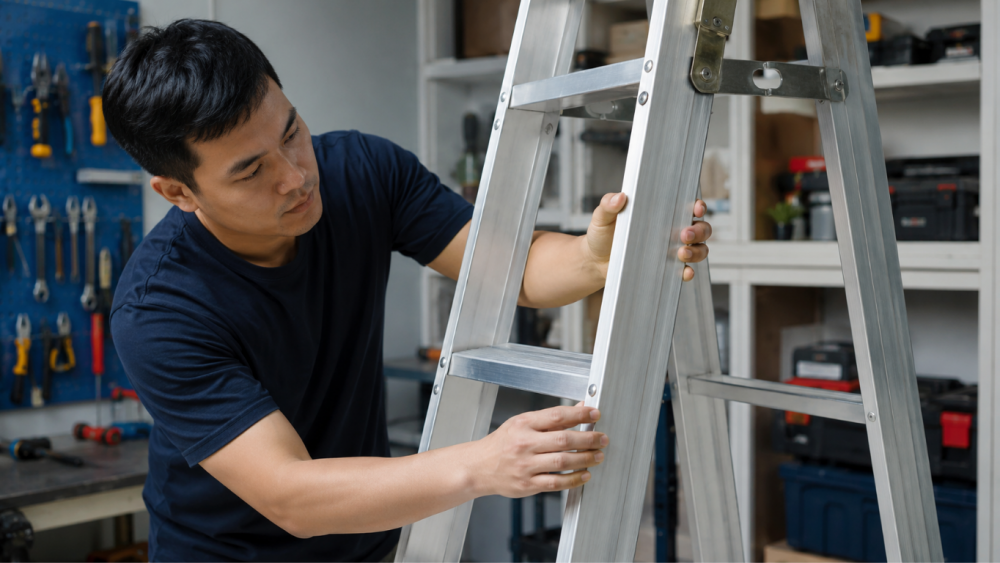
Steps are the part where feet make direct contact, so you should choose ones that allow stable footing, have an anti-slip surface, and are not too narrow. If the steps are too narrow, your feet cannot rest fully on them, causing quick fatigue and instability, especially for tasks requiring long periods of standing such as installing equipment, electrical repairs, wiping windows, or reaching high shelves.
Some ladder models feature anti-slip treads on the steps or are designed with wider steps for more comfortable standing. This may seem like a minor detail, but it greatly impacts confidence and safety in actual use.
Check the rubber ladder feet
Rubber ladder feet are a small detail that should not be overlooked, as they help the ladder grip the floor better, reduce slippage, and protect floors from scratches. Before purchasing, check if the rubber feet are firmly attached, made of sturdy material, and make good contact with the ground, especially if used on tile, smooth concrete, or relatively slippery office floors. If the rubber feet look thin, loose, or nearly detached, the ladder could easily shift or lose its balance during use.
Check the locks and hinges
For A-frame ladders, folding ladders, or multi-purpose ladders, hinges and locks are crucial parts because they keep the ladder stable when unfolded. Before purchasing, try unfolding and folding it to see if it operates smoothly, whether the locks are tight, and whether the ladder stands steadily when fully deployed.
A good ladder should unfold easily and fold away effortlessly, but once locked, it must be secure—not wobbling, loose, or shifting abnormally during use. If hinges are loose, locks are insecure, or it feels unstable when unfolded, it should be avoided, as these points directly affect safety.
For leaning or extension ladders, check the setup angle as well
When purchasing a leaning ladder or extension ladder, don't just look at the length; you should also check whether it can be set up at a proper working angle. A ladder set too steeply risks tipping backward, while one leaned too far may slip or fail to support weight properly.
Additionally, check the base surface and upper resting point. The ground must be stable, non-slip, and free from sinking, and the resting point must be strong enough—not propped against materials that move easily or cannot support weight. For working at height, choose a ladder suited to the actual nature of the work, and never place objects under the ladder to gain extra height, as this is extremely dangerous.
Check the folded size
Many people choose a ladder based solely on its use, forgetting to consider storage. If using it in a home, condo, shop, or office with limited storage space, you should check how tall and thick the ladder is when folded, and whether it can fit into your desired storage corner.
A ladder that is too tall or too thick when folded can be difficult to store, requiring it to lean against a wall constantly or be inconveniently moved around. If you need to use it frequently, choosing a model that unfolds and folds easily and is not too heavy will make grabbing it for use much more convenient.
Check the weight of the ladder
The advantage of an aluminum ladder is that it is lighter than many steel ladders and has better rust resistance. However, lighter is not always better. While a very light ladder is easy to transport, you should also consider material thickness, structure, assembly quality, and weight capacity.
Conversely, if it is too heavy, moving it around becomes difficult—especially for homes, shops, or offices where it must be used in multiple spots. You should choose a ladder with a well-balanced weight: easy to carry and move, yet still feels stable during use.
Check the assembly quality and small details
Before paying, check the overall assembly quality once more: are the aluminum edges sharp? Are bolts tightened securely? Do the rivets look sturdy? Are the ladder steps firm, and are there any loose or abnormally wobbling parts?
These small details clearly indicate the ladder's quality, as a poorly assembled ladder may develop problems after some use—such as wobbling, loosening, making noise, not folding completely, or rubber foot pads falling off easily. Especially if you are buying it for use in a shop, factory, or job site where it will be used frequently, choose a product with solid assembly rather than deciding solely on the cheapest price.
Check if it suits your actual working area
Different types of ladders suit different spaces:
- Home or condo — Should choose a model that folds easily, is not too bulky, and is convenient to move around.
- Retail Stores — Should choose a model that provides stable footing, allows easy access to high shelves, and does not take up too much space.
- Warehouse or storage facility — May need to choose a sturdier ladder with a wider base, or a platform ladder designed for stable work at heights.
For electrical work, take extra caution because aluminum is a metal and conducts electricity. If working near power lines, breaker panels, or energized electrical systems, never use an aluminum ladder. Always choose equipment suited for electrical work and adhere to safety measures at all times.
Related Articles
- Wish I'd read this before buying! 3 common mistakes people make when choosing an aluminum ladder
Check the Seller and Product Information
Besides the ladder itself, where you buy it is equally important. Choose a store that provides clear product information, including the ladder type, number of steps, height, material, load capacity, unfolded and folded dimensions, as well as suitable applications.
When buying online, consider product photos, details, and reviews. Don't just go for the cheapest price, as ladders are directly related to safety. If you're unsure which model to choose, consult the store before purchasing by stating your work requirements, desired height, and actual workspace to make the best choice.
At iToolmart, we offer a wide variety of aluminum ladders for homes, shops, technicians, and general use. This helps you select the right size and type for your needs without having to guess solely from the number of steps.
Once You Buy a Good Ladder, Use It Correctly
Even after choosing a good ladder suitable for the job, using it correctly is just as important. When in use, the ladder should be placed on a flat, stable, non-slip surface, and never use boxes, chairs, or other materials under the ladder to increase height. When climbing up or down, face the ladder and maintain at least 3 points of contact at all times, such as one hand and two feet or two hands and one foot, to reduce the chance of losing balance. Also, avoid leaning out too far to the side. If your work area is out of reach, climb down and reposition the ladder. It is much safer than overreaching and losing your balance.
A Good Aluminum Ladder Isn't Just Tall and Cheap
Even after choosing a good ladder suitable for the job, using it correctly is just as important. When in use, the ladder should be placed on a flat, stable, non-slip surface, and never use boxes, chairs, or other materials under the ladder to increase height. When climbing up or down, face the ladder and maintain at least 3 points of contact at all times, such as one hand and two feet or two hands and one foot, to reduce the chance of losing balance. Also, avoid leaning out too far to the side. If your work area is out of reach, climb down and reposition the ladder. It is much safer than overreaching and losing your balance.