EN
 ไทย


Customers Also Purchased


When it comes to Circular Saws carbide saws, we often think of circular-blade tools used for cutting wood, panels, or general materials, and might assume that simply checking the blade size, wattage, or price is enough, right? But once many people actually get to know these power saws, they find that some make straight cuts effortless, some are designed for large sheets, some excel at repetitive cuts, and tools like plunge track saws, miter saws, table saws, or metal cutting circular saws are not entirely interchangeable.
Because even though the principle is similar—using a spinning circular blade to cut material— what differs is how the workpiece is held, cut-line control, accuracy, safety, and suitable materials. Some tools require holding the saw and guiding it through the workpiece; others feed the workpiece into the blade. Some focus on locking angles, some on cutting large panels, and some are engineered specifically for cutting metal—it's not simply a matter of swapping the blade.
Therefore, in this article, we will focus on the basics: how different are circular saws, track saws, miter saws, table saws, and metal-cutting circular saws, even though they all use circular blades? Which saw should be used for which job, and what are the common misconceptions when buying or using them? This will help make your work much faster, straighter, and safer.
What is a circular saw? Why do they look similar but function differently?
A circular saw is generally a power saw that uses a rotating round blade to cut materials. The most familiar form is the handheld circular saw, where you hold the tool and push it along the cut line. It is suitable for cutting sheet wood, plywood, framing timber, boards, or on-site work that requires maneuverability without having to carry workpieces to a stationary machine.
However, the term "circular saw" is sometimes used to encompass various types of circular-blade saws, including handheld circular saws, track saws, miter saws, table saws, and metal-cutting circular saws. This may lead people to think they are interchangeable, even though each is designed differently: some focus on long straight cuts, some on miter cuts, some on repetitive ripping, and some specifically on cutting metal.
Tools that look slightly different can have very different applications. For example, when cutting long wooden panels for a clean edge, a track saw provides much better quality control than a handheld circular saw. Or, if you need to make repetitive 45-degree angle cuts, a miter saw is much more suitable because it is specifically designed to lock in angles.
What Kind of Work Is a Handheld Circular Saw Suitable For?
A handheld circular saw is among the most versatile tools because it can be used for a wide range of tasks. It can make short straight cuts, long straight cuts, cut sheet goods, cut framing timber, cut board materials, or cut certain construction materials depending on the selected blade.
Its key strengths are maneuverability and speed, making it ideal for tradespeople working on actual job sites—such as cutting formwork timber, plywood sheets, subflooring, light structural framing, or for DIY projects needing a single multi-purpose saw.
What types of power saws are there for woodworking? Does an all-in-one saw truly exist? However, the limitation of a handheld circular saw is that accuracy relies heavily on user skill and guide accessories. If cutting freehand without a track or straightedge guide clamped down, there is a high chance the cut line will wander—especially on long workpieces, when the blade cuts aggressively, or when the user pushes the tool unevenly.
Therefore, a handheld circular saw requires proper operating techniques, such as setting the blade depth to match the workpiece thickness, keeping the base plate flush against the material surface, using a straightedge guide when necessary, and selecting the right blade for the material being cut.
Key Highlights
- Easy to transport and convenient for on-site use without moving workpieces to a stationary machine
- Fast cutting speed, suitable for wood, sheet materials, and general construction tasks
- Wide range of prices and options, available in both corded and cordless models
- Compatible with guiding accessories such as straightedges, clamps, or certain guide rails
However, a handheld circular saw is not the best answer for every job. If the task requires extreme neatness, cutting expensive large panels, or repetitive angle cuts, using specialized tools like a track saw or miter saw will help reduce rework, minimize waste, and yield more professional results.
How Does a Track Saw Differ From a Standard Circular Saw?
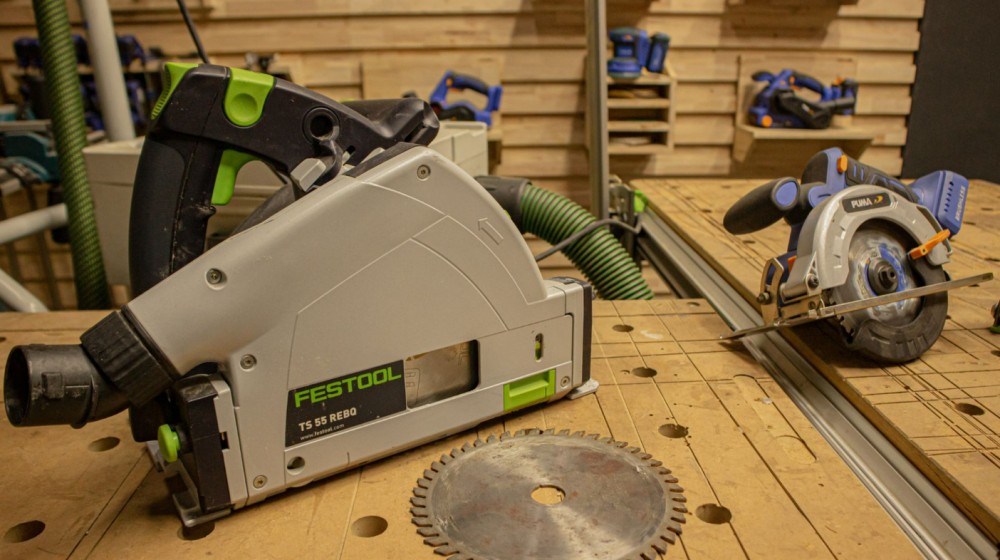
Choosing the Right Saw: How Do Circular Saws and Track Saws Differ, and Which Is Better to Use? A track saw is a tool that many people view as "just a circular saw with an added guide rail." While partly true, that doesn't tell the whole story.
A track saw offers much more than just a guide rail; the entire system is engineered for precise straight cuts, excellent cut-line control, and typically delivers a much cleaner finish than pushing a regular circular saw against a straightedge. This is especially true for cutting large sheets such as plywood, MDF, melamine, laminate, or furniture panels that require clean edges and precise dimensions.
The guide rail is an essential component of this type of saw. It acts as a dedicated track for the saw base to glide along, minimizing tool wobble, reducing cut drift, and allowing users to align the cut line on the workpiece with high precision. Some track saw systems feature an anti-splinter rubber strip along the rail edge, which helps further prevent tear-out on wood or laminate surfaces.
In addition, many track saws feature a plunge-cut mechanism, allowing you to plunge the blade down into the workpiece from above, making internal cutouts in the middle of a panel much easier than with a standard saw.
A miter saw is not just a circular saw mounted on a stand
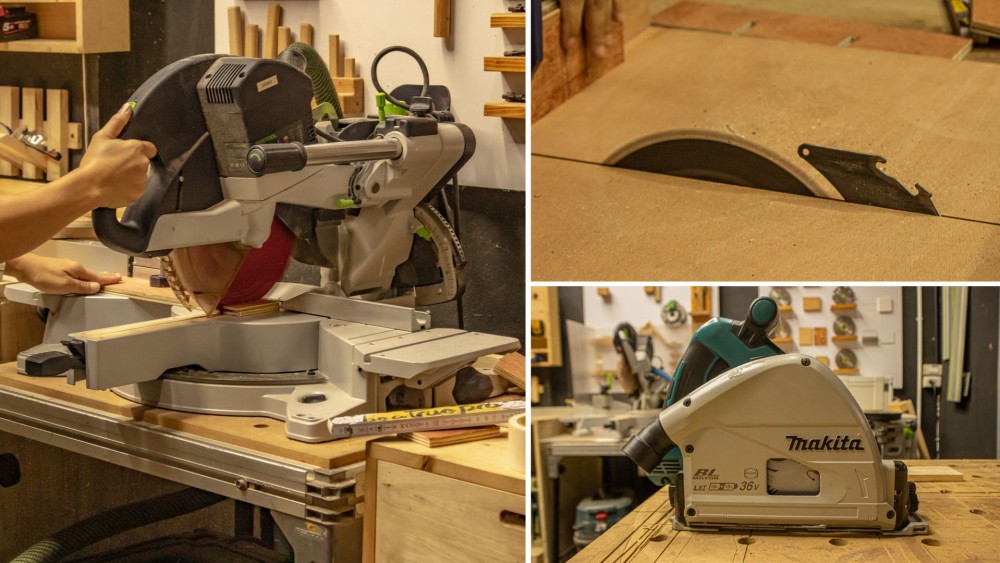
A miter saw is another tool that uses a round blade like a circular saw, but in reality, a miter saw is designed to "cut workpieces placed on a base at specified angles," not to rip or cut through long panels like a handheld saw or track saw.
A miter saw is ideal for jobs that require repeated cuts at 45 degrees, 90 degrees, or other specific angles across multiple workpieces. Its advantage is that you place the workpiece on the base, set the angle, press the saw head down, and get a much more consistent cut line than manually guiding a handheld saw—especially for tasks requiring multiple identical pieces, such as cutting framing lumber, trimming door and window frames, or cutting repetitive assembly parts.
What kind of work is a table saw suitable for?
A table saw shifts the concept from "bringing the saw to the workpiece" to "pushing the workpiece into the blade." The blade protrudes up from the table, and you place the wood on the table and push it through the blade along a set guide line. The key strength of a table saw lies in repetitive cuts, rip cuts along the grain, and tasks requiring multiple pieces of identical width, such as ripping wood strips, cutting panels into long strips, making furniture components, or prepping materials to uniform dimensions.
While a track saw excels at cutting large panels on the floor or a support table, a table saw excels at repetitive workpiece control using a rip fence. Once you set the fence distance, you can push multiple workpieces through the blade to achieve identical dimensions much faster than cutting line by line with a handheld saw.
Table saws are commonly used in workshops, furniture making, serious woodworking, or any work requiring the preparation of multiple workpieces of the same size.
How does using a metal-cutting circular saw differ from a wood saw?
Cutting metal differs from cutting wood by more than just the "cutting blade," as the differences also involve RPM, torque, chip clearance systems, guard durability, and spark protection, as well as the overall design of the machine.
Metal cutting circular saws are typically designed specifically for cutting metals such as sheet metal, square tubing, angle iron, or certain metal materials according to the tool and blade specifications.
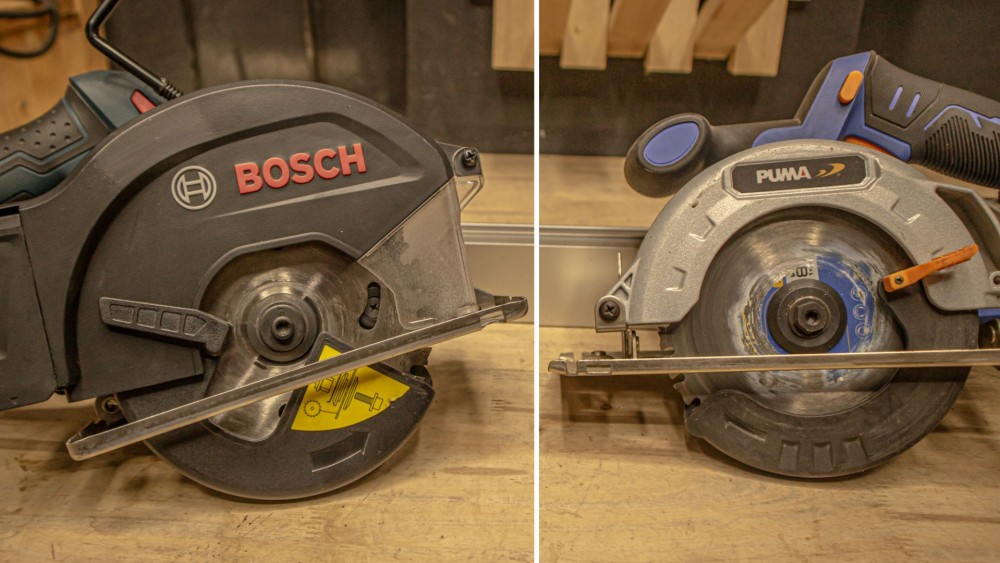
What should you check to use a circular saw safely? A crucial point is that metal-cutting blades require the correct RPM and tooth configuration for the material. Using a machine designed for wood on metal without understanding this can lead to extreme heat, excessive sparks, blade damage, heavy motor strain, or making the cut far harder to control than expected.
Cutting wood versus cutting metal is not just a matter of changing the blade
Wood behaves very differently from metal. Wood has grain, is relatively soft, and discharges waste as sawdust. Metal, on the other hand, is hard, ductile, generates high heat, and produces much more hazardous chips or sparks.
Saws used for metal must therefore take into account spark protection, load handling, blade selection, and appropriate operating speeds. Using the wrong type of saw, even if it cuts through occasionally, does not mean it is safe or cost-effective in the long run.
In-depth look at power saws and improper usage: Which type is most commonly mishandled? For serious metalwork, you should select a tool clearly specified for cutting steel or metal, and choose a blade that matches the material, such as steel, aluminum, stainless steel, or specific types of metal.
Additionally, blades used for different types of metals are not all identical. Furthermore, you should always wear personal protective equipment, such as safety glasses and appropriate gloves, and avoid cutting in areas near flammable materials.
How to choose the right saw for your job?
Choosing the right circular saw or circular blade cutting tool starts with identifying your most frequent tasks, as each tool excels in different areas.
- If you need to cut wood in various locations, Circular Saws a handheld circular saw might be the most cost-effective first choice.
- If working with large sheet goods and requiring clean, beautiful cut edges, Track Saw a track saw will significantly elevate your work quality.
- If making repeated angle cuts, Compound Miter Saw a miter saw is the more precise answer.
- If working in a workshop and needing to rip large volumes of wood repeatedly, Table Saws a table saw will noticeably save you time.
- If your primary task is metal cutting, you should look into metal-cutting circular saws or dedicated metal cutting machines.
Don't just judge by having a round blade. Just because a tool uses a circular blade like a circular saw doesn't mean it was designed for the same task.
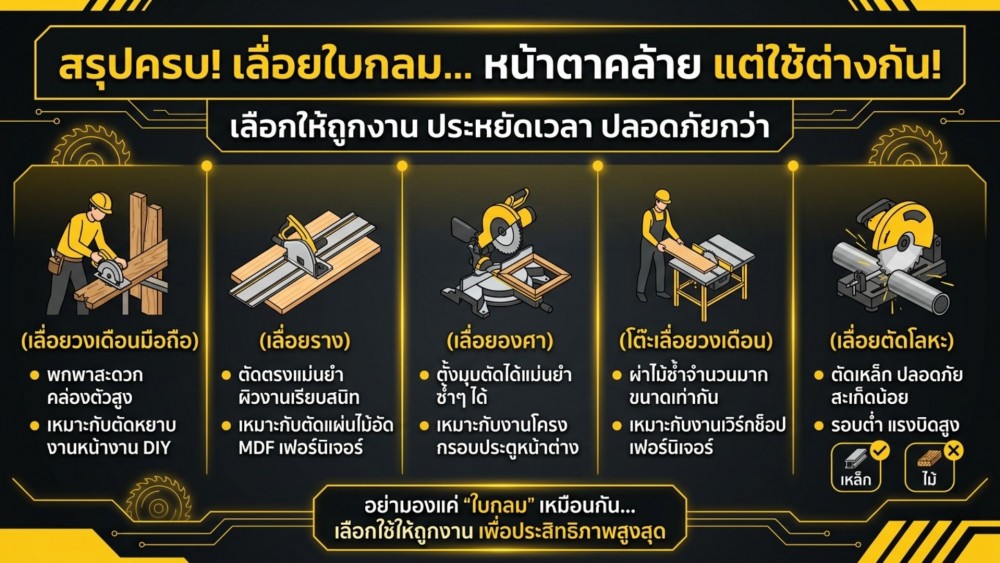
Summary: Circular saws and similar tools may not be built for the same purpose.
At a glance, handheld circular saws, track saws, miter saws, table saws, and metal-cutting circular saws might look very similar. This is something to be cautious of, because they are actually designed for entirely different jobs.
Handheld circular saws focus on portability; track saws focus on straight cuts and clean edges; miter saws focus on angled cuts; table saws focus on repetitive ripping in a workshop; and metal-cutting circular saws are suited for metal work, completely different from wood.
Therefore, before choosing, always ask: What is the primary task? What material needs to be cut? What level of precision is required? And are you working on-site or in a workshop? These answers will help you choose the right saw far better than just looking at wattage, blade size, or price alone.
Once you understand the differences between each saw type, you can choose and use them Circular Saws with more confidence, reducing rework, minimizing risks, and achieving sharp, straight cuts
that certainly look much more professional.