


 EN
 ไทย


Customers Also Purchased


Many people likely know well that when choosing to buy Laser distance meter The things you should look at are the measuring range, accuracy, or various functions. But another crucial aspect that shouldn't be overlooked at all is IP Rating This number indicates protection against dust and water, which affects the tool's durability in real-world use far more than you might think.
Naturally, we don't use laser distance measures only in clean rooms. Many people have to carry them onto job sites, set them on the ground, encounter cement dust, water splashes, humidity, or heat in vehicles. The IP rating is what tells you how well the laser distance measure will handle real job conditions.
In this article, I'll take a deep dive to clarify what the IP Rating specified on a laser distance measure really is, how to read it, what each digit means, and crucially, how it impacts actual work—so you can see whether the device will truly survive the job site conditions you're buying it for.
What is an IP Rating? Why Should Laser Distance Measure Buyers Know About It?
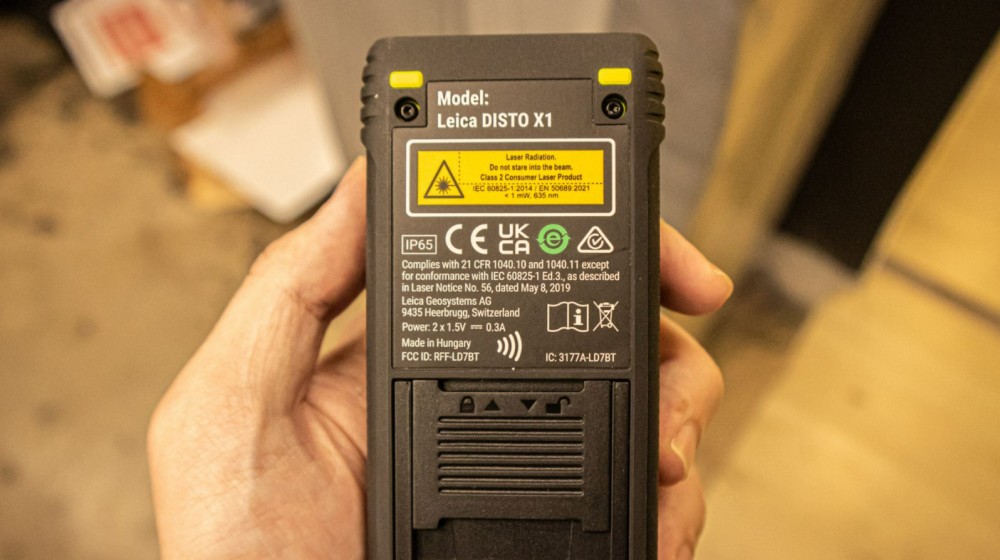
IP Rating stands for Ingress Protection, which is the level of protection against foreign objects entering the device, such as dust, small solids, and water. For a laser distance measure, this is more important than many people realize. What is a Laser Distance Measure? And Other Frequently Asked Questions This digital tool contains electronic circuitry, a laser module, push buttons, a display, as well as various ports and covers that have the potential to be affected by dust and moisture.
When seeing specifications like IP54, IP65, or IP67, many people tend to remember the shorthand rule that higher numbers are better—which isn't wrong. But to truly choose the right laser distance measure, we should know that each digit represents something different.
First Digit: Dust and Solid Objects
When talking about laser distance measures used in trade work, job sites, or installation jobs, the first digit of the IP rating matters greatly. It reflects how easily dust or foreign objects can enter the tool. The higher the number, the less chance there is for dust to penetrate and accumulate in critical parts of the laser distance measure.
Dust is truly the silent enemy of precision devices like laser distance measures. It's not just dust clinging to the exterior that can be wiped off; if dust repeatedly accumulates in button crevices, rubber seals, gaskets, covers, or connection points, it will gradually impact the performance and reliability of the laser distance measure.
Examples of dust impacts on a laser distance measure:
- Used in home renovations with continuous airborne cement dust accumulation
- Frequently setting the tool on the floor, allowing dust to enter grooves / seals
- Over the long term, push buttons become stiff and respond slower
- Deteriorated seals increase gaps, raising the chance of dust entering the tool.
- Dust prevents proper sealing, reducing the tool's reliability.
The second digit: Water, spray, and moisture
Many people assume that being waterproof means it can be washed, submerged in water, or used in the rain, but you actually need to be careful. This number indicates the level of water protection under different conditions. For example, some levels are suitable for water spray or drops, some can withstand water jets, and only certain ratings reach the level of surviving deep water or submersion for a specified period.
Most people do not need to submerge a laser distance measure in water anyway. What matters more is how well it survives light rain, sweaty palms, jobsite humidity, or accidental drops into water.
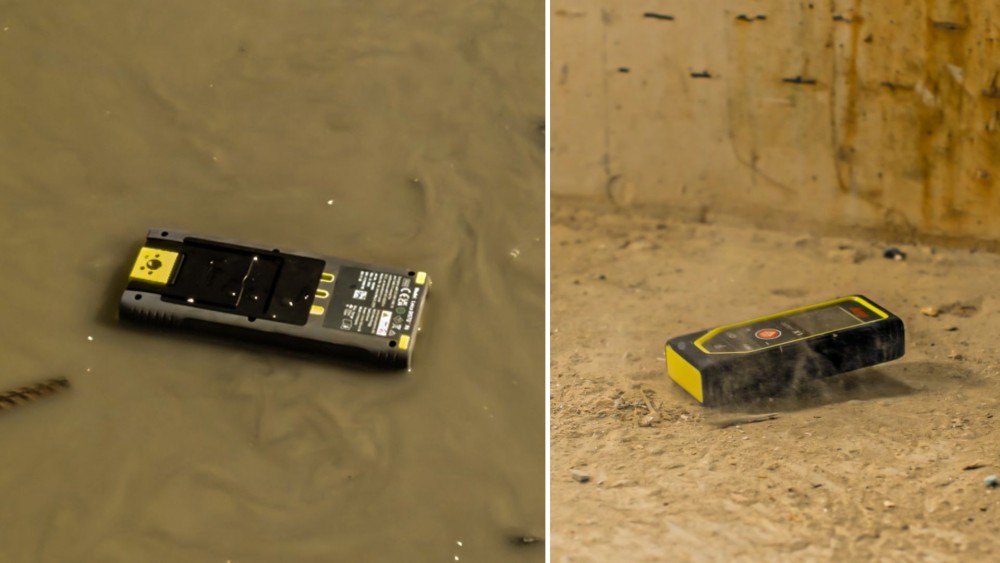
Examples of situations where this rating directly affects a laser distance measure:
- Caught in sudden rain while working outdoors
- Placing the tool near tile-cutting areas or wet-mist zones
- Measuring inside bathrooms or damp, humid areas
- Working outdoors in humid conditions or light fog
- Storing the tool in a car where rapid temperature changes cause condensation buildup
- Handling the tool frequently with wet or sweaty hands
- Moving the tool back and forth between cold air-conditioned rooms and hot, humid air
If a laser distance measure has an appropriate level of moisture and water protection, the risk of device malfunction from these environmental factors drops significantly.
Does the IP Rating of a laser distance measure really affect actual work?
The answer is yes—and it matters more than most people think. However, it's not in the sense that a higher IP rating directly makes measurements more accurate. An IP rating does not increase measurement range, strengthen the laser beam, or instantly improve reading accuracy.
What it actually does is help the laser distance measure maintain its original working condition longer in harsher environments. Simply put, it ensures the tool remains the same dependable device even when working in heavy dust, high humidity, or around frequent water splashes.
What if you use a laser distance measure at home? Does the IP Rating still matter?
Many DIYers or indoor measurers might think this doesn't really apply to them—they aren't working on rough construction sites, setting tools on concrete, or getting rained on. But even for home use, a laser distance measure's IP rating still matters; you just might not need as high a rating as for field work. In reality, home use isn't always clean and dust-free either, especially during home extensions, renovations, built-in furniture installations, bathroom or kitchen measurements, or when multiple contractors share the space on the same day.
Tools don't always fail from a single major incident; sometimes they gradually deteriorate from repeated minor ones—such as placing the device on damp ground, storing it in a toolbox with dusty items, leaving it in the car trunk, or dropping it on the floor so the seals slightly weaken. All of these accelerate the decline of a laser distance measure's reliability over time. Therefore, even for home use, the IP rating still indicates how much extra durability the tool provides.
IP54: Suitable for general work, not for heavy-duty use
In practical terms, IP54 is a common rating found in many laser distance meter models. It provides a reasonable peace of mind that the device isn't as fragile as typical electronic devices, capable of handling some dust and fair amounts of water splashes. For indoor work, installation tasks, furniture work, MEP systems, or job sites that don't face heavy, continuous dust all day, using it for these purposes means you don't have to overpay unnecessarily.
However, if you take an IP54 laser distance meter to a very dusty site, one with frequent water spray, or rapidly changing conditions, cumulative risks exist. You can still use it, but it may require extra care, and you shouldn't assume the tool is resistant to every situation.
IP65: Starting to suit more demanding work
Stepping up to IP65, the image of a laser distance meter shifts from a general-purpose appliance to a tool truly ready to handle real job site conditions.
IP65 gives laser distance meters tighter dust protection and better resistance to water jets and splashes. It's well suited for tradespeople who need to carry the tool across diverse locations, such as areas where dust and moisture are common.
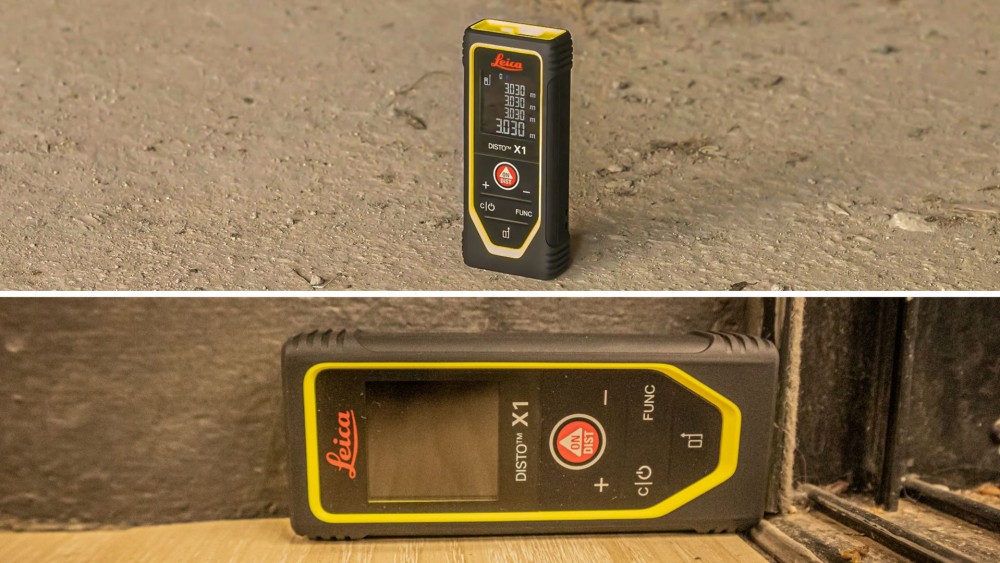
The significance of this level isn't just about "protecting more," but reducing mental burden while working. Laser distance meter users don't have to worry about minor mishaps, which, for daily users, translates into genuine peace of mind and true value for money.
IP67: Sounds great for tougher jobs, but first ask, "Do we really need it?"
Seeing IP67, many people immediately feel it's the ideal choice, which is understandable since the number 7 indicates waterproof capability up to 1 meter submersion for up to 30 minutes. The question, however, is whether our work truly demands that level. A laser distance meter with a very high IP rating comes with a higher price, potentially different weight or form factor, and isn't necessarily cost-effective for everyone.
Laser distance meters from hundreds to tens of thousands: which is the most worthwhile? If you frequently work outdoors, walk construction sites regularly, encounter heavy dust, high humidity, or face unpredictable rain and environments, a high IP model can genuinely be the right choice. But if most of your work involves indoor measuring, interior decoration, furniture measuring, or occasional use, a mid-tier IP model may be fully sufficient.
The key takeaway is not to choose based solely on the numbers, but rather select a laser distance meter based on your "job site condition risks."
An IP rating does not mean "indestructible"
Seeing a high IP rating, many might handle their laser distance meter carelessly—thinking heavy dust doesn't matter, water splashes are fine, or it can be set down anywhere. In reality, this rating is merely a standard for protection against the ingress of dust and water under specified test conditions. It does not mean the laser distance meter can withstand severe impacts, chemicals, extreme heat, or general misuse.
An IP rating provides extra peace of mind, but it isn't an excuse to neglect maintenance. Even with a high IP laser distance meter, if dropped frequently, seals degrade, rubber edges tear, port covers aren't tightly closed, or it's left in harsh environments too long, protective performance can decline. Looking at specs should go hand in hand with understanding proper usage, not assuming high numbers solve every problem.
The value of a high IP rating differs greatly between someone using a laser distance meter a few times a year and someone using it daily. Occasional users might be better off allocating budget to other aspects—such as accuracy, measuring range, or calculation functions—rather than overinvesting in an unnecessarily high IP rating.
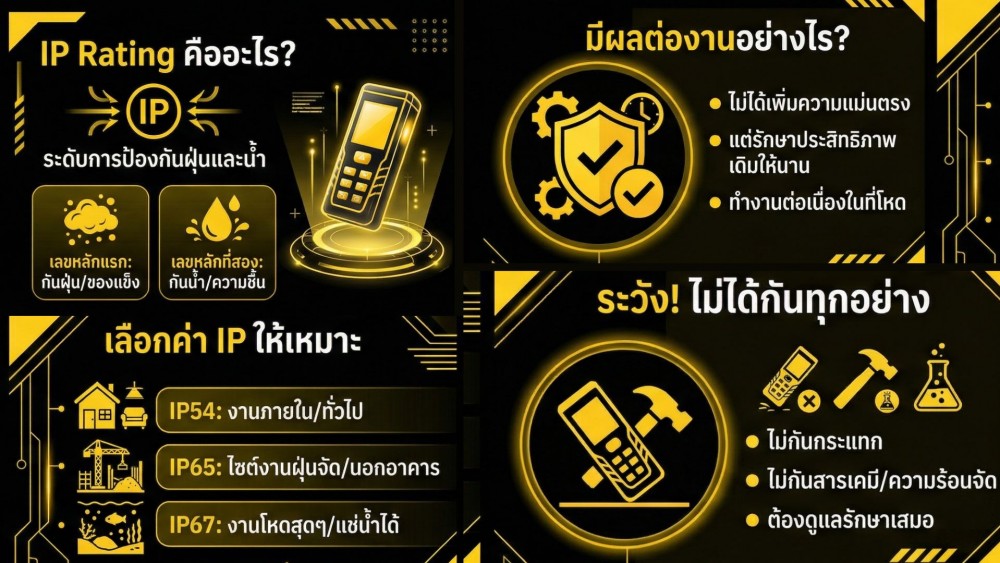
Summary: Does the IP rating of a laser distance meter really matter?
A laser distance meter's IP rating doesn't make measurements more accurate, nor does it extend measuring range. However, it helps the tool endure real-world environments better, reducing risks from dust, water, and moisture that gradually undermine device performance over time. Put simply, it doesn't add new capabilities; it helps preserve existing ones for longer.
So, to the question of whether an IP rating affects your work, the answer is yes—especially if you use your laser distance meter in environments that aren't consistently clean and controlled. The rougher the job, the more frequent the use, or the more unpredictable the surroundings, the more consideration should be given to the IP rating.
Because sometimes what keeps work running continuously isn't just having the most features, but the readiness of Laser distance meter to survive real-world jobs every single day