


 EN
 ไทย


Customers Also Purchased
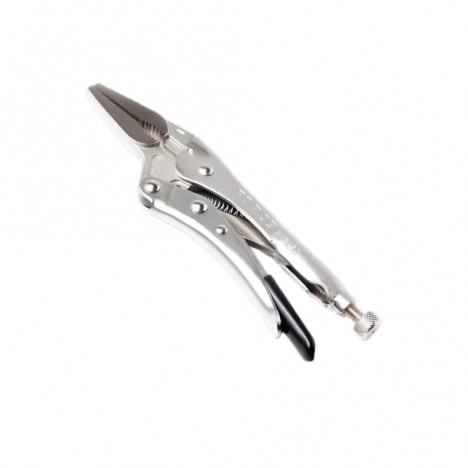
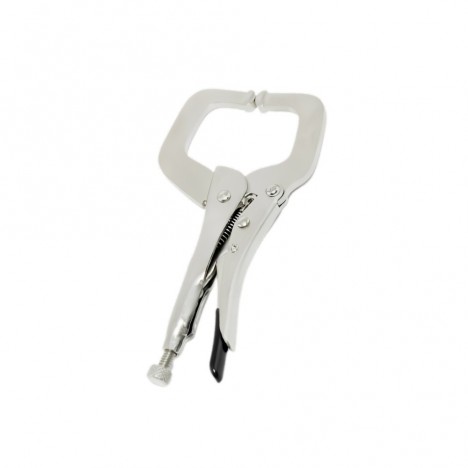
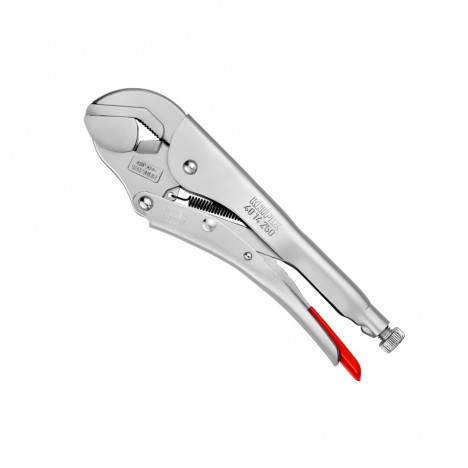
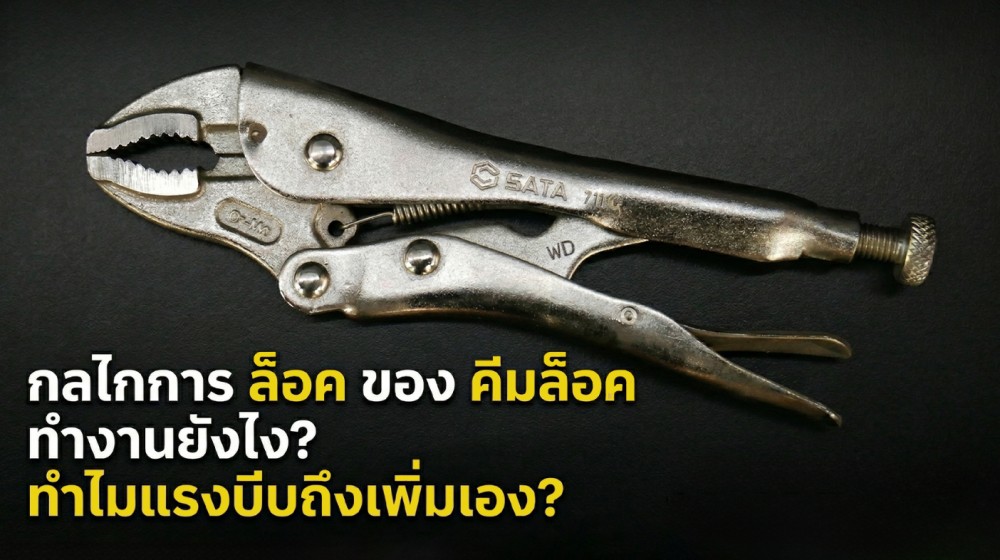
Ever wondered? When we use locking pliers to clamp onto a workpiece—whether it's a bolt head, a steel plate, or a pipe—why do they clamp down so tightly? Sometimes they're so tight that you have to pry open the release lever, even though they look just like ordinary pliers with an adjustment screw at the end of the handle. Many people might give the simple answer, "Well, because they lock," but that's not the real reason.
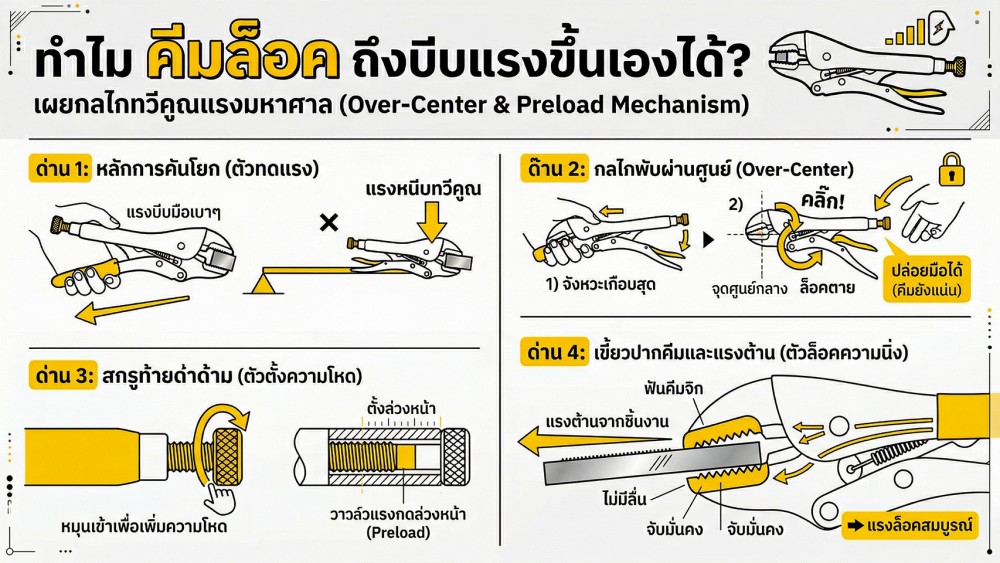
The secret hidden inside the handle of locking pliers is a mechanical marvel. Locking pliers don't rely directly on the squeeze from our hands; instead, they use the principles of levers, pivot points, and over-center toggling. This mechanism provides mechanical advantage and automatically converts our gentle squeeze into superhuman clamping force. That's why welders, mechanics, and DIY enthusiasts can't do without this tool.
In this article, we'll dissect the mechanism of Locking Pliers in a way that's easy to understand without needing engineering equations. We'll explore: How is such massive clamping force generated? What do the rear adjustment screw and the release lever actually do? Why do some locking pliers clamp rock-solid, while others fail to hold?
What are locking pliers, and how do they differ from regular pliers?
Before we dive into the internal mechanics, let's look at the big picture: how do locking pliers differ from ordinary pliers? Their brilliance doesn't lie in their looks, but in the structural design of the tool itself. Imagine using combination pliers or groove joint pliers: when gripping a workpiece, you have to constantly squeeze the handles, right? The jaw force is only as strong as your hand's grip. The moment you relax or your hand tires, the workpiece is ready to slip free.
Locking pliers were born to solve this problem! They are designed so that once you squeeze the handles past a certain point, the internal mechanism takes over and maintains that clamping force for you automatically. Even if you let go of the handles, the jaws will continue biting into the workpiece tightly without letting go.
Staying locked isn't just due to a stiff spring or friction in the joints. It is the clever arrangement of parts that toggle into a position engineers call "over-center." It's just like standing with your knees pushed all the way back until your legs "lock out" on their own, without needing to flex your thigh muscles!
In short, regular pliers use your hand strength directly to clamp the workpiece, but locking pliers use your hand strength to "engage the gear" that locks the mechanism. That's why this seemingly simple tool generates clamping power vastly greater than the force applied by your hand.
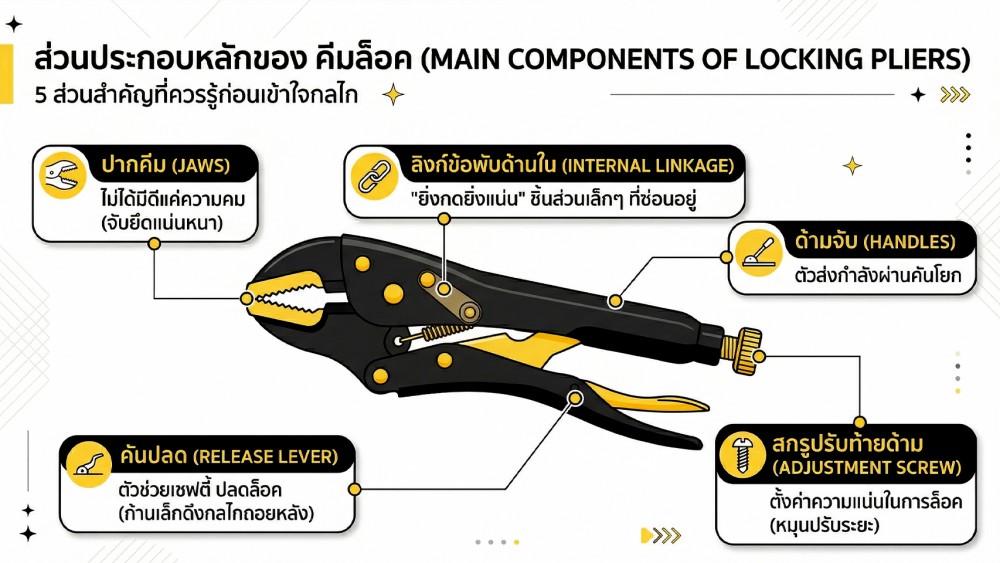
The core of it lies in the "lever," not just hand strength
The first secret behind the insane gripping force of locking pliers is fully utilizing the principle of levers. Levers might sound like high school physics, but we use them every day in everyday items like scissors, wrenches, and car jacks.
The key principle of a lever is trading distance for force. Notice that during use, your hand squeezes the handles over a relatively wide distance, while the "jaws" move only a tiny bit. This trade-off is the key! The less the output end (the jaws) moves relative to the input end (the distance your hand travels), the more the resulting clamping force is multiplied and amplified.
To put it simply: if you squeeze a workpiece directly with your bare hand, you tire quickly and the force is weak. But with a lever mechanism multiplying the force, the effort from your hand is magnified exponentially onto the workpiece. This is the mechanical reason why locking pliers feel remarkably powerful without requiring you to squeeze until you're red in the face.
The screw at the end of the locking pliers handle isn't just for size adjustment, but acts as a preload knob.
If there is one part of locking pliers that people use frequently yet misunderstand the most, it is the handle-end screw. Many people use it by turning it until the jaws get close to the workpiece, then squeeze; if it's too loose, they tighten it in more, and if it's too tight, they loosen it. However, rarely does anyone explain what it is actually adjusting.
This screw sets the stop point of the mechanism before it enters the locking point. Simply put, it determines how hard the jaws compress the workpiece just as the internal link is about to pass center. If you tighten the screw inward a lot, the jaws will have a smaller gap before the actual squeeze, requiring more force to push the mechanism past the locking point—but once through, the clamping force on the workpiece will be extremely high. If you back it out too much, the mechanism will pass the locking point easily, but the jaws may not apply enough pressure to hold securely.
This point is very useful because it explains what many users experience without ever having an explanation: why turning the screw just half a turn on the exact same locking pliers drastically changes its operating character—from pliers that close easily but feel loose, to pliers that clamp so tightly they can barely be released, or vice versa. To understand it most simply, think of the end screw as "preloading" the system—setting an initial force in advance. The higher the preload, the more squeeze force the system requires, but the greater the final gripping force achieved.
The teeth on locking pliers jaws are important, but they aren't the real star.
When talking about locking pliers, people often like to check if the teeth are sharp and deep, or if they bite into the workpiece. This is indeed important because good teeth help reduce slipping and distribute force more appropriately. However, if you ask what the real star is that actually allows locking pliers to "lock," the answer is not the jaw teeth. The teeth's primary role is to increase friction and provide traction on the surface, especially on round or slick surfaces like pipes, plated steel, or rounded bolt heads. But friction is only effective when backed by sufficient clamping force from the core mechanism. If clamping force is insufficient, no matter how good the teeth are, slipping can still occur.
This is another interesting perspective because it corrects the misconception that locking pliers grip tightly solely because of sharp teeth. In reality, teeth merely transmit the effect of the force generated by the mechanism—they do not generate the primary force. If the mechanism is loose, pivot points are worn, or the screw is improperly adjusted, the grip may still be insecure even if the teeth look brand new.
Therefore, when locking pliers fail to grip, don't just blame the jaw teeth right away. Check whether the locking mechanism is engaging through its full stroke, whether the screw is properly set, and whether the workpiece matches the jaw profile.
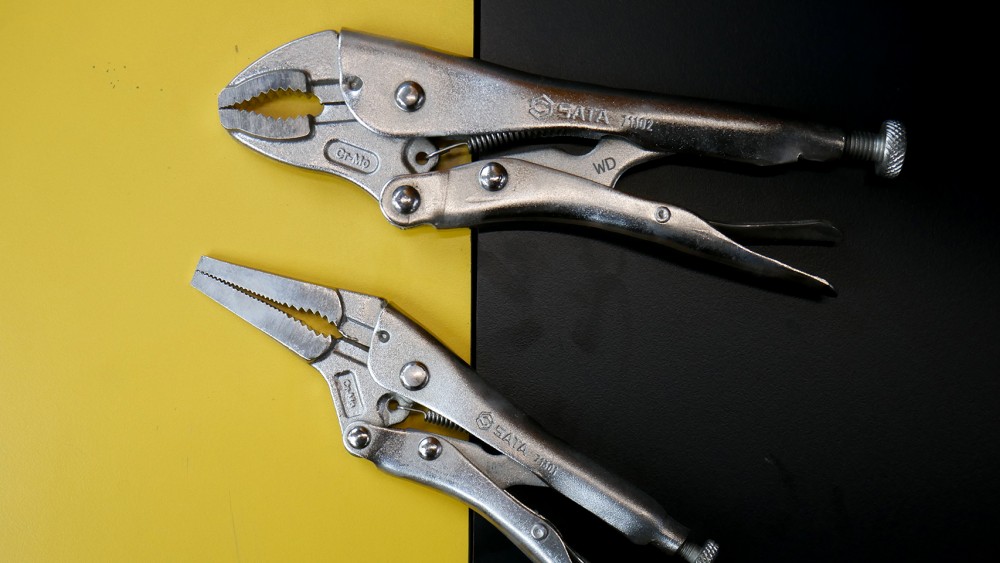
Why locking pliers are ideal for welding, repairs, and removing stripped bolts
Why are "locking pliers" a favorite item for tradespeople across every industry? From the clever mechanism we've discussed, it's easy to see why they are a real-world jobsite hero. They deliver the ultimate 3-step solution regular pliers can't: "extreme clamping power + hold-in-place lock + hands-free convenience." Let's take a look at real-world situations where locking pliers truly shine:
- Metal welding (holding workpieces): Welders often need to align workpieces precisely before welding. Having to hold them manually the entire time is impractical. Locking pliers are the perfect solution—just clamp the pieces firmly in place, and you're free to hold your welding helmet or torch with ease.
- Automotive and machinery repair (tackling rounded bolts): Facing a stripped, rounded, or damaged bolt head where standard wrenches can't grip? Locking pliers are the ultimate fix. They don't rely on the bolt's flats; instead, they use immense clamping pressure combined with sharp teeth to bite into the bolt head and twist it loose.
- Prying and freeing seized parts (on-the-spot problem solving): For rust-encrusted pipes or old screws that won't budge, locking pliers have the advantage of not needing an exact 100% tool size match. Just open the jaws to fit, clamp down as tightly as possible, and use the friction to muscle it out.
High clamping force doesn't always mean you're using locking pliers effectively.
What most people don't realize: when talking about locking pliers, people often focus on how tight they clamp. But in actual practice, excessive clamping force can also cause problems. If clamping force exceeds what is needed, the first thing damaged is the workpiece—especially soft-surfaced, thin materials or pipes that must maintain their shape, such as thin stainless steel tubes, aluminum pipes, or decorative parts. Excessive clamping force can dent, crush, or deform the workpiece.
The second issue is the user: overly tight pliers are hard to release, cause fatigue, and if they slip or pop open suddenly, they can pinch fingers or snap back. The third issue is tool lifespan: repeatedly overloading the mechanism, especially by forcing it past its travel limit, accelerates wear on pivot points, links, and the release lever.
Therefore, truly effective locking pliers aren't always the tightest ones, but rather those set "just right" for the job—holding securely without damaging the workpiece and releasing in a controlled manner.
How to tell if your locking pliers are adjusted properly
For everyday users who want to use locking pliers efficiently, there's no need for complex calculations of force or mechanical angles. Simply observe how they feel in use: if you squeeze and the pliers close too easily with almost no resistance, and the workpiece shifts after you let go, it usually means they are too loose—turn the screw in a bit more. But if you have to use excessive, unnatural force to squeeze them shut, and releasing requires hard prying with a risk of snapping open, that usually means they are too tight—loosen the screw slightly.
A good adjustment typically feels like a distinct increase in resistance as you approach the locking point, followed by a solid "click" or hold once past the point. The workpiece won't budge, yet the release lever can still disengage smoothly without aggressive jerking.
Another tip: if you need to do repetitive work on workpieces of the same size, such as clamping flat steel bars of identical thickness multiple times, try to remember the screw position once you find that sweet spot. Locking pliers perform extremely consistently when dialed in for repetitive tasks. But believe it or not, many people still mistime the release lever and have the pliers snap back onto their hands! In conclusion, Using locking pliers incorrectly risks ruining your workpiece or injuring your hands! What is the correct way to use them? We have the answers for you.
Conclusion
At first glance, "locking pliers" might look like just an ordinary, rustic hand tool—with jaws, an adjusting screw, and a release lever. But once you dissect its inner mechanics, you'll see that it conceals a wealth of mechanical brilliance! From using levers to multiply force, to creating a fixed over-center locking point, presetting clamping pressure, and utilizing the workpiece's own resistance to achieve a firmer grip.
This is precisely why locking pliers are a legendary, timeless tool. No matter how many advanced, specialized tools enter the market, an item that combines a rock-solid grip, a hands-free lock, and universal versatility remains a must-have in every tradesperson's toolbox. Better yet, once a user truly understands how its mechanism engages—rather than just randomly turning and squeezing—locking pliers become an exceptionally powerful go-to weapon.
Select Locking Pliers to suit the application