


 EN
 ไทย


Customers Also Purchased


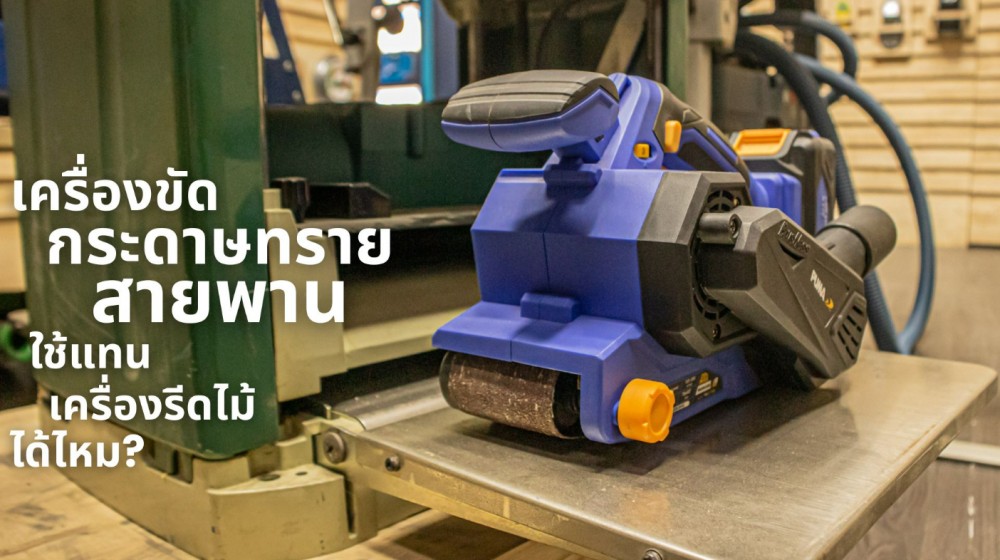
Have you ever wondered if having a Belt Sanders already means you still need to buy a thickness planer, or can one substitute for the other? A question that seems to be about saving budget, but is actually purely about operating principles, because One machine focuses on surface sanding and removing blemishes, while the other focuses on leveling and uniform thickness reduction across the entire board
However, it's not uncommon for people who own a tool like a belt sander to push it beyond its intended purpose, such as using it to reduce the thickness of an entire board or hoping to replace a wood planer altogether. While it might work to some extent, you'll likely end up facing uneven thickness, rounded edges, non-parallel surfaces, and spending far more time than anticipated.
Therefore, in this article, we'll take a close look at how well a belt sander can replace a wood planer: whether it's only suitable for surface-level work, merely a temporary workaround, or actually viable in certain situations without sacrificing too much quality. We'll also clearly outline which tasks are fine to continue using it for, which tasks you should strictly avoid forcing it on, and the consequences of misuse that many overlook—including time, precision, and the risk of unintentionally ruining workpieces.
Belt Sanders and Wood Planers: Fundamentally Different Working Concepts
Before answering whether one can replace the other, it's important to understand that a belt sander addresses completely different problems compared to a wood planer. Even though the end result might seem like improving the wood, their actual working principles are distinctly different.
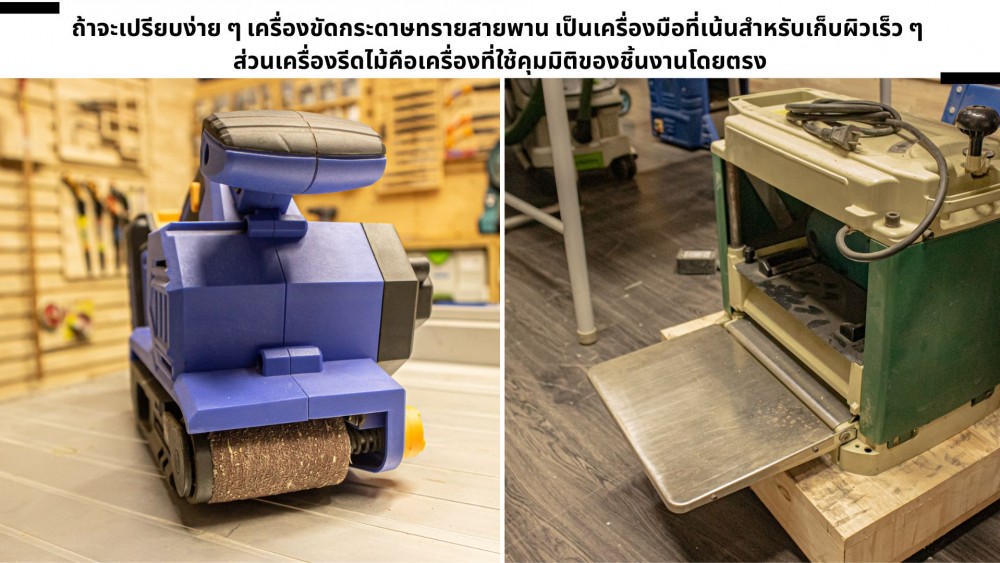
One of What You Need to Know Before Buying a Belt Sander to Get the Best Value A belt sander focuses on surface sanding, removing marks, and rapidly taking down the top surface of the wood. It is therefore ideal for surface finishing, basic leveling, and removing paint or glue residues. However, the results still depend heavily on the user's hands—including pressure, angle, and pass speed.
A wood planer, on the other hand, differs from a belt sander in that it focuses on making the wood flat, uniform in thickness, and perfectly parallel, relying on the machine's rigid structure to control the outcome.
However, there are some similarities in what both machines can deliver, such as:
- Removing material from the top surface
- Improving the surface appearance
- Usable on wood boards
- Saving time compared to manual hand work
The more crucial difference lies in "how it removes material" and "how well the result can be controlled." And this is precisely why a belt sander cannot directly replace a wood planer.
Can You Use a Belt Sander Instead of a Thickness Planer?
The short answer is Can substitute for some tasks, but cannot replace the core function Indeed, if you use a belt sander for surface finishing, removing marks, or minor leveling, it is fairly manageable. But if you intend to use it instead of a wood planer to control thickness, maintain parallelism, or accurately fix warped wood, it simply cannot achieve that effectively.
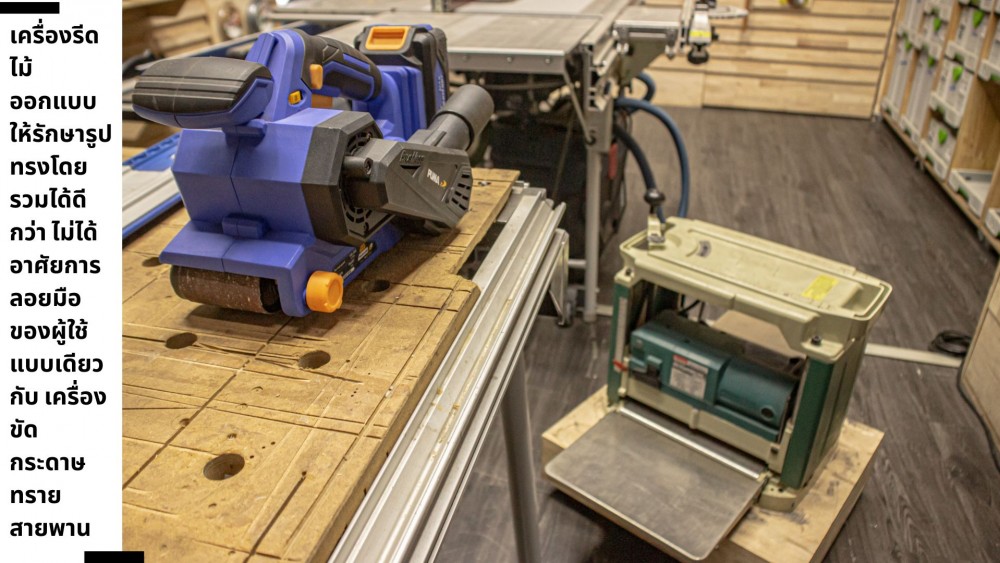
The reason is that a belt sander relies heavily on the user's manual control—pressure, angle, and feed pace—which risks uneven sanding, gouging depressions, or accidentally rounding edges.
In contrast, a wood planer precisely controls the depth of cut, delivering consistent results for tasks that demand straightness, parallelism, and uniform thickness.
Therefore, a belt sander
- Can be used as a substitute: for surface finishing, surface smoothing, removing blemishes, and rough leveling.
- Cannot be used as a substitute: for jobs requiring thickness control, flatness control, parallelism control, and high precision.
- Can barely manage: for temporary jobs or workpieces where dimensions are not critical.
- Should not be used as a substitute at all: for furniture making, fine assembly work, or multiple wooden pieces that need to be duplicated identically.
Why is a belt sander not suitable for replacing a thickness planer?
This point is crucial because many people do not misuse tools out of ignorance, but simply because they think, "Well, they both remove material." In reality, the fundamental nature of these two tools is worlds apart.
1. True thickness control is impossible
The core purpose of a thickness planer is to make the entire board a uniform thickness. A belt sander, however, lacks a thickness reference system, an indexing table that establishes a fixed depth of cut, and a feed mechanism ensuring uniform pressure across every point. As a result, certain areas inevitably get sanded more than others—especially if you accidentally apply extra pressure at the beginning or end of the workpiece.
In some types of woodworking, a difference of less than 1 mm shows immediately during assembly—such as tabletop butt joints, matching cabinet doors, or pieces fitted into grooves. Using a belt sander to reduce thickness across an entire board creates a high risk of the piece looking flat while actually being uneven.
2. Surface flatness depends far too much on hand pressure
A belt sander removes material quickly, but the faster it cuts, the more consistent your hand pressure must be. Press too hard on the front and it digs in; push too hard on the back and it gouges; linger in one spot and a dip forms; move unevenly and ripples appear; and if the belt wears down or tracks off-center, the resulting surface distorts even further.
This is why seemingly simple tasks, like running a belt sander over an entire board's surface, are not as easy as they look. Often, the wood feels flat because it feels smooth to the touch, but placing a steel straightedge or specialized measuring tool on it reveals that ripples and waves remain.
3. Workpiece edges lose their shape more easily than you think
Another very common issue with belt sanders is unintended edge rounding. When trying to sand across the entire board, reaching the edges often leads to lifting the wrist or altering hand pressure unevenly, causing the edges to be sanded away more than the center. This is a critical issue if parts must form square joints or maintain crisp, defined arris lines.
4. Takes much more time than expected when heavy stock removal is needed
A belt sander might seem powerful enough to make you think, "This should take down the whole board quickly." However, if you need to remove multiple millimeters of wood across the entire piece, using a belt sander will be much more tiring, time-consuming, and abrasive-consuming than expected. Furthermore, it generates huge amounts of dust and requires constant checks because a momentary lapse results in uneven removal.
A thickness planer is far better suited for this kind of work because it is designed for "systematic stock removal," not just making the wood surface look smoother.
Cases where a belt sander can serve as a substitute
None of this means a belt sander can never be used as an alternative. In certain situations, it performs wonderfully, and once you understand its limits, you can get great value out of it without disappointment. Let's look at the tasks where this type of sander can still get the job done.
- Leveling minor misalignments after edge-gluing wood Using a belt sander to bring down raised spots is quite suitable, because the goal here is not to control the thickness across the entire board.
- Cleaning up rough wood surfaces before the next fine sanding step For wood that has already been sawn or planed, it may still have tool marks or rough grain. Using a belt sander with coarse to medium grit helps you get to the fine sanding stage much faster.
- Adjusting workpieces where precise dimensions are not critical Certain types of work—such as simple shelves, rough framing, temporary assemblies, or decorative pieces that do not need to fit precisely with other parts—can be leveled and made to look better using a belt sander.
- Renovation work or stripping old finishes If the goal is to remove paint stains, clear coats, old marks, or damaged surface layers, this type of machine is an ideal solution.
Sometimes, a belt sander is even more practical to use than a thickness planer because many old workpieces have screw heads, nails, or rough surfaces that are not suitable for feeding directly into a planer.
When you should NOT use a belt sander instead of a thickness planer
I'd especially like you to remember this point, because this is where mistakes truly happen when assuming "it shouldn't be much of a problem." But when you force it on the wrong job, the consequences often go beyond just wasting extra time—sometimes you ruin the wood, waste energy, get frustrated, and might end up having to start the job all over from scratch.
- When you need uniform thickness across multiple pieces If all furniture components must have identical thickness, relying on a belt sander makes repeatable results almost impossible. Even if the first piece looks good, the thickness and surface of subsequent pieces will usually end up inconsistent.
- When two sides must be parallel A thickness planer has a distinct advantage in referencing one side against the other, whereas a belt sander naturally lacks that capability.
- Significantly bowed, twisted, or cupped wood Many people assume they can use a belt sander to fix warped wood, but the reality is that if the wood has structural or geometric distortion, sanding the top surface does not address the root cause.
- When tight, precise joinery tolerances are required Such as mortise-and-tenon joints, drawer fronts, flush-fitting components, or tabletop edges that must butt tightly together.

Conclusion: A belt sander cannot replace the entire system
Ultimately, to be completely straightforward, I see a belt sander as a tool that excels at what it was designed for, which is Sanding surfaces, removing marks, rough level reduction, and speeding up the wood prep stage. However, there are still things you need to know, such as Belt sanders and safety considerations you shouldn't overlook
And if we go as far as replacing a thickness planer, the answer must be clearly separated: are we talking about "substituting for certain tasks" or "substituting for its primary role"? If it's the former, it's fairly doable, but if it's the latter, the answer is genuinely no.
What makes many people feel that a belt sander could replace a thickness planer is that it makes surfaces look good quickly and removes material fast. But once faced with tasks that require uniform thickness, straightness, parallelism, and workpiece precision, different types of machines still cannot replace one another.
If you choose to use Belt Sanders it, use it to its full potential in its intended role. But if you become more serious about the precise dimensions of the wood, it's much better not to force this type of tool beyond its limits.