


 EN
 ไทย


Customers Also Purchased


Have you ever thought that Belt Sanders It seems like one of the most straightforward power tools: just turn it on, sand it flat, and you're done—like a step where nothing could go wrong? But frankly speaking, on the actual job site, it's the moment where people slip up most easily, especially when your mind starts wandering, your hands rush, or worse, when chatting while working.
The question is: why does a belt sander, which seems to just "sand," have the potential to cause far more accidents than many people think? Why do some people who use it every day still get hurt, even without doing anything reckless? And if we have to use this type of sander every day, what should we watch out for in a way that is practical and actually doable?
Therefore, in this article, we will go through the process step by step—from before turning on the belt sander, during sanding, to putting the tool down—examining common situations and repetitive small mistakes. Because the one thing we must never forget is: if you can't control the belt sander, it will control you instead.
Why Can Just a "Sander" Become a Risky Tool?
Many people assume that the main hazards in woodworking or metalworking lie with saws, cutting blades, or angle grinders used for stripping paint, because these tools have blades and produce sparks. But the truth is that a belt sander also has extremely high "pulling" and "carrying" forces. The sanding belt spins rapidly and will "drag" anything that comes into contact with it—from workpiece scraps to the tip of a glove. Which belt sander is right for you?
Besides 5 Things to Know Before Buying a Belt Sander to Get the Best Value What makes a belt sander a silent hazard is that it doesn't look as intimidating as cutting tools. But when an incident occurs, it happens fast and often when our guard is down—such as thinking, "It's just sanding or trimming a corner, no need for safety glasses," and then a small sanded fragment flies into an eye, or fine dust accumulates causing nasal irritation and persistent coughing, or the tool kicks back from sanding too aggressively against the grain. All of these are very real scenarios.
Before Switching on the Belt Sander: Commonly Overlooked Mistakes
Before you grab the belt sander and press the switch, ask yourself a brief question: "Am I ready to control this tool?" Sounds like a simple question, right? But if you can't answer it or feel uncertain, it means you're about to work at risk.
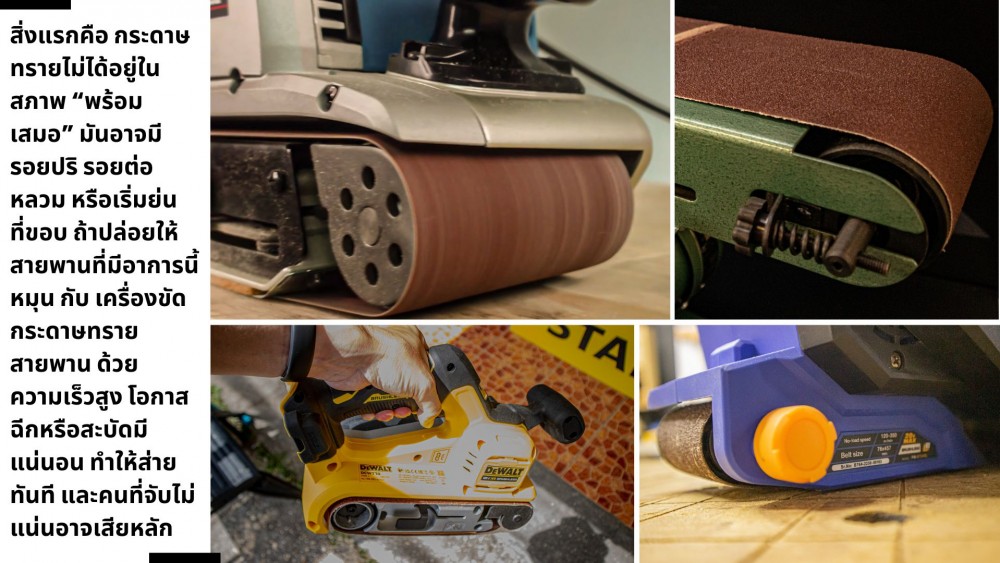
Another thing people often skip is "belt tracking." Some belt sander models feature an adjustment knob to keep the belt centered on the rollers. If you install a belt and don't test-run it raised in the air to see if it tracks straight, once pressed against an actual workpiece, the belt might wander and rub against the housing, causing premature tearing or slipping off the track—and the resulting violent swinging motion is very dangerous.
Finally, inspect the workspace. Power cords must not run across walkways or table corners where they could be snagged inadvertently, and workpieces must be clamped securely. Sanding a "slippery" workpiece or holding it "with bare hands" without clamping puts you at risk of the workpiece kicking back and pulling your hands toward the sandpaper unintentionally.
Belt Sanders and the PPE You Should Actually Wear
PPE is what minimizes damage "when a mistake happens." And with a power tool like a belt sander, believe it—if an error occurs, you can get injured in ways you wouldn't expect.
Safety Glasses and Belt Sanders: Why Must They Have Side Shields?
Dust from a belt sander doesn't just fly forward; it swirls around, and airflow from the motor blows it out sideways. Wearing regular glasses without side shields still leaves you vulnerable to dust or wood chips entering your eyes, especially when sanding hardwoods or surfaces with paint residue and filler.
Dust Masks: Is Simple Cloth Really Not Enough?
Fine wood dust generated from sanding with a belt sander isn't something to take lightly. If sanding in an enclosed space with a thin cloth mask, you will quickly notice restricted breathing, a sore throat, and coughing. Those are clear signs that dust is getting through. At minimum, use a mask genuinely rated for fine particulates. And for frequent work, a dust extraction system should be part of the setup—not just for keeping the area tidy.
Earplugs: Should You Wear Them Even for Quick Sanding?
High-frequency noise from the motor and friction of a belt sander can cause cumulative hearing fatigue. In environments where multiple sanders operate simultaneously, wearing earplugs or earmuffs significantly reduces long-term risk.
To Wear Gloves or Not? The Answer Is More Complex Than You Think
Should you wear gloves when using a belt sander? Honestly, it depends more on the nature of the task and the primary risks involved. Gloves have both pros and cons: the pros are protection against heat, cuts from wood scraps, and splinters; the con is that certain types of gloves, such as cloth gloves or loose-fitting gloves, can get "caught by the belt" and drag your hand directly into the sanding zone.
If wearing gloves is necessary, choose snug-fitting ones without frayed edges, and avoid fabric gloves whose loose threads can easily catch when working very close to the belt. However, if the job involves handling small workpieces near the sanding surface, it is recommended to use workpiece holding fixtures instead of gloves. Such as clamps, guides, or holding fixtures to keep your hands as far away from the belt as possible
During Sanding: Why Handheld Sanders "Kick Back" and How to Control Them Without Mistakes
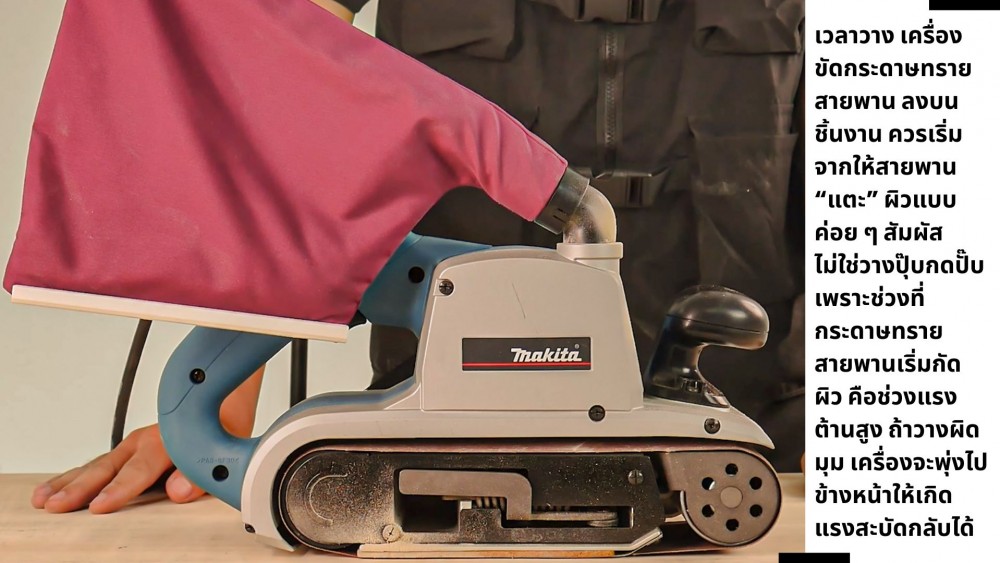
The "kickback" of a handheld belt sander can be caused by several factors, but the primary cause is uneven friction—such as pressing down too hard, sanding sharp corners with the tool tilted, or sanding against the wood grain until the belt catches and stumbles.
Pressing Hard Increases Danger—It Doesn't Always Make It Faster
Some people might believe that "pressing hard on the belt sander removes material faster." Sometimes it really does remove material faster, but at the cost of a hot tool, a hot belt, and a higher risk of kickback because the belt tries to escape the resistance. If there are exposed nails, screw heads, or hard knots in the workpiece, the belt will snag and can kick back violently.
Holding the Tool: One-Handed vs. Two-Handed Makes a Huge Difference
If you are using a belt sander to sand large surface areas, table tops, or long wooden edges, a two-handed grip helps you control the direction and downforce much more smoothly. One hand controls the front of the tool, while the other controls the rear. Don't overlook this, because when the tool kicks back, a single-handed grip can easily slip.
Small Workpieces: Why They Are a Beginner's Trap
A very risky task for a belt sander is sanding small workpieces, such as small wooden blocks, furniture components, or parts held only by your fingertips. Your hands will be extremely close to the belt, and if the workpiece jerks away, your automatic human instinct is to "reach after it." But in workshop tasks, some natural instincts pose serious risks.
A safer method is to make the workpiece "temporarily larger," such as by sticking it with double-sided tape onto a backing board and holding the backing board instead, or using a vise to clamp the workpiece securely and sand it keeping your hands well clear.
Belt Snapping / Slipping: Are There Warning Signs Before It Happens?
Yes, there are, and it often warns us through a "strange feeling" in the form of subtle symptoms that make us think, "Wait, the machine doesn't feel right today." Anyone accustomed to using a belt sander will sense it immediately through their hands and ears, such as:
- The machine begins to vibrate abnormally, even without changing your sanding stance
- The sound of the belt rubbing against the edges gets louder, like something is scraping
- An abnormally strong burning smell of sandpaper or wood
- The belt is tracking off-center, wearing down one edge faster than usual
- There is a rhythmic "jerking" sensation, as if hitting the belt seam on every full rotation
The safe approach is to lift the tool off the workpiece, switch it off, wait until it comes to a complete stop, and then check each component one by one: re-track the belt, see if it is rubbing against the frame, check for tears on the edges of the belt, and check if dust is clogging inside the housing. Fix the issue completely before resuming your sanding; controlling the belt sander will then be much easier and you won't have to take unnecessary chances.
Stance and Working Angle: Basics That Help Tremendously
When using a belt sander, I want you to think of it as holding a tool that has "traction and pull," not just a tool that "vibrates": that is, Stand firmly with your feet reasonably apart, do not stand too close to the workpiece, and avoid facing directly in the path of flying dust.
Placing the workpiece on a table of appropriate height reduces the need to bend over excessively, minimizing fatigue and the risk of accidentally bringing your face too close to the sanding area. Some people lean in closely to inspect the fine finish and forget that dust and debris are being ejected right toward them.
Sandpaper Grit and Safety: How Are They Related?
People often think coarse/fine grit only affects surface finish, but in reality, sandpaper grit also affects "resistance" and "control over the belt sander."
While coarse grit removes material quickly, it creates high resistance and a higher chance of kickback, especially when first contacting the workpiece. Fine grit, on the other hand, creates less resistance but clogs easily when sanding sticky or resinous materials, leading to heat buildup and burning odors.
Therefore, if you are a beginner, do not start with the coarsest grit because you are increasing your risk. Starting with a manageable grit and gradually progressing according to the job is safer for both you and the belt sander.
Setting Down the Belt Sander: Putting It in the Wrong Place Carries Risks
Another dangerous moment is "when setting down the belt sander." Sometimes after finishing sanding, people immediately place the tool down while the belt is still spinning, causing the machine to slide on its own or the belt to catch power cords, rags, or table edges.
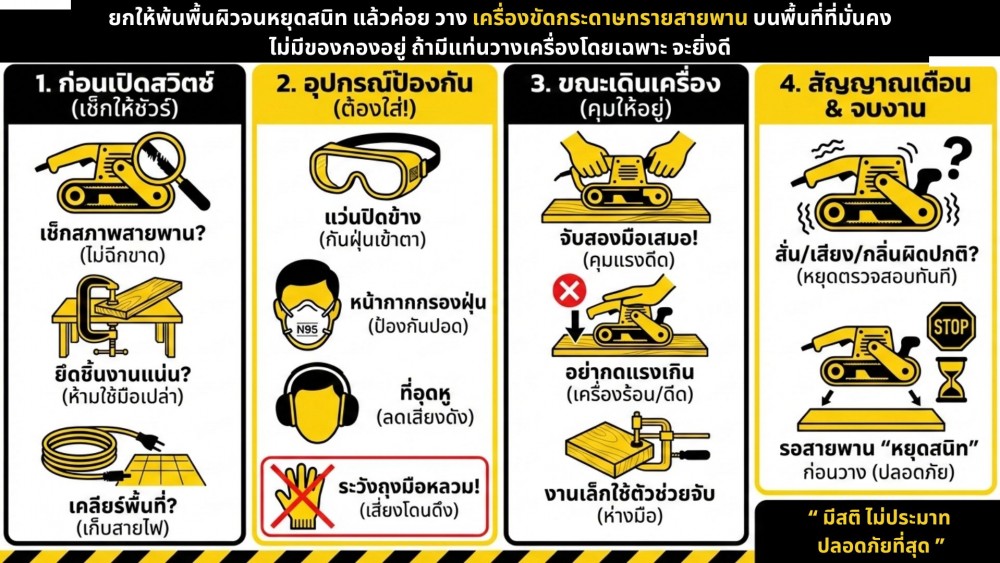
Summary: Belt Sander Safety Comes from "Usage Habits"
In brief, while a belt sander is a tool that works fast, what makes it truly "worth it" is speed combined with safety—not speed traded for risk.
Before using a belt sander, I recommend checking these 3 things:
- The Tool Belt aligned / not damaged, handle secured firmly
- The Area Workpiece secured, power cord out of the way, dust extraction / ventilation available
- Yourself Safety glasses with side shields, dust mask, stable stance, and hold with both hands whenever possible
Ultimately, safety is not just about reading and understanding warnings, but it stems from small habits we remind ourselves of and practice repeatedly.
Inspect the belt, wear glasses, manage dust, clamp the workpiece, hold with both hands, set down the tool at the right moment. If you can do these, you will use Belt Sanders with confidence, without having to take a gamble every time.