


 EN
 ไทย


Customers Also Purchased


Imagine this: you have an urgent job requiring a bit of steel drilling, but when you open your toolbox, you find Drill Bit only a few drill bits. The metal drill bit is nowhere to be found, leaving only wood and masonry drill bits mixed together. Some might console themselves by thinking, "Let's just use this for now, it should drill through anyway."
Once you actually start, the symptoms show up immediately: the motor doesn't sound smooth, the chuck vibrates, a faint burning smell appears, the tool heats up rapidly, the drill bit becomes dull or discolored, the drilled hole looks messy, and sometimes it even stalls to the point that the gears start grinding. This is the exact moment when many people begin to think, "Or am I actually ruining my drill?"
The question is: Can using the wrong drill bit really ruin your tool? If it doesn't break right away, how much faster does it wear down? And where is the fine line between "manageable" and "forcing it until it breaks" that we often overlook? All of this is more related to the "drill bit" than you might think. We will dive deep to give you a clear, easy-to-understand picture of where the risks lie and how to recognize them before things escalate.
Drill bits: more than meets the eye?
On a rushed workday, we might view a drill bit simply as a consumable or a "cutting tip" inserted into the end of the machine that spins to make a hole. But in reality, it is the component that defines the entire load on the tool, to say the least.
A drill bit isn't just about sharpness; it's about "geometry, material, and angles."
Each type of drill bit is designed to handle materials differently because different materials resist cutting in different ways:
- Wood: Softer; requires a sharp cutting edge that bites quickly, clears wood chips fast, and prevents splintering.
- Steel: Hard; generates high friction heat; requires a heat-resistant cutting edge and cutting angles optimized for metal cutting.
- Masonry/Concrete: It's not "cutting" like with steel or wood, but rather "crushing, pounding, and hammering"; it requires carbide tips and impact force from an impact drill or rotary hammer.
Can using the wrong drill bit really break the tool?
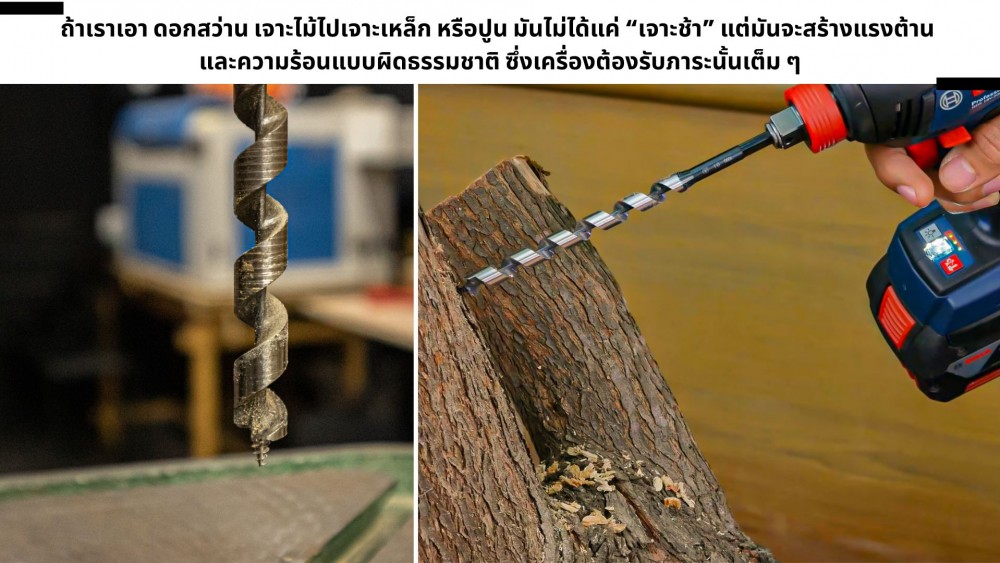
To be completely straightforward: "Yes, in some cases," but it won't happen every single time, nor will it break immediately.
Whether it will break or not usually depends on 4 main factors, which are: Type of tool (standard drill / impact drill / rotary hammer / drill press) Tool power and transmission system (Does it have reduction gears? Does the clutch disengage? How large is the motor?) The material being drilled (Hardness, thickness, toughness) all the way to Our own drilling habits (Do you push hard? Do you use high RPM? Is there coolant? Is it perpendicular?)
If you combine the wrong drill bit with forceful drilling habits, the chances of damaging the tool are "very real".
Common signs of failure are not instantaneous
Most symptoms appear gradually and quietly, as if the tool is slowly "straining itself." Some days it might still seem fine, but after a few uses, you may notice it overheats more easily, loses RPM more quickly, and requires more downward force. Simply put, it's more of a "prolonged torture on the tool" rather than sudden catastrophic failure.
How does using the wrong drill bit damage the tool?
The drill bit is like a knife, while the tool is the "person holding the knife." If the knife suits the job, the person works effortlessly, the motion is smooth, hands don't tense up, the tool doesn't jerk, you don't bog down the RPM, and you don't exhaust yourself pushing hard. But if you take a kitchen knife to cut steel, no matter how hard you try, you'll ultimately have to apply tremendous force and press harder. The result is an exhausted user, poor work quality, and useless wear and tear. If you replace the human hand with a power tool, the symptoms are quite similar.
1. High resistance and high current draw: Motor overheats
When the drill bit cannot cut into the material (due to incorrect cutting angles or bit material), the tool itself has to struggle to maintain its RPM. The motor draws more current, and heat accumulates rapidly. Heat is the number one enemy of power tool motors, whether across various types of drills, electric screwdrivers, or impact drivers used with drill bits.
2. Drill bit binding/jamming, kickback, gears and chuck taking the full impact
Ever had a drill bit "bind" during drilling and twist your wrist? That is kickback. It happens instantly, and if it occurs frequently, the gears and chuck wear out very quickly—especially in thick steel when using the wrong bit.
3. Abnormal tool vibration: Bearing and spindle wear
A drill bit mismatched to the job can cause extreme vibration. For example, using a masonry bit to drill steel or wood won't clear chips properly, causing vibration and hammering. The bearings and spindle absorb these vibrations constantly, eventually becoming loose and noisy.
Using a wood drill bit on steel: Why is it risky?
How different are wood drill bits and metal drill bits? Can they be used interchangeably? Many people have tried this, thinking "a sharp edge is a sharp edge," but in reality, they are vastly different. Wood bits and metal bits are designed for completely different tasks. A wood bit features a brad point to center the hole and bite into wood quickly, but its cutting edges and material are not engineered to withstand prolonged heat from metal. Using it on steel easily leads to chipping, dulling, or burning out quickly, whereas metal drill bits (such as HSS/Co) are specifically made to "cut metal" and withstand much higher heat.
If you absolutely have to use it temporarily, reduce the RPM, apply light pressure, drill a pilot hole, use cutting lubricant, and pause periodically. However, it must be emphasized that the bit will wear down fast, and the finish will never be as clean as using the right tool for the job.
Standard High Speed Steel (HSS) drill bits can be used to drill wood without issue, though the holes may not be as clean as those made with dedicated wood drill bits. However, if using auger bits or brad point bits (with a sharp tip), never use them to drill metal, as the cutting edges will chip immediately.
Using masonry drill bits to drill metal/wood makes them "ineffective"
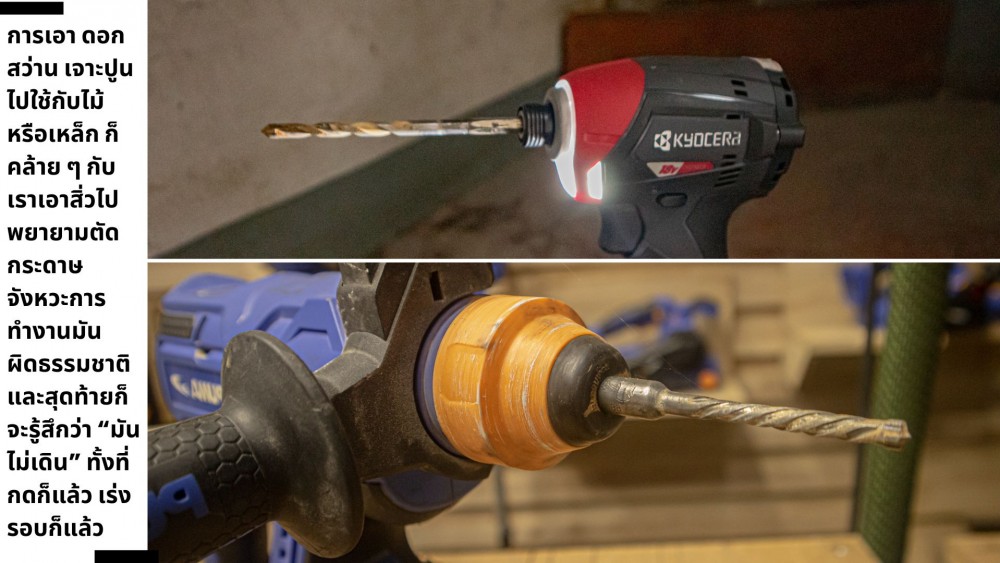
Masonry drill bits are designed to work together with "impact forces." Rather than relying on sharp edges to "slice" through material like you would with metal or wood, they work by "hammering" to crush the masonry and gradually bore through. The tip features a wedge-shaped carbide insert that, while extremely hard, is not shaped for shearing metal or cleanly clearing wood chips.
Slipping when drilling metal
Carbide tips do not have sharp angles engineered for cutting metal, causing them to slip on metal surfaces just like rubbing a hard stone against steel. What often happens is that it simply "skids" across the surface, leaving shiny scuff marks, and heat builds up extremely fast because it is creating friction rather than cutting chips. Moreover, high vibration levels cause the chuck to wobble and the tool to jerk periodically. Sometimes the drill bit wanders off-center, resulting in crooked holes or excessive damage to the workpiece.
Can it drill wood?
It can drill, but with great difficulty Yes, but it will be rough and uneven, leaving messy holes and a high risk of splintering, especially on softwoods or plywood where edges are prone to tearing out. Another common problem is "scorched wood" because masonry bits do not clear wood shavings efficiently; the bit heats up rapidly and easily leaves burned rings around the hole. In summary, it is technically possible, but the results are not worth it, and it forces the drill to bear far more vibrating and jerking loads than it should.
Using metal drill bits on concrete: risks ruining both the bit and the machine
This is a common misconception where people think, "Metal is harder, so it should be fine to drill concrete." But concrete and masonry do not require the razor sharpness needed for metal; they require resistance to impact and stone abrasion. Using metal bits will cause them to: Chip extremely fast
- Metal drill bit chips, tip flattens, fails to penetrate
- User presses harder, switches on hammer mode (on an impact drill)
- Bit wobbles, damages the chuck and spindle
- Motor overheats, abnormal gear noise occurs
If you are using an SDS rotary hammer and insert the wrong type of bit or use improper chuck adapters, the risk is even greater. The internal mechanism of a rotary hammer endures immense impact forces and requires bits specifically engineered to be compatible.
Can using the wrong drill bit shank damage the tool?
Let me highlight another point that many people overlook: sometimes we haven't picked the wrong "type" of drill bit, but rather the wrong "drill bit shank," leading to improper clamping. The resulting symptoms are very similar—excessive machine vibration, failure to advance, and ultimately, damage transferred directly to the chuck and spindle instead.
Round shank vs Hex shank vs SDS
- Round shank: Used with standard drill chucks for general drilling tasks
- Hex Shank: Designed for impact drivers, works well with drills, and reduces slipping in the chuck.
- SDS-Plus / SDS-Max: Specifically for rotary hammers; absorbs impact and slides back and forth while the tool is operating.
If you use an unsuitable shank, such as "forcing" a round shank into a loose chuck or using an adapter for heavy hammering, the result is that the chuck and drill spindle bear unnatural stress, eventually becoming loose and wearing out quickly.
Using a dull drill bit is practically equivalent to using the wrong type
Sometimes we don't pick the "wrong type," but the drill bit we use is so worn out that it effectively becomes "misuse"—it won't cut, and you have to force the tool harder than usual. Clear telltale signs include:
- Having to push harder and harder while drilling
- Smoke/burning smell coming from the workpiece
- Debris coming out as fine dust rather than chips
- The drilled hole starts becoming out-of-round or drifting off-center
- The drill bit changes color (blue/purple) from heat
5 telltale signs that let you know it's time to replace your drill bits! If you notice these signs and keep pushing through, the tool will constantly be overloaded, just like using the wrong type of bit.
Conclusion: Can using the wrong type of drill bit really ruin your tool?
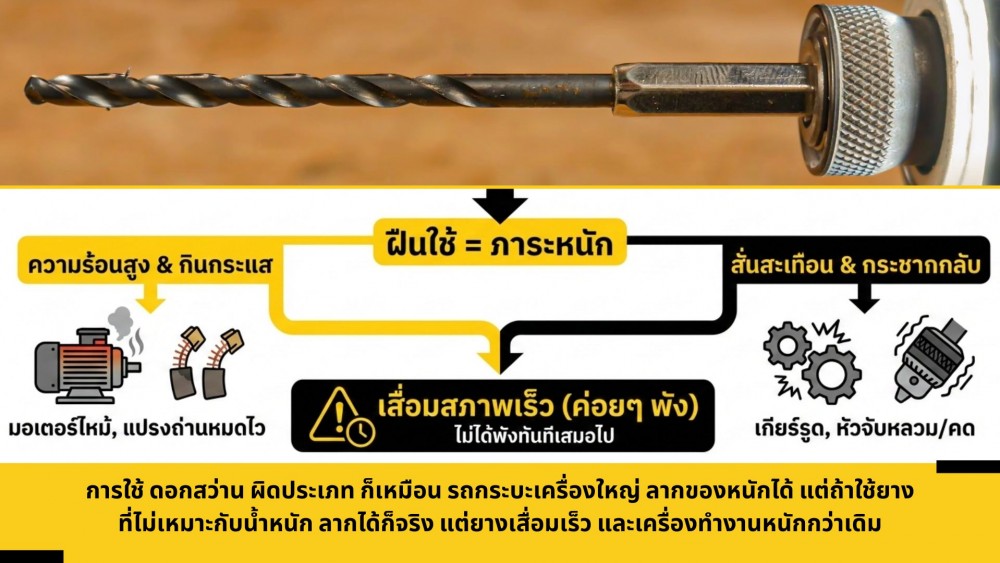
Here is my summary: using the wrong type of drill bit "can really ruin the tool" if it leads to situations with: High load, high heat, and frequent, repeated shock impacts. However, what people often overlook is that it doesn't necessarily break immediately with visible smoke or grinding noises. Most of the time, it causes the tool to "deteriorate rapidly" without you realizing it, such as:
- Motor overheating leading to rapid deterioration of the winding insulation
- Carbon brushes wearing out fast due to high current draw (in brushed models)
- Gear wear Due to kickback resistance and jamming
- Chuck loose / bent Due to bit wobbling and spindle wear
- Bearings overheat and become loose Due to high load and vibration
Before drilling, I recommend doing a quick check: What material are you drilling? What type of machine is being used? Is it the correct drill bit type? Is the RPM appropriate? Is cutting fluid required? And is the drill bit still sharp? If you can answer all of these, your work will be much easier, and most importantly, your tool will last long without frequent repairs.
In summary, choose Drill Bit correctly: the job gets done faster, and the machine lasts longer.