


 EN
 ไทย


Customers Also Purchased


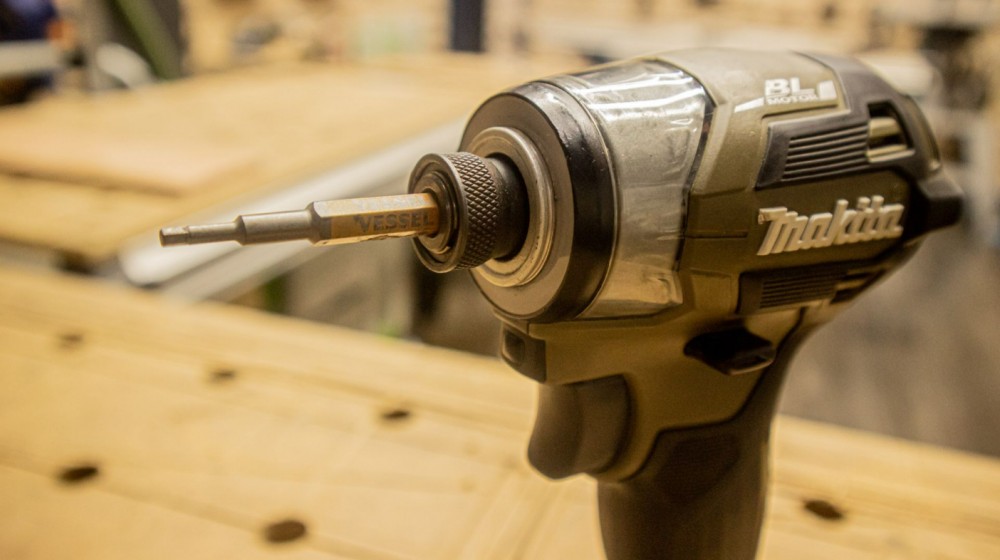
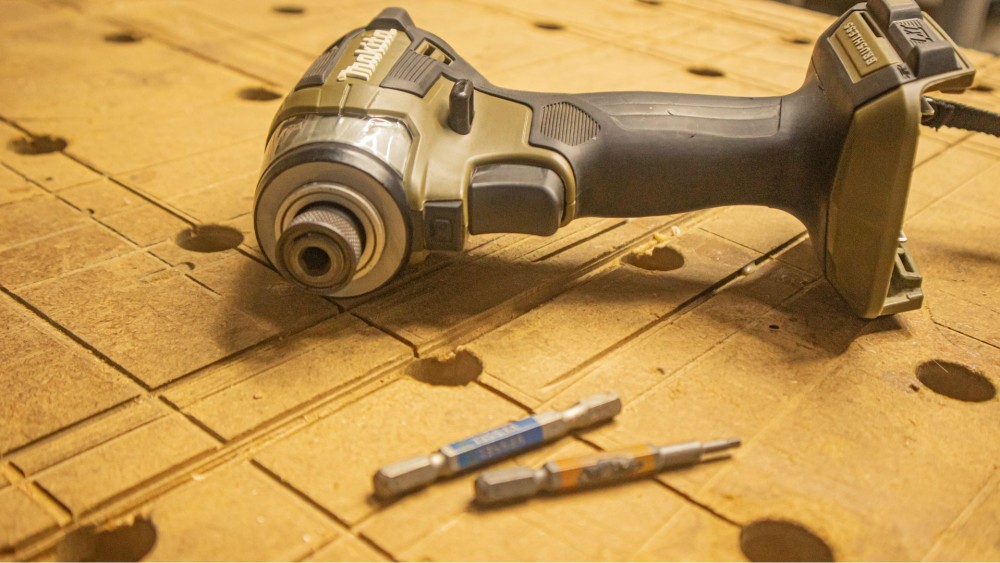
Impact driver It's safe to say it's one of the most popular power tools. If you've ever walked past a tool store, a parts repair shop, or assembled furniture, and seen a cordless tool that looks similar to a drill but with a shorter head, no clutch collar, or conventional drill chuck—instead having a protruding round collar with a hexagonal hole inside, making it look easier to insert bits than a drill—that's an impact driver.
However, when it comes to bits compatible with impact drivers, there's a wide variety to choose from, raising the question: "What bits can an impact driver actually use? Can any bit with a hex shank work?" Sounds simple, right? Just like asking, "If I already have a screwdriver, why do I need a drill?" But in reality, there's quite a bit more to it. Understanding this allows you to choose the right bits, maximize tool efficiency, and significantly extend the lifespan of both your tool and the bits you use.
Why is an impact driver different from a drill?
Before answering the question about compatible bits, we first need to understand that an "impact driver" is a power tool designed primarily for "driving"—such as driving tight bolts or screws, or very long fasteners—and importantly, requiring high torque. This is unlike standard drills, which are primarily used for boring holes. The highlight of an impact driver is delivering rotational impact force measured in Newton-meters, unlike the linear forward impacts of impact drills and rotary hammers, or standard drill/drivers that have no impact mode at all.
Put simply, an impact driver will continuously rotate the screwdriver bit or whatever bit you insert. But when it encounters resistance, it begins delivering repetitive impacts—much like repeatedly trying to twist open a stubborn bottle cap by hand without success, until you need a wrench to turn it and perhaps tap on the handle until it breaks free. That's precisely why impact drivers are far better suited for tightening and loosening stubborn fasteners than drills.
With its focus on high torque and rotational impacts, the bits used with an impact driver must be able to withstand impact force in this direction, which can be quite different from drill bits that aren't specifically engineered for this purpose.
How to insert an impact driver bit
Now that we've seen how an impact driver differs from a drill, let's take a look at how to insert a bit, whether it's a drill bit or a driver bit. Understanding how to insert bits correctly is one of the most fundamental basics of using this type of tool.
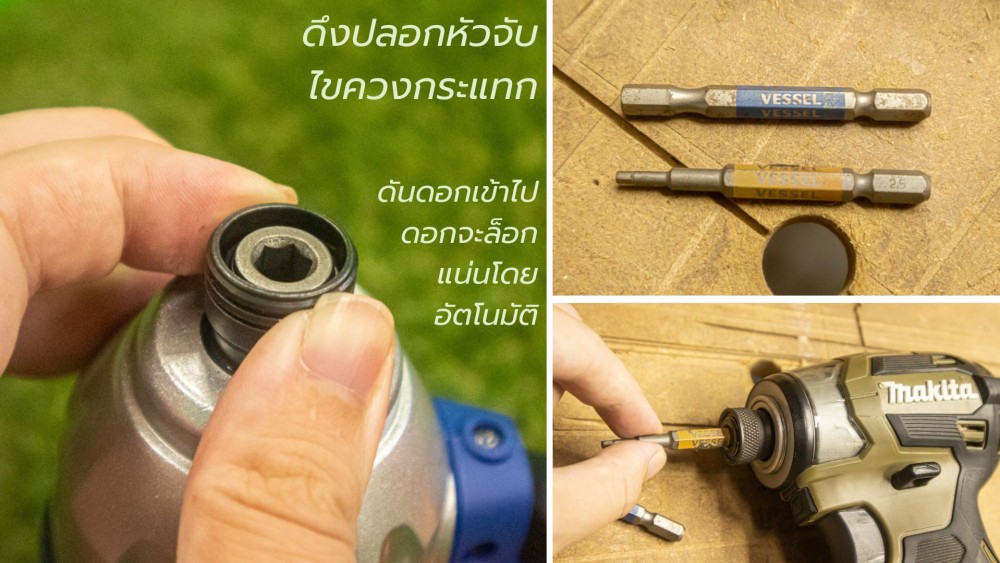
- Check the tool's chuck – The chuck of an impact driver is a 1/4-inch hex type featuring a quick-release mechanism with a sliding front collar.
- Pull the chuck collar forward – Use your fingers to pull the chuck collar forward.
- Insert the bit all the way in – While the collar is held in the open position, insert the hex bit until you feel it seat fully and firmly.
- Release to lock the bit – Once the bit is pushed in, release your hand. The bit will lock securely in place automatically, which can be confirmed by an audible click.
- Gently test-spin – Gently squeeze the trigger to spin the bit and check that it doesn't wobble, slip out, and rotates true.
Recommendation: If your tool has a magnetic chuck, the bit might seem to slide in easily, but don't assume it's secure until you hear that lock click or give it a tug to ensure it is genuinely locked in place.
What is a 1/4-inch hex bit, and why do impact drivers use it?
Almost all impact driver chucks use a "1/4-inch hex shank", which refers to a 1/4-inch (approx. 6.35 mm) hexagonal bit shank. This is an international standard designed specifically for impact drivers because it locks into the chuck more securely, resists slipping or spinning freely, and allows for extremely fast bit changes.
However, just because a bit has a 1/4-inch hex shank does not mean it can be used with every impact driver. Especially in today's market, besides hex driver bits, there are wood drill bits, metal drill bits, and multi-purpose hex-shank impact drill bits that can also be used in standard drill chucks.
Fitting doesn't mean working
Many screwdriver bits, drill bits, and various other bits on the market also feature hex shanks—whether for wood drilling, metal drilling, standard driving, countersinking, reaming, and more. In terms of shank size, they might physically fit into an impact driver, but that doesn't always mean they can be used safely or effectively.
Impact drivers generate very high rotational impact forces. If the bit itself is not engineered to handle this kind of force, unexpected issues can ruin your work, such as:
- The bit bends, snaps, or shatters midway through use
- The bit tip deteriorates rapidly
- The tool itself absorbs recoil from using the wrong type of bit, causing internal parts to wear out quickly.
So how can you tell which bits are actually compatible with an impact driver?
At this point, many people might think, "Wait, it's really not that simple." So once you buy the tool, how can you tell if the bit you choose or are about to use will work well, won't break, and won't damage the tool either? Generally, the answer lies in keywords like "Impact Rated" or "Impact Ready," which are clearly stated on the packaging of bits made for use with impact drivers.
- Impact-rated screwdriver bits are made from special materials such as S2 steel or feature a Torsion Zone, which helps absorb impact effectively.
- Drill bits labeled as Impact Ready often feature a reinforced collar or bearings at weak points to withstand torque and repetitive impacts.
- In addition, bits suitable for impact drivers often have distinctive colors or patterns indicating that they are engineered for durability.
What do bits meant for impact drivers look like?
When choosing screwdriver bits for an impact driver, it's not just about the shape or size; you must understand that torque-resistant properties are crucial. The high torque and concussive force from the tool can easily damage standard bits. Therefore, knowing the appearance and key features of impact bits helps you choose with confidence, whether for small or large jobs.
Standard screwdriver bits vs. Impact driver bits
Screwdriver bits commonly sold in cheap sets are usually not designed to withstand high impact force. Therefore, when used with an impact driver, they can easily snap, strip, or deform at the tip—especially when driving tight fasteners or under repetitive heavy-duty use.
In contrast, Impact Ready bits are engineered to flex when the tool delivers an impact pulse—such as with a Torsion Zone that acts like a shock absorber, paired with tough, non-brittle materials.
What about drill bits? Can an impact driver really drill?
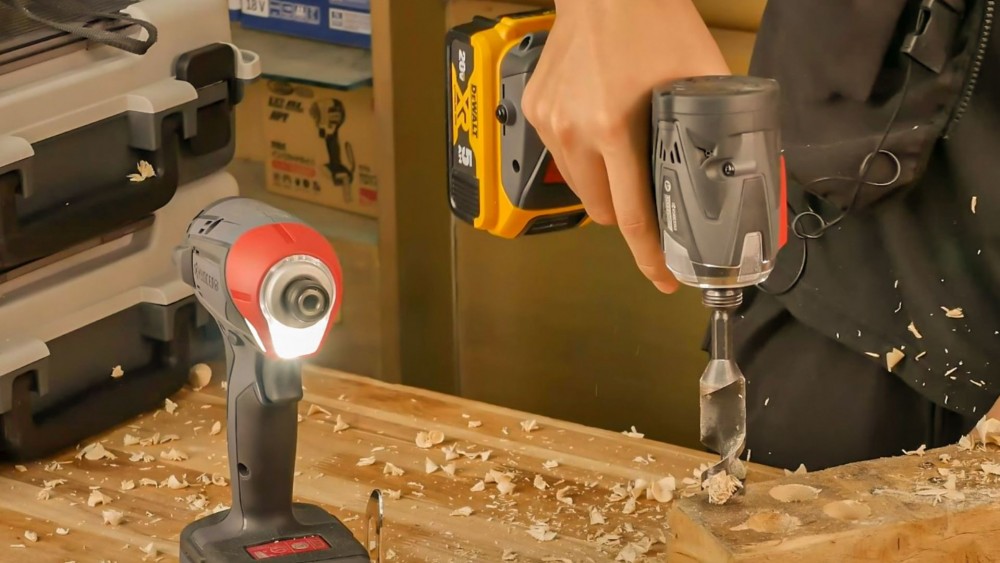
Many people might wonder, "Isn't an impact driver only for driving screws? Can it really drill holes too?" The answer is: Yes, but not every type, and not for every task.
The ideal situation for using an impact driver to drill is when you have to drive a lot of screws or bolts, but occasionally need to drill a few holes. Certain types of wood drill bits, such as spade bits or flat bits with a hex shank specifically designed for impact drivers, perform well when drilling hard wood or creating pilot holes.
However, using standard metal drill bits or masonry drill bits with an impact driver—even if they have a hex shank—will have limited performance and should not be used for primary or continuous tasks. You should consider using a conventional drill for these jobs instead.
- Standard metal drill bits cannot handle the impact force and may snap
- Bits without a locking notch on the shank will slip out of the chuck
- The rotational speed of an impact driver is often too high for drilling steel or masonry.
If you want to drill with an impact driver, choose only bits labeled "Impact Rated" and use them strictly on suitable materials such as wood, plywood, or light metals.
How to choose bits for an impact driver?
At this point, many may begin to realize that an impact driver isn't just about inserting any hex shank bit and going to work. There are details you should understand to ensure safe operation, good results, and to prevent premature tool wear. So if you are buying new bits or wondering if your existing bits are suitable for an impact driver, let's take a clear, concise look at the answers.
A simple guide to choosing drilling and driving bits for an impact driver
- Check the packaging – Look for words like Impact Rated / Impact Ready / For Impact Driver
- Check the bit shank – It must be a 1/4-inch hex shank with a locking notch on the shank.
- Avoid cheap bit sets – Bits with unspecified applications may just be designed to fit, but are not durable.
- Do not force standard drill bits into use – Especially round-shank bits or unrated metal drill bits.
- Look at the brand – Brands that manufacture specialized bits such as Bosch, Makita, DeWalt, and Milwaukee usually have dedicated Impact lines.
What happens if you use the wrong bit?
Many people might think, "Giving it a try won't hurt." Thinking this way isn't entirely wrong, as trial and error is part of learning, as the saying goes, "Mistakes are life's lessons." But let me warn you first: using the wrong type of bit with an impact driver can lead to the following consequences:
- The bit snaps during operation, causing injuries.
- The tool chuck gets damaged because the bit slips or gets stuck.
- The bit wobbles, leading to crooked, inaccurate work.
- Constantly having to spend money buying new drill bits and driver bits because they aren't durable
It's true that making mistakes is part of learning, but you also have to ask yourself if the ensuing risks are really worth it.
Conclusion: What kind of bit should you use for an impact driver to work effectively?
“Hex shank bits” are easy to insert, and there is a wide variety available that fit impact drivers. Even drill bits can be used from time to time, but not every drill bit can be used with this type of driver.will always work well. Choosing bits suited to the machine's torque and impact force is key to making your work smooth, safe, and prolonging the life of your tools.
Don't overlook it just because it fits. Choose bits that actually work well with Impact driver and you'll realize that when good tools are properly matched, they make the work so much easier.