Welding machines What is an IGBT Inverter system? Why do welders choose it? Compare the advantages and differences from other systems, both MOSFET and traditional ones. Read on for more details. Welding machines are indispensable tools for all types of welding work, but evolving technology has brought a wider variety of welding systems—especially IGBT Inverter welding machines, which are gaining increasing popularity. Do you know how it differs from other systems?
For anyone interested in welding machines utilizing Inverter technology, especially the IGBT system, and wanting to know what this system is, what advantages it offers, and how it differs from other systems?
What is an Inverter Welding Machine?
An Inverter welding machine is a welding machine that uses electronic circuit boards to control and convert electric current, unlike traditional welding machines that rely on large transformers. The Inverter converts alternating current (AC) to direct current (DC) and allows for more precise adjustment of voltage and current. As a result, the machine is compact, lightweight, and more energy-efficient than other types of welding machines. In addition, an Inverter delivers a stable current, resulting in higher welding efficiency.
What is the IGBT System in Welding Machines?
IGBT (Insulated Gate Bipolar Transistor) is a transistor developed for use in Inverter welding machines, functioning to control electric current and voltage with high stability. IGBT combines the characteristics of two types of transistors: the high-speed MOSFET and the high-power-handling BJT. This enables the IGBT to withstand high currents with low power loss, as well as provide fine and stable voltage adjustments, resulting in smooth welding operations. Furthermore, welding machines using the IGBT system are more compact, durable in operation, and more energy-efficient than older welding machine models.
Working Principle of IGBT (Insulated Gate Bipolar Transistor)
An IGBT is a semiconductor device that combines the characteristics of a BJT (Bipolar Junction Transistor) and a MOSFET (Metal-Oxide-Semiconductor Field-Effect Transistor) into one. This allows it to efficiently control the switching of electrical current. It operates via a Gate that uses voltage to control the flow of current between the Collector and Emitter terminals.
1. When voltage is applied to the gate, it allows electric current to flow from the collector to the emitter.
2. When there is no voltage applied to the gate, the flow of current between the collector and the emitter stops.
3. IGBTs can switch on and off rapidly, making them efficient at handling high currents and managing power consumption effectively.
4. On-State Resistance: When the IGBT is in the on state, it has low resistance, allowing current to flow through efficiently without significant power loss.
Differences Between IGBT and MOSFET Systems
Welding machine systems such as IGBT or MOSFET both have distinct characteristics. Choosing the appropriate system for the job significantly impacts welding efficiency. You can refer to the comparison table to better understand these differences.
Comparison Table: IGBT vs. MOSFET
| Compare | IGBT | MOSFET |
| Current Endurance | Withstands high currents, suitable for heavy-duty welding tasks | Tolerates lower current, suitable for lower power applications |
| Operating Frequency | Operates at a lower frequency than MOSFET | Performs better at high frequencies than IGBT |
| Energy Efficiency | Energy-efficient in high-current applications | Energy loss when used with high current |
Application Type
| Suitable for heavy-duty tasks, such as welding thick metals | Suitable for general tasks that do not require high power |
| Size and Weight | IGBT-based machines are usually compact and lightweight
| MOSFET machines may be bulkier in high-power applications |
From this table, it is clear that IGBT and MOSFET systems have features catering to different applications. IGBT power transistors can generate pulses and deliver current better; the choice should primarily depend on the requirements of the welding task.
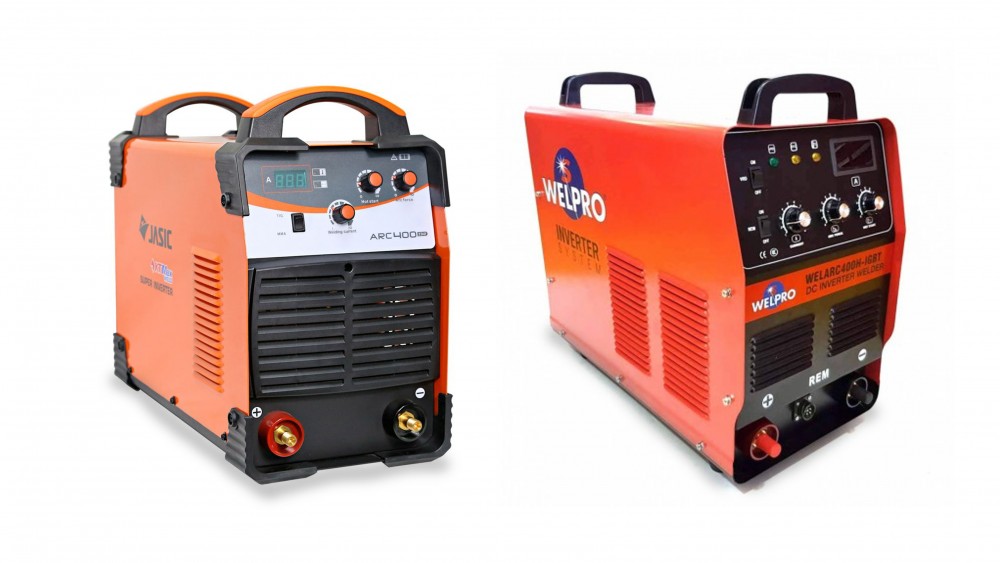
Advantages of IGBT Welding Machines
IGBT (Insulated Gate Bipolar Transistor) welding machines have quickly gained popularity among welders due to numerous advantages that make them suitable for a wide range of applications
1. High Efficiency - Welding machines utilizing an IGBT system offer high energy efficiency, reducing power loss during the welding process and resulting in more effective welding.
2. Stability - IGBTs provide stable current control, reducing spatter during welding for superior results.
3. Compact and Lightweight - The IGBT system enables welding machines to be compact and lightweight, making them easy to carry and use in various locations.
4. High Current Resistance - IGBTs excel at handling high electrical currents, making them ideal for welding thick metals or materials requiring high power.
5. Precise Current Adjustment - The IGBT system allows users to adjust the current precisely, resulting in fine and high-quality welds.
Conclusion
Welding machines IGBT inverter welders are gaining popularity due to their superior durability and efficiency, especially in jobs requiring high power and precision. On the other hand, MOSFET systems might be a better choice for general welding work. Users should select a welder that suits their specific work requirements to achieve the best results. In summary, choosing the right welder should be based on power requirements, job complexity, and your budget.


 EN
 ไทย