


 EN
 ไทย


Customers Also Purchased


You finish installing a shelf, place a spirit level on it, and confirm the bubble is dead center. But when you step back to look from across the room, it still looks slightly crooked. Has this ever happened to you? Most of the time, your eyes aren't deceiving you; it usually comes down to two issues: the spirit level wasn't accurate to begin with, or it was too short for the job. A spirit level looks like a simple tool—just a straight bar with a bubble—yet choosing the wrong one can make a world of difference. Let's walk through how each type differs, what length is sufficient, and how to test for accuracy right at the store.
How Does a Spirit Level Work? What Does Each Vial Tell You?
The principle is very simple: inside the small vials, there is liquid and an air bubble. The air bubble always floats to the highest point of the vial. When placed on a level surface, the bubble sits centered right between the two lines. If tilted, the bubble moves toward the higher side. Most spirit levels have three vials. The horizontal vial in the middle measures levelness (horizontal). The vertical vial at one end measures plumb (vertical), such as checking posts, door frames, or walls. The angled vial measures roughly 45 degrees, which is useful for bracing or diagonal pipe runs. Some models have only two vials, while others have more—choose based on which angles your work requires.
How Many Types of Spirit Levels Are There, and Who Is Each For?
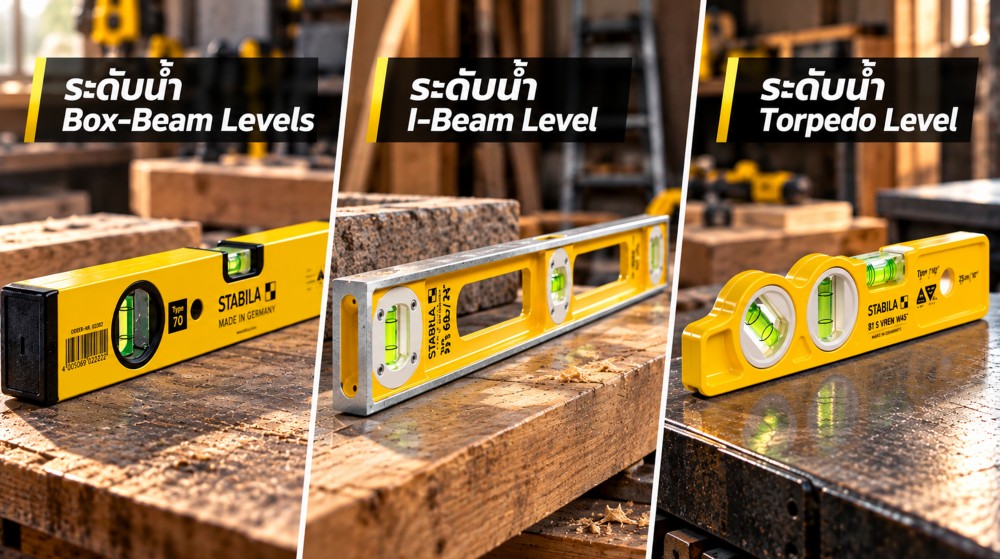
- Torpedo Level: Short with tapered ends, resembling a torpedo. It fits easily in a tool pouch and is ideal for tight spaces like checking electrical outlets, switches, shelf brackets, or hanging pictures on a wall. Many models feature a magnetic base. The limitation is its short length: if used to measure long shelves or wide floor areas, inaccuracies become immediately apparent.
- I-Beam Level: Has an I-shaped cross section. Mostly made of aluminum, it is lightweight, reasonably priced, and available in various lengths. It is widely used by homeowners and many tradespeople, suitable for general tasks ranging from furniture installation to light masonry work.
- Box Beam Level: Has a hollow rectangular box cross section. The frame is sturdier than an I-beam, resists twisting, and withstands impacts better. As a result, it is popular among masons, tile installers, and tradespeople who use it daily on job sites, traded off against heavier weight and a slightly higher price.
- Magnetic Level: Not a separate standalone category, but an option available on torpedo, I-beam, or box beam levels. Magnets along the base allow it to hold firmly onto steel, freeing up your hands for other tasks. It is ideal for welders, steel framing installers, or conduit fitters. Some models include a V-groove on the base to sit securely on round pipes without rolling.
- Digital Level: Features a display that shows degrees or pitch percentages in digital numbers. It is ideal for work requiring precise slope values, such as gutters, ramps, or tasks where measurements must be recorded. However, it requires batteries and comes at a higher price; it isn't necessary for simple home tasks like hanging pictures or mounting shelves.
What Length Spirit Level Should You Choose?
This question is more important than many people think. The longer the spirit level, the better it averages out surface irregularities, and small errors won't multiply over the span of the workpiece. Imagine placing a short level on a long countertop: the spot where it rests might show level, but the far end could already be sloping down without you noticing.
Conversely, a level that is too long cannot be used in tight spaces—it won't fit into cabinets and can't be placed on small shelf brackets.
A simple rule of thumb is to match the level's length to the size of the workpieces you handle most often. For typical household use, having two provides the best coverage: a short torpedo level for detail work, and a medium-length one for shelves, doors, or furniture. For tiling or masonry contractors, a longer level is also a must.
Aluminum, plastic, or wood body: what's the difference?
Most spirit levels nowadays are aluminum because they are lightweight, rust-proof, and hold their shape well—suitable for both home use and job sites. Plastic ones are lighter and cheaper, fine for light-duty tasks, but if frequently exposed to sun or impacts, the frame is more prone to warping. Wooden levels are rarely seen today; their drawback is that wood absorbs moisture and can warp. If you still have an old wooden one at home, try checking its accuracy using the end-for-end flip test described below before using it.
Small details that make a real difference
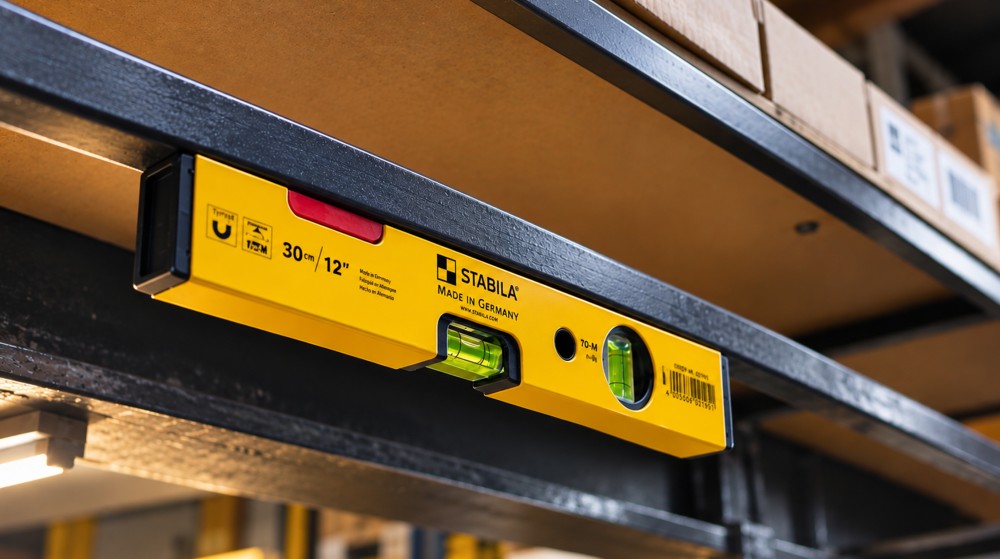
Beyond shape and length, subtle details make a big difference in actual use: rubber end caps protect the vials from coming loose if accidentally dropped; hanging holes allow wall storage to keep heavy objects from warping the frame; factory-milled bases ensure a flusher fit against surfaces; and high-visibility vials are ideal for low-light conditions, such as working under roofs or inside cabinets.
How to read the accuracy rating on the box
Most are stated in millimeters per meter (mm/m). This means that if you place the level on a 1-meter surface, the reading may deviate by no more than that number. For example, if the box specifies 0.5 mm/m and you measure a 3-meter shelf, the two ends could differ by up to about 1.5 mm. For hanging picture frames, no one will notice; but for laying large tiles over long spans or installing drainage slopes, this number starts to matter. The smaller the number, the more accurate the level—though usually at a higher price. For general household tasks, you don't need the absolute highest precision, but you should choose one with a clearly stated accuracy rating. If the box specifies nothing at all, be cautious.
How to test in-store to see if it's truly accurate
There's an easy method used by tradespeople called the 180-degree flip test (end-for-end). Find a flat surface, like a table or counter. Place the level down and note the bubble's position. Lift the level, rotate it end-for-end (swap left and right ends), and place it back on the exact same spot. If it is accurate, the bubble should rest in the exact same position both times. If the bubble shifts to the opposite side, that vial is off-calibration.
The tabletop doesn't need to be perfectly level for this test, because you are only checking if the bubble stays in the same position, not whether it sits dead center. Also inspect the vial to ensure it is clear, not cloudy, free of cracks, has sharp graduation marks, and is firmly mounted without wobbling. Place the level on the table to check that the base sits completely flat without bowing or twisting.
Summary
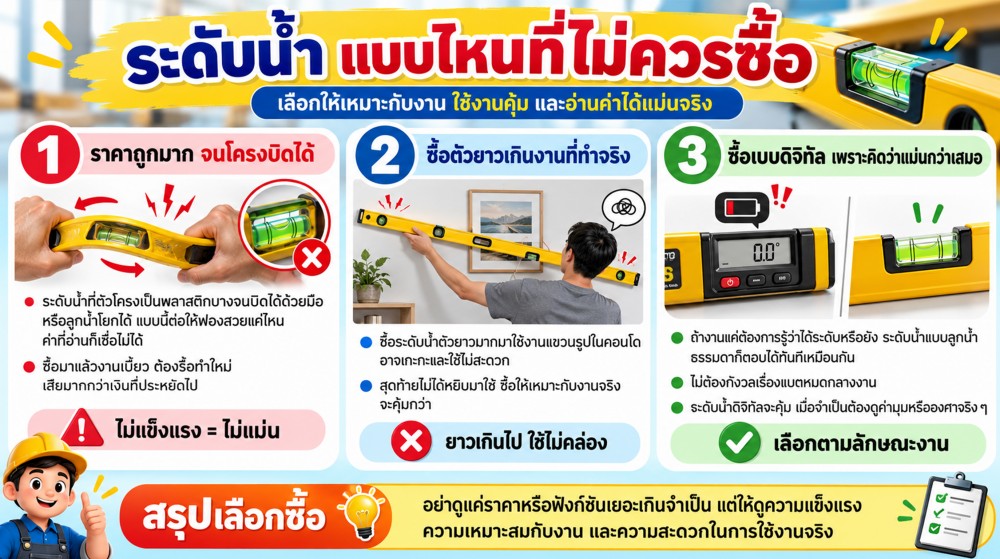
A good spirit level is one that is accurate, suited to the length of your work, and durable enough for your working style. For general home use, one torpedo level and one medium-length level will cover almost every task. Pros who use them daily should step up to a box beam; metalworkers should choose a magnetic model; and always remember to do the 180-degree flip test before buying. If you're still undecided, browse the models in itoolmart's spirit level category or stop by to try them out at our branch. Which task do you find hardest to level—installing shelves, hanging doors, or laying tiles?