


 EN
 ไทย


Customers Also Purchased
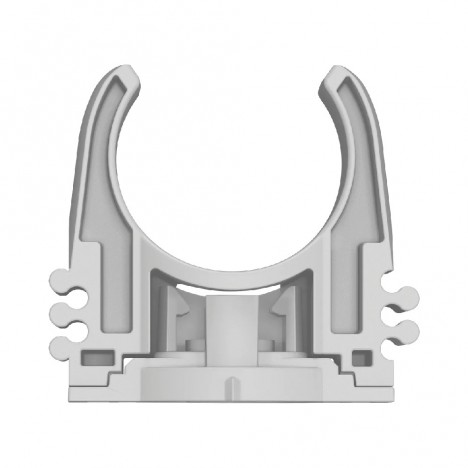
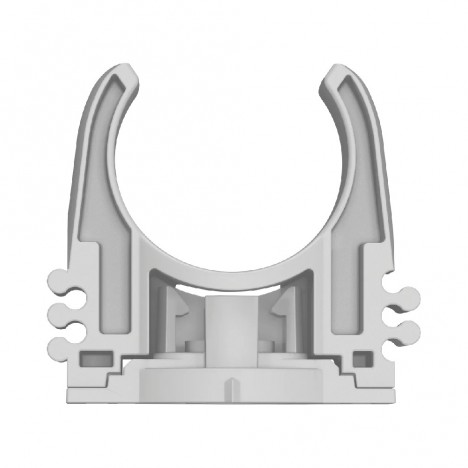
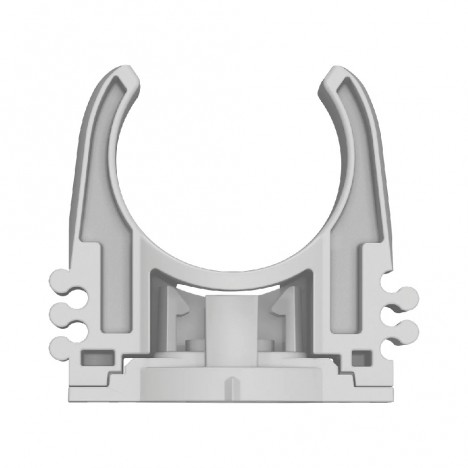
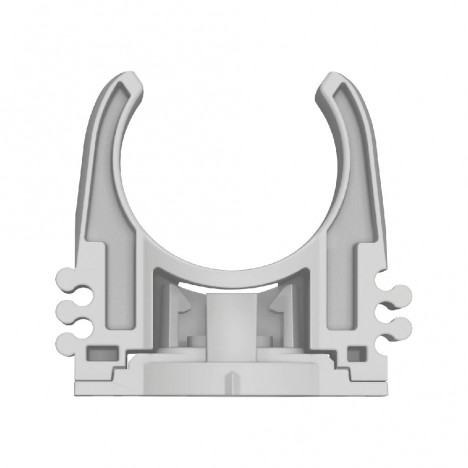
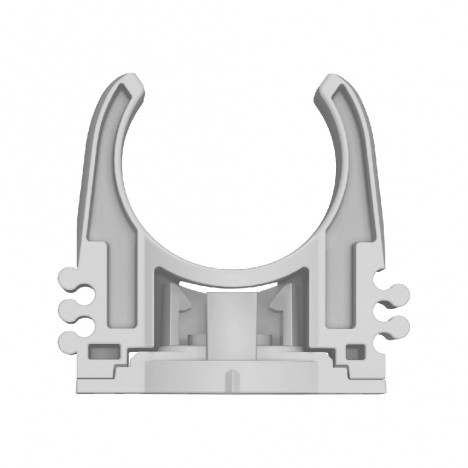
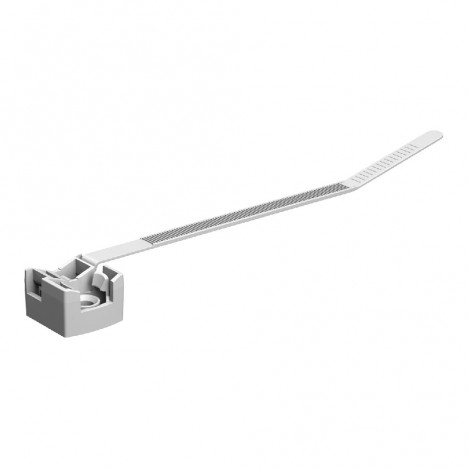
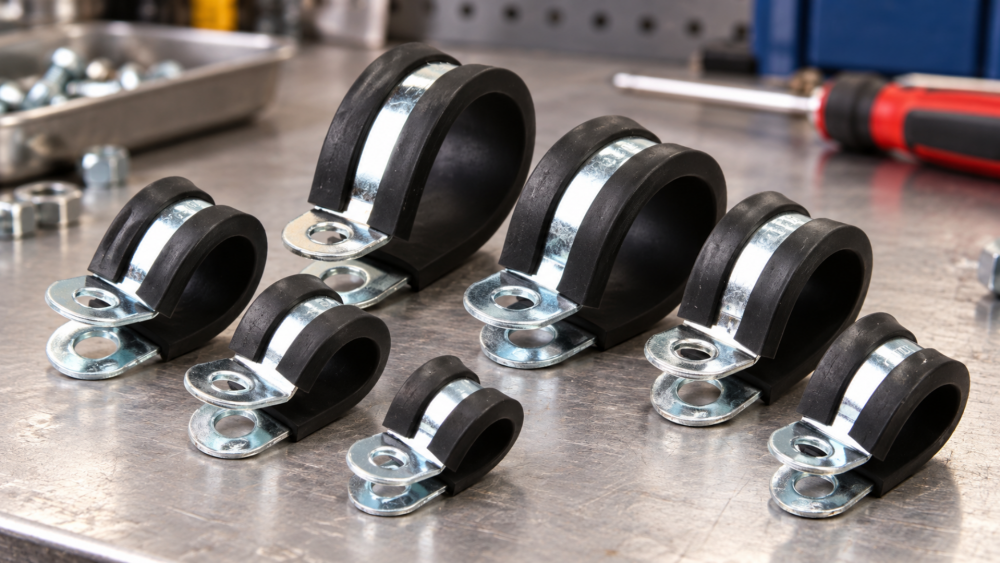
If you placeCable Clampsseveral sizes side by side, especially models that differ by only one or two sizes, each one might look virtually identical. The shape remains a curved loop designed to hold cables, with ends for screw fastening, and sometimes the difference in size is hardly noticeable to the naked eye. However, once applied to actual cables, a difference of just a few millimeters immediately takes effect. One might fit the cable perfectly, another might be too loose allowing the cable to shift, while yet another might be too small, requiring force to squeeze the clamp ends together just to tighten the screw.
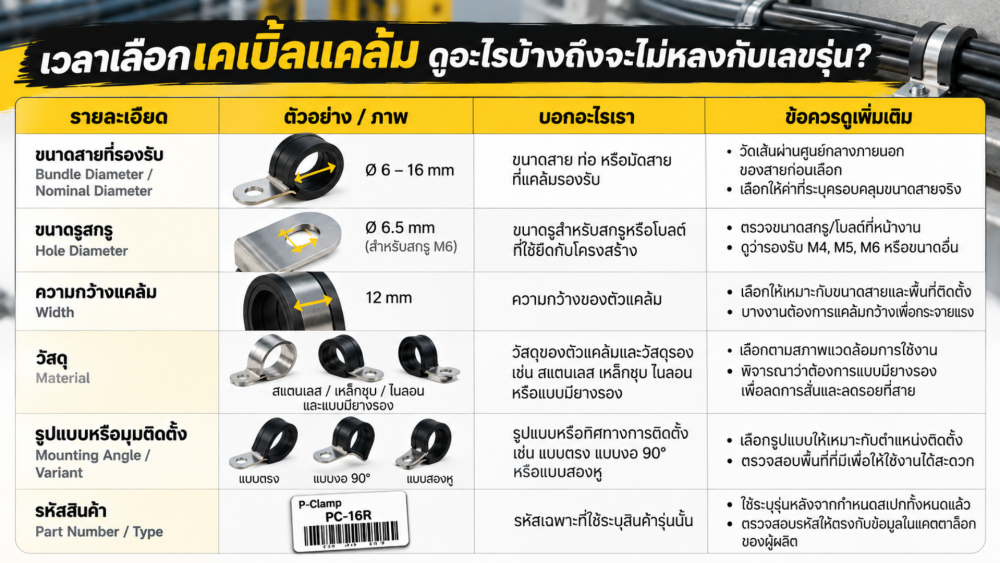
The reason is that cable clamps don't come in multiple sizes just for you to choose based on a feeling of small, medium, or large; rather, their size directly relates to the outer diameter of the cable or wire bundle being secured, as well as other specifications such as mounting hole size, clamp width, material, and mounting orientation.
As for the numbers in model names, extra care is required because there is no universal standard dictating that the numbers on every brand's cable clamps mean the same thing. Some models use numbers to represent size sequences, some systems use numbers to indicate angles or bolt sizes, and some manufacturers use their own proprietary coding structures. Therefore, seeing No. 6, No. 10, or No. 12 should not immediately lead to the conclusion that the clamp is always intended for a 6, 10, or 12 mm cable.
What the cable clamp size actually needs to fit is the cable size
When choosing a cable clamp, the first thing to consider is not the length of the clamp, but the outer diameter of the cable, conduit, or wire bundle where the clamp will grip. In manufacturer datasheets, you will often find terms like Bundle Diameter, Nominal Diameter, or Bundle Ø, which specify approximately what diameter the clamp's loop is designed for.
For example, HellermannTyton's plastic P-Clamp model H6P specifies a maximum Bundle Diameter of 11 mm, while the H7P, which has a similar appearance and structure, is rated for 12.5 mm. Both models also use a 4.2 mm mounting hole. This illustrates that model variations can lie entirely in the cable-retaining loop, even when all other elements are virtually identical.
A difference of just 1.5 mm may not seem like much on paper, but for a clamp loop that needs to enclose a cable, this fit directly affects installation. If the clamp is too large, the cable may not be held securely in place as required. If it is too small, you may have to force the clamp shut, applying excessive pressure onto the cable. Therefore, choosing a size that simply looks "close enough" without verifying the actual cable diameter is not a reliable method.
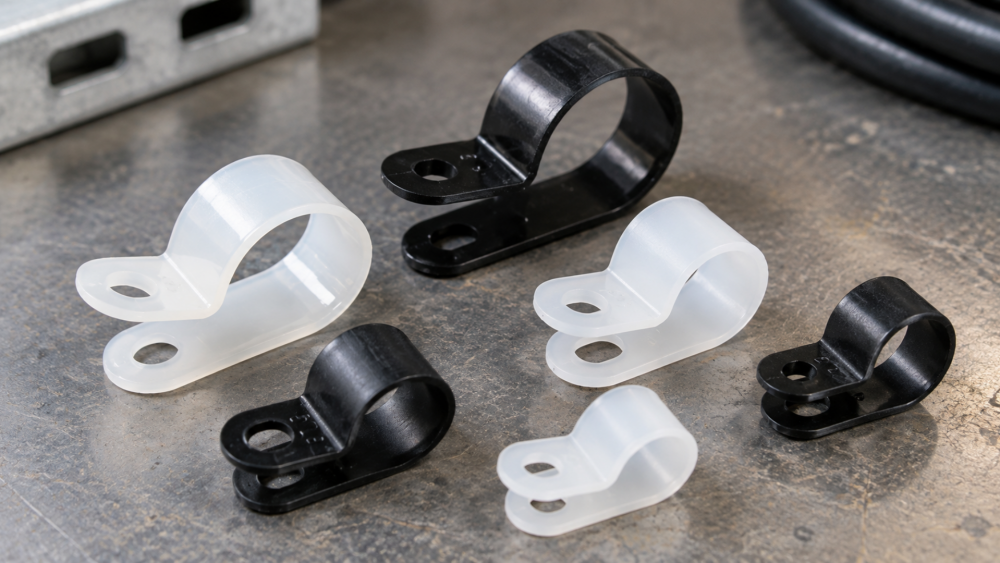
So do numbers like H6P or H7P mean 6 and 7 mm cables?
This is a very common point of confusion, because when seeing numbers in a model name, we often instinctively interpret them as dimensions. However, as shown in the example above, H6P supports a maximum Bundle Diameter of 11 mm, while H7P supports 12.5 mm. This means the 6 and 7 in these model names do not directly represent the cable diameter.
The same applies to metal cable clamps. For example, model ALU11C has a Nominal Diameter of 14.3 mm, while ALU12C is 15.9 mm. Thus, the 11 or 12 in the model name does not mean the clamp is intended for an 11 or 12 mm cable either.
What these examples demonstrate is: never substitute model numbers for datasheets. Manufacturers define their own naming conventions, and model codes are often meant to distinguish products within the same family rather than act as universal size values comparable across brands. If you are shopping for cable clamps and only see "Size 10," the next question should not just be whether that's big or small, but which model's Size 10 it is, and what diameter the manufacturer actually specifies.
Some codes indicate more than just cable size—they also conceal installation details
Things become even more interesting with cable clamps that offer multiple mounting configurations, as a single model code can incorporate far more information than just cable size. For instance, HellermannTyton's Ratchet P-Clamp divides bundle capacities into several groups: A, B, C, and D, where the A-Series accommodates bundle diameters of 6.2–13.7 mm, B-Series 12.7–19.5 mm, C-Series 19.4–36.0 mm, and D-Series 36.0–51.0 mm. In addition, you can choose mounting angles, mounting plate lengths, and hole sizes for M6, M8, M10, or M12 bolts.
Take the model name RCB180SM10 as an example: according to product data, this model belongs to the B-Series, which supports a Bundle Diameter of 12.7–19.5 mm. The number 180 corresponds to a 180-degree mounting angle, the letter S denotes a Short mounting plate, and M10 specifies the M10 screw or mounting hole size for that model. As you can see, a single model code can differentiate multiple product attributes, not just indicate the size of the clamp loop.
However, this code deciphering structure applies specifically to that particular product line. It should not be automatically applied to model codes from other manufacturers, as each brand may establish its own naming methodology.
Mounting hole size is also important, yet often overlooked
When selecting a cable clamp, many people only focus on the loop that holds the cable because it is the most visibly distinct part. In reality, the other end of the clamp is just as important: the hole for the screw or bolt. Clamps designed for similar cable sizes may be manufactured for different mounting hole sizes.
For example, some Ratchet P-Clamp systems offer M6, M8, M10, and M12 options to match the bolt size used in that specific application. A clear example is the RCB180LM6 versus the RCB180LM12; both accommodate cable bundles from 12.7–19.5 mm and share the same Long 180-degree configuration, but one is designed for an M6 mounting point while the other is for M12. Therefore, simply having the same clamping loop size does not mean they can be used interchangeably everywhere.
This is why, when checking cable clamp dimensions, you should examine at least two aspects simultaneously: the loop holding the cable and the mounting hole securing it to the structure. Looking only at the former might result in a clamp that fits the cable perfectly but cannot be installed with the existing bolt. Looking only at the screw hole might allow it to mount to the structure, but the loop size may not fit the cable properly.
Identical Appearance, but Even a Slight Difference in Loop Size Means a Different Model
Consider the rubber-cushioned Aluminium P-Clamp as an example: model ALU11C supports a diameter of 14.3 mm, whereas ALU12C accommodates 15.9 mm. Both share a 5.2 mm mounting hole diameter and a primary clamp width of 16.3 mm. Viewed from the outside without a side-by-side comparison, these two models look virtually identical. What actually changes is the internal area accommodating the cable and certain specific dimensions.
This explains why cable clamps have so many sub-variants. Because electric wires, cables, and conduits come in a vast range of dimensions, manufacturers must produce multiple clamp loop sizes so users can match their actual workpieces as closely as possible. As size increments become increasingly fine, choosing based on appearance alone becomes even more difficult. Checking values specified in millimeters is far more reliable than trying to estimate from product photos.
Do Not Select by "Conductor Size" When the Clamp Grips the Outer Diameter
Another distinction to keep in mind is that the size used to select a cable clamp does not necessarily match the electrical size printed on the cable. The cross-sectional area of the conductor, such as 1.5, 2.5, or 4 sq mm, indicates the conductor's cross section, not the overall outer diameter of the complete cable. Once insulation, sheathing, and other structural layers are included, different types of cables can have completely different outer diameters even if their conductor cross-sectional areas are identical.
Therefore, when choosing a cable clamp, what you must compare against the Bundle Diameter specification is the actual outer dimension where the clamp will grip, rather than matching the conductor cross-sectional area directly to the clamp size. Likewise, if clamping multiple cables together, you must account for the total diameter of the bundled cables after grouping.
If a Cable Measures 12 mm, Should You Buy a 12 mm Clamp Directly?
If the manufacturer specifies a Nominal Diameter or Bundle Diameter of 12 mm, and the product's installation design designates it for that size, selecting based on that data is certainly a better starting point than guessing from the model number. In practice, however, you must also look at how the manufacturer defines these numbers, as some clamps state a single nominal size, while other systems provide a minimum–maximum range.
For instance, the Ratchet P-Clamp B-Series does not specify just a single size, but accommodates a range of 12.7–19.5 mm because its design can adjust its grip to suit various bundle sizes within that specified range. In contrast, a fixed-loop P-Clamp such as the H6P lists a Nominal Diameter of 11 mm. These are entirely different product types and should not be selected using the same criteria without examining each model's specific details.
Consequently, the phrase "12 mm size" is only meaningful when you know which dimension the manufacturer is referring to and what type of clamp it is. You should not assume that similar numbers can be used interchangeably right away.
What Happens if You Choose a Size That Is Too Small or Too Large?
An appropriate cable clamp should support the cable in its intended position without imposing abnormal stress at the mounting point. If the clamp is too small, a common symptom is that the ends of the clamp are difficult to bring together, requiring excessive squeezing or force to align the holes, and the cable may be compressed more than it should be after tightening.
Conversely, if the clamp is too large, the cable may still have room to shift inside. In applications subject to vibration or movement, the issue is not just an untidy appearance; repetitive movement around the mounting point should also be avoided.
Particularly with metal cable clamps, if the application involves vibration or requires extra protection for the cable surface, you must also consider whether to choose a version with internal cushioning. You can read more in the article "Why Do Some Cable Clamps Need a Rubber Cushion? It's Not Just to Prevent Scratches." Sizing and cushion material selection are separate issues, but they must be evaluated together. A rubber cushion does not fix an incorrectly sized clamp, and a properly sized clamp must still be suitable for the working environment.
Model Numbers Identify Products, but Actual Dimensions Must Be Checked from the Specs
The reason whyCable Clampscome in multiple sizes despite looking virtually identical is that the cables and conduits being secured have different diameters. Even a slight change in the clamp loop size creates a distinct product model, even if the mounting hole, width, or material remains the same.
As for the numbers in the model name, they should not automatically be interpreted as millimeter dimensions. Real-world product examples show that H6P does not mean a 6 mm cable, and ALU12C does not mean a 12 mm cable, while another clamp system might use parts of the number code to indicate angles and bolt sizes.
Therefore, keep a simple rule in mind: "Check the number to find the model, but check the datasheet to find the size." Before purchasing, determine the diameter of your cable or cable bundle first, then verify the clamp loop size and mounting hole diameter against the manufacturer's data. This method is far more accurate than visual comparison or selecting solely based on the model number, and it also helps you make sense of the subtle differences among various cable clamps that look almost identical on the shelf.