


 EN
 ไทย


Customers Also Purchased
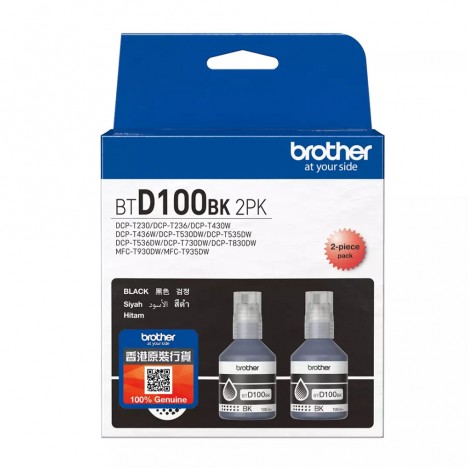
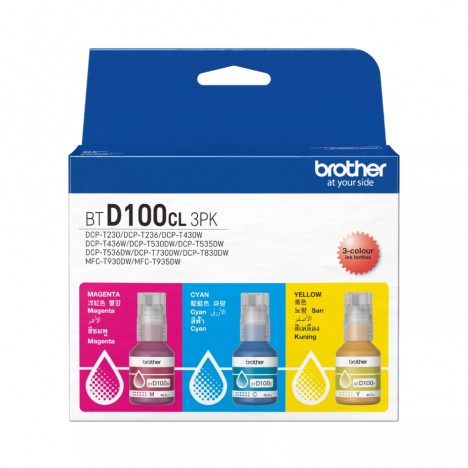
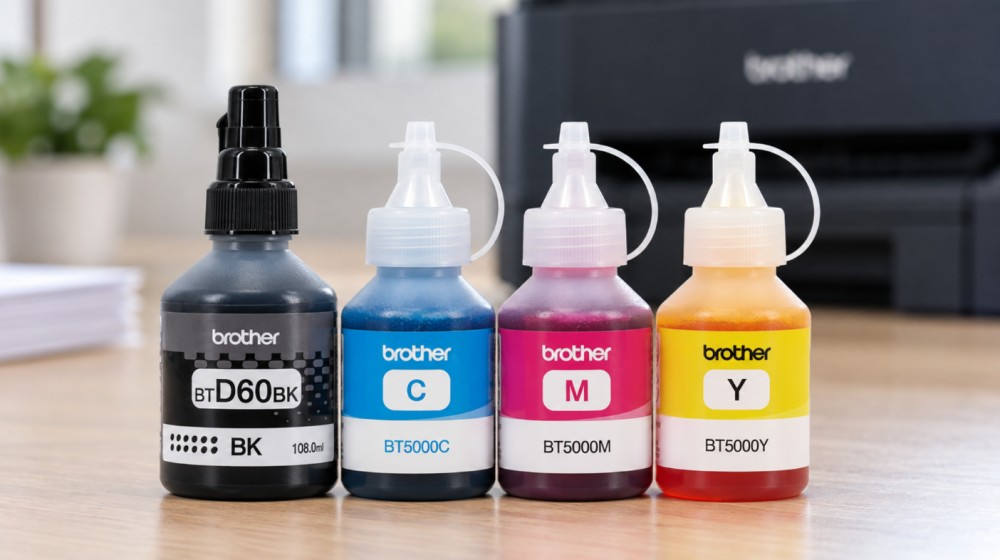
Black ink is black ink, colored ink is colored ink. It sounds simple enough, but if you have ever shopped forPrinter Ink & Toner you may have seen the terms Dye Ink and Pigment Ink on the box or in the product details. Some printers even have two black ink slots, separated into BK and PGBK, even though to the naked eye they both appear black. This difference goes beyond just the name, as the two types of ink use different types of colorants, and this exact point affects font sharpness, image vibrancy, water resistance, and the types of work suitable for each ink.
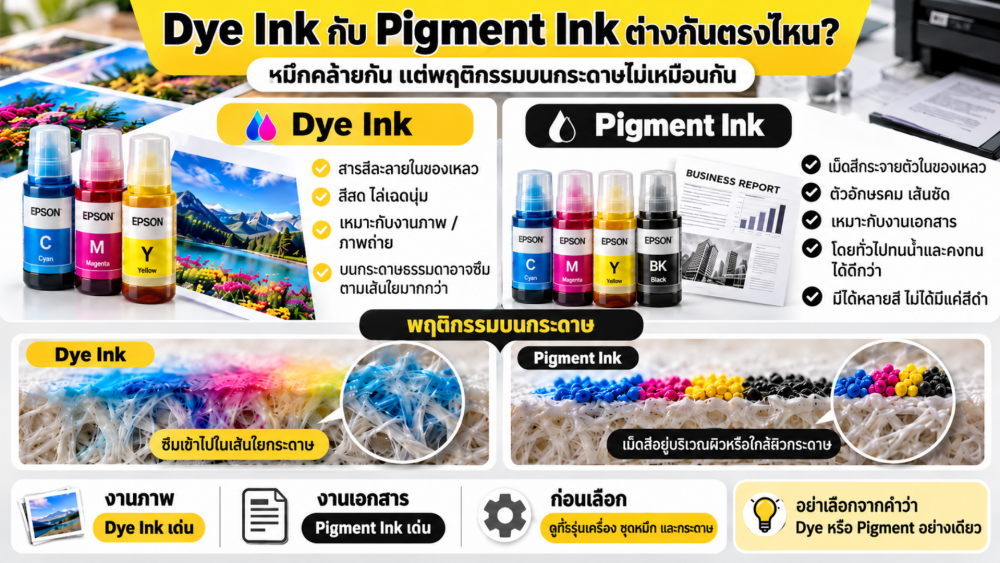
Dye Ink uses colorants dissolved in liquid, while Pigment Ink uses tiny pigment particles suspended within the ink. When sprayed onto paper, the behaviors of these two colorants are entirely different, even though they look like similar liquids inside the bottle. Therefore, if you have ever wondered why printer inks that look identical produce different results, the answer begins with the structure of the colorant itself.
What is Dye Ink? Why is it often suitable for photo prints?
Dye Ink uses colorants that are fully dissolved in the ink liquid. Think of water mixed with food coloring until it becomes a uniform solution. When the ink is sprayed onto paper, both the liquid and the colorant absorb into the paper structure simultaneously. Canon explains that Dye Ink uses water-soluble colorants, and this absorption characteristic allows the ink to produce colors and smooth gradients seamlessly. This is why this type of ink is frequently found in printers geared toward graphics, illustrations, and photos.
The advantage people often notice with Dye Ink is its vibrant colors and soft tonal transitions, especially when used with Photo Paper designed specifically for inkjet printers. However, the fact that the colorant absorbs along with the liquid also has another side: if used on regular plain paper with high ink absorption, the color may feather or bleed along the paper fibers, especially on small text or fine lines.
However, this shouldn't be interpreted as Dye Ink being bad for printing text, because the actual result still depends on ink formulation, paper type, print head, and print settings. It is simply that the nature of the colorant causes it to behave differently from Pigment Ink, and this difference becomes more apparent when applied to different types of tasks.
How is Pigment Ink different?
Pigment Ink works on another principle entirely. Instead of dissolving the colorant completely into the liquid, this ink features microscopic pigment particles suspended within it. When the ink is sprayed onto paper, some of the liquid absorbs or evaporates, while the pigment particles tend to remain on or near the paper surface. As a result, they do not spread along the paper fibers in the way Dye Ink does.
This behavior directly impacts document printing: because the colorant doesn't bleed deeply into the fibers, text edges, fine lines, tables, or graphs can maintain sharp clarity, especially on plain paper. In addition, Pigment Ink generally offers the advantage of greater water resistance and fade resistance from light compared to Dye Ink under identical conditions. Manufacturers like HP and Epson have explained these characteristics in their documentation regarding pigment ink systems.
For this reason, Pigment Ink is commonly found in printers focused on document output, office work, or archiving projects requiring longevity. However, "more durable" does not mean Pigment is better than Dye in every scenario, because when shifting from plain-paper documents to glossy photo prints, the desired ink properties change accordingly.
Why do some printer models feature two types of black ink?
One clear example showing that manufacturers don't view Dye and Pigment as an either-or choice is that certain printer models feature more than one black ink slot, such as BK and PGBK in some Canon PIXMA models. In these systems, BK is Dye Black while PGBK is Pigment Black, and the printer automatically selects which ink to use based on the print job and print settings.
When printing photos or illustrations, Dye Black blends smoothly with other color inks to create accurate tonal shades and image details. Meanwhile, for printing text on plain paper, Pigment Black is better suited for producing bold, crisp text with sharp edges. Therefore, having two black ink slots is not redundant, but rather a deliberate division of roles built directly into the system design.
Other manufacturers adopt a similar approach, such as certain HP printer series that use Pigment Black for text and Dye Ink for color sets, allowing a single printer to better handle both documents and images. This clearly illustrates why "the same black color" doesn't mean every black ink serves the same function.
Is Pigment always best for documents and Dye always best for photos?
As a rough rule of thumb, yes, but it shouldn't be taken as an absolute rule. If most of your work involves documents on plain paper—such as reports, quotations, forms, spreadsheets, or general office paperwork—Pigment Ink, especially black, typically fits the bill best because it delivers sharp text and crisp lines while offering good water resistance.
On the other hand, Dye Ink is commonly found in photo-centric systems because it provides vibrant colors and smooth, continuous gradients, particularly on photo paper. However, it is not unusual to see high-end photo printers that use an all-pigment ink set, as manufacturers can formulate pigments specifically optimized for photographic quality as well.
Ink type is therefore just one factor that defines the characteristics of a printing system. It does not dictate whether a printer is entirely good or bad, nor should it override other important details such as color count, resolution, print head technology, or paper compatibility.
If inks are both Dye or both Pigment, can they be used interchangeably?
This is a critical point: "both being Pigment" does not mean all pigment inks are interchangeable. The same applies to Dye Ink. Printer ink is not just composed of colorants; it also contains other components that regulate viscosity, surface tension, flow rate, drying time, and compatibility with the print head. Each manufacturer formulates their inks to work specifically with the mechanisms of particular printer models.
This is especially true for Pigment Ink, which contains microscopic pigment particles suspended in liquid. Controlling these particles to keep them properly dispersed and flowing smoothly through the print head as designed is a crucial part of the ink system. Therefore, when purchasing or refilling ink, always prioritize the specific ink code and compatible printer models. Never base your decision solely on the color or the words Dye/Pigment on the bottle, because two black inks might not be compatible, and two pigment inks do not share identical formulas.
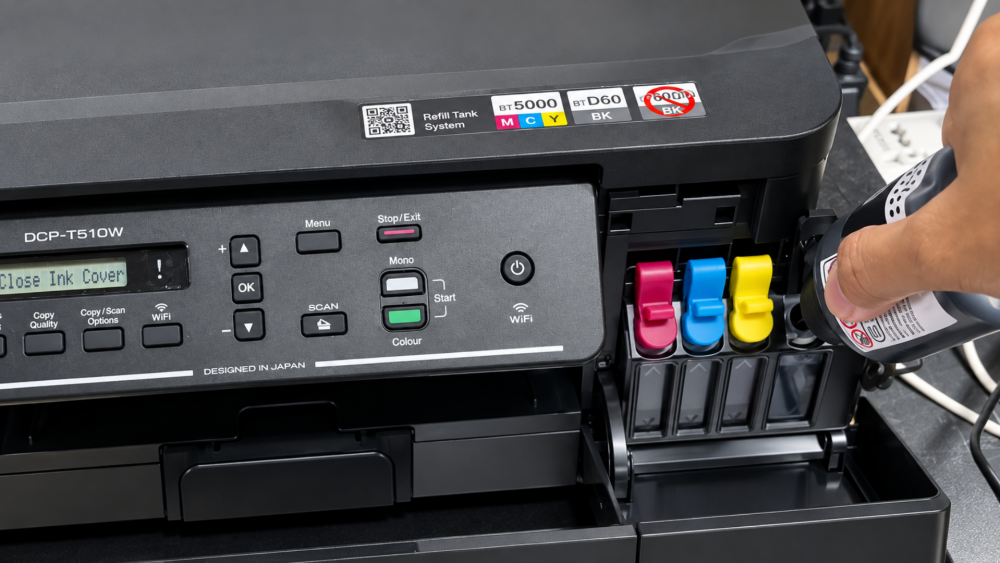
What to look for beyond just "Dye" or "Pigment"
If you are choosing a printer or selectingPrinter Ink & Toner A much more practical question than "Which is better, Dye or Pigment?" is: what do you print most often? If you print a large volume of documents on plain paper, having Pigment Black can be a major advantage. But if your focus is on photos, you should also look at the overall ink system, number of color cartridges, and supported paper types.
When buying replacement ink, the most important factor remains the ink code specified by the manufacturer for that particular model—not just picking by ink type alone. Neither Dye nor Pigment is universally superior; each is engineered with distinct characteristics and advantages. Once you understand this, labels like BK, PGBK, Dye Black, or Pigment Black on ink packaging won't be confusing codes anymore, but helpful information explaining the exact role each bottle plays in your printing setup.