


 EN
 ไทย



Customers Also Purchased


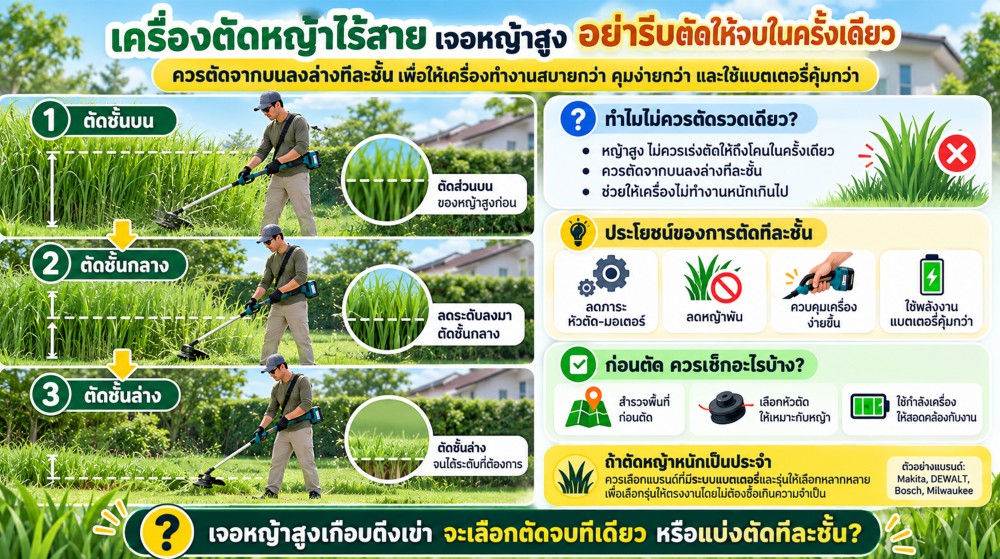
Why shouldn't tall grass be cut all at once down to the base?

How does cutting in layers help a cordless string trimmer?
The benefits go beyond just easier cutting; they directly affect motor operation and battery life. When the cutting head encounters a heavy volume of grass all at once, the motor experiences a higher load. If the user keeps pushing forward without reducing the grass load, trimmer head RPM drops, and the system must pull more power to keep running.
In modern cordless string trimmers, performance doesn't depend solely on the battery's Ah rating, but also links to voltage, the motor system, and the tool's power management—a topic iToolmart previously covered in an article on cordless string trimmer Ah ratings and motors.
Simply put, even with a high-capacity battery, forcing the cutting head through thick grass constantly wastes power fighting unnecessary heavy loads. Cutting in layers turns one heavy burden into multiple lighter passes; cutting head RPM stays more consistent, and the tool is much easier to steer.
Proper techniques for cutting tall grass with a cordless string trimmer
Before starting, do not just switch it on and immediately walk in to cut, especially in areas that have been left overgrown for a while, as there may be stones, branches, wires, ropes, or hidden objects under the grass clumps.
The proper working procedure can be divided as follows:
- Inspect the area before cutting. Pick up rocks, branches, wires, and foreign objects that could fly out or tangle around the trimmer head.
- Start from the top part of the grass. Do not immediately drop the trimmer head down to the final level.
- Cut about 5-10 cm per pass depending on grass conditions. If the grass is thick and tough, reduce the cutting amount per pass even further, primarily following the manual of that specific model.
- Move the tool steadily. There is no need to rush sweeping the trimmer head into thick clumps of grass.
- Listen to the motor RPM sound. If the RPM drops noticeably, pull the trimmer head back and reduce the amount of grass cut at a time.
- Cut the first layer across the entire area before coming back for the second layer. This method is usually easier for continuous operation than trying to cut each spot down low in a single pass.
- Turn off the tool before untangling grass from the trimmer head, and always remove the battery before touching the blade or trimmer line area.
This method might seem like it requires more than one cutting pass, but in real situations, it can help reduce time wasted on stopping to untangle grass, waiting for the tool, or resolving head jams.
What kind of grass should be cut in more than 2 layers?
You don't need to use the same number of passes for every yard, because height is only one factor. If the grass is tall but has slender stems and isn't very thick, dividing it into just 2 levels may be sufficient. However, if the grass is knee-high, dense, has vines, or begins to have tough woody weeds mixed in, dividing it into 3 levels or more will make the tool much easier to control.
What should truly be used as the deciding factor is the behavior of the cordless grass trimmer. If you sweep the trimmer head in and the RPM remains steady, grass is cut continuously, and the tool doesn't jerk violently, it means the amount cut per pass is still appropriate.
However, if the RPM drops immediately, grass begins to tangle, the tool vibrates, or the overload protection system trips frequently, that is a sign that you are overloading the tool. You should raise the cutting height and gradually lower it.

Then how powerful of a cordless grass trimmer is needed for tall grass?
This is another point where many people only look at the Voltage number and conclude that a higher Voltage must always mean more power, even though choosing a tool should consider the motor system, trimmer head, trimmer line size or blade type, battery, and type of application altogether.
For light trimming around the house, regularly maintained grass, or areas that aren't very overgrown, small- to medium-grade tools can meet your needs. But if you have to deal with wide areas, thick grass, or frequent continuous use, stepping up to a tool designed for higher loads with a Brushless motor might be more appropriate.
Currently, iToolmart's cordless grass trimmer category features various tiers, from compact models to high-power ranges from Makita, DEWALT, Bosch, Milwaukee, WADFOW, PUMA, and Dong Cheng. This allows you to choose a tool based on your terrain characteristics and existing battery platform without always needing to pick the largest tool.
For example, those who already have Makita batteries might look for models on the same battery platform to share equipment, while users who regularly tackle dense grass might consider high-power models or versions that support heavy-duty cutting heads. The key is to match the tool's power to the job, rather than choosing based solely on a single spec sheet number. And in addition to choosing the right tool for the job, proper battery maintenance is equally important. Let's take a look at 5 Ways to Extend the Battery Life of a Cordless Lawn Mower That will help your battery last longer and be more cost-effective
Signs You Are Mowing Grass Too Aggressively
While working, always pay attention to your cordless lawn mower. If the motor's sound changes from a steady high RPM to a strained, bogged-down tone every time you hit grass, or if grass repeatedly wraps around the cutting head, don't jump to the conclusion that the battery is degraded or the motor lacks power. Sometimes, simply switching from "cutting all at once" to "trimming the top layer first" can bring the machine back to normal operation.
If reducing the load still leaves the machine repeatedly spinning and cutting out, then check the battery, ventilation slots, cutting head, and other tool systems. iToolmart also has a dedicated article covering the issue of cordless lawn mowers cutting out while spinning.
Select Cordless Brushcutter to suit the application