EN
 ไทย


Customers Also Purchased


Cutting jobs around the house or on small job sites do not happen every week; some months there is nothing to cut at all. But when the day to actually cut arrives—such as a piece of plywood bought too wide for its opening, a DIY shelf assembled two inches too long, or an old pipe that must be dismantled before installing a new one—the question that follows is whether to buy Jigsaw and Shear a power saw, and if so, which type should it be?
The question many ask first is which brand of electric saw is best or which model is the most powerful. But for someone who does not own one yet, the question that yields a more direct answer is whether your most frequent cuts are straight or curved, and what material you are cutting.
Because each type of electric saw is truly designed for different proficiencies—a more expensive model cannot do everything. As commonly known, circular saws are built for straight cuts, jigsaws for curved cuts, and reciprocating saws are ideal for demolition jobs.
Choosing one that matches your most frequent cutting path makes a bigger difference than increasing your budget to get a more powerful tool that doesn't fit the task. This is why many people end up buying a second saw within the same year—not because the first one broke, but because it didn't perform well enough for their actual tasks.
Before choosing, answer these questions for yourself: "What are you cutting?" and "What is the cutting path?"
Every electric saw is designed around two main factors: the material being cut and the nature of the cut line. If you can answer these two questions, your options will narrow down, eliminating the need to compare confusing specs across different machine types.
Imagine your most frequent job is ripping large plywood sheets down to required sizes, cutting in a straight line almost across the entire sheet, with medium-thickness wood. This type of work is strictly the domain of a circular saw. If you use a reciprocating saw for the same job, it cuts through just the same, but leaves a rough edge requiring extra finishing. A jigsaw can also cut it, but might take many times longer and is harder to keep straight.
Conversely, if your frequent jobs involve cutting curves along a template, plunging an opening in the middle of a panel for a sink or socket, or fretwork on thin wood, a circular saw cannot do it at all—not from a lack of power, but due to design limitations. This type of work belongs to the jigsaw.
The problem for those who cannot yet answer these two questions is that they will end up choosing the electric saw that appears to be the most versatile. In practice, this means it is not particularly good at anything, and when faced with actual work, they still have to buy a machine specifically suited for the job.
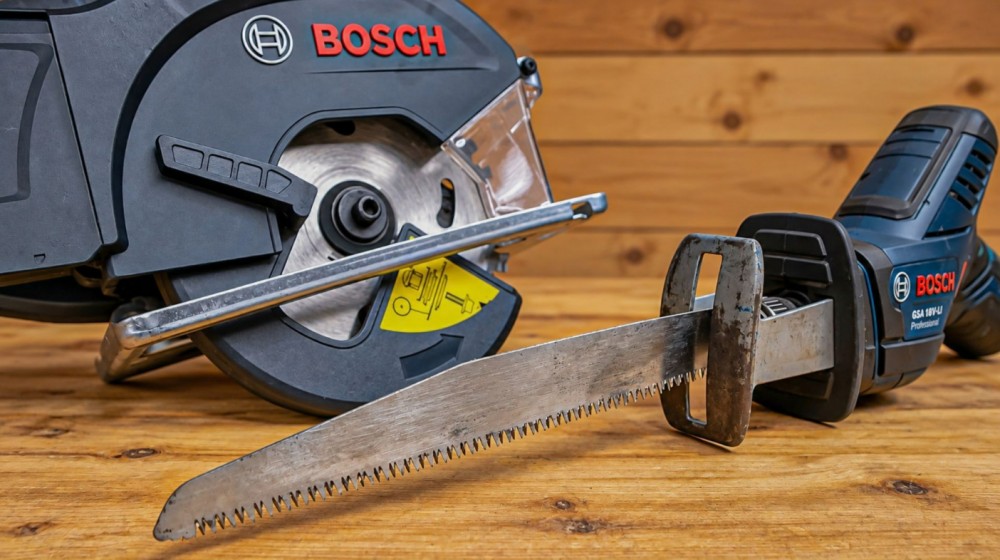
Circular Saw: The power saw that cuts straight the fastest, but cannot turn at all
A circular saw is a power saw that uses a fast-spinning circular blade to cut straight through wood quickly and produce relatively smooth cuts. If your primary tasks involve ripping sheet goods, framing timber, or cutting door frames, this is the very first tool you should own.
However, the limitations of a circular saw are straightforward: it cannot be steered or turned. The circular blade can only travel in one direction—straight forward. It is also one of the power saws where you must be most vigilant about kickback, because if the kerf closes and pinches the blade mid-cut, the rotational force will throw the saw back toward the user in a fraction of a second. A common cause is improper workpiece support, which allows the wood to sag and pinch the blade right before the cut finishes. Anyone about to start using this tool should read up on Understand Kickback Before Choosing a Power Saw: Which Types Are Riskiest Ranked! to thoroughly understand it before getting hands-on.
Jigsaw: The power saw that offers the most freedom, at the cost of speed
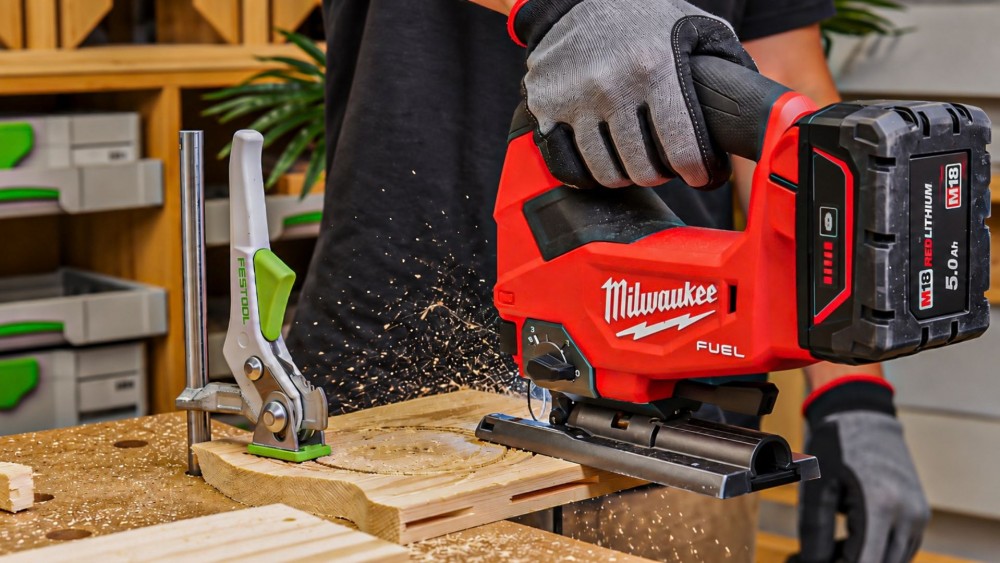
A jigsaw is a power saw that uses a thin, small reciprocating blade moving up and down, allowing you to follow curved lines, cut patterns, or make plunge cutouts in the middle of a panel—such as a sink cutout on a wooden countertop—all with a single tool. Furthermore, by switching to material-specific blades, it can also cut plastic and thin metal sheets.
What you have to accept is the sacrifice in speed and straightness. For a one-meter straight cut, a jigsaw can do it, but it takes much longer and is far harder to keep straight compared to a circular saw. Another issue is that thin, long blades tend to bend or deflect when cutting thick wood, leaving a beveled bottom edge even while the top cut looks completely straight. If most of your work involves straight lines or thick lumber, do not choose a power saw just because it seems like it can cut "everything."
Reciprocating Saw: A power saw built for demolition, not fine finishing
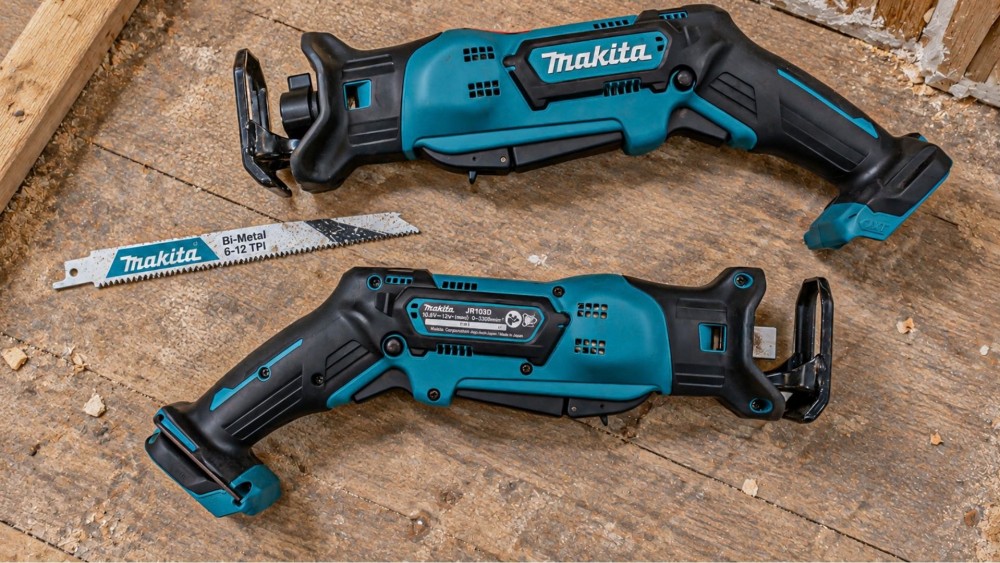
A reciprocating saw is a power saw that uses a long blade moving in and out with high force, capable of cutting through nail-embedded wood, pipes, and metal. Its true strength lies in accessing tight spaces and blind corners where other tools cannot reach, such as cutting flush-mounted wall pipes or demolishing an entire old wooden framework without having to pull the nails out first.
However, do not expect cut surfaces ready for immediate assembly; the cuts will be rough and often out of square due to the long blade and heavy tool vibration during cutting. This is not a flaw, as this saw was never designed for trim or finish work. If you are looking for a tool to build furniture or tackle precise joinery, a reciprocating saw is not the answer.
Miter Saw: The most cost-effective power saw when repetitive cuts of dozens of pieces are required
A miter saw is a benchtop power saw that allows angle adjustments; you place the workpiece down and bring the blade downward. Its key advantage over handheld saws is consistency: cut ten pieces, and all ten will have identical lengths and angles. For picture frames, baseboards, moldings, or laying wood flooring across an entire room, the difference is strikingly evident.
The trade-off is that a miter saw is not a tool you can easily carry around everywhere; it requires a permanent or semi-permanent workstation, and the workpiece width is limited by the blade diameter and slide capacity. If most of your work consists of making just a few cuts scattered across various locations, this machine will end up sitting idle more than being used.
Band Saws and Multi-tools: Two power tools you can purchase later
A band saw is a power saw that uses a continuous looped blade running in one direction, delivering smooth, continuous cuts. Woodworking models excel at curved cuts in thick stock that a jigsaw cannot handle, while metalworking models are used to cut pipes and rebar with clean, burr-free cuts without generating sparks like abrasive chop saws. It is an investment that pays off when you regularly have this specific type of work, rather than buying one "just in case."
Meanwhile, an oscillating multi-tool is a power tool that uses a high-frequency, short-stroke vibrating blade, excelling at fine detail work where larger tools cannot fit—such as undercutting door jambs to slide in new flooring, trimming baseboards attached to walls, or plunging small openings into panels where pilot holes cannot be drilled. Unless you are doing installation or renovation work, the need for it is less pressing than for the other tools mentioned above.
Corded vs. Cordless Power Saws: Choose based on how often you relocate your workspace
Corded power saws are ideal for working in a fixed location with nearby electrical outlets. There is no need to worry about batteries dying mid-job, and there are no batteries to maintain during long periods of disuse—which is crucial for those who only pull out their tools a few times a year.
Cordless power saws have the upper hand when you need to change locations frequently, work at heights, or operate in areas without power. However, if you are starting from scratch with no existing tools and most of your work is close to an outlet, a corded machine remains a great starting point and offers excellent value at a lower price point.
If you already own cordless power tools, selecting a power saw brand or model that shares the same battery platform is much more economical than starting an entirely new system, and it allows you to purchase it as a tool only (no battery).
Saw blades are just as important as the power saw itself
A more expensive power saw doesn't make cuts any better, because if you choose the wrong blade for the material, the result may be rough cuts, slow cutting, burnt wood, and the tool working harder than it should.
Before starting any job, always check whether the installed blade supports the material and thickness you are cutting. In many cases where people think a power saw isn't powerful enough, it's actually because the wrong type of blade was installed or the blade was already dull.
Safety precautions before using a power saw every time—even for just a single cut
- Always unplug the power cord or remove the battery before changing blades or making adjustments to the tool.
- Secure the workpiece with clamps; do not use your hands or knees to hold it down. Support the workpiece so that the kerf opens up rather than pinching toward the blade.
- Wear safety glasses and use ear protection when working for long periods.
- When the blade binds or the tool starts to stall, release the switch and find the cause; do not force it to keep cutting.
- Wait for the blade to come to a complete stop before lifting the tool off the workpiece.
- If you notice a burning smell, abnormal noise, or damaged power cord, stop using it immediately and have a technician inspect it first.
For structural cutting, work at heights, or any task you are unsure about, let an experienced technician do it or provide on-site guidance first, because damage or accidents from power saws happen much faster than most people expect.
Buying your first power saw: Which type should you start with?
If most of your work involves sheet wood and straight cuts, start with a circular saw. If the work involves cutting curves or interior cutouts, you can start with a jigsaw. If doing demolition or plumbing pipe repairs, start with a reciprocating saw. And if the work requires repeated cuts at consistent angles, a miter saw is a worthwhile choice.
What we don't recommend is buying the most powerful power saw within your budget without knowing what you'll be cutting most often. Unnecessary power won't make small jobs any better; instead, it makes the tool heavier and harder to control for beginners.
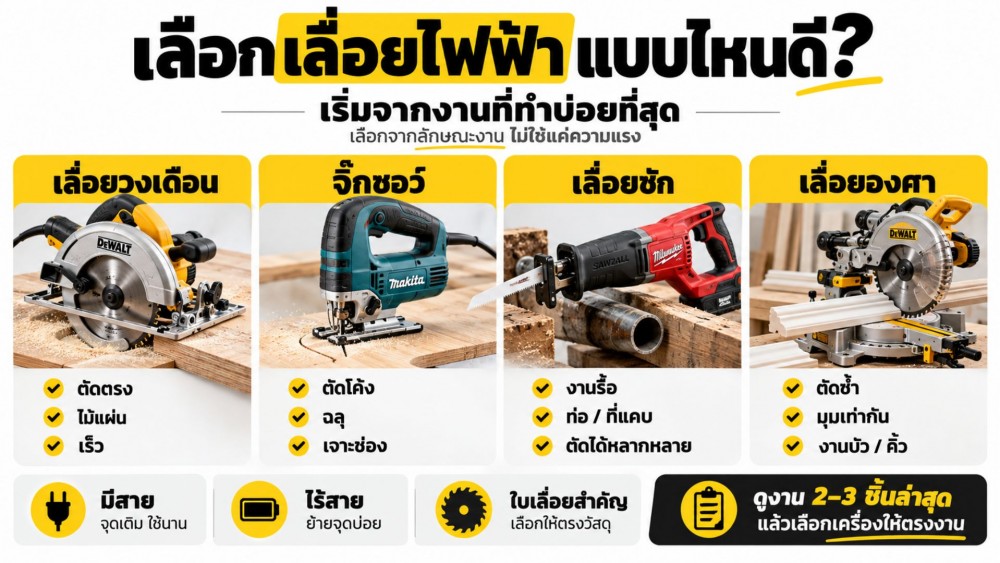
Summary: Choose a power saw based on the work you do most often
No single power saw is best for every job; there is only the type that best matches the work you do most often, as each type is clearly designed with distinct strengths. Circular Saws is suitable for straight cuts, while jigsaw stands out for its blade maneuverability, allowing you to follow curved lines,
whereas Reciprocating Saws Suitable for demolition work, while Compound Miter Saw Suitable for repetitive cuts requiring the same length or angle, such as baseboards, moldings, or multiple framing studs
Therefore, when choosing a power saw, you don't need to look for an all-in-one machine; check what your most frequent task is: Straight cuts, curved cuts, demolition work, or repeated angled cuts, and choosing a machine designed specifically for that task will be more cost-effective and practical than just picking the one with the highest power or price.
If you're still undecided, look back at your last 2-3 projects and choose the one Jigsaw and Shear that performs those tasks best. This approach aligns better with reality than choosing based on jobs you think you might do someday.