


 EN
 ไทย


Customers Also Purchased


When liftingElectric Wire hoistalmost all the way to the top, many people have likely experienced the moment where the hook stops on its own even while the UP button is still being pressed. Seeing that the hoist has an automatic shut-off system, it's natural to think that holding the button down until it tops out every time wouldn't hurt, since the limit switch is there to stop it anyway.
This understanding is only half right. While a limit switch is designed to limit hoist travel when approaching predefined boundaries, for systems serving as overtravel protection, it does not mean you should intentionally run the hoist into the limit on every cycle and let the system stop the hoist instead of the operator.
Simply put, a limit switch must be ready to operate, but it is not meant to be used as a routine stop button—unless the hoist model features a system specifically engineered by the manufacturer to define operational stopping points during use.
What is the function of an electric hoist's limit switch?
A limit switch is an electrical switch triggered when a machine component reaches a predetermined position, causing the electrical circuit to change states in order to control or stop that motion. OSHA defines limit switches in a similar manner, distinguishing them from Emergency Stops, which are a separate type of device with a different function.
When used on electric hoists, limit switches are commonly found governing lift travel, such as an Upper Limit Switch, which restricts upward hook movement to prevent the hook block from traveling higher than designed. Some hoist models may also feature a Lower Limit Switch for the bottom boundary, but specifications vary across models, so one should never generalize from one hoist to another without checking the manual.
One example is the KITO ER2 High-Function Series system, which separates user-configurable "Limit Lock" positions tailored to specific tasks from the Upper/Lower Limit Switch locations at the ends of travel. Additionally, the system automatically decelerates when approaching the limit switches to cushion the impact as the hoist reaches the end of its travel.
This clearly highlights that although we collectively refer to these systems as "limits," operational positioning limits and travel-end limits do not necessarily serve the same function.
Why shouldn't you hold down the UP button until the limit switch trips every time?
Consider finishing a job and needing to raise the hook for storage. If an operator holds the UP button down every time until the hook hits the limit and the system shuts off automatically, they are effectively using a boundary-limiting safety device as a routine stop control.
For limit switches designed as protective safety devices, this is not normal operation. The manual for the Yale SEL Electric Chain Hoist by Columbus McKinnon states that the limit switch on that model is a protective device and should not be used to stop the hoist during normal operation. It also warns that repeatedly tripping the limit switch under load can cause hoist damage.
In the context of overhead and gantry cranes, OSHA standards also explicitly state that the upper hoist limit switch, which controls the maximum travel of the load block, should not be used as an operating control—or simply put, it should not replace normal hoist stopping controls. Therefore, when wanting to stop the hook at any given position, the operator should release the button upon reaching the desired point, rather than continuing to press it until the limit switch stops it every time.
What happens if you frequently hit the limit switch?
The actual outcome depends on the construction and design of each hoist model. Therefore, one should not assume that every type of Limit Switch fails in the same way, but there is evidence from manufacturer manuals that habitual use of the limit switch can be associated with equipment malfunctions.
The KITO manual cites examples of problems related to Upper/Lower Limit Switches, such as damaged or welded switch contacts, and specifies "Habitual use of the limit switch" as one contributing factor, along with advice against using the limit switch in this manner. Furthermore, the manual advises against leaving the hoist parked at the Upper or Lower Limit position for extended periods.
Therefore, there is no need to wait for the Limit Switch to fail before changing operating habits. A better approach is to use the control buttons to stop the hoist according to the actual working position and allow the Limit Switch to perform the function designed by the manufacturer.
Another important point is that if operators have to push the hook near the limit on almost every trip to gain a little more height, the issue may not just be about how the buttons are pressed. It might require reviewing whether the hoist's lifting range suits the nature of the job, because operating at the system's boundary all the time is not a situation that should be resolved by repeatedly relying on the Limit Switch.
What should you do if the hoist has already tripped the Limit Switch?
Activation of the Limit Switch does not mean the hoist is broken. If the hoist reaches the set position and the system stops normally, it means the device has performed its duty. You should then stop operating in the same direction and follow the manufacturer's instructions to move the hook away from the limit position.
What you should not do is repeatedly press the button in the same direction hoping the hook will move further. If the system is limiting travel, attempting to force the machine to run will not increase the lifting height and may place unnecessary strain on the equipment. However, if there are abnormalities—such as the hook continuing to move after reaching the point where it should stop, the hoist stopping significantly earlier than normal, or the Limit Switch working intermittently—you should stop using it and have qualified personnel inspect it. Do not repeatedly test raising it to the top to see "if it will cut off next time."
OSHA regulations for Overhead/Gantry Cranes require that if the Upper Limit Switch fails to function properly during testing, the person in charge must be notified immediately. It also specifies testing without a load and inching cautiously toward the limit rather than driving into it at full speed. The key principle applicable to hoists is that when travel-limiting devices show any abnormality, the cause should be investigated, rather than attempting to keep operating to test it yourself.
Do all electric hoists use the same type of Limit Switch?
No, they do not, and this is why reading the manual for the specific hoist model in use is crucial. Some hoist models use Limit Switches primarily for end-of-travel limits, while others feature additional systems that allow setting stop positions for working processes. For example, the aforementioned KITO ER2 allows Upper and Lower Limit Locks to be configured within the lifting range, with Upper/Lower Limit Switch positions located further beyond as another layer.
Therefore, saying "never use a Limit Switch to stop a hoist under any circumstances" is not entirely accurate. What needs to be understood is distinguishing whether the limit in question is an over-travel limit or a positioning stop system intended by the manufacturer for use during operation.
If you are unsure, do not make assumptions based on the hoist's appearance or experience with other models, as limit positions, setting methods, and testing procedures can vary.
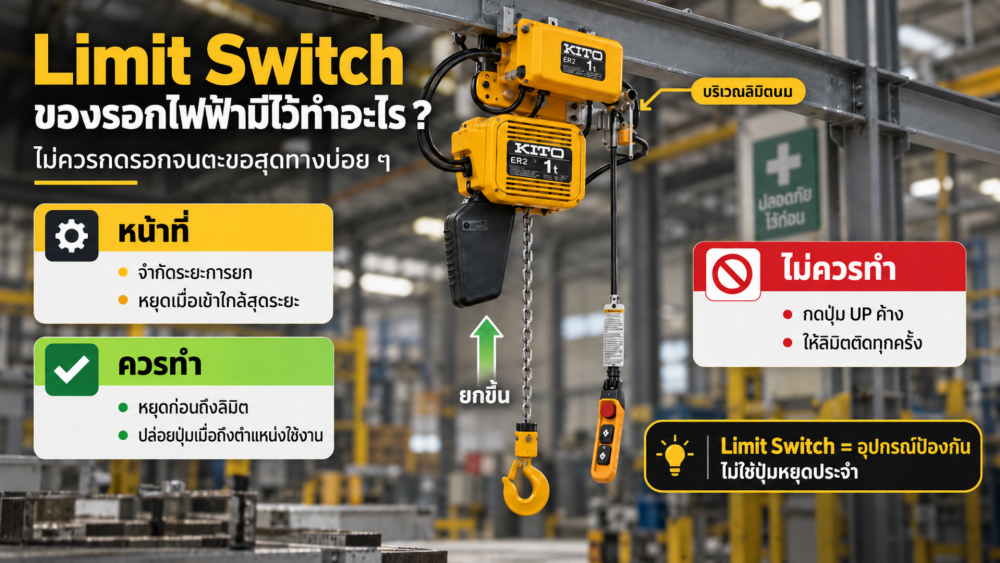
Using the Limit Switch for its intended purpose is better than relying on it as a routine stop every time.
Remembering this is simple: if the hoist's Limit Switch is an end-of-travel protection system, we should stop the hoist before reaching the limit during normal operation, rather than holding down the button until the system cuts off automatically on every cycle.
The Limit Switch is useful for restricting travel as the hoist approaches specified boundaries. However, its ability to stop the hoist does not mean it should replace routine operator control—especially when some manufacturers' manuals clearly state that repeatedly tripping the limit under load can cause damage, and habitual use of the limit switch may lead to switch malfunctions.
For operators Electric Wire hoist What you need to know is not just "whether the machine has a Limit Switch," but also what type of Limit Switch it has, where it is located, and how the manufacturer intends it to be used. Once you understand its proper function, there is no need to make a safety protective device act as the daily hoist stop.