


 EN
 ไทย


Customers Also Purchased


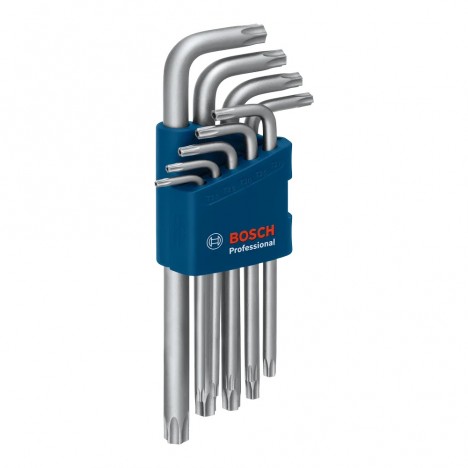
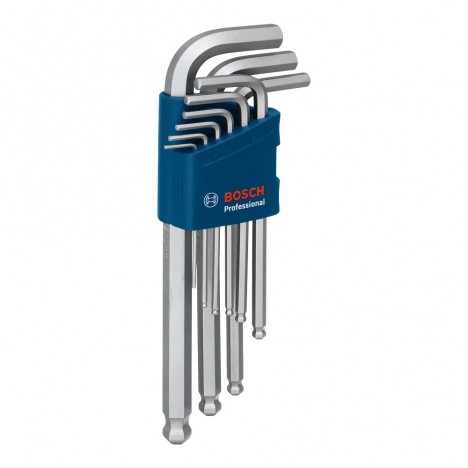
Has this ever happened to you? You grab a 4 mm hex key from the toolbox, walk over to tighten a bolt that you're sure is also size 4, but when you try to insert it, it gets stuck right at the edge of the socket. No matter how hard you push, it won't go in; wiggling it left and right doesn't help either, until you start wondering: "Did I grab the wrong size?" Checking the stamped number on the wrench confirms it's correct; comparing it with another one shows it's the exact same size. So what's causing the problem?
In reality, a hex key not fitting doesn't always mean you picked the wrong size. Aside from key dimensions, there are metric vs. imperial sizing systems, the condition of the hex socket, rust buildup, paint coatings, bolt head deformation, and manufacturing tolerances that can make a wrench that "looks like the right size" fail to fit.
Hex keys of the same size do not necessarily fit every time
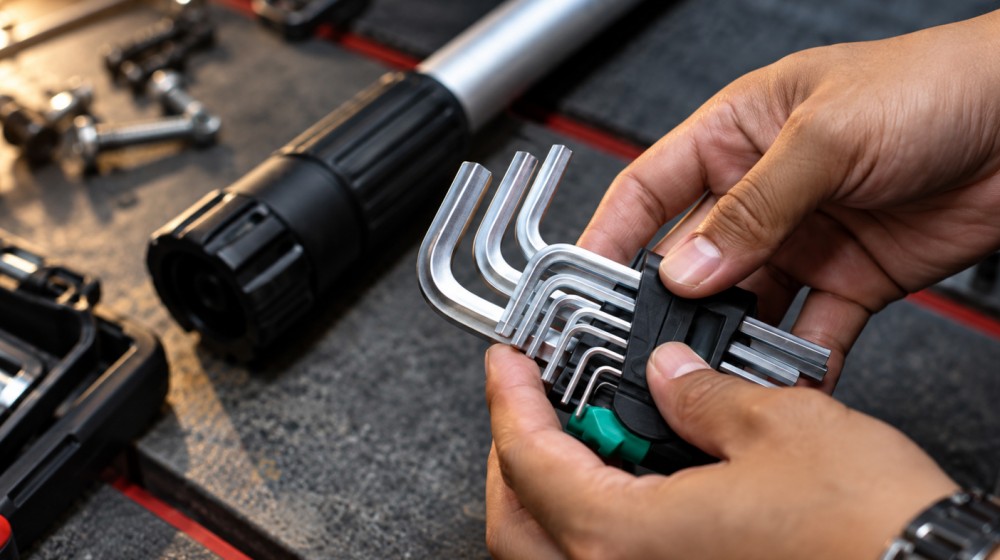
Allen Keys Also known by many as an L-wrench, Allen Key, or Hex Key, it is designed so that all six sides of the wrench make contact with the inside surface of the screw head to transmit torque while tightening or loosening. Therefore, what matters is not just the number printed on the wrench, but the "actual width across flats," as well as the condition of both the wrench and the screw's socket.
The ISO 2936:2014 standard, which covers Hexagon Socket Screw Keys, specifies dimensions, test methods, designation, marking, and minimum hardness values for hex keys, and this standard was reviewed and confirmed again in 2025 as remaining current.
This means that in precision work, 4 mm should not be treated as merely an approximate number, but as a tool dimension that must match the screw head within specified tolerances.
Beware of Metric vs. Imperial: a top cause often overlooked by technicians
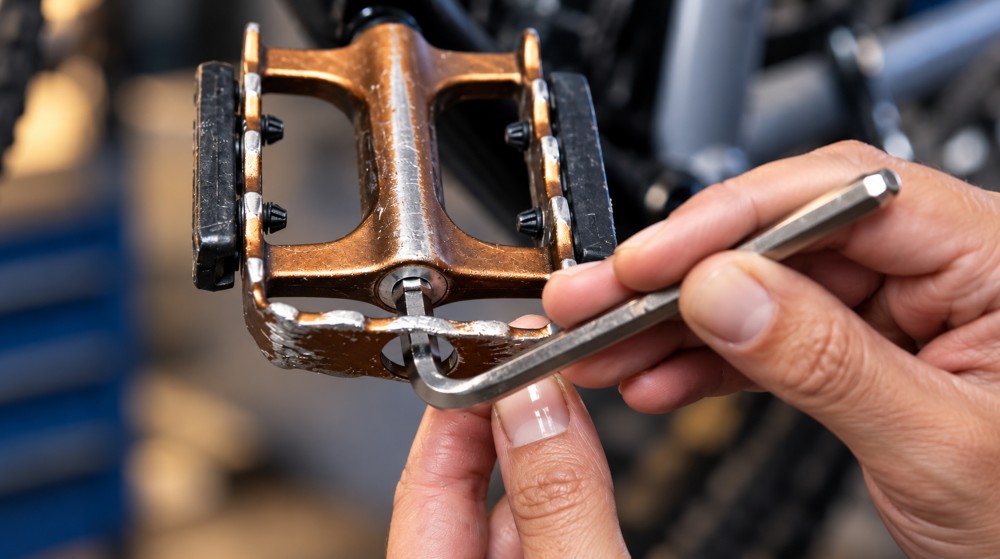
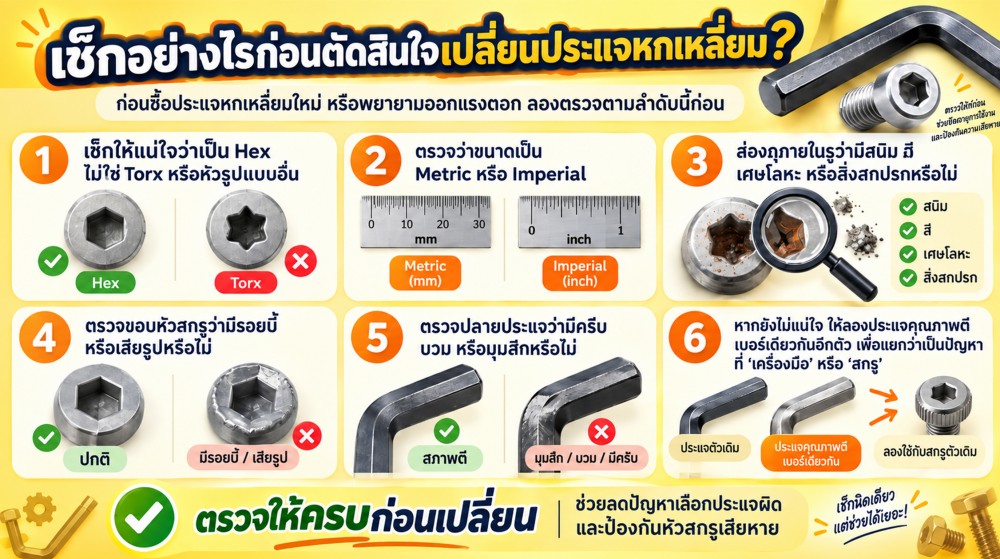
This is one of the first things you should check. Hex keys are commonly available in at least two systems: Metric (millimeters) and Imperial (inches/fractions). The problem is that some sizes are so close that they are nearly indistinguishable to the naked eye. A clear example is 5/32 inch, which equals 3.96875 mm, while the nearest Metric size is 4 mm—a difference of only 0.03125 mm or about 0.78%.
Placing them side by side makes it almost impossible to tell easily. If the screw head has slight tolerance variations, a 5/32-inch wrench might seem like a 4 mm one, but in actual use, it may be too loose or fail to seat fully. Conversely, grabbing a tool that is just slightly larger may cause it to bind right at the socket opening.
Therefore, if machinery, bicycle components, automobiles, or furniture are imported from abroad, do not assume they are metric based on appearance alone. Check the user manual or manufacturer specifications first.
Rust, dust, paint, and debris inside the bolt head take up more space than you think
Bolt heads used outdoors or in factory environments for long periods may have rust accumulated inside, while structural work or repainted machinery may have paint coating the hex socket. When the internal clearance is reduced even slightly, a correctly sized hex key may not fit.
This often leads technicians to mistakenly assume the wrench is the problem and switch to a smaller size. While it might fit, the contact area with the bolt head will be reduced, increasing the risk of stripping the hex socket corners. A better approach is to clean the bolt socket first, then try the correct hex key size again.
The hex socket opening may already be crushed or deformed
Screws that have been subjected to high torque, used with the wrong wrench size, or struck improperly with impact tools may have bulging or inward-crushed metal edges around the socket opening. In this case, an odd symptom occurs: the hex key is the correct size, but it only goes in slightly before binding.
Do not force or hammer the hex key in right away, as this will not only damage the screw head further but could also twist or chip the wrench tip. If deformation is found, inspect the condition of the screw head first and replace the screw if the damage is too severe for the tool to engage fully.
The tip of the hex key itself can bulge, wear down, or develop burrs
A hex key is a tool that directly withstands torsional force. If it has been overloaded, dropped, ground down at the tip, or misused, the tip's shape may alter slightly without being easily visible. Even a tiny metal burr on a corner of the wrench is enough to prevent it from entering a snug-fitting socket.
Try comparing it with another hex key of the same size in good condition. If one fits and the other does not, the issue may be with the tool, not the bolt head.
Cheap hex keys or non-standard bolt heads may have high tolerances
Even when marked with the same size number, manufacturing quality directly affects how well the tool fits. For example, data from earlier versions of the ISO 2936 standard shows that even small wrenches have strictly defined dimension ranges, such as a nominal 2 mm wrench having a width across flats range of roughly 1.96–2.00 mm, while a 2.5 mm wrench is around 2.46–2.50 mm. These numbers show that fractions of a millimeter truly matter in this kind of work.
When you combine the tolerances of the hex key itself with those of the screw head, if either the tool or screw is not manufactured to standard, the discrepancy can be large enough to cause the "correct size but won't fit" problem.
How to choose hex keys to reduce stripped screw head problems?
In addition to choosing the correct size, you should also consider profile quality, materials, and manufacturing precision. One example is Wera Hex-Plus, available in several models in iToolmart's hex key category. Wera explains that the Hex-Plus profile increases the contact surface inside the screw head to reduce notch effect at the corners, and the manufacturer states it can transfer up to about 20% more torque compared to conventional profiles under brand test conditions.
For general maintenance, iToolmart also carries KINGTONY in both individual pieces and sets, such as the H10 L-key made of SNCM+V alloy steel, as well as multi-size sets ideal for those who need clearly organized sizes. Meanwhile, EIGHT offers both Metric and Imperial sets within iToolmart's hex key product range, making them ideal for workshops that handle Japanese machinery, industrial applications, and inch-based equipment. The key point is not necessarily sticking to one specific brand, but choosing tools with clearly specified units, complete sizing for the job, and precise manufacturing to engage the screw head across full surface area.
Conclusion
Next time a chosen hex key seems to be the right size but won't fit, don't rush to conclude that the tool is the wrong size. Start by checking Metric vs. Imperial, cleaning the screw head, checking for burrs and rust, inspecting the wrench tip, and confirming that the screw head is actually Hex. Then consider the precision and quality of the tool. Because for hex fastening, a fraction of a millimeter can be the difference between a "perfect fit" and "won't fit at all," and between smoothly removing a screw or stripping it, resulting in wasted repair time. What is the most common reason you've encountered for a hex key being the right size but not fitting?
Select Hex Key to suit the application