


 EN
 ไทย


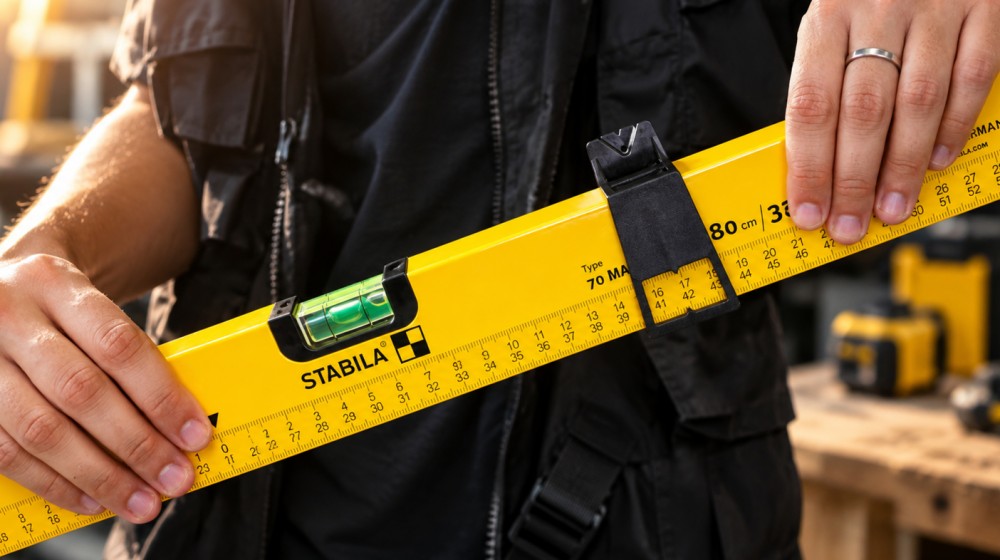
Customers Also Purchased


Imagine you are installing a new storage cabinet. You place a spirit level on the floor, and the bubble is right in the center. Everyone agrees that the floor is level. But once the cabinet is actually placed, you find that some legs are floating, the cabinet doors are misaligned, or when walking on certain spots on the floor, you feel small ridges and dips. The question is: Is the spirit level broken? The answer might be that the spirit level is not broken at all, but rather we are using one tool to answer two completely different questions. The terms "level floor" and "flat floor" do not mean the same thing. In professional construction, these two properties are clearly separated. For example, the F-Number system used for concrete floors separates the FF (Floor Flatness) value for surface bumpiness or waviness from the FL (Floor Levelness) value for floor slope or inclination.
Therefore, before claiming that a floor is ready to use just because the bubble of a Water level spirit level is centered, we should first understand what the tool is telling us—and what it isn't.
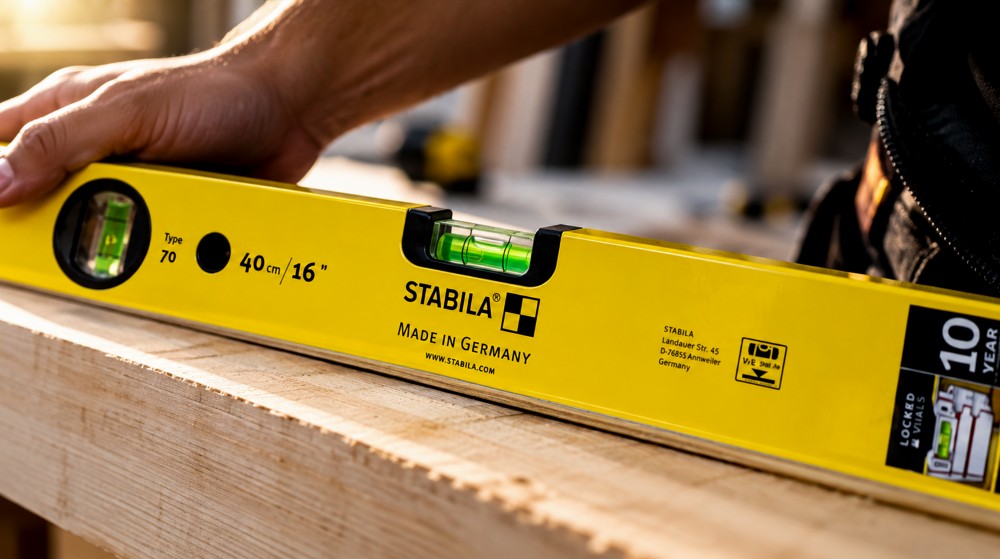
What does a spirit level actually measure?
A spirit level works using a liquid-filled vial with an air bubble. When the tool is laid horizontally and the bubble rests between the guide lines, it means the base of the level at that measured spot is close to the horizontal plane. Put simply, it answers the question: "Is this area tilted?" However, it does not automatically mean that "the entire floor area has no dips, no ridges, and is completely flat." This is a point often misunderstood by many homeowners and even DIYers, as the word "level" in everyday speech is often conflated with "flat," even though in actual floor inspection, the two can occur independently.
How can a floor be level but not flat?
Try placing a spirit level on a concrete floor with two small ridges. If both ends of the tool rest on spots of similar elevation, the bubble may sit perfectly in the center, yet a depression or dip could exist right between those two contact points.
In another case, the floor might have continuous small waves, but the spots where the spirit level rests happen to align with two high points; the reading still appears "level." In engineering, Floor Flatness and Floor Levelness are therefore distinctly separated: FF is used to evaluate surface waviness and variations over short distances, while FL evaluates deviation from the horizontal plane over longer spans. The ASTM E1155 standard is one of the standard methods used to determine FF and FL values for concrete floors.
The easiest analogy to visualize is a ramp. A well-constructed ramp can be exceptionally flat, without dips or ripples, but it is certainly not level because it is designed with a slope. Conversely, a room's floor may have an average slope that is perfectly horizontal, yet have hollows and ridges scattered all over. That is why "flat" and "level" must be inspected separately.
Why does floor flatness matter, even if the spirit level says it's level?
Slight deviations may not be visible to the naked eye, but once materials or equipment are installed, problems become apparent. A common example is large-format tiles or pre-finished flooring: if the subfloor is wavy, the planks or tiles may lack full surface support, causing hollow sounds or squeaks when walked on, lippage at seams, or localized stress points.
For the installation of cabinets, shelving, machinery, or workbenches, an uneven surface can result in uneven load distribution among the legs, even if the equipment itself has been adjusted to be level.
This difference is so crucial that American Concrete Institute guidelines specify separate flatness and levelness values depending on intended use. For instance, ACI documents cite sample values of around FF25/FL20 for carpeted office spaces, whereas areas for thin-set tile flooring or high-traffic warehouses might require around FF35/FL25. These figures are examples from US standard systems and not rigid requirements for every project, but they clearly illustrate that flatness and levelness are evaluated as distinct metrics.
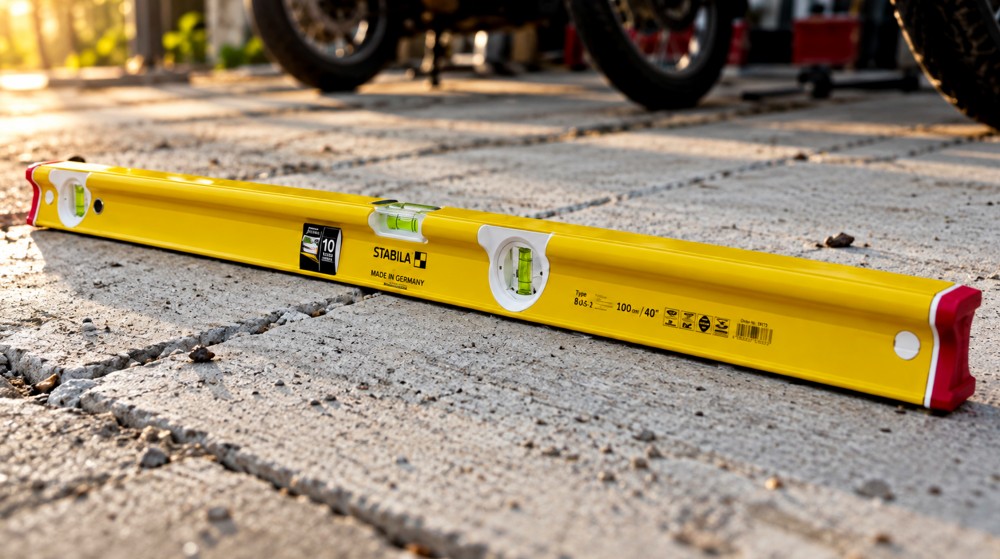
How to use a spirit level to inspect floors for more information than just "the bubble is centered"
For routine home maintenance and general handyman work, you don't always need specialized measuring instruments, but you can adjust how you use a spirit level to catch more issues. The key is never to measure just a single spot and judge the entire area. Instead, check multiple locations and orientations, such as:
- Place the spirit level along the length of the area and slide it across section by section.
- Rotate the tool 90 degrees to check the other direction, because a floor might be level along one axis but sloped along another.
- Observe the gap beneath the spirit level's base, rather than just looking at the bubble's position
- Press lightly on the ends of the spirit level; if the tool rocks, there might be a high spot in the center or uneven contact along the line.
- For wide areas, use a longer spirit level or a straightedge to check for waviness over an appropriate span.
- When inspecting work with specific tolerances—such as tiles, machinery, or racking systems—primarily adhere to the tolerances specified by drawings, manufacturers, or relevant project standards.
This technique allows the spirit level to do more than just indicate whether a surface is tilted; it also helps spot surface imperfections before moving on to the next step. However, using a straightedge or spirit level to inspect gaps is merely a preliminary on-site check and should not replace standard testing methods on projects that specify FF/FL numbers.
Does the length of a spirit level affect the inspection?
It has quite a significant impact. A short spirit level is ideal for confined spaces such as door frames, shelving, furniture installation, or spot checks. But if you use an overly short spirit level to inspect a large room floor, you are only seeing a small section of the floor at a time. A longer spirit level is therefore beneficial when you want to see the overall alignment across a broader span, especially when combined with observing the gap under the base.
At iToolmart, we offer spirit levels in various sizes and brands such as STABILA, STANLEY, BOSCH, and WADFOW, ranging from compact models up to around 120–150 cm. This allows you to choose the right length for your specific task instead of relying on a single size for everything. For tasks requiring repeated checks and uncompromising precision, some professional-grade models clearly specify their measurement accuracy. For instance, the STABILA Type 196-2 K available at iToolmart specifies an accuracy of approximately ±0.5 mm/m in both normal and reverse positions.
However, no matter how accurate a spirit level is, the tool must still be chosen appropriately for the job and used correctly, because an accurate tool will not yield correct results if you are measuring a different property from what needs to be inspected.

Where should you start fixing an uneven floor?
Before fixing it, you must first distinguish whether the issue is tilting or waviness. If the floor only has high spots, those areas may need grinding or shaving down. If there are isolated depressions, patching compound might be required. But if the floor has variations across multiple spots, consider a floor leveling or self-leveling system suited for both the flooring material and the substrate condition.
Some flooring manufacturers recommend checking multiple spots before installation to identify hollows, dips, and height differences, rather than simply laying a spirit level down in one spot and beginning the install immediately. For professionals, the key is not just keeping the bubble centered everywhere, but understanding how much flatness, levelness, or slope the finished project actually requires according to the design.
For example, a typical room floor may require a flat horizontal plane, whereas a bathroom floor or drainage area requires a slope. Therefore, making every spot perfectly level horizontally could actually result in non-compliance with the design.
Summary: A spirit level shows that it's level, but flatness still needs a separate check
A spirit level is one of the most useful basic tools for tradespeople across construction, furniture installation, steelwork, ceiling installation, and DIY projects. However, a centered bubble should never be interpreted as an entire surface being "perfectly flat." What a spirit level primarily indicates is whether the measured line is tilted; flatness requires further examination of waves, ridges, dips, and overall surface discrepancies. For general work, checking multiple spots, rotating across multiple directions, using a spirit level suited to the area's span, and observing gaps under the base will significantly minimize errors. But for projects with engineering specifications, inspect strictly according to the drawings and project standards rather than relying on a spirit level alone.
Because in the end, what appears straight to the eye may not be flat, and a surface where the bubble sits dead-center may still harbor hidden dips—the last time you used a spirit level, did you only check the bubble, or did you look at the gap underneath as well?
Select Water level to suit the application