


 EN
 ไทย


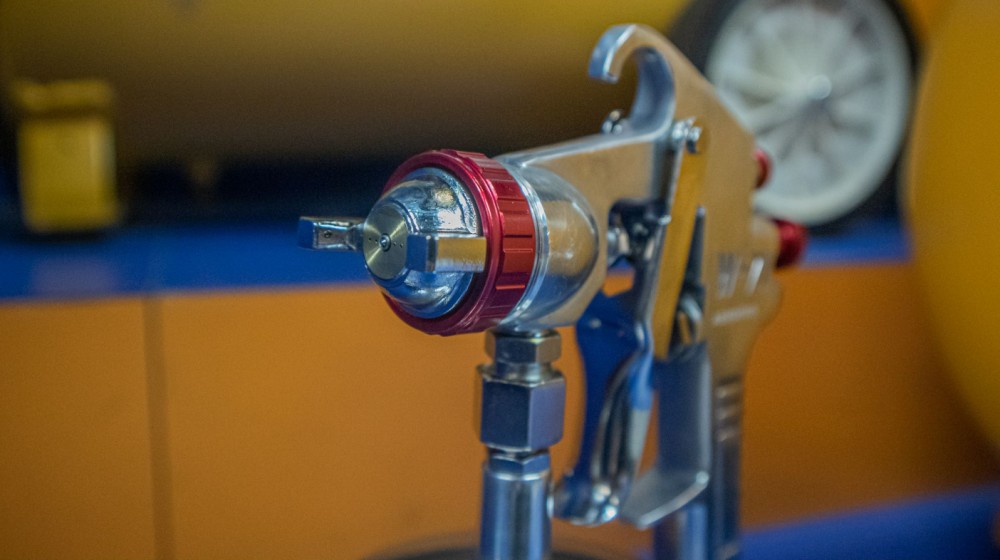
Customers Also Purchased


If you have ever disassembled the nozzle Spray gun to clean it, or ever looked at the front of the spray gun up close, you have probably wondered why the nozzle area is full of small holes—the center hole, surrounding holes, and on both wings/horns—even though when spraying paint, all we want is for the paint to come out of the tip and disperse onto the workpiece.
Looking at basic principles, we might think a spray gun should work like a standard nozzle: having an opening to release paint and using pressure to help propel the paint forward. But actual spray painting is more complex than that. What we need is not just for the paint to "come out of the gun," but to atomize the liquid paint into fine droplets, disperse them evenly, form a spray pattern suitable for the job, and land on the surface in a controllable amount. This type of equipment therefore comes in many types, leading to the question: How exactly do the operating principles of gravity-feed and suction-feed spray guns differ?
The various holes seen on a spray gun air cap do not all serve the same function. Some are meant to deliver air, some help with atomization, and some are responsible for shaping or flattening the spray pattern into a fan shape. This is why just one small clogged hole can cause a spray gun that once sprayed beautifully to produce a distorted pattern, uneven coverage, or coarse droplets.
"Spray Gun Nozzle Assembly" Does Not Consist of Just a Single Part
Operationally, the spray gun nozzle assembly consists of several components that must work in coordination. The key parts include:
- Fluid Nozzle
- Air cap
- Fluid needle
The fluid nozzle is the orifice where spray materials such as paint, primer, lacquer, or coatings flow out of the spray gun body. Meanwhile, the fluid needle moves in and out to open or close the paint pathway. When you pull the trigger, the needle retracts from the fluid nozzle, allowing the liquid to flow out, while the air cap surrounding the fluid nozzle directs compressed air to interact with the fluid emerging from the nozzle tip.
This principle makes what happens in front of the spray gun a controlled process where paint and air are brought together at a specifically designed position and direction before atomizing into a fine mist and traveling toward the workpiece.
Spray gun manufacturers place great importance on the shape of the nozzle and air holes because even minor alterations can affect atomization characteristics and spray patterns.
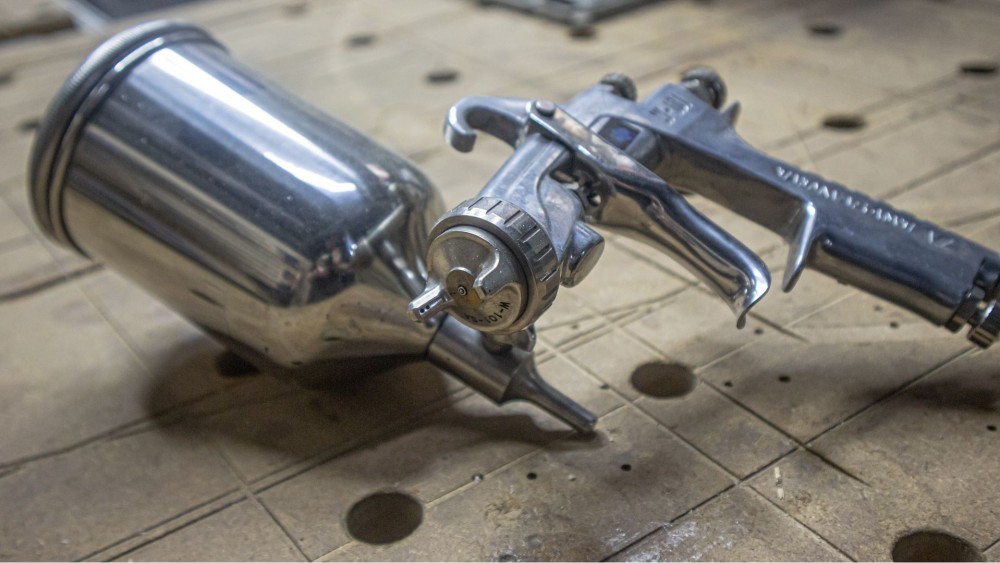
The center hole of the spray gun nozzle is the main outlet for paint
The center area of the spray gun nozzle is the part we are probably most familiar with. Common values we encounter such as "1.3 mm nozzle", "1.4 mm nozzle", or "1.6 mm nozzle" generally refer to the size of the fluid nozzle or the material outlet passage. It does not mean every single hole we see on the head has that exact measurement.
If you see spray gun specs indicating a 1.3 mm nozzle size, that information primarily concerns the material outlet. It does not indicate the total number of holes on the cap, nor does it guarantee that the same nozzle size on different spray gun models will always produce the same spray finish, because the air cap design also has a significant impact on how paint is atomized.
Many brands match the fluid nozzle, needle, and air cap as a single system or specify dedicated nozzle sets that must be used together.
What are the small holes around the nozzle for?
This is the key aspect that distinguishes a spray gun from a conventional liquid dispenser. When paint emerges from the fluid nozzle, it is still in liquid form. If released without proper intervention, you will not achieve the fine mist required for spray applications.
Therefore, compressed air from the air cap is required to assist in causing Paint stream atomization Air is routed through internal passages in the spray gun and exits through various holes or slots in the air cap in designated directions to impact or shear the fluid stream released from the fluid nozzle.
Imagine a narrow stream of running water: if you blast strong air into it from the side, the stream shatters into smaller droplets. The working principle of a spray gun is quite similar, but engineered for far more precise control—including air impact location, air volume, velocity, direction, and air port geometry. That is because the goal is not merely to disperse paint into the air, but to distribute droplets evenly as well.
A spray gun's air cap often features holes of various sizes and positions, and each design may have a different internal layout. Some technologies even incorporate auxiliary air passages or ports that initiate preliminary atomization before entering the primary atomization stage.
The holes on the two side horns create the fan pattern
If you examine the air cap of a typical spray gun, you will notice protruding horn- or wing-like features on both sides, which also contain holes. These holes play a vital role in transforming the spray mist from a naturally circular shape into a flattened spray profile, commonly known as a fan pattern.
Air jets from the air cap horns converge on the droplet cloud from both sides, squeezing and elongating the spray pattern in perpendicular directions until it forms an oval or fan-shaped profile. This is ideal for broad surface spraying, allowing you to pass the spray gun over the workpiece in continuous strokes and overlap each pass far more easily than with a round spray pattern.
This is why rotating the air cap can change the fan pattern orientation. In many spray gun models, if the horns are horizontal, the spray pattern exiting the gun corresponds to the direction of the air delivered from the horns. When you rotate the air cap, the direction of the airflow changes accordingly, allowing users to choose the right spray orientation to match their movement and the shape of the workpiece.
In some spray gun systems, we can also adjust from a wide fan pattern down to a narrow fan or nearly a round spray via the fan pattern control valve. This is because what is being adjusted is not just the "hole size," but the volume of air delivered to the channels that shape the spray pattern.
More Holes Doesn't Mean Stronger Spray
When seeing an air cap with many holes, some might think that spray gun model blows harder or sprays more paint. In reality, the number of holes alone does not indicate the gun's performance; what matters more is the overall air system design.
Hole size, position, hole angles, air pressure, required air volume, and the internal air passage shapes all affect paint atomization. Two spray gun models may have drastically different air cap designs, yet both can produce droplets perfectly suited for their intended applications.
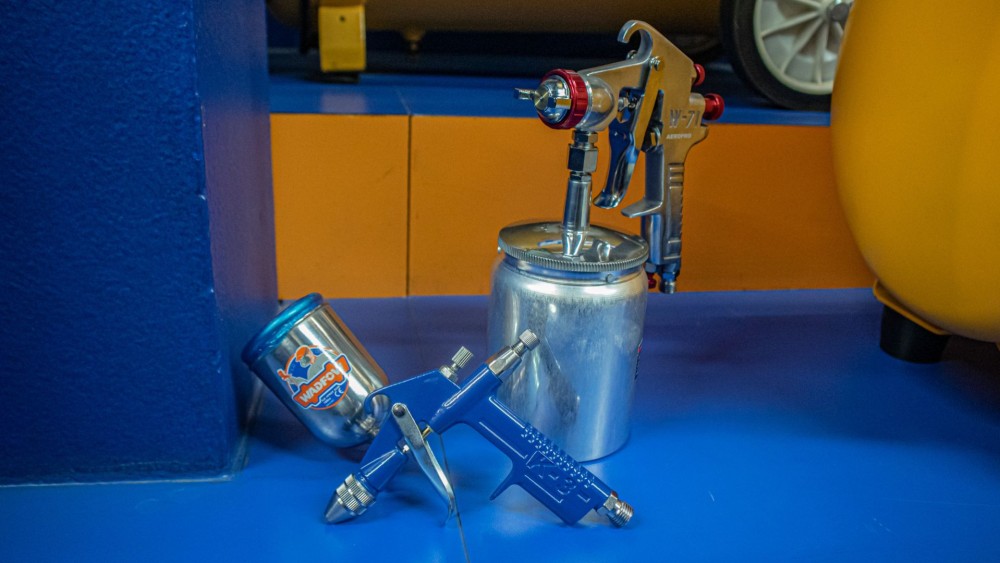
Some modern spray guns demonstrate this concept even more clearly, as manufacturers not only engineer hole sizes but also optimize internal airflow paths within the nozzle. This shows that spray nozzles aren't just about "how many holes there are," but rather the management of the entire air system.
A Single Clogged Small Hole Can Distort the Spray Pattern
Once you understand that the holes around the spray gun nozzle control the air, you can immediately see why even a minor clog causes far more trouble than you might think. Common causes of spray gun clogs and easy solutions
Suppose an air cap has air channels on both sides designed to release equal amounts of air to squeeze the paint droplets into a symmetrical fan. If the holes on one side become clogged with dried paint, airflow from that side drops while the other side functions normally. The result is unbalanced force on the atomized mist, causing a skewed spray pattern, heavy paint build-up on one side, or an uneven fan pattern.
Therefore, whenever a spray gun begins producing an abnormal pattern, one of the first things to inspect is the cleanliness of the air cap and fluid nozzle. In particular, the small holes around the nozzle—both fine and large—play a crucial role in atomizing and distributing paint evenly. These holes should always be kept clean and free from clogs.
Same 1.3 mm Spray Nozzle, Why Do They Spray Differently?
The reason is that 1.3 mm is just one part of the system's data. There is also the air cap, which varies in hole count, hole size, airflow angle, atomization system, required air volume, and fan pattern shape. Furthermore, internal fluid passages, needle design, and the control characteristics of each spray gun model also come into play.
One spray gun with a 1.3 mm nozzle may be designed for ultra-fine atomization and easy control, while another might be engineered for high-speed operation, wider pattern widths, or handling different material flow rates, even though the nozzle sizes are identical.
This also explains why, when replacing nozzle spare parts, you should not just match the size and mix-and-match similar-looking parts yourself. Some spray gun manuals specify replacing the air nozzle, paint nozzle, and paint needle as a matched set, as these components are precision-engineered to work together.
Spray Guns Vary in Hole Count and Positioning Across Different Models
If you compare air caps from several spray gun models side by side, you will find that their appearances can differ drastically.
- Some models feature numerous small holes
- Some models look much simpler
- Some models feature different openings on the horn areas
- Some technologies feature special structures around the fluid tip to facilitate pre-atomization before entering the main atomization stage.
The same applies to HVLP systems or other atomization technologies that may manage pressure, air volume, and air velocity differently.
These differences do not mean that models with more holes are better, or that models with fewer holes will produce a less fine spray, because it all depends on the design philosophy of that specific paint spray gun.
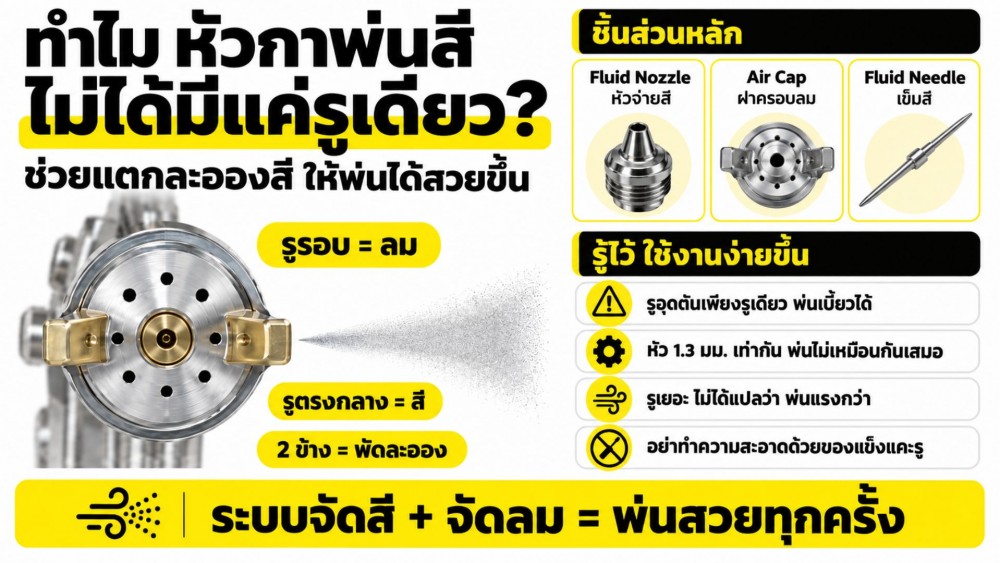
Summary: Why do spray gun nozzles need multiple holes?
The answer is because A spray gun doesn't just release paint from the gun, but it also has to break down liquid paint into a fine mist and control those droplets into an appropriate spray pattern.
If you take apart a spray gun nozzle to clean it and see lots of tiny holes, don't dismiss them as insignificant details. These holes are an integral part of the system that transforms liquid paint into a fine mist and turns a round spray pattern into a controllable fan pattern.
Once you understand this, you will gain a deeper understanding of paint spray guns overall—from selecting nozzle sizes, adjusting the fan pattern, setting air pressure, fixing distorted spray patterns, to proper cleaning methods.
Sometimes, simply knowing what each hole does can help you troubleshoot on-site issues much more easily than adjusting Spray gun by guesswork.