


 EN
 ไทย


Customers Also Purchased


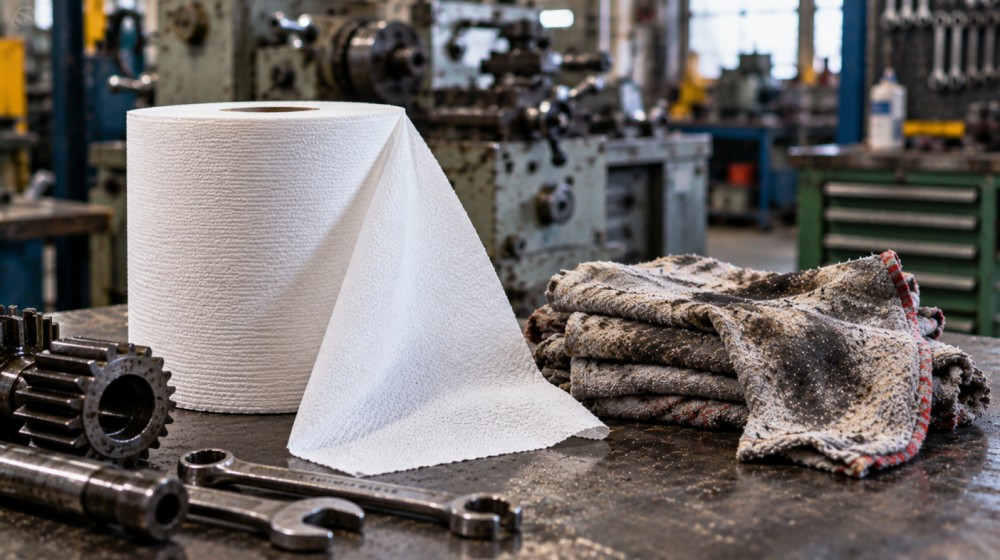
Oil stains on machinery, grease clinging to parts, or spilled liquids during operations are common occurrences in factories. A seemingly mundane thing like "wiping material" affects workflow more than you might think, as each material differs not only in absorbency, but also in strength, linting, reusability, and post-use disposal methods.
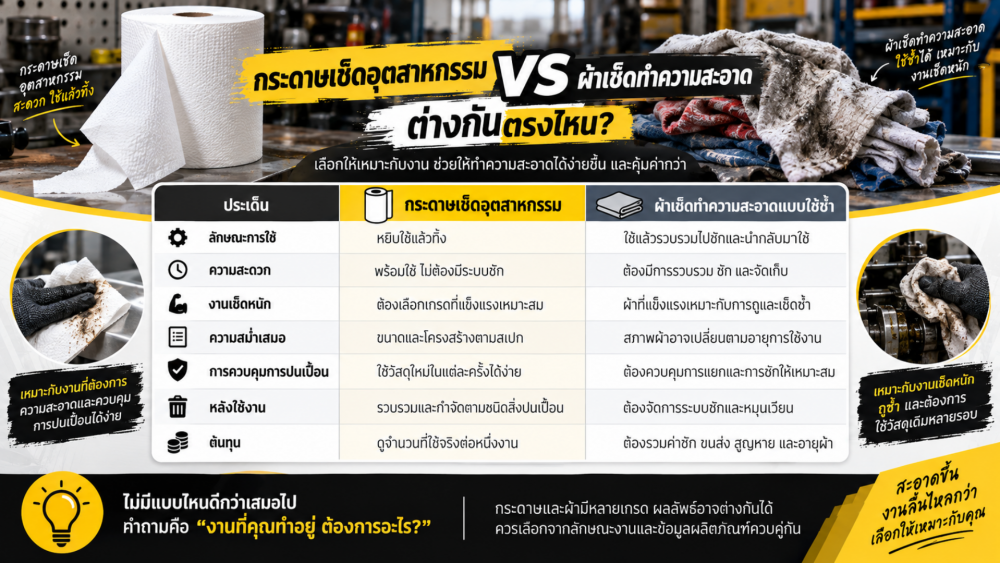
When choosing between Industrial Wipes and reusable cleaning cloths, the answer isn't always that one is strictly better. Paper wipes stand out for their grab-and-go convenience, providing a fresh sheet every time without requiring laundering. Rags, on the other hand, have the upper hand in heavy-duty scrubbing, repeated wiping, and multi-cycle reuse. Therefore, the question that helps you make the right choice is: "What does the task at hand require from a wiping material?"
Before comparing, it is important to know that industrial wipes are not ordinary tissue paper.
The name "industrial paper wipes" might bring to mind thicker paper towels, but these products are engineered for tougher tasks, such as wiping away oil, grease, and grime on tools, machinery, or workpieces. Consequently, they emphasize strength, absorbency, and durability during use.
Moreover, the term "paper" in the market doesn't always mean pure paper pulp. Some industrial wiping materials are nonwoven fabrics or hybrid blends developed for specific applications, such as requiring high tensile strength, high absorbency, or low linting.
Reusable cleaning rags, however, are different: after use, they don't immediately leave the system; they must be collected, laundered, dried, and circulated back into use. Comparing these two options is therefore not just "paper vs. cloth," but rather a comparison between a disposable system and a reusable system.
In what types of tasks do industrial wipes have the advantage?
The most obvious advantage of industrial paper wipes is grab-and-go convenience. Suppose a maintenance technician needs to wipe grease off a wrench or machine component; they can simply grab a fresh sheet, wipe it down, and dispose of it at the designated collection point, without any need for laundering and recirculating.
This characteristic is ideal for tasks requiring clean, ready-to-use materials each time, especially in areas where you want to avoid cross-contaminating with reused rags from other zones. In addition, industrial wiping paper comes in various grades depending on the application—ranging from water absorption, wiping oil and grease, to tasks requiring heavy scrubbing or lint control.
However, the convenience of a disposable system comes with a trade-off, as it immediately generates waste that must be managed after use. Particularly when paper is contaminated with oil, chemicals, or solvents, factories should not assume it can be disposed of as general waste in all cases. Instead, the type of contaminant and relevant waste management regulations must be considered.
When Are Cleaning Cloths More Suitable?
For tasks requiring heavy scrubbing, wiping large surface areas, or repeated wiping cycles, cloth still holds a clear advantage. This is especially true for durable cloths designed for industrial applications, as they can be used continuously for extended periods without frequent replacement.
Another key point is that cloths can be reused multiple times if the factory has an adequate collection and laundering system. Thus, they are often well-suited for general maintenance, wiping tools, or areas without strict cleanliness or lint control requirements.
However, do not jump to the conclusion that "reusable is always cheaper," as the cost of cloth involves more than just the initial purchase price. Factories must also factor in laundering costs, water, energy, transport, collection, loss, and the number of cycles a cloth can withstand before deteriorating. Meanwhile, with paper, you must consider both the number of sheets used per task and waste management fees. Therefore, when comparing costs, you should look at the "actual cost per use" rather than the price per cloth or price per roll.
If Contamination Is a Concern, Paper Is Generally Easier to Control—Though Not Always Problem-Free
A cautionary point regarding reusable cloths is inadvertently transferring contaminants from one job to another. For example, a cloth previously used to wipe oil from machinery might be grabbed and used on a workpiece requiring a higher level of cleanliness. Even if the cloth has been laundered or looks clean to the naked eye, unsystematic management still introduces risks.
Factories using reusable cloths should therefore categorize them by task or area, designate collection points for used cloths, and clearly control routing between soiled and clean cloths. The stricter the job's cleanliness requirements, the more critical these systems become.
Disposable paper eliminates the issue of reusing the same material, but that does not mean there is zero chance of contamination. If paper is stored in dirty areas, grabbed from the dispenser with soiled hands, or used across multiple areas with a single sheet, cross-contamination can still occur. Thus, whether you choose paper or cloth, storage and handling methods still matter.
For Low-Lint Applications, Do Not Choose Solely Because It Says "Paper"
If you need to wipe parts prior to assembly, spray painting, electronics work, or surfaces sensitive to fibers and particulate matter, selecting a wiping material requires greater precision. Both paper and cloth can generate varying levels of lint depending on their material and construction.
Therefore, do not assume all types of paper have less lint than cloth. If your application prioritizes this, check the product specifications for low-lint, lint control, or particle generation ratings to verify they meet your actual process requirements.
Simply put: choose based on what the job requires, not based on the material's name.
A Simple Decision Method: Start from the Worksite, Not the Price
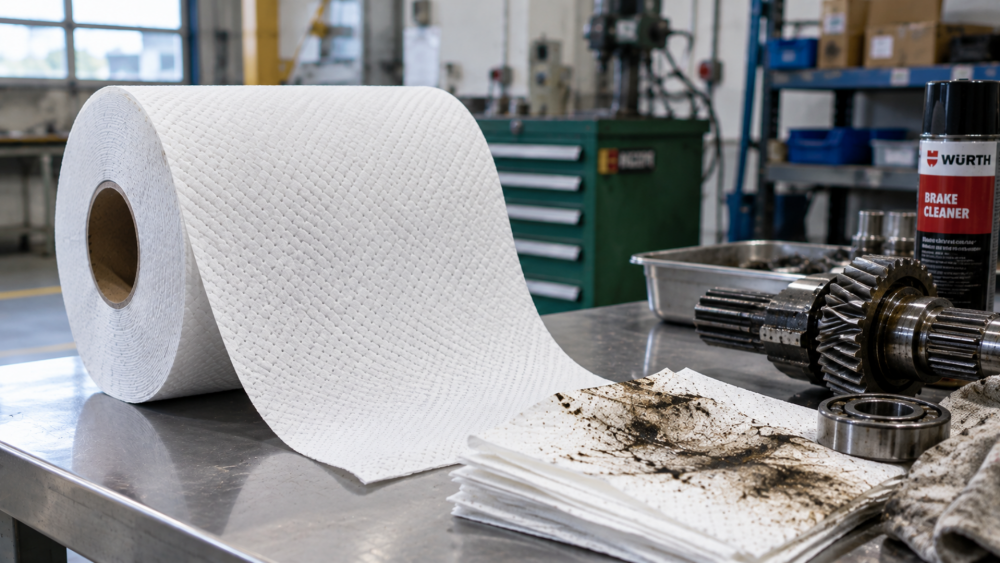
Before buying, first look at the actual application: what are workers wiping? If it is water, oil, or grease, how absorbent does the material need to be? If the residue is dry and requires heavy scrubbing, is durability more critical? If it is a workpiece before entering the production process, are there strict requirements regarding lint or residue?
Next, consider what happens after use. If choosing cloth, does the factory already have an efficient washing, sorting, and rotation system? If choosing paper, where does the used material go, and does the substance absorbed require different handling than general waste?
Combining these answers shows that the price per roll or price per kilogram is only part of the decision. A material that appears cheaper may require using higher quantities or create more post-use procedures, while a slightly higher-priced material may require fewer sheets per task and offer greater convenience.
A Single Factory Can Use Both Paper and Cloth
In practice, factories do not need to choose strictly one over the other. Assigning specific roles to each type of material is often more practical than trying to force a single material onto every application.
For example, maintenance areas that require wiping tools and heavy grease repeatedly might choose durable cloth rags backed by a laundering system. Meanwhile, parts preparation stations or spot-cleaning areas might use industrial paper wipes so that fresh material is immediately accessible. For tasks with strict lint or chemical requirements, materials with specifications matching those specific jobs should be selected separately.
This approach allows factories to maximize the benefits of each material without trying to determine whether paper or cloth is "best" in all situations.
Paper or cloth: which is better for a factory?
If the task demands convenience, fresh ready-to-use material, reduced laundry steps, or easy control against cross-contamination, industrial paper wipes are often the better answer. But if the work requires heavy scrubbing, repeated wiping, and continuous use—and the factory has an effective laundering system—cleaning cloths remain a suitable choice.
Ultimately, the same factory does not need a single answer. Maintenance areas may be suited for cloth, while parts prep stations may be suited for paper. The key is to start by looking at what needs to be wiped, the required level of cleanliness, and how the material will be handled after use, and then choose what fits the actual job.
Looking at it this way, Industrial Wipes and cleaning cloths do not need to be competitors, but rather different tools suited for different areas in the factory.