


 EN
 ไทย


Customers Also Purchased


When choosing to buy Soldering iron One of the first things many people look at is the power rating stated on the unit, such as 40W, 60W, or perhaps well over 100W. It is commonly assumed that the higher the wattage, the hotter the soldering iron will get. Therefore, if you want to melt solder quickly or work on large components, you should pick a soldering iron with the highest wattage you can find. What Should You Check Before Using a Soldering Iron?
This concept isn't entirely wrong, as wattage certainly affects a soldering iron's performance. However, what many people may misunderstand is that "Wattage" does not directly mean heat or the "maximum tip temperature." An 80W soldering iron does not mean it is twice as hot as a 40W iron, and some lower-wattage models can maintain temperature during soldering better than cheap high-wattage irons.
The main reason lies in how a soldering iron works. In real-world work, what we need from a soldering iron is not just the question of "how many degrees the tip reaches," but also aspects of heat-up speed, heat transfer to the workpiece, and the ability to maintain temperature when the tip touches metal that all come into play at the same time.
What Does the Wattage of a Soldering Iron Mean?
The electrical power, typically specified in watts (W) on electrical devices including soldering irons, fundamentally refers to the rate at which the tool consumes electrical energy to convert it into heat energy.
- This number does not indicate that all the energy is completely delivered to the soldering tip, nor does it tell you what temperature the tip will top out at once it heats up.
- Basic soldering irons without a temperature control system typically use a heater that generates heat continuously. When turned on, the tip temperature gradually rises until the heat energy produced by the heater equals the energy lost to the surrounding environment through the air, handle, and surrounding areas. Once equilibrium is reached, the temperature stabilizes.
- A 40W soldering iron and an 80W soldering iron can be designed to reach similar tip temperatures, but an 80W soldering iron will usually heat up faster and have more reserve power when transferring heat to the workpiece.
For soldering irons, "higher wattage" and "hotter" do not mean the same thing.
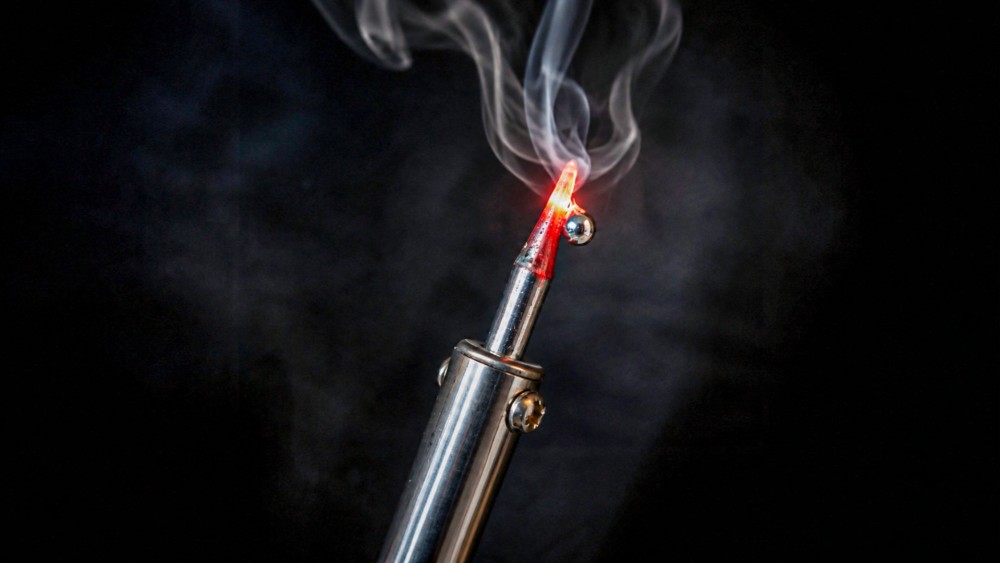
What matters is how well the soldering iron maintains its temperature.
In practical soldering work, problems usually don't occur when the iron is just resting idle in its stand; they happen when we touch the tip to the workpiece. Suppose we have two soldering irons, both idling at a tip temperature of around 350°C before starting work—one rated at 30W and the other at 80W. If used to solder small wires, you might barely notice any difference because the workpiece does not absorb much heat from the tip.
However, if you switch to soldering thick wires, copper terminals, or circuit boards with large copper ground planes, what happens is the workpiece will rapidly absorb heat from the soldering tip, causing the tip temperature to drop immediately.
A higher-wattage soldering iron can generate and compensate heat energy faster, preventing the tip temperature from dropping significantly or allowing it to recover to the set temperature more quickly. As a result, solder melts and flows more easily. This is where the wattage rating truly makes a difference in soldering work.
High-wattage soldering irons do not always mean higher temperatures
Another common misconception is that a high-wattage soldering iron, such as 80W or 100W, poses a greater risk of burning circuit boards than a 30W iron. Is an extremely hot soldering iron normal? How to prevent issues for smooth operation
The truth depends on the case
- For standard soldering irons without temperature control systems, the wattage and heater design do indeed affect the tip's equilibrium temperature, so you must choose one suitable for the type of work.
- For Temperature-controlled soldering stations The system will attempt to maintain the temperature set by the user.
- For example, a 100W soldering iron set to 330°C will try to maintain the tip around 330°C, rather than letting it continuously rise simply because the unit is rated at 100W.
- The advantage of higher power is that when the temperature drops upon contact with the workpiece, the system has sufficient power reserve to quickly bring the temperature back up.
- A high-power soldering iron with good control can actually help reduce damage to circuit boards because you can complete the soldering quickly without having to hold the iron against the joint for an extended period.
The size and shape of the soldering iron tip also have a major impact
Even if you use a 100W soldering iron, if you choose a very small tip to solder large wire terminals, the results may still be poor. Heat does not travel from the heater to the workpiece by wattage numbers alone; it also depends on the contact area between the tip and the workpiece.
Think of scooping hot water with a small spoon versus a large ladle. Even if the water is at the same temperature, the amount of energy transferred at one time is not the same. Soldering tips work similarly. Very fine needle-point tips are suitable for small electronic components because they access tight spaces well, but they have less thermal mass and contact area, making them unsuitable for tasks requiring high heat transfer.
For soldering wires, connectors, or large planes, switching to a chisel tip with a larger contact area can sometimes yield better results than increasing the iron's temperature.
A large soldering iron tip doesn't mean it's only for rough work
Beginners in soldering often prefer using the smallest soldering tip because they feel it offers more precise control. However, for general electronic soldering, an appropriately sized chisel tip typically transfers heat much better, melting the solder quickly and reducing the time the heat is in contact with the components.
Choosing a soldering tip should therefore take into account both the size of the solder joint and the amount of metal that needs to be heated, rather than just the precision of the work.
Higher temperature does not always mean faster soldering.
When a soldering iron feels slow to melt solder, the easiest fix might seem to be cranking the temperature up from 320°C to 380°C or 400°C. But sometimes the problem isn't the temperature; it could be that the tip is too small, the tip is oxidized, or there is insufficient flux.
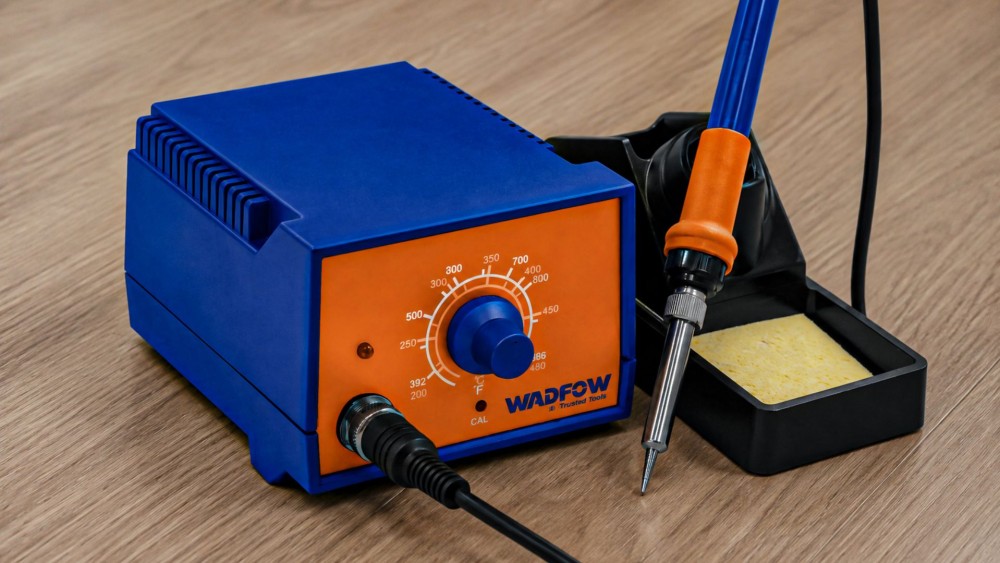
Raising the temperature too high can lead to negative consequences, such as:
- Flux evaporating or burning off faster
- Faster tip oxidation
- Melted wire insulation
- Overheated circuit board pads
A soldering iron with good heat transfer does not always need to be set to a very high temperature. In many applications, selecting the right tip and using an iron that maintains temperature well allows for faster soldering even at a lower temperature setting.
Why do different models of 60W soldering irons perform differently?
Looking at the box, two soldering iron models labeled 60W might seem to offer similar performance, but in real-world use, several other factors create differences in performance.
- Heater position If it is located far from the soldering tip, heat must travel through multiple metal parts before reaching the solder joint, causing heat loss and slower thermal response.
- Temperature sensor If the sensor is located far from the tip, the unit might register the temperature as normal even though the actual tip has already cooled down upon touching the workpiece.
- Power control system If the circuitry can respond and deliver power back to the heater quickly, the temperature will remain much more stable.
All of these factors allow a high-quality 60W soldering station to outperform an 80W or 100W soldering iron that lacks an optimized heat transfer and temperature control design.
How many watts should you choose for a soldering iron?
If you ask what wattage of soldering iron to choose, the answer is to choose based on the type of work rather than looking for the highest number. For general electronics work, such as small PCBs, signal wires, through-hole components, or general circuit repair, a soldering iron in the range of approximately 40–70W with a good temperature control system can cover a wide range of tasks.
If you need to work with thick wires, metal terminals, large ground planes, or high heat-sinking jobs, a power of 70–100W or more will noticeably improve thermal recovery when heat transfers to large workpieces, because the electrical current generates heat more quickly.
As for very low-wattage soldering irons, they can still be used for certain types of work, but when dealing with high heat-absorbing workpieces, they may require longer contact times, which does not always mean they are safer for the components.
When choosing a soldering iron, also check whether the unit has adjustable temperature, what kind of heater system it uses, whether it has a temperature control sensor, if there are multiple tip sizes to choose from, and how easy it is to purchase replacement soldering tips in the long run.
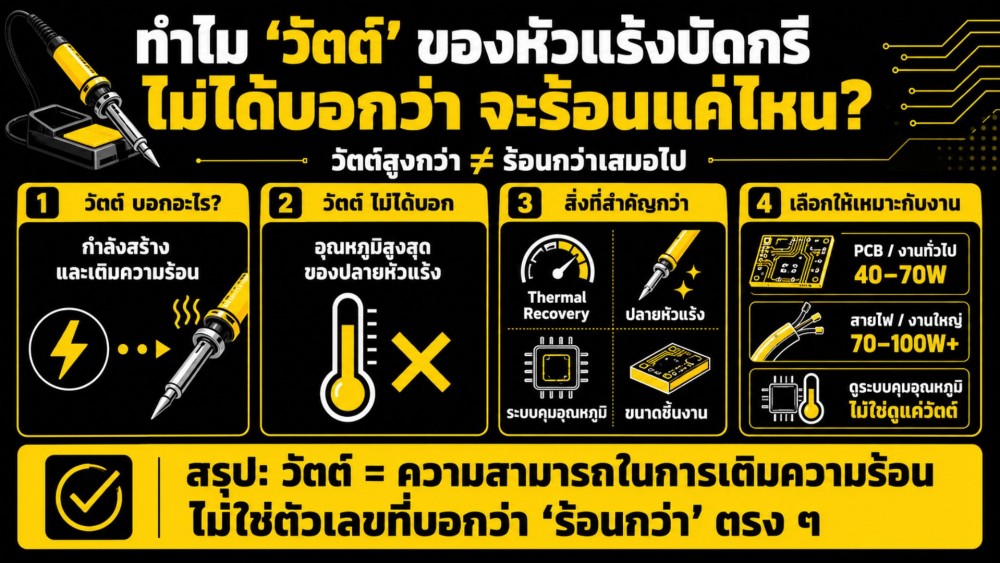
Summary: What can the wattage of a soldering iron tell us?
The wattage number of a soldering iron is important information, but it should be seen as an indicator of "the ability to generate and replenish thermal energy" rather than a number indicating "how hot the soldering iron can get."
What truly affects actual soldering work is the interaction of multiple factors, including:
- Heater power
- Heating element design
- Sensor placement
- Temperature control system
- Size and shape of the soldering tip
- Characteristics of the workpiece being soldered
Therefore, a 100W soldering iron does not always reach a higher temperature than a 60W iron; what it may do better is maintain temperature without dropping significantly upon touching the workpiece, and recover heat much faster.
Because good soldering does not come from making the tip "as hot as possible," but from transferring the right amount of heat to the solder joint quickly and controllably.
Next time you purchase a soldering iron, Soldering iron besides asking "how many watts is this model?", you might also need to ask "how well does it maintain heat in actual use?" because it is the latter question that tells you much more about the soldering iron's performance than the number on the box.