


 EN
 ไทย


Customers Also Purchased




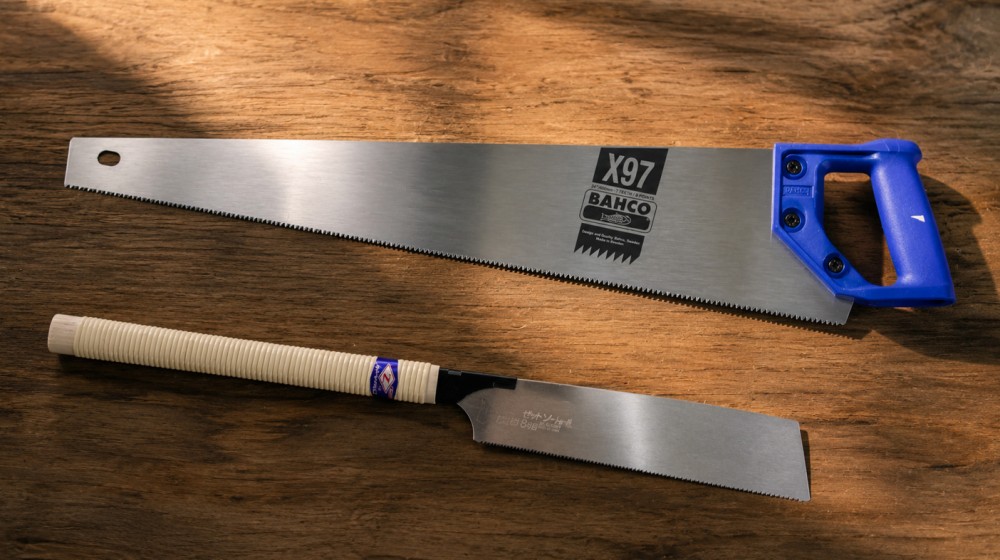
When choosing a saw, beyond coarse or fine teeth and blade length, another noticeable factor is the blade thickness. A thick blade feels rigid and does not twist, unlike a Japanese pull saw whose blade is ultra-thin and can be bent by hand. This leads many people to think that a thick blade cuts straighter and is easier to control, while a thin blade might wobble and wander off line.
- Push Saws (Western style): Thick blades really are better! Well-known brands like Bahco design their blades to be thicker to reduce buckling, increasing stability and accuracy on the push stroke.
- Pull Saws (Japanese style): A blade as thin as 0.3–0.6 mm can still cut straight! The Z-Saw brand explains that applying a "pulling" force keeps the blade naturally in tension, eliminating buckling issues. Moreover, the thin blade removes less wood, making cuts smoother and more precise.
Therefore, the question: Saws "Thick vs. thin blade: which is easier to control?" does not depend solely on thickness, but on the cutting stroke (push or pull) and what you mean by "easy to control"—whether it refers to a rigid blade that doesn't flex, or cutting accurately along the marked line!
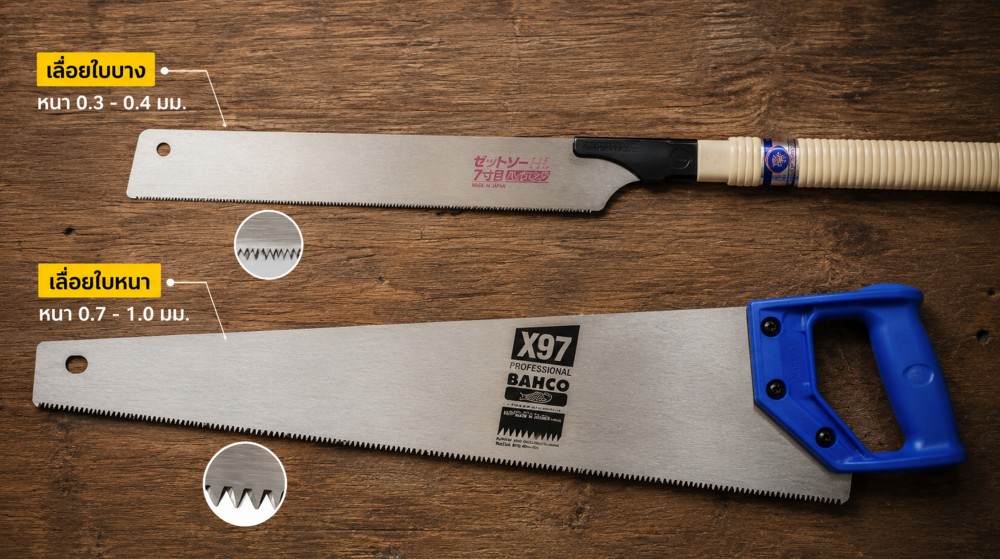
First, you need to understand that a saw blade is not as rigid as a steel ruler.
Take a look at a saw: the blade is a long, thin sheet of steel with a handle at only one end, while the tip floats in mid-air. When you apply cutting force, that force does not travel directly to the teeth immediately; it must pass through the entire blade. As a result, the blade can bend, twist, wobble, or buckle sideways at any moment, causing it to deviate from your cut line.
The ability to resist this deviation depends primarily on the blade's thickness. Simply put, with the same steel type and width, a thicker blade is naturally stronger and harder to bend. This is why holding a thick-blade saw feels more stable and balanced in hand.
How does a thick blade help keep a saw stable?
Imagine sawing a 30 cm wide board... At first, it's fine, but as you cut deeper, more of the blade sinks into the wood. With a Western-style push saw, as you push forward, the blade is subjected to compressive force along its length. It's just like a steel ruler—if you hold both ends and push them toward each other, the ruler buckles sideways immediately!
Therefore, if the blade is too thin and flexible, it will easily buckle and drift off the cut line under resistance from the wood. Reputable brands choose blade thicknesses of around 1.03 mm to increase stability and ensure straighter cuts. However, thickness is only one way to solve the problem, not the only one. If a thick blade were the complete answer, fine-woodworking saws would simply have the thickest blades possible!
What are the advantages of thin-blade saws that make the added flexibility worthwhile?
Although a thick blade wins on rigidity, the trade-offs are increased mass and a wider kerf. The kerf is the width of the cut removed by the saw. The narrower the kerf, the less wood you remove, and the less effort required! A clear example from Z-Saw illustrates this:
- Universal S-265 saw (blade thickness 0.60 mm) produces a kerf width of 0.92 mm.
- Universal S-175 saw (blade thickness 0.50 mm) produces a kerf width of just 0.66 mm.
However, there is a catch! Blade thickness and kerf are not the same number, because the kerf also depends on the tooth set. For example, a 0.6 mm thick blade may have teeth set outwards to produce a 0.9 mm wide kerf. Therefore, a thinner blade simply "opens up the possibility" of creating a narrower kerf and saving more effort; it does not mean the kerf will always equal the blade thickness.
Saw teeth affect control more than you think.
- Using coarse teeth on thin wood: Too few teeth make contact with the wood, causing snagging, chattering, jerking, or the saw jumping off the cut line.
- Using fine teeth on thick wood: Sawdust will quickly pack tightly into the gullets, causing the saw to bind and require high effort while barely cutting.
The Z-Saw brand clearly summarizes this principle: if too many teeth contact the wood, sawdust packs tightly and stalls the cut; but if too few make contact, the cutting becomes heavy, jerky, and rough. Therefore, when you feel that "this saw is hard to control," the root cause might not be whether the blade is thin or thick... but rather that the tooth count and geometry do not match the size of the wood.
Conclusion
The answer is: it depends on the saw and the type of work!
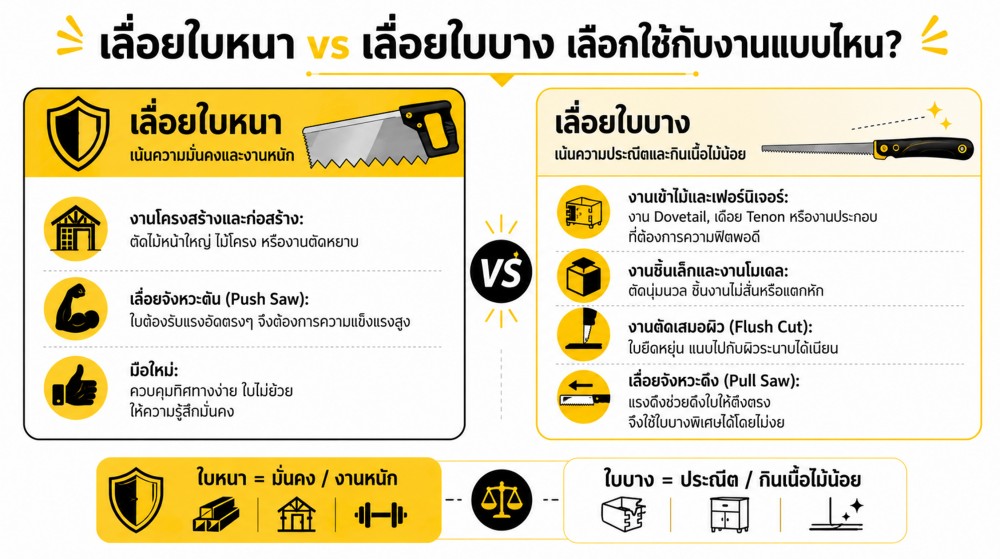
- Thick-blade saws have the advantage of stability and do not flex easily. They are suited for push-stroke sawing, which must withstand compressive forces during cutting, making cuts in heavy structural work straighter and more stable.
- Thin-blade saws are used for pull-stroke cutting. Tension naturally pulls the blade taut and straight, allowing for a thinner blade and a narrower kerf. They are ideal for furniture making or detailed work requiring cuts right on the line (especially with a reinforced spine like a Dozuki saw, which provides both a narrow kerf and stability).
So, don't judge a thin-blade saw too quickly as being flimsy, or a thick-blade saw as guaranteed to cut straight. The easiest saw to control is not the thickest or the thinnest... but the one designed to match your direction of force and suited to the wood you are cutting!
Select Saws to suit the application