


 EN
 ไทย


Customers Also Purchased
When choosing aMicrofiber Cloth We often judge by what we can see and touch first—color, size, softness, or thickness. But if you read the product details a little deeper, you'll encounter numbers like 250 GSM, 300 GSM, 400 GSM, or higher. These numbers lead many to assume that a higher GSM means a thicker, softer, and better-wiping cloth. Especially when comparing two cloths side by side, the fluffier and heavier one automatically feels like the "better" product.
In reality, the GSM value does not act as a quality score, nor does it directly indicate that a cloth will clean better, absorb more water, or be more suitable for every surface than another. What GSM conveys has a much more specific meaning, and misunderstanding it from the start can lead you to choose a cloth that is thick, soft, and nice-looking, but actually unsuitable for the job at hand.
What is microfiber cloth GSM?
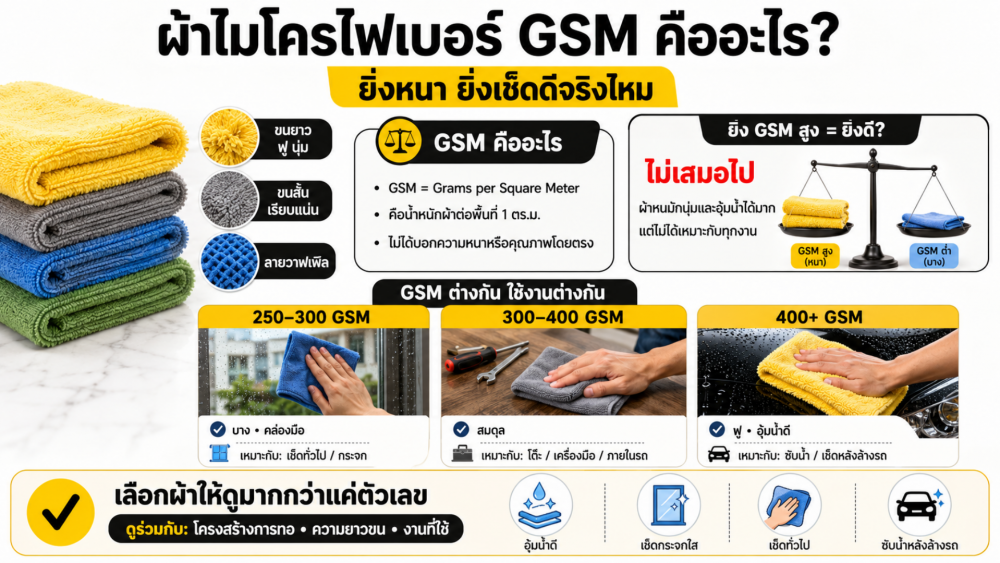
GSM stands for Grams per Square Meter. It is a value used to indicate the weight of fabric per one square meter of area. For example, if a microfiber cloth specifies 300 GSM, it means that the fabric will weigh approximately 300 grams when measured over an area of 1 square meter.
It sounds straightforward, but the common confusion is interpreting GSM directly as "thickness." In fact, GSM indicates weight per area, not direct physical thickness. Two cloths can have the exact same GSM value yet differ in thickness, plushness, and surface texture if they use different weave structures, pile lengths, or fiber arrangements.
However, when comparing cloths made from similar materials and construction, a higher GSM cloth typically contains more material per area, tending to be thicker, fluffier, and capable of holding more liquid. But the word "tending" is crucial, as it does not mean every high-GSM cloth shares the same properties, or that it will outperform a lower-GSM cloth in every type of application.

Why does a higher GSM often seem more appealing?
One reason is that microfiber cloths with more fabric mass and fluffy pile tend to feel softer to the touch, instantly giving the impression that the cloth is dense and high quality. However, what our hands perceive through softness does not reflect overall cleaning performance.
Consider a cloth for drying a car after washing versus one for cleaning glass. Although both are microfiber cloths, their required characteristics are vastly different. Water absorption demands a cloth that can take in and hold large amounts of liquid, whereas glass cleaning requires a surface texture that lifts moisture and residue without leaving streaks or lint. Therefore, an extra thick and fluffy cloth doesn't win in every task just because it feels softer in hand. This is why GSM should be viewed as data regarding fabric structure rather than a substitute for terms like "high grade" or "low grade."
What are the advantages of high-GSM microfiber cloths?
When comparing cloths with similar materials and construction, a higher GSM cloth has more material per unit area, typically allowing it to hold more liquid before becoming saturated. Tasks that require soaking up water or wiping heavily wet surfaces often benefit from this type of cloth, as it can reduce the need to wring it out or switch cloths frequently during work in certain situations.
On the other hand, there is the matter of touch and feel. Towels with plush, dense fibers create more cushioning between your hand and the surface, usually offering a softer feel and distributing pressure better than short-pile towels. This quality is useful for tasks where you don't want to press or scrub firmly on the surface, such as absorbing water, wiping delicate surfaces, or jobs requiring extra space within the fibers to trap dust and liquids.
However, these benefits also depend on the weave structure. Two towels with the exact same high GSM may perform quite differently. One might have very long, fluffy fibers, while the other is tightly woven with shorter pile. Even if the numbers are nearly identical, their wiping behavior can be noticeably distinct.
Why Thinner Towels Are More Convenient for Certain Tasks
Thinner or short-pile microfiber towels offer the advantage of a firm, controlled grip during use. The towel conforms more directly to the surface, making it easier to control hand pressure. This is especially true for spot-cleaning stains, wiping tables, cleaning tools, or working on hard surfaces where you want to clearly feel and control the contact area.
Very thick, fluffy towels can reduce this tactile feedback because hand pressure gets dispersed across thicker fabric layers. Therefore, when scrubbing stubborn stains, choosing the thickest towel does not always mean the stain will come off easiest.
Glass cleaning is a prime example: the goal is not just absorbing water, but completely picking up moisture and residue without leaving streaks or lint. The weave pattern, surface texture, and lint-free capability are crucial. Often, a thinner towel with a flat, smooth finish is vastly better suited for glass than a thick, plush towel.

Why Towels with the Same GSM Feel Different
This point best illustrates how GSM works. Suppose you have two microfiber towels both rated at 300 GSM. Looking only at the number, you might assume they feel almost identical. In reality, one might be short-pile, tightly woven, and firm to the touch, while the other could have longer, fluffier fibers that feel much softer and thicker in hand.
This difference comes from various factors: the weave pattern, pile height, fabric density, and fiber structure. GSM does not directly specify these details, meaning a single number cannot fully describe a towel's overall characteristics.
From a user's perspective, this means while GSM is a good starting point when comparing different models or brands, you should also examine product photos, fabric details, and intended use descriptions. Doing so provides a far more accurate expectation than looking at the number alone.
Fabric Structure Matters More Than Many People Think
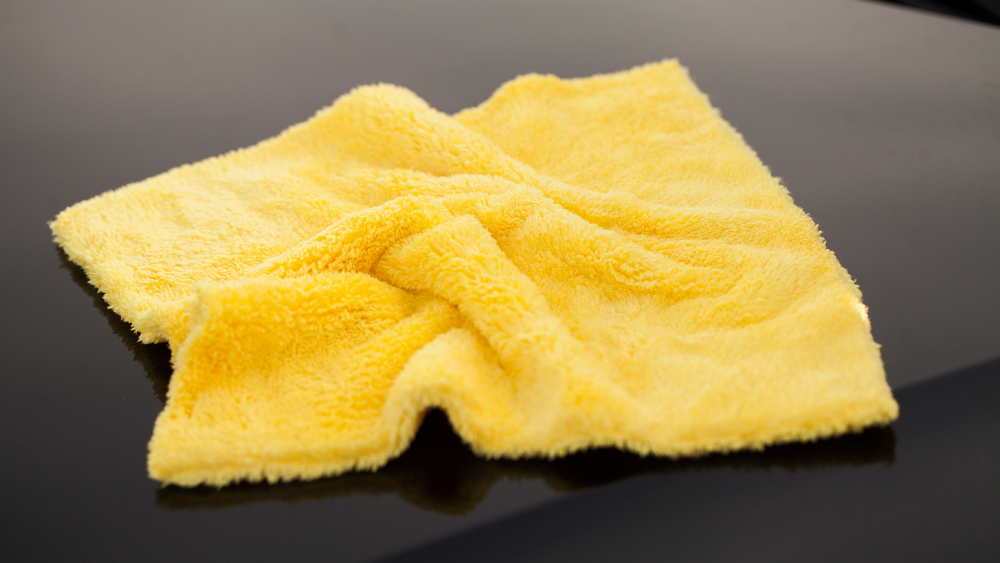
Microfiber towels come in more varieties than just short-pile and long-pile; they feature various weave structures. Examples include terry weaves with looped or short piles, fluffier plush weaves, and waffle weaves with a honeycomb-like grid pattern. These characteristics influence surface contact, liquid-holding capacity, and handling feel.
Short-pile, densely woven towels are generally ideal for general wiping or tasks requiring precise hand pressure. Plush towels provide extra softness and capacity for trapping dirt or liquids, while waffle-weave towels are often favored for efficiently absorbing and lifting moisture away from surfaces. Therefore, if two towels share the same GSM but have different weave structures, choosing based solely on the number tells you almost nothing about which one will suit your job better.
Pile Length Is Just as Important as GSM
Pile length directly affects wiping feel. Short-pile towels typically offer a firmer grip and closer contact with surfaces, making wiping pressure easier to modulate. Long-pile or plush towels, conversely, create a deeper barrier between your hand and the surface, providing a softer touch and trapping more dust or debris within the fibers in certain applications.
However, a longer pile is not always superior. For sticky residues or stains requiring scrubbing effort, plush towels can feel squishy and offer less control than short-pile options. Likewise, a short-pile towel might not hold as much water as a plush towel with more fibrous bulk. This clearly demonstrates that GSM and pile length are two distinct factors that should always be evaluated together.
When Choosing Microfiber, Start with the Application
Instead of starting with "what GSM should I use?", a much more reliable approach is to ask what surface or task you are cleaning. Each type of work demands different characteristics.
If you need to absorb a lot of water, look for a towel with suitable material density and a weave structure that holds liquid well. If you are cleaning glass, prioritize surface texture, weave type, and lint-free performance over thickness. For wiping tables, tools, or general surfaces, a towel that is not overly thick but comfortable to grip and conforms well to surfaces may be more practical.
The same applies to car care; a single towel may not suit every step. Towels for drying after washing, buffing off detailing products, and cleaning the interior can all have different structures and GSMs, as each task requires a different combination of softness, absorbency, and surface contact.
Very high GSM also has its limitations.
A thick, heavy towel might look appealing, but once wet, its weight increases with the amount of liquid it holds. If wiping large areas or working continuously for a long time, an exceptionally thick towel can feel heavier in hand than a thinner one and can be harder to wring out in some cases.
Additionally, towels of the same dimensions with higher GSM naturally have a heavier dry weight, which may affect washing and drying times compared to thinner towels, depending on the fabric structure and drying conditions. These factors do not make a high GSM a drawback, but rather practical usability details to weigh alongside cleaning performance.
If a towel is used for tasks that do not require high absorbency, choosing one that is unnecessarily thick might not add much benefit, while making it more awkward to grip or harder to reach into tight crevices.
Besides GSM, what else should you look for?
When choosing a microfiber towel, do not let the GSM figure overshadow other factors, because actual towel performance comes from multiple elements combined: weave type, pile length, fiber quality, material composition blend, edge construction, and the specific application the manufacturer designed it for.
The most common blend found in microfiber is polyester with polyamide, but this ratio alone does not dictate overall quality, as production methods and fiber structure also impact real-world use. It is best to treat these specs as complementary pieces of information that describe the towel's characteristics, rather than searching for a single metric as the definitive answer.
If the manufacturer clearly specifies the towel's intended purpose—such as a drying towel, glass towel, or general-purpose cleaning towel—this information is highly useful, as it lets you know what task it was engineered for from the start.
Is a thicker microfiber towel really better for cleaning?
The answer is not always, because "cleaning well" depends entirely on what you are wiping. If you need to absorb large amounts of water, a towel with higher material density and an absorbent structure certainly has the advantage. However, for wiping off stains, controlling hand pressure, or cleaning surfaces like glass, a thinner or short-pile towel often delivers better results.
GSM is therefore very useful when used correctly: it indicates how much weight the fabric has per unit area and helps you anticipate the towel's characteristics when considered alongside pile length and weave structure, but it should not be used as a standalone score to determine which towel is better.
The next time you see aMicrofiber Cloth 300 GSM towel sitting next to a 500 GSM one, there is no need to automatically pick the higher number. Check how both towels are designed—long or short pile, tight weave or plush texture—and, most importantly, consider what job you will use it for. A towel that matches the actual task will almost always give better results than simply choosing the thickest, plushiest option on the shelf.